





Davos, Munich, Nashville: Taking the National Security Conversation Beyond the Beltway

Why the Asness Summit matters for renewing the American national security contract
NASHVILLE — “Davos. Munich. Nashville.” That is how General Paul Nakasone, the former director of the National Security Agency and commander of U.S. Cyber Command, opened the fifth edition of the Asness Summit at the end of April 2026.
The sequencing was deliberate. Davos sets the global economic agenda. Munich shapes transatlantic security. Nashville, Nakasone is wagering, can become the place where the United States works through the harder, less polished questions about how it competes, deters, and adapts in an era of converging threats.
That wager is the animating idea behind Vanderbilt University’s Institute of National Security , which Nakasone launched in 2024 to pull elite national security debate out of the Washington bubble, and broaden the pipeline of talent willing to consider this kind of public service. In just over a year, the institute has stood up a Wicked Problems Lab, trained hundreds of Vanderbilt students through mentorships and leadership development and is now anchoring a push to create a dedicated national security major. The Asness Summit is the institution’s flagship moment, and this year’s edition made clear why a venue outside D.C. is more than a branding exercise.
The opening keynote came from General Dan Caine, Chairman of the Joint Chiefs of Staff, who pressed an uncomfortable question in the room: before any use of military force, are we honestly asking, “and then what?” Caine’s argument was less about restraint than about discipline and proper strategy making, a warning that ambiguity downstream of a kinetic decision is where wars get lost. He paired that with an argument for modernization for how the Pentagon procures things. Better contracts, he argued, mean shared risk between government and industry. Without that, the warfighter pays the bill in capability gaps. Industrial capacity, real collaboration between buyers and sellers, and a willingness to rewrite acquisition norms were not framed as procurement issues but as deterrence issues.
The supply chain panel, Weaponized Lifelines: Supply Chains as Gray Zone Battlegrounds, made the same point from a different angle. Ukraine is on track to build seven million drones this year. UAVs iterate so quickly that stockpiling them is essentially obsolete as a concept – what matters is the ability to scale production, including under wartime conditions. That is a fundamentally different industrial logic than the one the U.S. defense base was built for, and the panel was candid that closing the gap is not primarily a technology problem.
Dan Wang, the New York Times bestselling author of the Breakneck: China’s Quest to Engineer the Future, followed with one of his most quoted framings: the United States is a lawyers’ society, China is an engineers’ society. The national security implications are not abstract. A system optimized for adjudication and process produces different outcomes than one optimized for building, and on questions of speed, scale, and infrastructure; and that asymmetry between the U.S. and China is starting to bite.
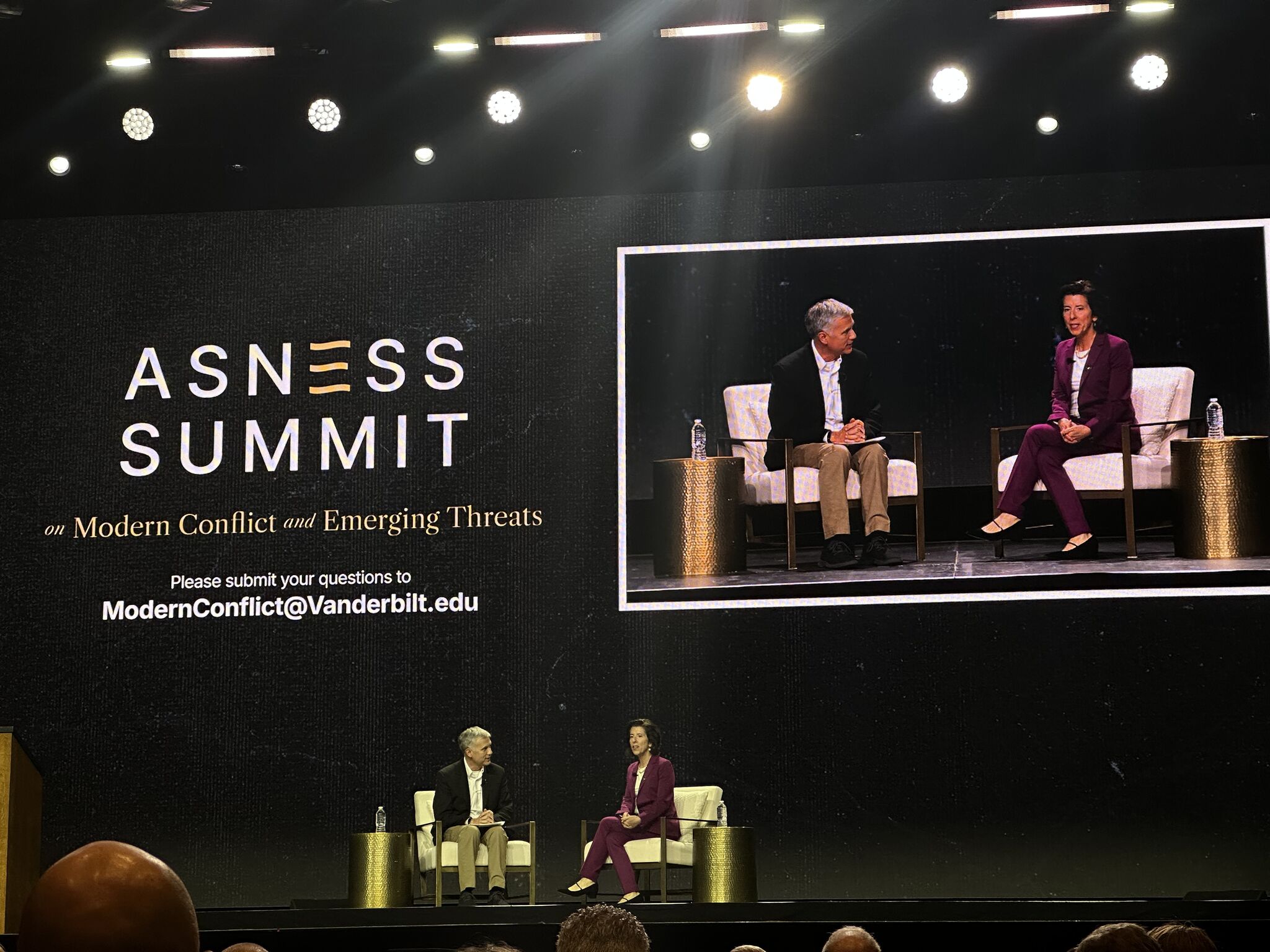
Former Commerce Secretary Gina Raimondo’s fireside chat returned to the CHIPS Act, but her sharper points were about how the government itself must change to keep pace with the asymmetric threats U.S. faces. Two themes ran through Secretary Raimondo’s remarks. First, the U.S. government must relearn how to take risk – not recklessness, but the kind of considered bet-making that any serious industrial strategy demands. Second, the country needs what she called a “transition infrastructure” for the AI economy: the institutions, retraining systems, and social support that let workers and communities adapt rather than simply absorb the shock.
Cognitive warfare was the thread that ran through nearly every session of the Asness Summit. The discussion of the GoLaxy documents discovered by Vanderbilt’s researchers—and what they reveal about China’s industrialization of influence operations—landed especially hard. The takeaway was not that adversaries are running information operations; everyone in the room knew that. It was that the tooling, targeting, and scale have moved into territory the U.S. policy apparatus has not yet caught up to.
The second day shifted from diagnosis to execution: how should the United States respond if the threat environment is defined by speed, diffusion, and constant competition? The panels tackled cyber operations, military innovation and procurement reform, and alliances. A common message was how slow institutions are struggling to keep up with the pace of reality.
General Tim Haugh, former Commander of U.S. Cyber Command, Director of the National Security Agency, and Chief of the Central Security Service, spoke to how the United States can impose coercion, and not deterrence on China in the cyber domain. The distinction matters. As China continues its rapid advancement against the United States, coercion implies continuous pressure to shape behavior, emphasizing the importance of having a persistent U.S. strategy rather than one that is reactive.
The panel on air power titled Asymmetric Air Power: Drones and the Democratization of the Air Domain, addressed another major theme – the mismatch between technological speed and institutional adaptation. Jason Hastings, Senior Technical Director for SOF Strategic Pursuits at ManTech, addressed the scalability problem. The challenge is no longer simply inventing new tools but instead scaling them fast enough to have operational relevance. It is also a human-power problem as much as it is a technology problem with the need to scale the operators for new technologies. Procurement systems built for decades-long weapons programs are poorly suited for technologies whose relevance may change within months. The panel also addressed the problem with doctrine falling behind innovation. As innovation moves rapidly, doctrine falls behind, resulting in a strategic lag.
The Pentagon identifies the right problem but struggles to move resources fast enough to match it. Other speakers have mentioned that solutions do not always come top-down. Innovation within the military happens on the edge with sergeants, junior officers, and technical operators solving immediate problems or dealing with frontline challenges. They develop solutions long before some problems are recognized on an institutional level.
The final panel of the summit on national security predictions had an important discussion on the future of alliances and public-private partnerships. The factors that shape national security today—supply chains, emerging technologies, cyber operations, cognitive warfare, and procurement problems—point to directions where alliances should evolve and improve areas of cooperation beyond traditional means. Questions of whether alliances should be more formalized or whether burden-sharing is still effective overlap with debates on public-private cooperation and defense industrial integration at home and abroad as strategic competition becomes more sensitive to private capital.
General Nakasone closed the summit by mapping where the threat landscape is now and where it is heading. The current picture is defined by constant competition, blurred boundaries between peace and conflict, converging threats across domains, and vulnerabilities that compound. The trajectory is characterized by a democratization of asymmetric capability, where small actors can impose disproportionate costs, a premium on speed, because technology is collapsing decision timelines faster than institutions can adjust, and a renewed centrality of trust – between allies, between government and industry, and between citizens and the institutions that defend them.
None of these arguments is unfamiliar inside the Beltway. What was different in Nashville was the format, as well as the Southern hospitality that made tough conversations candid. Students sat next to four-star generals. Engineers sat next to former cabinet secretaries. Investors sat next to operators who had run the missions being discussed. That interdisciplinary mix is hard to assemble in Washington, where the conversation tends to sort itself by clearance level and committee jurisdiction long before anyone sits down. If the Asness Summit continues along its current arc, the summit’s real contribution will not be any single panel or VIP keynote. It will be the slow, deliberate construction of a national security conversation that includes more of the country than the conversation currently does – and a generation of talent that hears about this work somewhere other than a recruiting pitch in a federal building.
Landmark global security summits did not become what they are overnight, but this year, the Asness Summit made a convincing pitch to become a remarkable “Munich of the South.” As America marks its 250th anniversary, broadening the pool of citizens who see national security as their work and their personal stake is not a nice-to-have; it is how a republic of this size renews the human capital its defense depends on. And in an era when asymmetric threats reach into supply chains, information environments, and civilian infrastructure, renewing the national security contract of the republic, the quiet bargain between citizens and the institutions that defend them will require far more Americans, in far more places, treating this work as their own.



