The Last Interlocutor: Imran Khan, Pakistan’s Leadership Vacuum, and the Search for a Regional Peacemaker

Pakistan as Facilitator: The Islamabad Moment
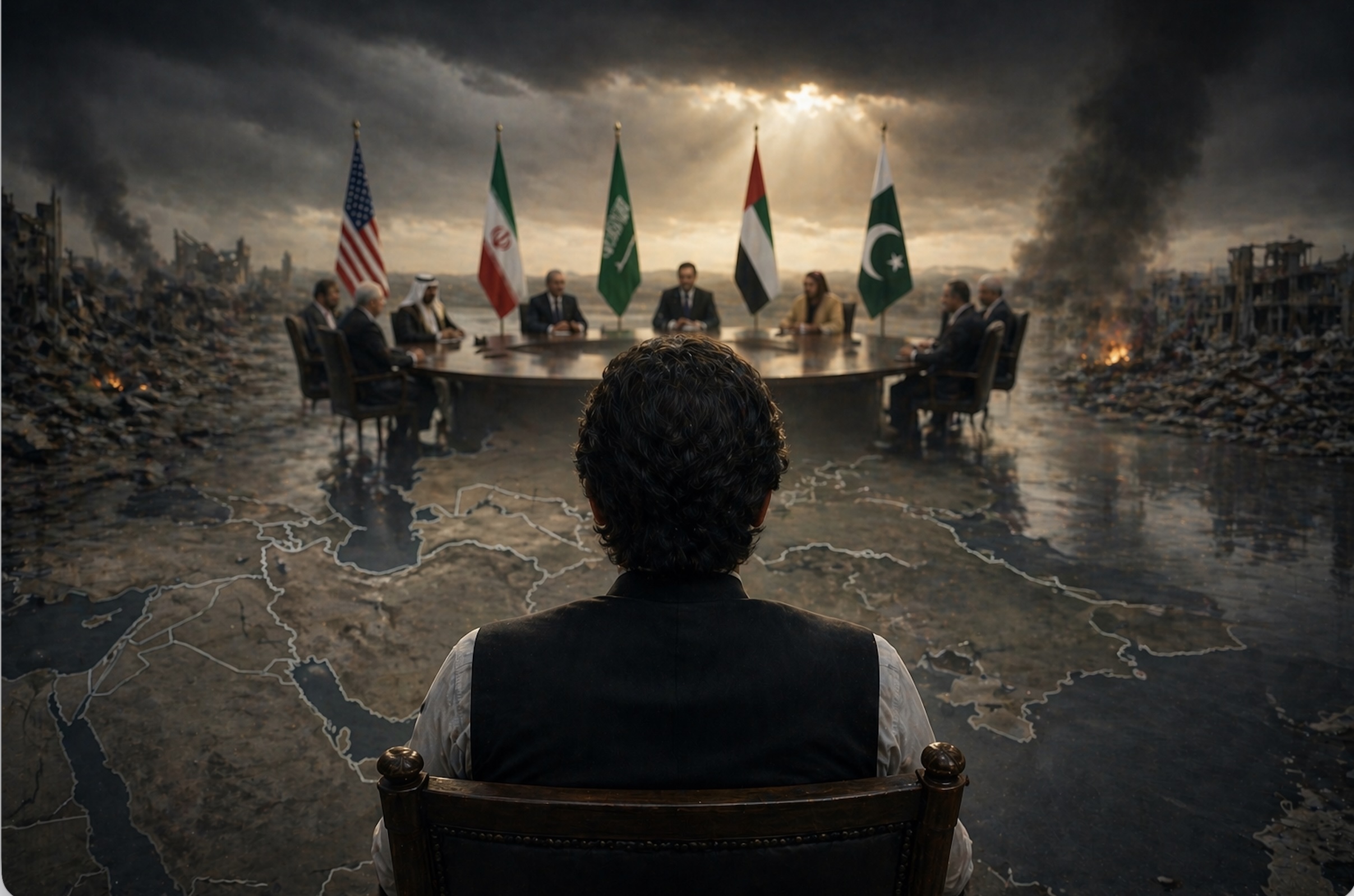
On April 11, 2026, the world’s attention converged on a single city. Islamabad was placed on lockdown: roads were sealed, 10,000 security personnel were deployed, and the Serena Hotel became the venue for what Al Jazeera described as the highest-level meeting between the two sides since the 1979 Islamic revolution, face-to-face negotiations between the United States and Iran, moderated by Pakistan.
U.S. Vice President JD Vance, alongside special envoys Steve Witkoff and Jared Kushner, sat across from the Iranian delegation led by Parliamentary Speaker Mohammad Bagher Ghalibaf and Foreign Minister Abbas Araghchi. Pakistan’s team facilitated throughout. The talks lasted 21 hours across two days in three rounds; the first was indirect, and the second and third were direct. It was, by any measure, a moment of extraordinary diplomatic consequence for a country that weeks earlier had been described as trapped between two alliances with no clean exit in sight.
How Pakistan arrived at this point is itself a significant story. Pakistan and China jointly delivered a five-point peace initiative on 31 March, calling for an immediate cessation of hostilities and humanitarian access to the region. By 8 April, Pakistan had brokered a two-week ceasefire between Washington and Tehran, the first halt in fighting since the war began on 28 February. The White House was explicit in its praise: “The Pakistanis have been incredible mediators throughout this process. They are the only mediator in this negotiation,” said White House spokesperson Karoline Leavitt.
In six weeks, Pakistan had transformed from a state paralyzed by competing obligations into the architect of the most consequential peace process of 2026. The structural reasons were always present: no US military bases on Pakistani soil, a significant Shia minority, deep trade and cultural ties with Iran, longstanding institutional relationships with the Gulf states, and a proven diplomatic record. But structural potential had converted into actual diplomatic action. The question was whether Pakistan’s current establishment could finish what it had started.
The Talks That Could Not Close: Iran’s Unconvinced Position
The Islamabad Talks ended without a deal. After 21 hours, Vance departed, saying Tehran had refused to accept Washington’s terms. Iran’s position had been clear from the moment its delegation landed. Ahead of the talks, Iran’s chief negotiator Ghalibaf had publicly set preconditions: no progress without a ceasefire in Lebanon, and no deal without the unfreezing of Iranian assets abroad. During the talks, Iran pressed its comprehensive ten-point plan for a permanent settlement encompassing the resolution of all regional conflicts, full sanctions relief, reconstruction funding, retained Iranian sovereignty over the Strait of Hormuz, and the acceptance of its right to uranium enrichment for civilian purposes.
The US demanded the opposite: a firm, enforceable commitment to end all uranium enrichment; the dismantling of all major enrichment facilities; the removal of Iran’s stockpile of highly enriched uranium; an end to funding for allied militant groups; and full, unconditional reopening of the Strait. Vance called these “red lines” and presented what he described as the “final and best offer”. Iran called the demands excessive and outrageous. The gap was not merely technical. It was a collision, as Al Jazeera’s account described it, between an American doctrine of “peace through strength” and an Iranian insistence on “resistance with dignity”.
Iran’s ambassador to Pakistan described the talks as having reached a “critical, sensitive stage”. Iran’s Foreign Ministry spokesman wrote that the success of the process depended on the opposing side “refraining from excessive demands”. A member of Iran’s parliamentary security commission stated plainly: if the US did not accept Iran’s demands, they would continue the war. Time magazine captured the outcome precisely: “The cocoon of Islamabad’s fanciest hotel was not enough to coax the United States and Iran into a historic peace agreement.” Pakistan pledged to continue to facilitate. But the question that the Islamabad Talks raised—and that the Pakistani establishment has so far declined to answer—is why, with every structural condition in place, the current ruling elite could not deliver the one thing Iran required: the conviction that the party across the table was genuinely independent and genuinely trustworthy.
The Establishment That Could Not Deliver
The Pakistani establishment’s failure to close the Islamabad Talks is not a logistical failure. It is a credibility failure. The current ruling elite of Pakistan—which came to power without a democratic mandate, which signed a mutual defense agreement with Saudi Arabia without parliamentary consent or public deliberation, and which has spent the past four years systematically suppressing the country’s most popular political movement—arrived at the negotiating table carrying baggage that no amount of diplomatic skill could set aside.
Iran is a sophisticated state actor that has managed decades of sanctions, proxy wars, and superpower confrontation while preserving its core interests. Its negotiators are experienced, its strategic community is sophisticated, and its reading of regional alignments is precise. When Tehran assesses Pakistan’s current ruling establishment, it sees an administration whose most consequential foreign policy commitments align structurally with the US-Saudi axis, regardless of the neutral language in which those commitments are expressed. The Strategic Mutual Defense Agreement, signed in September 2025 without parliamentary ratification and committing Pakistan to treating aggression against Saudi Arabia as aggression against itself, is not a detail that Iran’s negotiators set aside at the Serena Hotel.
This is the structural weakness that the Islamabad Talks exposed. Pakistan’s current establishment can host, facilitate, and shuttle between capitals with evident diligence. What it cannot do is look Iran’s negotiators in the eye and say, with the authority of genuine democratic legitimacy and genuine political independence: we are not anyone’s proxy, we carry no hidden obligation, and we will put our full political weight behind a deal that is fair to you.’ That sentence requires credibility that the present administration lacks. It requires, in other words, a different kind of Pakistani leadership entirely.
As a former Pakistani diplomat and ambassador to Tehran told Al Jazeera, “Pakistan is facilitating this meeting, and the most it can do is suggest certain things that mediators can offer in their capacity. But ultimately, it all depends on the political will of the two parties.” Political will, on Iran’s side, requires a mediator it trusts without reservation. That trust does not currently exist for Pakistan’s ruling establishment. But it exists for one Pakistani—and it exists in Tehran as much as it does across Pakistan itself.
The Phenomenon That Cannot Be Imprisoned
In April 2022, Imran Khan became the first prime minister in Pakistan’s history to be removed through a vote of no confidence. What followed was a campaign of institutional suppression without precedent in the country’s democratic experience. Party leaders were arrested en masse. PTI-controlled provincial assemblies were dissolved. He was convicted on charges his supporters regard as transparently political. UN Special Rapporteurs formally documented his detention conditions—prolonged 23-hour daily solitary confinement, denial of family visitation, and restricted legal access—as constituting inhumane and degrading treatment under international law. Reports confirmed that he lost approximately 85% of vision in one eye due to an untreated injury sustained in custody. Over forty globally prominent scholars, jurists, and public intellectuals have publicly demanded his immediate release.
Every act of exclusion has amplified his stature. Every conviction has deepened the identification of millions of Pakistanis with his cause. The “Imran Khan factor” has not diminished under pressure—it has calcified into something more durable than electoral politics: a national identity shared across three generations. For Generation X—those who witnessed him lift the 1992 Cricket World Cup and build the Shaukat Khanum Cancer Hospital from nothing—he embodies the proposition that integrity can defeat inheritance. For Millennials who watched his twenty-two-year struggle and supported his 2018 electoral breakthrough, he represents proof that accountability is possible. And for Generation Z—constituting nearly 60% of Pakistan’s population and its most politically active cohort—he is simply the one honest voice in a landscape of dynasties, cronies, and collaborators. Across every class, region, and generation, Khan occupies a space in Pakistani public life that no contemporary figure rivals.
What makes this strategically significant beyond Pakistan’s borders is that the Imran Khan factor does not stop at the Durand Line or the shores of the Arabian Sea. His name carries resonance across the Muslim world in ways no other living Pakistani leader approaches. He is not perceived as an American client. He is not perceived as a Gulf proxy. He openly critiqued US unilateralism and paid a political price for it. He received Iranian President Masoud Pezeshkian in Islamabad as recently as August 2025; even while imprisoned, Iran continued to engage his movement because Tehran understands that he, not the current establishment, represents Pakistan’s authentic political center of gravity. And it is precisely this quality, genuine independence from every regional patron, that makes him the one Pakistani figure Iran would listen to, trust, and negotiate with in good faith.
Pakistan’s Domestic Stability: The Cost of Every Passing Day
The Islamabad Talks were conducted in a diplomatic bubble, but the consequences of their failure are felt on every street in Pakistan. The Iran war and the Afghan conflict are not distant foreign policy matters for the Pakistani people—they are daily economic realities, sectarian pressures, and security threats that compound with every passing week.
Pakistan relies on imports for more than 80% of its oil needs. The US-Israeli war against Iran has triggered the largest fuel price increase in the country’s history, a 20% jump in a single week for a country already under severe IMF structural adjustment. The government was compelled to declare a four-day workweek and a two-week closure of schools as emergency austerity measures. Gulf remittances, exceeding six billion dollars annually, are at risk. The working class and the poor are absorbing the worst of it, and their patience is not limitless.
Pakistan’s Shia community—one of the world’s largest, concentrated across Karachi, Lahore, Punjab’s heartland, and Gilgit-Baltistan—has received the killing of Supreme Leader Khamenei as a civilizational attack. As it was reported and documented, demonstrations have erupted across every major Pakistani city. The risk of internal sectarian violence, absent at scale since the 1990s, is structurally present in a way it has not been for a generation. A government that lacks popular legitimacy is the last administration capable of managing it.
The open conflict with Afghanistan that broke out in late February 2026 has militarized the north-western frontier and empowered the Tehreek-e-Taliban Pakistan (TTP) inside Pakistani territory. TTP attacks rose 34% in 2025. Chatham House has warned that urgent de-escalation is needed before the situation becomes irreversible. Afghan drone debris has caused civilian casualties in Quetta, Kohat, and Rawalpindi. When Pakistan has previously attempted to manage comparable internal fractures without political inclusivity and democratic legitimacy, the lesson of 1971 remains unambiguous. Every day the dust is not settled, that lesson inches closer to repetition.
Why Iran Will Listen to Imran Khan
The Islamabad Talks answered one question definitively: Pakistan has the structural position, the relationships, and the diplomatic will to serve as the world’s most consequential peace facilitator. They also answered, with equal definitiveness, that the current Pakistani establishment cannot close a deal with Iran. Not because of bad faith, not because of lack of effort, but because Iran does not regard Pakistan’s current ruling elite as a genuinely independent actor. That verdict, delivered in the negotiating room rather than any press conference, cannot be reversed by more shuttling, more hosting, or more communiqués.
Iran is a sophisticated state actor. When it assesses a potential mediator, it asks one question above all: Is this person truly nobody’s agent? Does this person carry an obligation to any of the parties in this conflict? Can this person say something to Washington that Washington does not want to hear, and still be sitting at the table the next morning? The current Pakistani establishment fails this test on every count. It signed a defense pact with Riyadh. It governs with tacit institutional endorsement from Washington. It imprisoned the one Pakistani leader Tehran actually respects.
Imran Khan passes every count of this test. He openly critiqued US unilateralism and paid a personal political cost. He maintained warm relations with Tehran throughout his tenure as prime minister. He carries no obligation to the Gulf states that supersedes his own political judgment. He has never been anyone’s strategic client. And crucially, Iran knows all of this. Iranian President Pezeshkian visited Islamabad in August 2025 specifically to engage Khan’s political movement—not the government in power—because Tehran understands where Pakistan’s authentic political authority resides. The message was unambiguous: Iran will do business with the real Pakistan. The real Pakistan is Imran Khan.
His popularity is not merely a domestic phenomenon that happens to be visible from abroad. It is a cross-border, cross-sectarian, cross-generational force that the Muslim world registers and responds to. Among Pakistan’s Shia community, his respect is profound. Among Sunni majority populations across the Gulf, his name carries genuine warmth. In Iran’s political culture, which prizes resistance to external domination above all else, a leader who chose jail rather than bend to an establishment backed by Western and Gulf interests commands not just sympathy but genuine moral authority. That is the rarest of diplomatic assets: a figure both sides can trust for reasons that are not contradictory but complementary.
The Doha precedent is directly applicable. Under Khan, Pakistan maintained simultaneous credibility with the United States and the Taliban—two parties defined by decades of mutual violence and suspicion—because the Pakistani government of that era was perceived by both sides as an honest broker with genuine independence. A structurally identical configuration now exists: Tehran requires a channel to Washington; it regards as uncaptured; Washington requires an interlocutor that Iran will engage without preconditions; and Pakistan holds the only relational and geographic position that makes this possible. But only a Pakistan led by a figure of genuine democratic authority and genuine independence can fill that role. The current ruling elite has demonstrated it cannot. The next round of talks will require a different Pakistani face at the table. As Al Jazeera has reported, the first round concluded without resolution, contacts are expected to continue, but the ceasefire deadline is approaching, and the window is narrowing by the day.
Nuclear Stakes and the Cost of Continued Inaction
Pakistan’s political fractures carry consequences that extend far beyond its borders precisely because it is a nuclear-weapon state of 240 million people. The International Crisis Group has warned that the rules of engagement on the subcontinent shifted dangerously after the May 2025 India-Pakistan confrontation, with both sides now striking deep inside each other’s territory for the first time since 1971. A Pakistan in acute political crisis, governed without democratic consent, managing an open western front, navigating a sectarian emergency, and mediating a global conflict it cannot resolve, presents structural risks that no neighboring government and no nuclear power can treat as a domestic matter.
The lessons of 1971 are not ancient history. The crisis that produced the fall of Dhaka was a failure of political legitimacy before it was a military defeat. A government that refused to honor the democratic verdict of its own people, that governed through coercion rather than consent, and that responded to political challenge with repression rather than dialogue, produced the conditions for catastrophe. The parallels with Pakistan in 2026 are close enough to demand the most serious analytical attention from every actor with a stake in the region’s stability.
The “Imran Khan factor” is no longer simply a domestic political variable. It is now the central variable in Pakistan’s capacity to function as a stable, credible, and purposeful state actor at the most dangerous moment in its recent history. He commands the loyalty of Generations X, Y, and Z simultaneously. He retains the trust of Iran and the respect of the Gulf states. He carries the moral authority of a man who chose imprisonment over capitulation. He demonstrated through the Doha process that he can bring mutually hostile parties to an agreement. He is, in the truest analytical sense, irreplaceable. And every day he remains in Adiala Jail is a day that Pakistan’s most critical diplomatic asset remains locked away from the region that needs it most.
Conclusion: The Talks Proved the Opportunity. The Vacancy Proved the Problem
The Islamabad Talks of April 2026 will be remembered as one of the most significant diplomatic moments in Pakistan’s history and as a profound missed opportunity. Pakistan demonstrated that it could bring the United States and Iran to the same table for the first time since 1979. What it demonstrated with equal clarity is that the current Pakistani establishment, for all its effort and diligence, could not deliver the one thing the process required: Iran’s genuine conviction that it was dealing with an honest broker.
Three conclusions follow, and all are urgent. First, the Pakistani establishment’s failure at Islamabad is not a reason to abandon Pakistan’s mediating role. It is a reason to change the mediator. The structural conditions that make Pakistan indispensable remain intact. What must change is the face that represents them. Second, the political crisis that produced this credibility deficit, the imprisonment of Pakistan’s most popular leader, governance without a democratic mandate, and treaty commitments made without parliamentary consent are not separable from the diplomatic failure. They are the same failure expressed in different arenas. Third, and most urgently, Iran has already signaled, through its continued engagement with Imran Khan’s political movement, even during his imprisonment, where it believes Pakistan’s authentic authority resides.
That face exists. It carries no patron’s obligation. It commands the loyalty of a nation across three generations. It negotiated the impossible at Doha. It is respected in Tehran, trusted across the Gulf, and known in Washington. And it is currently in Adiala Jail.
The Islamabad Talks provided the opportunity. The establishment’s inability to deliver proved the obstacle. The ceasefire is fragile. The deadline is approaching. And the one Pakistani who can look Iran in the eye with the full authority of a free people behind him remains behind bars. The dust will not settle on its own. Pakistan cannot afford to miss this window. The region cannot afford for Pakistan to miss it.