The U.S. Should Establish an anti-Etela’at Channel in Iran
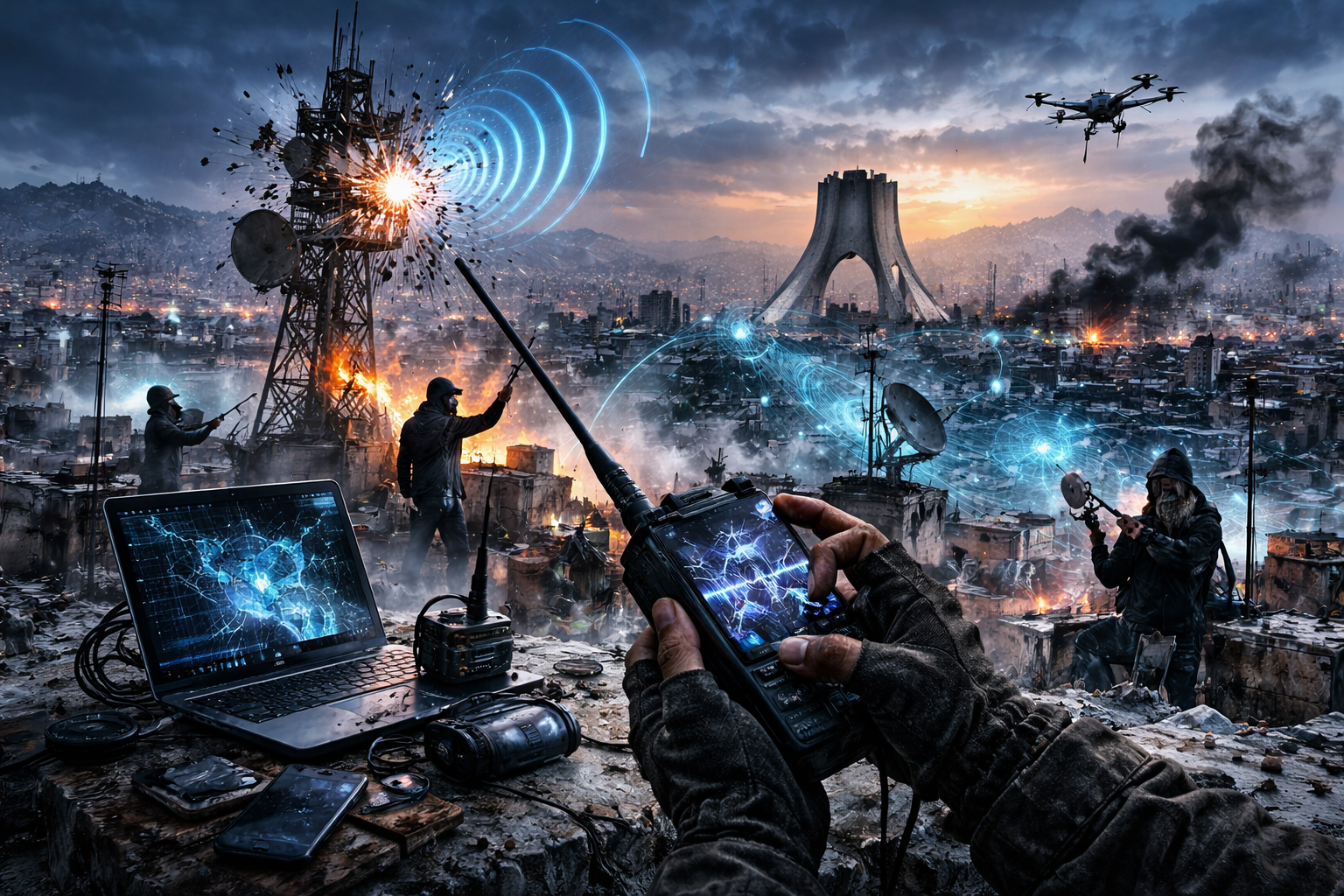

The war with Iran has now entered its 30th day. The regime has suffered significant damage to its military infrastructure, yet it still stands. One reason for its resilience is the strength of its internal institutions—particularly “Etela’at” (“intelligence”). For more than four decades, this system has played a decisive role in suppressing dissent and ensuring the regime’s survival.
In 1983, Ayatollah Khomeini urged citizens to act as extensions of the intelligence apparatus: “You should be Etela’ati in groups and communities. Every person can observe their neighbors—who they are and what they do.” This idea has been interpreted as: “Every Iranian should be an intelligence agent.” The intelligence network has become a pillar of the Islamic Republic, embedding surveillance within everyday life. Its continued activity may be one reason large-scale protests have not yet erupted despite the regime’s military setbacks. What can the United States do about this?
Every thesis invites an antithesis. In wartime, adversaries seek to penetrate and weaken each other through intelligence channels. Traditionally, such operations rely on trained operatives. But in a system built on widespread civilian surveillance, the counterstrategy can rely on ordinary citizens. The United States should consider establishing a secure anti-Etela’ati channel—a mechanism that allows Iranians to share information safely and anonymously.
Despite frequent cutoffs, some people still have access to the internet through virtual private networks (VPNs) because the regime has not fully shut down connectivity. A secure reporting channel would allow people to transmit information that could be analyzed and, where relevant, shared with opposition networks or armed parties such as Kurds, Baluch, and Arabs. These parties already have members on the ground who are waiting for zero hour.
Control of even one city—for example, in Kurdish or Baluchi regions—could have a psychological effect on the regime’s forces. Momentum in political uprisings often spreads rapidly once a symbolic breakthrough occurs. Reliable intelligence would be essential for such an effort, as government forces remain present in most urban areas. However, many of these forces are not local to the cities where they are stationed, which could reduce their willingness or courage to confront local populations.
History offers a precedent. On these days in March 1991, a raperîn (“uprising”) began in the city of Ranya in the Kurdistan region and quickly spread across surrounding cities, ultimately forcing Iraqi government forces to withdraw from much of the area. A similar dynamic could emerge in Iran, and a local spark might ignite broader demonstrations across the country.
In conflicts where surveillance has long been used to control people, information can also become the tool that cripples that control. Establishing a secure channel for Iranians to share intelligence could help turn the regime’s own logic against it—and potentially accelerate regime change.