





Proxy Warfare: The Missing Facet of Australian Defence Policy

“Proxy Warfare: The Missing Facet of Australian Defence Policy” by Andrew Maher (Inter Populum, Mar. 2026).
Andrew Maher argues in his latest article, “Proxy Warfare: The Missing Facet of Australian Defence Policy,” that Australian defense policy overlooks proxy warfare as a central instrument of strategic competition. Maher examines historical cases from World War II through the Cold War to show that Australian policymakers once understood subversion, political warfare, and proxy dynamics in Southeast Asia. The article shows that this understanding has declined in recent decades despite the widespread use of proxies, gray zone tactics, and externally supported insurgencies in modern conflicts. Current Australian policy focuses too heavily on conventional conflict and fails to address how adversaries compete below the threshold of open war. Maher concludes that Australia must rebuild conceptual clarity about proxy warfare to strengthen deterrence, alliance coordination, and resistance strategy.
Part 1: The Australian Proxy Warfare Literature Gap
There has been no recent open-source discussion regarding proxy warfare from an Australian Department of Defense and national security perspective prior to 2025… After 1975, there is little in Australian proxy war policy and literature to point to. This gap remains evident today… Here, I use the term ‘proxy warfare’ to denote external support from a state to enable a non-state actor to engage in violence… The plausible deniability or covert nature of such support relationships is what makes them ‘gray zone’ actions that occur beneath the threshold that might warrant a conventional military response… Australia’s policy gap lies first in understanding the nature of the threat and second in providing options to shape the international environment using methods short of direct conflict.
Part 2: Proxy Warfare from an Australian Perspective
Pre-World War II Competition
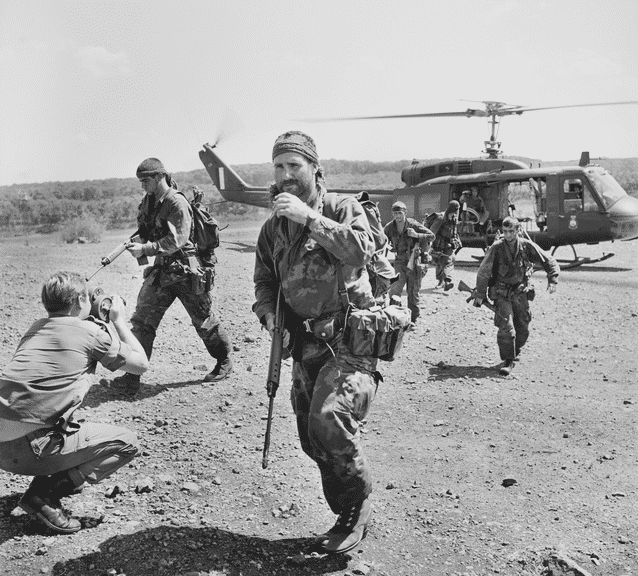
Australia’s special operations capability, here simply termed Special Operations Australia (SOA) for simplicity, was raised as a counter-subversive organization in response to Japanese fifth-column activities leveraging nationalist movements. Thus, guerrilla campaigns were waged during WWII in Timor, Borneo, Malaya, and Burma, unilaterally and in concert with allies…[to] undertake subversive operations, intelligence gathering, and the training of underground native armies. That policymakers used such terminology, including that of fomenting “fifth-column activity” behind expanding Japanese lines, is instructive. This was an organizational adaptation to the “gray zone” methods the Axis had so successfully employed in their offensive strategies.
The Early Cold War Period
Australian concern regarding growing nationalist movements was acute in 1947… An Australian WWII leader, Field Marshal Blamey, argued in March 1949 that “Communist advance parties are already here, in Australia, and their tactics are the same as those of the fifth columnists in the last war”… Nonetheless, American policy influenced Australian thinking; the “loss of China” and fears of a surging Communist force gave rise to the Australia–New Zealand–United States (ANZUS) Treaty in 1951… Australian policymakers approached proxy warfare similarly to the British during the early Cold War period through a constrained “pinprick” strategy that eschewed overt proxy warfare.
Australian defense policy evolved over this first decade of the Cold War through the experience of the Korean War, the Viet Minh defeat of the French in Indochina, the Malayan Emergency, and ongoing regional tensions regarding Communist influence in Japan, Burma, Indonesia, and the Philippines. This decade concluded with a relatively mature understanding of Communist revolutionary war theory… Australian and Western governments, in general, were aligning to the new era of “limited wars” dictated by fears of unrestricted nuclear warfare and the proliferation of “brushfire wars” of anti-colonialism.
The Mid-Cold War Period
Australian policy in the mid-1950s had recognized that “it is probable that China will encourage war by proxy”… Australian strategic understanding of a proxy warfare threat further matured in 1959 with the terminology of “Communist Insurgency”… In response to this threat, Australian policy documents recognized the need to counter Communist insurgency in Laos, to develop defense against Viet Minh aggression, and to prepare the SEATO area for defense against both Viet Minh and Chinese aggression.
The result was a tension between the recognized primary threat posed by Communist regimes employing subversion and proxy warfare and Australian public opinion. This tension has thereafter been captured by describing Vietnam (and others) as “wars of choice.” This tension ultimately led to the creation of an Australian policy gap relating to proxy war.
Late Cold War Era
Australia, and the West writ large, had pivoted from a state of confronting Indonesia during Konfrontasi to one of cooperation during the 1970s. Jakarta and Canberra feared Communist extension of support to a fledgling East Timor in the wake of the collapse in South Vietnam. This fear caused Australian diplomats to overlook the thorny issue of self-determination, perhaps much to Australia’s regret following the Timorese referendum of 1999… the second-order effects of proxy conflict continued to engage Australian interests. During the late 1970s into the 1980s, a gradual expansion in the Soviet use of proxy warfare was undertaken to advance its strategic interests, particularly in the Middle East and Africa… These mechanisms of generating influence within strategic competition were seemingly advanced in the margins of 1980s Australian foreign policy.
Part 3: Today’s Challenges?
In Australia’s region, non-state actors may similarly be externally supported as a form of competition between major powers to achieve geostrategic advantage. Given the history of CCP proxy warfare during the Cold War, it is entirely conceivable that secessionist influences in Bougainville, Aceh, New Caledonia, or the New People’s Army in the Philippines might be covertly supported by Beijing… A geographic reality for Australian sovereignty is that almost all physical threats would first need to compromise the sovereignty of one or more of our northern neighbors… The strategic option of support to resistance counters subversion, proxy warfare, and conventional invasion. If communicated effectively, it might deter by denying an aggressor the quick fait accompli seizure it desires of a targeted region or country.
An Australian support-to-regional-resistance strategy might learn from the recent exercise of Western “superpower” coordination in Ukraine—a “democratic internationale” that could deter autocratic regimes elsewhere… As Australia evolves its National Security Strategy, such lessons from proxy warfare activities in periods of competition, as charted throughout this paper, are prescient considerations for policymakers, military practitioners, and security scholars today.
Conclusion
Australia has shown an enduring strategic concern that the neighborhood might succumb to the influence of an inimical foreign power… today’s limited awareness of proxy threats and appropriate policy guidance should be of concern to the Australian national security community, yet the term is absent from our discourse… It has seemingly been forgotten that the primary threat faced by Australia in the region is the Chinese Communist Party, an organization with which Australia has competed before… few Australian policymakers today would be familiar with the recognized importance of insurgency to Australian strategic policy… In today’s competition between democracies and autocracies, the future is fraught with the potential for mistakes to be remade due to such ignorance of past competitions.

