From Paper to Permafrost: Applying Irregular Warfare Doctrine to Arctic Homeland Defense

Abstract
The American Arctic is the shortest avenue of approach to the homeland, where Russian and Chinese threats exploit geography and endurance at low cost. The stakes for the US include defending sovereign borders, ensuring freedom of navigation, securing resources, and sustaining credibility through partnerships with Indigenous communities and allies. Competing requires more than episodic presence; it demands enduring, co-produced domain awareness and resilient logistics that turn survival into strategic advantage.
Introduction
The United States cannot secure the Arctic without continuous domain awareness, and today it lacks it. The Arctic represents America’s northern flank of homeland defense, where Russian and Chinese forces can approach across the polar routes, and it is also the site of America’s critical missile defense complex and the chokepoint to new sea lanes and resource reserves (See Figure 1). As Arctic sea ice continues to retreat, maritime corridors like the Northern Sea Route and Northwest Passage are opening to regular navigation. These routes cut Asia–Europe transit times by up to two weeks and expose vast untapped reserves (an estimated 13 percent of the world’s undiscovered oil and 30 percent of its natural gas). These changes amplify the region’s geostrategic value, heightening the risk of competition among major powers for access and control of Arctic territory, sea routes, and resources.
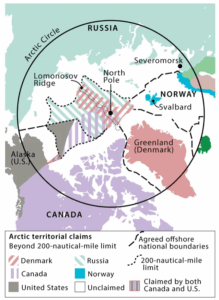
Figure 1: Arctic Territorial Claims, Source: International Arctic Research Center, University of Alaska, Fairbanks
Yet domain awareness in this environment is uniquely difficult to achieve. At high latitudes, surveillance thins, logistics strain, and the environment itself can disable equipment and personnel as effectively as an adversary. The result is degraded power projection, intermittent presence, and limited control over America’s northern approaches, conditions adversaries can exploit to test US sovereignty and response capacity. In irregular warfare, legitimacy is equally decisive: the ability of security forces to be accepted, trusted, and aligned with local communities. This is magnified in the Arctic, where Indigenous peoples bring different cultural perspectives, national identities, and interpretations of government power. The US security presence in the Arctic remains intermittent and reactive, signaling awareness but not control. Presence alone is insufficient; it must evolve into one that is persistent, legitimate, and co-produced with the people who already live in the region; anchoring American sovereignty and deterrence at the northern flank.
The limits of Arctic domain awareness became clear in early 2023, when a high-altitude balloon was detected drifting over Alaska. What began as an unremarkable radar contact evolved into an international incident revealing how ambiguity, endurance, and slow attribution can turn observation into opportunity.
The Balloon That Floated Over Alaska
In January 2023, US officials detected something out of place over the Aleutian Island chain: a high-altitude balloon drifting silently across the northern skies. By the time the object was shot down by a US Air Force F-22 off the Atlantic coast a week later, it had crossed much of the continental United States. For its journey across Alaska, the balloon passed largely unchallenged.
US officials later confirmed the device carried sophisticated surveillance equipment linked to the Chinese military. The ambiguity of the chosen platform was the point. It was not a missile or an aircraft; it was something stranger, lower-cost, and politically and militarily harder to classify. That ambiguity complicates immediate responses: militarily it invites caution—strike first to prevent intelligence gains over unpopulated areas and sort attribution later—while politically it demands clarity on ownership, intent, and the diplomatic fallout before escalation.
The episode did more than expose a single detection lapse; it revealed structural constraints unique to high latitudes. Persistent surveillance is harder to achieve in sparsely populated and geographically isolated regions. Satellite coverage in the Arctic is limited not by capability but by design—a deliberate allocation of finite ISR assets toward higher-priority threat areas (See Figure 2). When an area is not considered a strategic named area of interest, overlapping coverage is difficult to justify. Combined with sensor degradation in extreme cold and electromagnetic interference that complicates attribution, these factors create persistent blind spots across the northern approaches.
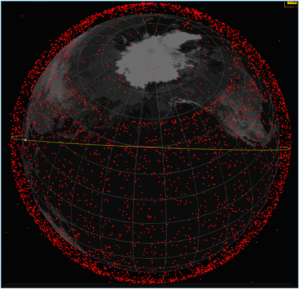
Figure 2: Satellite Coverage above the 66th Parallel, Source: https://www.starlinkmap.org/
In such conditions, hybrid and irregular threats—ranging from GPS jamming and spoofed signals to surveillance balloons or disinformation seeded through rural communication networks—are difficult to identify quickly, allowing adversaries time to exploit uncertainty. These actions can disrupt navigation, mask reconnaissance, and erode local trust in authorities before a clear response is possible. Had that balloon deployed sensors near Fort Greely’s Ground-based Midcourse Defense (GMD) site, the installation responsible for detecting and intercepting intercontinental ballistic missile (ICBM) threats to the US homeland, it could have gathered sensitive information on US early warning and missile defense capabilities. Alternatively, had it been used to seed disinformation across Alaska’s rural communication networks, it could have undermined public confidence in critical infrastructure and governance capabilities, while disrupted coordination with military and civil responders. Instead, it drifted on, leaving behind a warning: in the Arctic, irregular threats often look absurdly cheap, yet their effects can be strategically significant—exploiting operational vulnerabilities that make irregular warfare not a weapon of the weak, but the logic of the environment.
Lessons From the Cold
The Arctic has long been a stage for irregular threat ingenuity. In 1962, two US intelligence officers parachuted onto the abandoned Soviet drift station NP 8. The mission, known as Operation Coldfeet, sought to capture Soviet acoustic research equipment used for submarine detection. After three days on the ice, the men were extracted not by helicopter or ship, but by the experimental “Skyhook” system, a low-flying aircraft that snagged a tether attached to the team on the ice and reeled them aboard.
Operation Coldfeet highlighted more than daring tradecraft; it demonstrated that intelligence in the Arctic is not optional but essential to US security. The mission’s objective was not routine collection but the denial of a potential Soviet technological edge; an operational necessity directly tied to the balance of power at sea. It also underscored how the environment itself becomes an adversary. At extreme Arctic temperatures, often below -40°C and in some cases approaching -55°C with windchill, equipment fractures, fuel thickens, movement slows, and storms can reduce visibility to an arm’s length, halting resupply or evacuation. In such conditions, ISR is not a supporting function; it is the foundation for presence, detection, and survival. The lesson endures today: in a region where adversaries exploit ambiguity and distance, enduring Arctic ISR combined with resilient logistics is indispensable.
Operation Coldfeet was not an outlier. During World War II, the Alaska Territorial Guard, composed largely of Native Alaskans, patrolled thousands of miles of coastline and supported US forces during the Aleutian Islands campaign, when Japanese forces occupied Attu and Kiska from 1942 to 1943. The Guard’s operational value was derived from its perceived legitimacy among local inhabitants—communities saw the Guard as their own defense, not an outside imposition—and its environmental expertise rooted in intimate knowledge of regional geography, climate, and culture. This combination extended US sovereignty into remote villages, reassured Alaskans who feared further incursions, and denied Japanese forces the ability to move or resupply undetected. Operationally, legitimacy provided persistence, intelligence, and access: persistence because Guard members lived in the environment year-round, intelligence because they understood terrain and movement patterns better than conventional units, and access because their familiarity opened cooperation with communities that might otherwise have remained wary of federal authorities. In effect, the Territorial Guard created host-nation-style defense effects inside US territory, amplifying national combat power far beyond what their limited arms suggested.
Finland’s defense against invasion by the Soviet Red Army during the Winter War of 1939 offers a similar lesson: small, mobile ski units leveraged terrain and climate to slow and degrade a much larger mechanized force. Operating in subzero conditions that immobilized Soviet armor and vehicles, Finnish troops used ambushes, raids, and rapid withdrawal to isolate columns, sever supply lines, and destroy equipment. In less than four months, the Red Army suffered more than 120,000 casualties, lost hundreds of tanks and aircraft, and saw entire divisions rendered combat ineffective. Although the Soviet invasion ultimately succeeded, the larger operational lesson of Finland’s campaign was clear: terrain mastery and environmental expertise can offset conventional inferiority by imposing disproportionate costs on an unprepared adversary.
Greenland’s Sirius Patrol, founded in 1950, demonstrates the same principle in a different form. Composed of six two-man dog sled teams, the Patrol projects Danish sovereignty across vast stretches of uninhabited ice where no conventional garrison can survive year-round. Their endurance and resolve generate domain awareness, demonstrate government presence, and provide early warning at minimal cost. For modern Arctic defense, Sirius illustrates how lightly equipped forces with deep environmental expertise can achieve strategic effects that outstrip their size and resources.
The theme common to each example is clear: irregular methods thrive in the Arctic not because they are exotic, but because the environment punishes rigidity and rewards adaptation. Operation Coldfeet demonstrated two enduring requirements: continuous surveillance to detect enemy activity and persistent presence by specially trained, pre-positioned forces capable of exploiting fleeting opportunities. The Alaska Territorial Guard provided permanent surveillance and planning support to commanders, guided US forces into tactical positions, and reassured local populations. Finland’s ski troops delayed and degraded a numerically superior enemy for three months through raids, ambushes, and harassment, buying time for defensive preparations to be completed. Greenland’s Sirius Patrol shows that sovereignty can be projected year-round through endurance and domain awareness rather than massed firepower. Taken together, these cases reveal that in the Arctic, effectiveness belongs to those who can persist, sense, and exploit the environment itself—turning isolation, terrain, and climate into instruments of advantage where conventional forces, dependent on infrastructure and centralized firepower, often falter. In these conditions, small adaptive units empowered by local legitimacy and environmental awareness can source, coordinate, and control fires disproportionate to their size, acting as critical force multipliers in a complex battlespace.
The Contest Today
Although the Cold War ended, competition in the High North never ceased.
Today, Russia pours investment into the Northern Sea Route, building ports, airfields, and bases that blur the line between civilian and military use. Icebreakers, ostensibly for commerce, double as platforms for Arctic patrol. Scientific expeditions serve intelligence-gathering purposes. In 2019, Norwegian officials accused Russia of deliberate GPS jamming during NATO exercises in the High North, a classic gray zone tactic that disrupts without firing a shot.
China, though not an Arctic nation, insists it is a “near-Arctic state” and promotes a “Polar Silk Road.” Beijing advances access through research stations, infrastructure investments, and diplomatic engagement. Facilities such as the Yellow River Station in Svalbard support atmospheric research, but Western analysts note that the infrastructure is capable of supporting signals collection, space tracking, or other dual-use operations. Chinese overtures in Iceland, Greenland, and remote Russian ports seek commercial entry points that can translate into influence and overwatch.
The 2024 Department of Defense Arctic Strategy acknowledges US shortfalls: limited infrastructure, fragile logistics, and incomplete domain awareness. Yet these phrases deserve unpacking.
Infrastructure. Unlike Russia, the United States maintains very little Arctic military infrastructure. Alaska hosts critical sites—Joint Base Elmendorf-Richardson near Anchorage, Eielson Air Force Base in Fairbanks, and the Ground-Based Midcourse Defense complex at Fort Greely—but north of Fairbanks, permanent facilities are scarce. There is no operational deep-draft port north of Dutch Harbor; Nome’s port expansion is underway but not yet delivering capacity. Runways capable of supporting sustained airlift are few and often seasonal, while radar and communications sites are relics of the Cold War, costly to maintain, and vulnerable to weather. Simply put, the US lacks the bases, ports, and airfields needed for persistent Arctic presence.
Logistics. Even if infrastructure existed, sustaining forces in the Arctic presents another barrier. The road and rail network ends at Fairbanks. Beyond that, most settlements are accessible only by air or sea, and often only during ice-free seasons. Fuel must be delivered in bulk during summer and stored for the year, while winter storms routinely ground aircraft and restrict maritime access. Temperatures immobilize vehicles, degrade batteries, and freeze hydraulics. Every resupply run requires deliberate planning, and small disruptions cascade quickly when the weather closes in. Logistics in the Arctic is not just costly; it is fragile.
Domain Awareness. Surveillance of the US Arctic is incomplete. Space Force and Air Force maintain long-range radar and missile-warning sites, but polar coverage remains patchy. Satellite orbits thin at high latitudes, and unmanned systems struggle with endurance in subzero cold. Electromagnetic interference complicates attribution, while maritime awareness is even weaker; commercial vessels, research ships, and foreign fishing fleets often move through US waters with limited monitoring. The United States has critical sensors, but they do not provide a continuous picture of activity across the Arctic air, sea, and land domains.
Operational Effect. Taken together, these shortfalls mean the United States can surge forces into Alaska, but it cannot easily sustain them north of the main road and rail network. Exercises prove capability but not continuity. Sensors detect some threats but leave blind spots. Bases exist but are too few and too far south to project into the Arctic Ocean. The result is the appearance of access without the reality of persistence.
What fills the gap today is a patchwork. Outside brief Army and Air Force exercise rotations, continuity rests with Coast Guard Arctic District cutters and stations; Space Force and Air Force radar and missile-warning sites; the Alaska National Guard in civil support and winter response roles; and a network of contractors and Alaska Native Corporations that sustain base operations, bulk fuel, remote camps, aviation support, and telecommunications. These actors keep access open, but they do not generate year-round military commitment that builds cold-weather mastery, local trust, or routine domain awareness. The effect is coverage without continuity.
The United States continues to rely on rotational forces for deterrence by presence, a model that struggles to deliver a credible response to adversary actions. Units deploy for exercises like Arctic Edge, then return home, leaving vast expanses of Alaska and the Arctic waters unattended. The 11th Airborne Division (Arctic) is based in Alaska, but its focus is largely Pacific-oriented. Its training posture remains rotational and exercise-based, rather than truly Arctic-defined. While its establishment signals overdue attention to Arctic defense, without enduring presence in the Arctic and adaptation to its conditions, the Division’s existence risks being more symbolic than transformative.
The result is an asymmetry tailored for irregular competition. Russia and China practice endurance, dual-use presence patrols, and ambiguity, while the United States shows up episodically. Yet the most overlooked advantage for America is not hardware or infrastructure; it is people. In the Arctic, Indigenous communities represent partners in domain awareness, a source of legitimacy, and the key to persistence in terrain that resists conventional control.
Arctic Partners in Domain Awareness
Irregular warfare is about people as much as terrain. In the Arctic, Indigenous communities are not simply observers but collaborators whose lived heritage can facilitate co-produced domain awareness. For millennia, communities across Alaska, Nunavut, and Sápmi have read ice floes, hunted in extreme cold, and moved through terrain where modern GPS struggles. This knowledge is not folklore; it is time-tested survival data. Their presence is not symbolic; it is an expression of sovereignty, stewardship, and resilience.
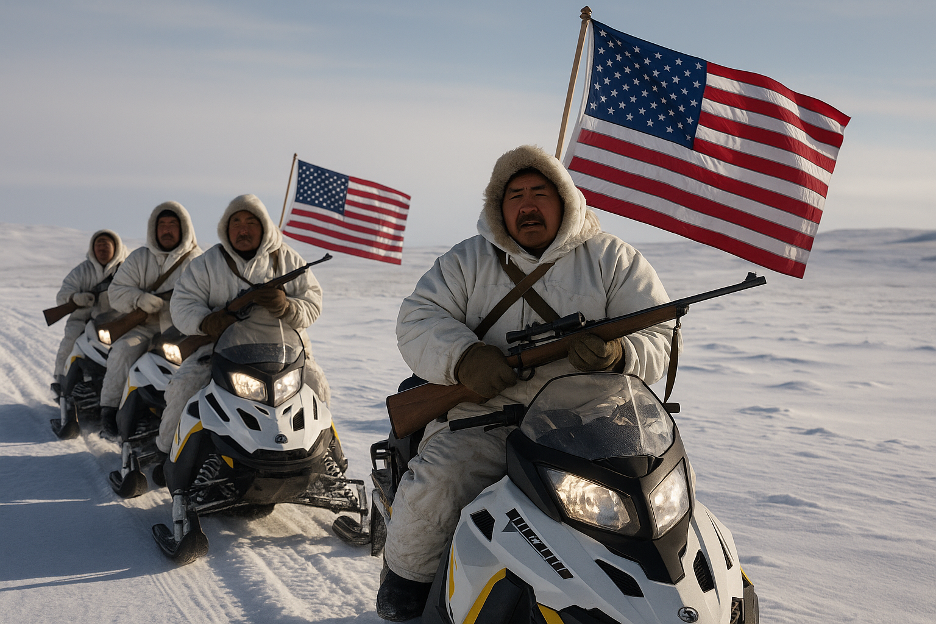
Canada understands this through the Canadian Rangers, part-time Indigenous patrol units under the Canadian Armed Forces Reserves. The Rangers extend domain awareness across thousands of miles and serve as critical partners for local and federal authorities. With little more than bolt-action rifles, snowmobiles, and generational expertise, they remain one of the most cost-effective irregular forces in the world.
Norway’s Home Guard, a civilian-based defense force, integrates local populations into national resilience. Organized into regional districts, it combines part-time soldiers with community networks to ensure rapid mobilization, local knowledge, and immediate support to national forces. This model allows Norway to maintain persistent presence across remote terrain without the cost of large permanent garrisons.
Denmark’s Sirius Patrol, with just 12 men on dog sleds, projects sovereignty and provides early warning across a landmass larger than many European countries. More than symbolic, the patrol demonstrates endurance and persistence: two-man teams endure months in isolation, conducting surveillance, reporting incursions, and deterring illegal activity through presence alone. Their ability to survive and operate where most forces cannot turn sovereignty from a legal claim into a lived reality.
Together, Canada’s Rangers, Norway’s Home Guard, and Denmark’s Sirius Patrol illustrate how small, locally rooted forces can generate disproportionate effects in extreme environments. By contrast, the United States has no comparable program, leaving vast stretches of the American Arctic without security presence or community-integrated defense. Alaska does maintain a State Defense Force, but it’s not equivalent. The ASDF exists under state law, and it’s limited under gubernatorial authority, lacking federal resourcing and authorities needed for Arctic defense. Indigenous consultations also exist, but they are episodic, underfunded, and rarely institutionalized. A US “Arctic Rangers” program, co-produced with Alaska Native communities, could change this. Such a force would be an enduring sensor, force multiplier in austere terrain, and provide initial response capacity—to locate, secure, and notify—until additional forces arrive. It could also co-manage multi-use logistics nodes, embed traditional knowledge into planning, and anchor legitimacy in places where Washington struggles to be present or trusted. The most enduring way to hold the Arctic is not with more hardware and technology, but by consulting and empowering the people who already live there as full partners in defense.
Logistics is the Campaign
In the Arctic, logistics isn’t just support, it is the campaign itself. Every frozen battery, gelled fuel line, or grounded aircraft proves that survival, not maneuver, decides outcomes.
Russia has acknowledged this reality by investing in hardened, dual-use bases, forward airfields, and the world’s largest icebreaker fleet. These platforms extend Moscow’s ability to sustain patrols and project sovereignty along the Northern Sea Route. China, for its part, is experimenting with drone batteries engineered to survive Arctic conditions, seeking cheap but enduring ISR where heavy platforms falter. The United States, by contrast, still depends on long-range airlift and seasonal sealift from the lower forty-eight, with limited depot capacity and shallow caches. The result is an asymmetry: America treats the Arctic as a destination, while Russia and China treat it as a domain.
This asymmetry matters because in the Arctic, effects follow logistics. In irregular warfare, sustainment often outweighs firepower. Insurgents in Afghanistan outlasted US patrols by relying on caches, smuggling networks, and pack animals. Guerrillas in Colombia used jungle terrain to offset superior technology, disappearing into the environment until they chose to reemerge. The same principle applies in the Arctic: the side that can stay fed, fueled, and connected will dominate.
US irregular warfare doctrine emphasizes adaptability, but Arctic training still assumes short deployments and robust supply lines. That assumption is misplaced. Forces here must be built for isolation, not rotation. To make logistics the campaign, several principles stand out:
- Plan from sustainment outward. Operations succeed or fail based on how long units can survive in isolation. Campaign design must begin with logistics, not maneuver.
- Preposition to extend reach. Distributed caches of fuel, food, and communications gear turn geographic distance into endurance and give options when main supply lines close.
- Partner for resilience. Indigenous communities can co-manage staging points and shared caches, blending traditional knowledge with modern supply chains. This reduces strain on long-haul logistics while anchoring legitimacy.
- Design for endurance. In the Arctic, reach depends on how long units can endure in isolation. Light platforms like snowmachines, sleds, drones, and dog teams outlast fuel-hungry convoys. Finland in 1939 and today’s Canadian Rangers show that endurance in sustainment makes persistence possible.
- Harden and repair. Every Arctic pier, airstrip, and fiber line is dual-use. Teams must be equipped and trained to conduct field-expedient repairs that keep operations alive.
- Institutionalize Arctic fieldcraft. Cold-weather sustainment skills—repairing equipment, building shelters, field hygiene, caring for casualties, surviving storms—must be formally taught and certified, not left to chance or short rotations.
- Effects follow logistics. Tactical concepts like domain awareness and precision strike are only possible if teams can remain on station. Sustainment is the prerequisite for every other effect.
The blunt truth is this: in the Arctic, logistics is the center of gravity. Those who can persist in place, adapt sustainment to the environment, and endure isolation will shape the contest. Those who cannot will remain visitors in a competition that is increasingly permanent.
Doctrine Meets the High North
The United States does not lack doctrine for irregular warfare. What it lacks is the willingness to apply it in the Arctic with the seriousness the region demands.
In February 2025, the Army published Army Techniques Publication 3-90.96: Arctic and Extreme Cold Weather Operations, the first service-level doctrine in years to focus on sustained cold-weather operations. It outlines fundamentals for maneuver, sustainment, and survival in extreme cold, from mobility on frozen terrain to medical risks in subzero climates. Yet while ATP 3-90.96 provides technical solutions, it does not grapple with the strategic contest already underway: one defined less by large maneuver forces and more by irregular competition for legitimacy, presence, and influence.
By contrast, Joint Publication 3-05 has long described irregular warfare as a “struggle among state and non-state actors to influence populations and affect legitimacy.” The Irregular Warfare Annex to the 2020 National Defense Strategy stressed that irregular competition is not the exception but the enduring condition of global rivalry. These insights are directly applicable to the Arctic, where influence is contested among states, local communities, and multinational institutions.
The gap is that Arctic planning still defaults to conventional assumptions: brigades flown in for seasonal exercises, infrastructure-dependent deployment, and episodic force projection. This conventional bias overlooks the reality that irregular competitors, Russia through dual-use “scientific” stations, China through polar diplomacy, already operate year-round in ambiguous ways that elude this intermittent form of deterrence.
The models and tools to respond exist. Section 1202’s logic of enabling unconventional partners has lessons for homeland defense; Civil Affairs units bridge military and local governance; small Army Special Forces detachments can endure where large formations cannot. What is missing is institutionalization: embedding these capabilities permanently in Alaska rather than temporary rotations.
History shows that doctrine adapts best when forced to confront stubborn environments. Counterinsurgency doctrine evolved in Iraq and Afghanistan because the costs of ignoring irregular dynamics became untenable. Stability operations doctrine matured in the Balkans only after years of grappling with fractured legitimacy. The Arctic now poses a similar test. Doctrine must move from the page to the ice.
For Special Operations in particular, this means embracing the High North as more than a training and exercise location. Permanent SOF presence in Alaska, working by, with, and through Indigenous communities, supporting early warning, and experimenting with distributed sustainment, would bring doctrine to life. Until then, Arctic irregular warfare remains something the United States can describe in publications but not yet practice at scale.
What Must Change
Four shifts are needed if the United States wants to keep pace in Arctic irregular warfare:
- Permanent Teams in Alaska
Small, cold weather trained Special Forces and civil affairs detachments should not just pass through Alaska for episodic exercises and operations, they should live there. Rotational forces treat the Arctic like a proving ground; permanent teams treat it like home. Stationed year-round, these units would develop true Arctic expertise: how to move, sustain, and survive in subzero conditions without waiting for resupply from the lower forty-eight.
Their mission would extend beyond training. Permanent teams could partner with local communities, support civil authorities, and conduct domain awareness patrols in places where larger formations cannot linger. For irregular warfare, presence is power, and in the Arctic, presence must be constant.
- A US Arctic Rangers Program
The United States needs a force that blends community legitimacy with national defense, modeled on Canada’s Ranger Patrol Groups. A US Arctic Rangers program, co-produced with Alaska Native communities, would give the nation enduring eyes and ears across remote terrain. Equipped lightly but empowered nationally, these Rangers would provide domain awareness, deterrence, and rapid response in environments that defy conventional control.
Such a force would require permanence, not ad hoc mobilization. The most viable legal pathway may be a blended construct: Title 14 authorities to anchor continuity and law enforcement legitimacy, Title 32 frameworks to enable state–federal mobilization, and selective Title 50 integration to fuse local reporting into the national intelligence architecture. Together, these authorities could institutionalize an Arctic Rangers program that is lawful, permanent, and co-produced with Indigenous communities, ensuring domain awareness and resilience where federal presence is otherwise episodic.
- Co-Produced Strategy
Indigenous partnerships must move beyond symbolic consultation and become permanent fixtures of homeland defense in the Arctic. Co-production means embedding Alaska Native communities directly into planning cells, early warning networks, and infrastructure decisions.
Programs modeled on Canada’s Rangers and Norway’s Home Guard show how legitimacy, local knowledge, and persistence extend national reach where conventional forces cannot. For the United States, a co-produced strategy would anchor Arctic sovereignty in the very communities that live it daily; from coastal villages to sled patrols across the ice. For example, village-based observers linked into NORAD’s early warning system through dual-use platforms, similar to FEMA’s disaster reporting apps or neighborhood tip-line systems, could provide both situational awareness and legitimacy, closing gaps that satellites or radars alone cannot cover.
Such integration is not a gesture. It is irregular warfare applied at home: sovereignty exercised by those who endure the terrain, legitimacy built by those already trusted, and security extended through partnerships that cannot be replicated from Washington.
- Whole of Society Sustainment
Leverage local industry and Alaska Native Corporations and their subsidiaries for persistent sustainment. Use multi-year contracts with Alaska Native Corporations and regional providers for caches, fuel staging, winterized sensors, and remote camps; set performance metrics for uptime and time to restore. Combine this with rapid-prototyping and experimentation authorities to cold weather resilient energy, batteries, small UAS, and mesh communications.
Whole of society sustainment also means integrating civilian infrastructure and services into defense resilience. Telecommunications providers, aviation firms, fisheries, and energy producers already operate year-round in austere conditions. Formal partnerships and incentives can align their existing capacity with defense requirements, ensuring that critical infrastructure serves both community needs and national security.
The goal is simple: presence that endures off the land and local supply chains. In the Arctic, sustainment is a collective effort where defense, industry, and Indigenous partners co-produce resilience.
Conclusion
Irregular warfare is not confined to deserts, jungles, or failed states. It occurs wherever presence is contested and legitimacy matters—and in the Arctic, this contest is already underway. Russia and China are not experimenting at the margins; they are investing in endurance, building the infrastructure and logistics that allow them to persist where the United States can only rotate in. America is starting from behind in a race where endurance, not firepower, sets the pace.
To close the gap, US strategy must reverse its logic: start with the mission effects the Arctic demands—persistent domain awareness, credible deterrence by denial, and rapid response to crises—and then build the logistics and force structure that make those effects possible. Caches, co-produced sustainment with Indigenous partners, light but enduring platforms, and resilient dual-use infrastructure are not enablers on the margins; they are the campaign itself.
This requires institutional courage. The Department of Defense and its service branches must treat Arctic irregular warfare as a standing mission set, not an episodic exercise. That means resourcing permanent small units, embedding them in local networks, and measuring readiness by endurance and legitimacy rather than tonnage or sorties. It also means reframing homeland defense as a continuous competition for access and trust, where every partnership, radar site, and fuel cache extends sovereignty northward.
The Arctic is teaching a clear lesson: ambiguity, endurance, and adaptation decide outcomes. Adversaries have already adapted; they have normalized ambiguity and turned presence into pressure. The United States must now adapt faster—by linking doctrine to geography, investment to endurance, and legitimacy to deterrence. If America fails to translate strategy into persistent practice, it will cede its northern flank not through defeat in battle but through absence.
Doctrine written is knowledge; doctrine lived is power. To defend the homeland’s northern frontier, the United States must live its doctrine—embedding presence, partnerships, and persistence as the foundations of deterrence. Until Washington moves doctrine and investment from paper to permafrost, it will remain a visitor in its own Arctic backyard.