Space-Guided Supremacy: How China’s Satellite Systems Strengthen its Missile and Hypersonic Forces

Introduction
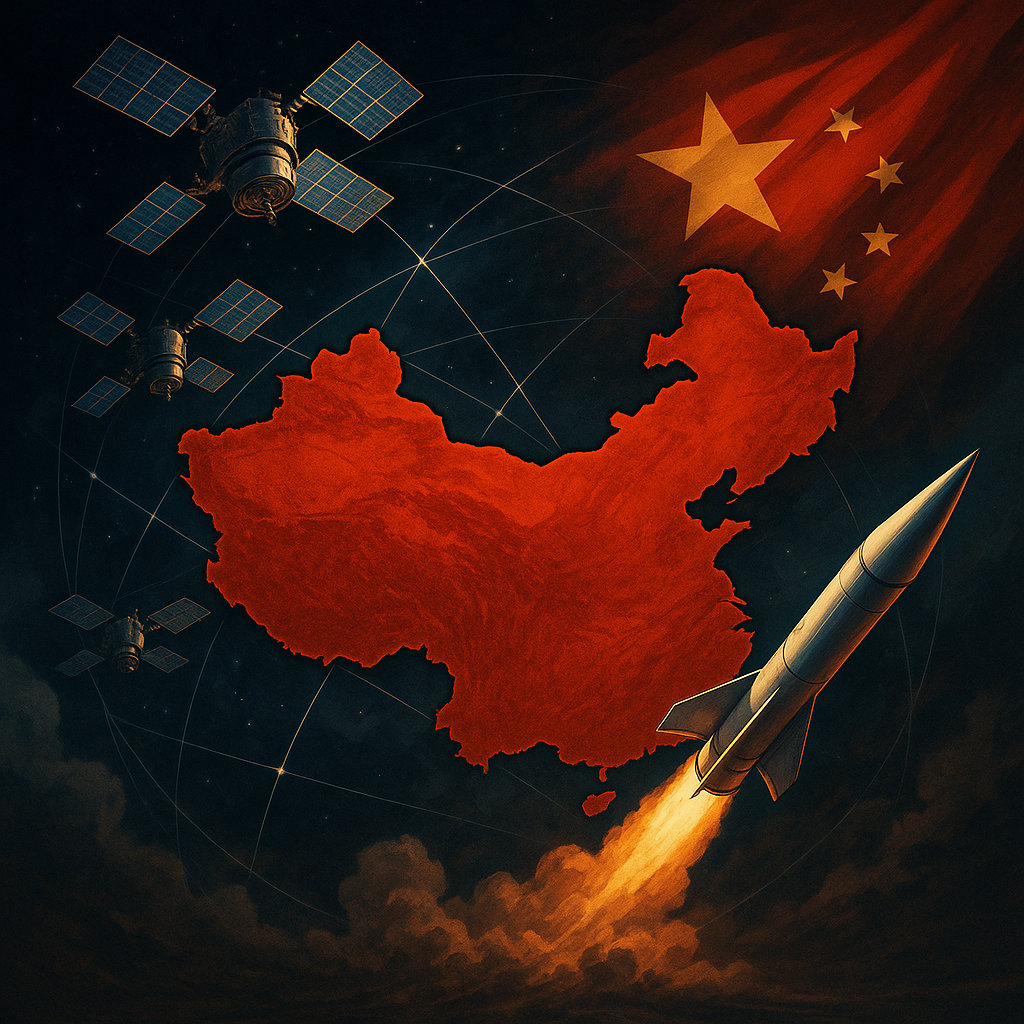
A decade ago, talk of “space dominance” meant the United States and, increasingly, Russia. The strategic picture is now clearly three-polar, and in many mission areas, it’s even two-polar. The U.S. and China are now in a fast-paced race to control the high ground of orbit. Beijing’s growing satellite networks, which include navigation, intelligence, surveillance and reconnaissance (ISR), communications, and missile early warning, are creating a “kill web” in space that makes it easier for the PLA’s missile and hypersonic forces to find and shoot down targets.
Beijing views space integration as the key to achieving information dominance and missile precision, giving it a decisive edge in both deterrence and strike capability. This matters because space superiority now underpins strategic stability, early warning, and real-time targeting, allowing China to combine cyber, electronic, and kinetic domains into a unified warfare network. The United States increasingly fears that China’s space-enabled precision warfare could neutralize traditional U.S. advantages in command, control, communications, intelligence, and missile defense. Top officials in the U.S. Space Force have warned about a “mind-boggling” Chinese military buildup that could upset the balance of deterrence and shorten decision-making times in a crisis.
Beidou, Precision Strike, and the Shift to Space-Guided Warfare
China’s integration of it’s satellite architecture with advanced missile systems is at the heart of this change. The BeiDou-3 (BDS-3) global navigation network now offers very accurate positioning, navigation, and timing (PNT). Official papers and technical evaluations show that the PPP-B2b service is broadcasting from GEO with real-time positioning accurate to the decimeter level (after convergence). It is supported by inter-satellite links and short-message service. These are features that go beyond a basic GPS equivalent and can be used for both precision strikes and re-targeting.
China has also built a lot of electro-optical, synthetic-aperture radar (SAR), and electronic-intelligence (ELINT) satellites that speed up the find-fix-finish process. Ludi Tance-4, the world’s first GEO-based SAR, and Yaogan-41, a high-resolution GEO optical platform, together give us constant, weather-independent views of large ocean and coastal areas. This is a big step up from episodic LEO overflights. Independent studies say that Ludi Tance-4 has a SAR resolution of about 20 meters and that Yaogan-41 might have an optical resolution of a meter or more. The mission is officially “civil”, but the performance, orbit, and program lineage are all in line with PLA ISR. Together, these platforms fuse imagery and signals intelligence into a seamless targeting web that enables rapid detection, tracking, and strike coordination across maritime and terrestrial theatres, fundamentally enhancing China’s precision-strike readiness and operational tempo.
Yaogan-30 satellites, which are often launched in groups of three, are thought to do ELINT and geolocate ships by measuring the time and angle difference of arrival of their radio emissions (similar to the U.S. NOSS). They are used for ocean surveillance and anti-ship targeting. This network tells other sensors and shooters what to do, which lets them kill moving targets like carrier groups and logistics convoys. At the same time, open-source analysts link the Tongxin Jishu Shiyan (TJS) series in GEO to missile early-warning tests(Huoyan-1) and signals intelligence, which is another part of a growing strategic ISR and warning system.
Hypersonic Strike Integration and the Kill-Web Advantage
China is also working on communications that spread out in LEO. The state-run Guowang (China SatNet) broadband mega-constellation, which is supposed to have about 12,992–13,000 spacecraft, has had several launch batches since late 2024. By mid-2025, at least eight batches had been reported, and dozens of spacecraft were already in orbit. This creates a sovereign alternative to Starlink with direct dual-use implications for resilient PLA command, control, and autonomy. China’s larger LEO push also includes more “ten-thousand-star” projects, like Qianfan/Thousand Sails, that are meant to speed up coverage and make China less dependent on foreign networks.
 This orbital structure is what has allowed the PLA to change from a straight “kill chain” to a moving “kill web”. Chinese missile units can find, follow, and hit moving naval or land targets much faster thanks to near-real-time targeting across the Indo-Pacific. According to U.S. reports, the PLA has deployed the DF-17 medium-range missile with a hypersonic glide vehicle (HGV), the DF-26 IRBM (including anti-ship variants) extends hold-at-risk ranges, and a longer-range DF-27 is said to have been tested in 2023 and talked about in U.S. government reports as being able to do both. The ISR and PNT data from China’s growing satellite network, which turns speed into deadly accuracy, is what makes these systems work. At the same time, Beijing is deploying a counterspace toolkit to protect its own networks and stop or disrupt an enemy’s space services: direct-ascent ASAT testing legacy, jamming/spoofing, cyber, and rendezvous/proximity operations (RPO) in space. The Secure World Foundation and CSIS do yearly evaluations of China’s demonstrations in almost every major counterspace category.
They also warn that non-destructive effects, like uplink/downlink jamming, dazzling, and cyber, are already a steady-state feature of competition. Security in the aerospace industry co-orbital capabilities are not just ideas: In 2022, Shijian-21 did a widely watched grapple-and-tow of a dead satellite to a graveyard orbit. This was useful for getting rid of debris, but it also showed that dual-use RPO works. Washington’s growing worry can be traced back to a number of technological trends. First, GEO ISR at scale (SAR + optics) provides imaging that last all the time and in all kinds of weather over huge areas of the Pacific and Indian Oceans. This is perfect for cueing salvos of DF-26/DF-27, timing land attacks and anti-ship strikes, and keeping track of logistics that are spread out. Second, proliferated LEO broadband (Guowang , Qianfan) aims to provide resilient C2 for distributed forces and unmanned swarms, mirroring lessons from Starlink’s battlefield utility in Ukraine that Chinese defense writings have studied closely. Third, hypersonic-space integration, which includes BDS-3 PNT, space-based ISR cueing, and early warning for missiles, makes it possible to quickly change targets and make decisions more quickly, which increases the risk of instability in a crisis. Finally, on-orbit servicing and inspection (like SJ-21) makes normal capabilities that could be used to grapple, tug, or nudge in a conflict.
Orbital Diplomacy and the Export of Space Power
China’s strategy goes beyond it’s own capabilities to include what is known as “orbital diplomacy”. Beijing sells satellites, launch services, ground infrastructure, financing, and training through China Great Wall Industry Corporation (CGWIC) and other state-owned businesses. Pakistan’s PRSS-1 and PakTES-1A, Nigeria’s NigComSat-1R (the replacement for NigComSat-1), Venezuela’s VRSS-2, Algeria’s Alcomsat-1 (with two control stations and operator training in China), Laos’s LaoSat-1, Belarus’s Belintersat-1, and Egypt’s MisrSat-2 (with local assembly and training) are all examples. The package usually includes everything from hardware to launch to ground segment to people, making them dependent on Chinese standards and ecosystems for a long time. Journalistic and policy reporting says that more than 20 African countries now have active space partnerships with China, which combine technology with training and, in some cases, access to data.
This has raised concerns in Washington about the use of these technologies for both military and civilian purposes. By exporting space infrastructure, China extends its strategic footprint, binding partner nations into long-term technological dependencies that translate into diplomatic leverage and influence across emerging geopolitical frontiers.
China has turned orbit into a thriving space economy at home. In 2024, there were a record number of launches (about 68 attempted/orbital launches), and about 257 spacecraft were deployed by Chinese operators, most of which are commercial. This shows activity from both the government and private sector. The global space economy is worth about $570 billion in 2023, with about 80% of that coming from businesses. Private companies like Land Space, Galactic Energy, and iSpace are working on methalox propulsion and reusability. It is clear what this means: satellites and launches aren’t just strategic tools; they’re also growing industries that make China’s tech presence around the world even bigger.
Beijing has strategically weakened what was once thought to be an American monopoly on important orbital services. The U.S. no longer has an unchallenged edge in precision PNT(BDS-3), exquisite ISR (China has unique GEO SAR and GEO optical assets), or sovereign broadband low-Earth orbit (LEO) networks (Guowang/Qianfan). U.S. officials are increasingly calling China and Russia “pacing threats”, with Beijing’s space build-up being the most dynamic.
The U.S. Response: Proliferation, Resilience, and Distributed Space Networks
Washington’s response is to focus on growth and strength. The Space Development Agency’s Proliferated Warfighter Space Architecture (PWSA) is sending hundreds of LEO satellites into space to provide global missile warning and tracking (including hypersonic), low-latency data relay, and battle management. At the same time, the Missile Defense Agency’s HBTSS adds fire-control-quality infrared. The first launches of these programs took place in early 2024 and continued through 2025 (Tranche-1 milestones). This was part of a U.S. plan to fight through attacks. It is easy to see why: a big, spread-out LEO swarm is harder to blind or kill than a small number of high-quality GEO assets, and it also lowers latency in areas where there is competition.
This combination of space and missile technologies is already changing how the world plans its defenses. Persistent ISR and high-speed C2 make crisis stability worse because they make decisions faster and make it more tempting to strike first, whether to disarm ISR nodes or missile units. Counterspace actions like jamming, dazzling, cyber, and RPO “bumping” could be misunderstood and lead to more trouble. Maritime denial depends on space-enabled targeting: with strong cues from Yaogan and other sensors, the DF-26 family can threaten U.S. bases and carriers all the way to the Second Island Chain; a more complex ISR web makes terminal accuracy and salvo timing better.
The U.S. Department of War says that both sides are now fighting for PNT. With BDS-3 global, both sides are putting money into receivers that can withstand jamming, multi-constellation chips, and backups on land and in low Earth orbit. As longer-range Chinese systems, like DF-27 HGV profiles, come into play, homeland and allied defense calculations are changing. This has led to more interest in layered counters (SM-6 afloat; even PAC-3MSE at sea in experimental planning) that are backed up by space-based tracking. With co-orbital “inspectors”, GEO ISR, and mega-constellations, norms and risks in GEO are growing. If there aren’t shared norms for RPO and interference, accidents or secret actions could quickly get worse.
 More countries are developing their own space capabilities, not just the U.S. and China. India’s Chandrayaan-3 made the first soft landing near the lunar south pole on August 23, 2023. It is also adding new satellites (NVS-02 launched January 29, 2025) and L1 support to NavIC, which strengthens PNT sovereignty. Japan landed SLIM on January 20, 2024, to show off its ability to land precisely. QZSS/CLAS adds centimeter-level accuracy, showing how important precise navigation services are. The UAE’s Hope Mars mission, South Korea’s Danuri lunar orbiter, and Iran’s Noor-2/3 show that even small programs can have military-related aspects like ISR, communications, and prestige. This wider participation creates new markets and security problems: more satellites to protect (and maybe target), more ground stations, more data flows across borders, and more partners for both Washington and Beijing to court. China’s export model is not just about hardware; it also includes financing, launching, building infrastructure on the ground, and human training. Contracts often include ground control stations and training (like Algeria’s Alcomsat-1) and sometimes even co-development and assembly (like Egypt’s MisrSat-2) to help local ecosystems while tying partners into Chinese supply chains and standards. This is strategic statecraft by other means, and Western officials are worried about the possible data-sharing and dual-use effects. What’s going to happen next? Space is the center of gravity for modern strikes. The PLA’s missiles and hypersonic get a lot of their power from space-based sensing and guidance.
Expect more money to be spent on GEO persistence, LEO density, and AI-assisted fusion to speed up cueing. Guowang/Qianfan-class networks will support distributed C2, autonomy, and resilient communications. Protecting and disrupting them will be a top priority in the first week of war.
Space proliferation and resilience are better than delicate vulnerability. The U.S. shift to PWSA + HBTSS shows how to deal with attacks: spread out, reassemble, go around damage, and close the loop from orbit to shooter. Counterspace is now a part of everyday life. Jamming, dazzling, cyber, and RPO will all be steady-state tools. Militaries need to plan for degraded space as the norm, which includes multi-constellation PNT and hardened receivers. It is important to follow the rules and stay within the lines. As co-orbital inspectors and GEO ISR crowd the same lanes, the chances of making a mistake go up. RPO behavior, laser illumination, and interference reporting need to be given immediate attention.
In conclusion
China has combined its satellite systems into a powerful force multiplier for missile and hypersonic capabilities. These include BDS-3 for precision, GEO/LEO ISR for persistent targeting, mega-constellations for reliable communication, and counterspace tools to block enemy vision. This space-guided supremacy is a moving target that the United States is trying to stop with its own spread-out architectures, while many other countries are quickly building their own capabilities. The winner of the contest will not be determined by a single satellite or test, but by who can integrate sensors, shooters, networks, and decision systems the fastest while still making the domain usable.
China has already shown that it can change markets, challenge the U.S. as the world’s top power, and make partnerships in space. For Washington and its allies, the challenge is to build resilience, interoperability, and shared situational awareness in orbit without accelerating escalation risks. This requires investing in joint space governance mechanisms, multinational early-warning architectures, and transparent operational norms that deter miscalculation. Sustainable cooperation and controlled competition must coexist if space is to remain a strategic enabler rather than an uncontrollable battleground of the future. Washington and its allies need to out-innovate and out-network each other, but they don’t want to turn the heavens into a permanent battlefield.