





The Hemisphere’s Shadow War | Center for the Study of Democracy
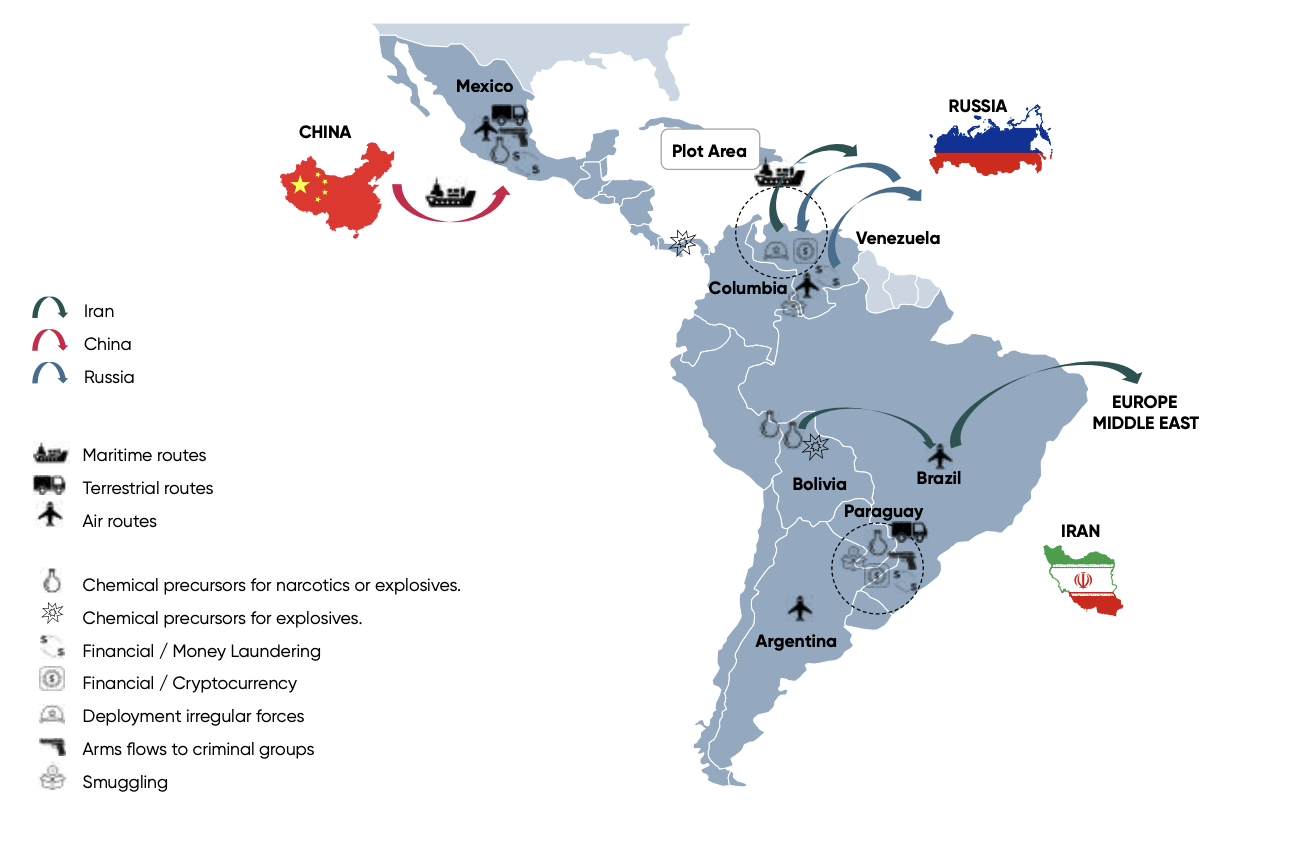

The Center for the Study of Democracy’s “Shadow Alliances: Authoritarian Powers and the Hybrid Warfare Nexus in Latin America” is the most comprehensive open-source mapping yet of how Russia, China, and Iran have embedded themselves in Latin America.
The core argument: These three actors have made criminal networks a functional instrument of statecraft. They’ve built a layered system that fuses legitimate economic engagement with criminal networks, disinformation, and covert finance. The line between state and criminal actor has been deliberately erased.
“Rather than treating criminality as incidental or opportunistic, China, Russia, and Iran increasingly rely on criminal networks as functional enablers of their geopolitical strategies.”
Each actor operates differently, but converges on the same logic.
China builds structural dependency through infrastructure, loans, and technology—the Bogotá Metro, Bolivia’s Chinese-financed satellite, surveillance systems deployed in Venezuela, Argentina, and Bolivia. Its chemical precursor networks supply Mexican cartels with fentanyl inputs, though the report is careful to note this operates commercially rather than through direct state direction.
Russia concentrates leverage in strategic sectors. It controls over 90% of Brazil’s foreign diesel imports and roughly 40% of its fertilizer market. That’s outsized influence from a relatively small economic footprint. It weaponizes that footprint through disinformation campaigns, intelligence operatives, and paramilitary actors.
Iran operates through decentralized proxy networks, primarily Hezbollah-linked, running sanctions evasion, barter arrangements, and informal finance across the Caribbean basin and the Tri-Border Area.
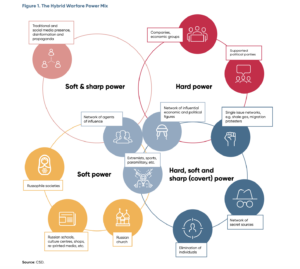
Source: Center for the Study of Democracy.
The report’s most arresting case studies are Russian. Mexico has become the single largest hub for Russian intelligence operations in the Western Hemisphere.
Take these data points:
- The number of Russian diplomats in Mexico increased by roughly 60% following mass expulsions from Europe—many redeployed GRU operatives.
- Between 2022 and 2024, over 166,000 Russian citizens entered Mexico, with at least 73,000 subsequently crossing illegally into the United States. At least 13 identified GRU agents embedded in those migration flows.
- A Kremlin-linked disinformation network, “La Compañía,” paid Argentine journalists $2,500 monthly to spread anti-Ukrainian narratives.
- RT en Español reached 715 million visits on X in Mexico in a single year.
- Russian-origin weapons accounted for roughly 60% of arms seized from Mexican cartels between 2022 and 2024.
“The largest concentration of Russian intelligence personnel in the world is in Mexico.” — General Glen VanHerck, former Commander, U.S. Northern Command
Venezuela functions as the clearest proof of concept
- Russia, China, and Iran have each embedded themselves in PDVSA’s shadow economy, sustaining a regime that has become a logistical hub for sanctions evasion, gold smuggling, and proxy operations across the continent.
- A ruble-backed stablecoin processed an estimated $100 billion in transactions before being sanctioned in 2025.
- Wagner Group personnel trained colectivos in repression techniques later used on civilian demonstrators.
Three takeaways stand out
First, formal economic entry is the gateway, not the destination. Ports, pipelines, financial agreements, and digital infrastructure all become dual-use platforms once established. The shift from legitimate to hybrid activity is gradual and happens inside the same institutional frameworks—making it nearly invisible until entrenched.
Second, the threat is regional but responses remain national. Hybrid networks exploit jurisdictional seams. Enforcement in one country displaces activity to the next. Latin America’s existing regional coordination mechanisms—Ameripol, bilateral intelligence-sharing—are inadequate to the scale of the problem.
Third, organized crime is no longer a domestic law enforcement issue. It is a strategic service provider for authoritarian statecraft. Treating it otherwise produces intelligence blind spots that these actors have learned to exploit systematically.
To consider
The report stops short of prescribing hard timelines or specific bilateral actions, and its recommendations—institutional integration, financial transparency, regional cooperation—are directionally correct but familiar. The value here is in the mapping. Shadow Alliances gives policymakers the most granular publicly available picture of what the competition looks like in America’s strategic backyard.
Find the full report from the Center for the Study of Democracy here: Shadow Alliances: Authoritarian Powers and the Hybrid Warfare Nexus in Latin America.

