





Analysis: ISKP’s Exploitation of the Af-Pak Border War

Abstract
Much of the current discussion treats the Iran–Israel–U.S war and the Pakistan–Afghanistan conflict as separate crises, but along the Iran–Afghanistan–Pakistan corridor they are unfolding in the same strategic space. This article analyzes how that overlap is reshaping militant dynamics in Balochistan, focusing on the growing confrontation between ISKP and Baloch nationalist groups. It also assesses the implications for U.S. counterterrorism policy, particularly in tracking cross-border networks, digital recruitment, and declining intelligence visibility.
Background
On the early morning of February 27, 2026, Pakistan’s defense minister, Khawaja Muhammad Asif, declared what he termed “open war” between Pakistan and the Taliban authorities in Afghanistan. The announcement formalized a week of cross-border strikes and escalating retaliation along the Durand Line, a boundary whose instability has long been sustained by overlapping insurgencies and unresolved sovereignty disputes. This escalation differs from previous cycles of Af-Pak tension; it is unfolding simultaneously with intensifying conflict involving Iran, producing a regional security environment defined not by a single crisis, but by concurrent shocks.
Current Status
Since early 2025, the Islamic State-Khorasan Province (ISKP) has expanded its operations into Pakistan’s Balochistan province, sparking a direct conflict with the Baloch Liberation Army (BLA). This pivot marks a shift for ISKP, seeking to delegitimize the Pakistani state while undermining the nationalist appeal of the BLA. As Pakistan’s military attention is divided across multiple fronts and border enforcement weakens, ISKP has increased attacks and propaganda targeting Baloch nationalist groups.
On May 25, 2025, ISKP released a 36-minute propaganda video in Pashto through its Al-Azaim Media Foundation titled “Mastung Incident”, claiming that the BLA had launched an assault on an ISKP training camp, killing 30 fighters. The video criticizes Baloch separatists, calling them “secular infidels” who are more aligned with the West than Sharia Law. It is in this video when ISKP declared war against Baloch nationalist armed groups. Before this incident, both groups largely maintained a tacit non-interference arrangement. According to the video, however, the Mastung Incident marked the point of no return, effectively collapsing the informal truce and triggering open confrontation between the two factions.
BLA Activity and Security Gaps
The security architecture of southwestern Pakistan fractured significantly in March 2025 when the BLA’s Majeed Brigade hijacked the Jaffar Express near Sibi. The 30-hour hostage crisis resulted in at least 26 deaths and the kidnapping of hundreds, signaling a shift toward more sophisticated, large-scale urban operations. While the BLA frames this as a struggle for “national liberation” against state exploitation, ISKP views the BLA as a rival to its caliphate project. By exploiting the vacuum left by the Pakistani military’s focus on separatist insurgents, ISKP has begun a systematic campaign of targeted assassinations and sectarian bombings designed to trigger a total collapse of local governance. This escalation is further complicated by the Taliban’s continuing struggle to secure the Durand Line, creating a regional “triple threat” that challenges U.S. counter-terrorism interests in both physical and cyberspace.
Regional Escalation Along the Durand Line
The 2021 U.S. and NATO withdrawal reconfigured the external security architecture of Afghanistan, reducing Western on-the-ground intelligence presence and shifting counterterrorism responsibility primarily to the Taliban regime. The disputed Durand Line has seen renewed cross-border strikes and tense military exchanges, and jihadist groups such as ISKP have entrenched themselves within porous border regions where governance remains uneven and mobility networks remain contested. What distinguishes the current moment is the redistribution of strategic attention and coercive capacity across the broader “greater-Iran” space. As Iran confronts external military pressure and internal strain, the possibility, however contested, of regime destabilization introduces an additional systemic variable.
While the February 2026 declaration targets the Taliban authorities in Kabul, it is vital to distinguish between the Afghan Taliban and their ideological cousins, the Tehrik-e Taliban Pakistan (TTP). The IEA maintains a policy of ‘strategic ambiguity’ regarding the BLA – while they have not officially endorsed the Baloch cause, they have largely ignored BLA movement in southern provinces ,like Kandahar and Helmand, as a leverage point against Islamabad. By contrast, the TTP has actively moved toward a tactical alliance with Baloch insurgents, finding common ground in their shared goal of dismantling the Pakistani state’s western frontier. This ‘marriage of convenience’ has turned the Durand Line into a blurred combat zone where the IEA provides the sovereign shield, and the TTP and BLA provide the kinetic spear.
BLA Background
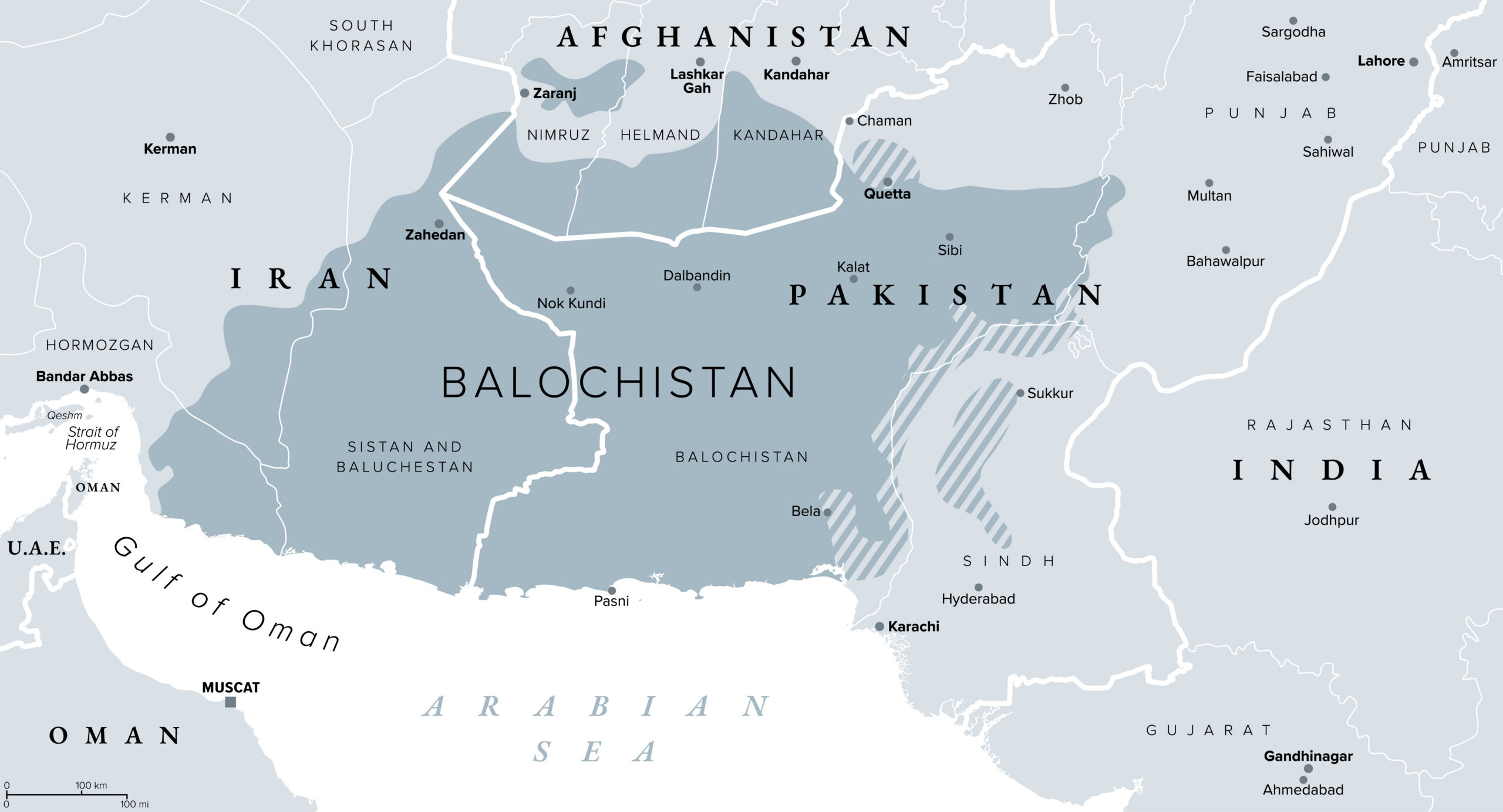
BLA is a group that, since its August 11, 2025 US State Department FTO designation, continues to project itself as a separatist fighting force for the rights and independence of the Baloch, a cross-border minority split between the Pakistani province of Balochistan, the Iranian province of Sistan and Baluchistan, and Afghanistan. From 2018-2025, the majority of BLA activities included terror attacks on security forces, development projects, and Chinese convoys working on China–Pakistan Economic Corridor (CPEC) corridors. A distinctive feature BLA’s increasingly lethal attacks are the inclusion of female suicide bombers in carrying out suicide attacks.
The FTO designation was strategic as Balochistan persists as a conflict-ridden geopolitical theater, both in its proximity to the Durand Line and the Af-Pak conflict, and in the way the group has operated and survived under pressure. The FTO designation could surely limit financial channels, but may not halt operational capacity. Relying heavily on local support networks and safe havens, BLA’s ability to recruit, sustain propaganda, and conduct asymmetric attacks will affect Pakistan’s ability to neutralize the group regardless of international recognition.
ISKP Propaganda and Recruitment
Beyond the Mastung Incident, ISKP’s expanding propaganda footprint reflects both its limited grassroots penetration and its attempt to compensate through digital influence operations as tensions escalate along the Durand Line and across the broader Greater-Iran security space. Condemning Baloch nationalism as “ethnic apostasy”, the goal of ISKP is to replace nationalist identity-driven insurgency with jihadist insurgency, using propaganda as a tool to absorb militants from collapsing or weakened groups. For instance, ISKP has turned its propaganda tactics toward the Baloch religious sect known as the Zikri community.
The Zikri community, considered to be a sect of Islam, is mostly based on Turbat, Gwadar, and Awaran, and has produced many fighters to the Baloch insurgency. Islamic State social media users continue to urge the Baloch community to translate their propaganda into Balochi. This demand for a language pipeline to foster the communication and understanding of propaganda forces the Balochi people to employ digital translation tools. The effect: language barriers slow penetration and require local intermediaries, creating a reliance on local intermediaries who function as informal ideological gatekeepers. Individuals capable of translating and distributing ISKP media effectively become nodes in the recruitment pipeline, determining which narratives circulate within Baloch online spaces and which audiences are exposed to jihadist messaging.
As the conflict progresses alongside the death toll, ISKP supporters increasingly turn to Facebook, Telegram, and Element to broaden their reach. ISKP announced a social media campaign to garner support from the Baloch community, requesting their supporters to identify Facebook pages that are linked to them. Leveraging Balochi-speaking intermediaries allows ISKP to localize its messaging and challenge the BLA’s influence over Baloch grievances.
Use of Encrypted Platforms
The use of semi-encrypted messaging apps is not new to Islamic State counterparts. Sanctions and counterterrorism pressure have produced a parallel adaptation across distinct regions: migration toward semi-encrypted, decentralized communication ecosystems optimized for survivability rather than spectacle.
The resilience of Telegram-based jihadist networks, according to the European Commission’s 2024 Quarterly Research Review titled New Trends in Jihadism, was heavily prevalent in the Islamic State’s online digital activities in 2024. Successful terrorist attacks are growing more reliant on communication through encrypted messaging platforms such as Telegram, which has caused authorities in the United States, United Kingdom, and Germany, to call for the installation of backdoors to weaken encryption strength. The target audience overlaps significantly with the same online spaces where Baloch nationalist identity circulates, particularly among younger users. Digital platforms therefore become a recruitment battlespace, allowing ISKP to insert jihadist narratives directly into online communities where nationalist sentiment traditionally circulates.
As ISKP refines its digital survivability under sustained counterterrorism disruption, homegrown Baloch militant networks have adapted under persistent state surveillance and military pressure. This structural overlap rewards actors capable of operating quietly with patience. Though ideologically opposed, both ecosystems have pushed toward the same communication architectures optimized for survival under pressure: decentralized, encrypted, redundant, and plausibly deniable within the realm of cyberspace.
Impact of the Afghanistan-Pakistan Conflict
The war between Pakistan and Afghanistan massively impacts the ISKP-Baloch conflict. As Pakistan continues to launch airstrikes in Afghanistan, targeting ISKP and TTP camps, border fighting has escalated into an “open war” with hundreds and thousands of civilians displaced in border areas.
Border chaos increases the capacity for militant mobility along the Durand Line and Balochistan Corridor, with fighters, weapons, and funds moving across with room for ISKP to exploit Taliban-Pakistan tensions. Pakistan’s military attention is split, as the state is simultaneously fighting the Afghan Taliban, TTP, Baloch insurgents, and ISKP – which positions itself as the true jihadist alternative to the Taliban.
Most recently, on March 5 of 2026, ISKP carried out an attack on a Chinese restaurant in Kabul, which was a significant blow to the Taliban regime. While the Taliban conducts counter-operations against rival jihadist factions, its security dynamics remain contested. A case of this lies in ISKP: it faces persistent accusations from Pakistan that it tolerates or fails to suppress anti-Pakistan militants operating from Afghan territory.
The post-2021 environment is, therefore, best described as a regime-consolidation phase characterized by uneven territorial enforcement capacity. Why does this matter? The Taliban sits at the center of the regional militant ecosystem: its enforcement decisions directly shape the operational latitude of both ISKP and the TTP.
Taliban, Iran, and ISKP dynamics
Iran’s relationship with the Taliban has been volatile since the Taliban’s reclaim to power, acting as less of an endorsement and more as a tool to preserve regional stability amid growing insurgency within the region. Relations between Iran and the Taliban have oscillated between confrontation and pragmatic engagement. Tehran nearly went to war with the Taliban in 1998, yet later hosted Taliban representatives while the group was still fighting Afghanistan’s former government. With the emergence of ISKP in 2014 and 205, Afghanistan has not engaged in overt antagonism towards Iran, nor has Iran taken steps to undermine the Taliban’s authority in post-US Afghanistan. Tensions persist, revealing a deliberate restraint of official endorsement from Tehran.
Secondly, open-source reporting indicates over 20 extremist organizations remain active in Afghanistan, and al-Qaeda’s de-facto leader Saif al-Adel, believed to be sheltered in Iran, maintains influence across the region. Maintaining plausible deniability, such a collaboration accentuates a dangerous convergence between state and non-state actors, blurring the line between statecraft and subversion.
Regional Escalation Involving Iran
The Iran-Israel-US War, and wider Middle-East escalation, may indirectly strengthen militant ecosystems around Balochistan in furthering three main counterparts: sectarian escalation, Baloch cross-border militancy, and strategic distraction. For groups such as ISKP, confrontation involving Iran provides propaganda material that reinforces long-standing sectarian narratives portraying Shia-led states as enemies of Sunni Islam. In framing regional conflict through this sectarian lens, ISKP can recast local grievances in Balochistan as part of a broader religious struggle, strengthening its appeal among militants dissatisfied with the secular orientation of Baloch Liberation Army.
Baloch populations live on all three sides of the Iran-Afghanistan-Pakistan borders. Historically, Iran and Pakistan have conducted cross-border strikes against Balochistan militants. Regardless of whether Iran emerges strengthened, weakened, or politically transformed from the ongoing war, during periods of heightened conflict border enforcement may weaken enabling smuggling networks, militant transit, and greater weapons flows – conditions that assist jihadist groups with agendas to further implement their strategic agendas.
By the time the immediate conflict subsides, external networks in Balochistan will already have shifted. Some will contract, others will consolidate, but movements will have occurred nonetheless. As regional crises shift state priorities, analysts warn instability in Iran could worsen militant activity in Pakistan’s border regions in Balochistan and the
Middle-East-North-Africa (MENA) regions. A key connector is the tri-border militant corridor – the porous frontier linking Afghanistan, Pakistan’s Balochistan province, and Iran’s Sistan-Baluchestan region – where weak state control, smuggling networks, and cross-border militant mobility have created a contested security space between ISKP, the Taliban, and Baloch insurgent groups.
These conflicts do not operate independently – each reinforces the other by redistributing state attention and weakening border enforcement. Local insurgencies combine with interstate tension to produce precisely the conditions in which transnational jihadist actors thrive. As Baloch insurgency weakens Pakistan internally, the Afghanistan Pakistan War destabilizes the border, and the Iran war radicalizes sectarian narratives. ISKP exploits all three simultaneously by: infiltrating Balochistan, recruiting disillusioned militants, and framing regional instability as proof of a global jihadist struggle.
Implications for Counterterrorism
For U.S. counterterrorism strategy, militant opportunity expands when multiple regional crises fracture state attention simultaneously. The confrontation between ISKP and BLA thereby shows how jihadist actors exploit these fractures by inserting themselves into existing insurgencies rather than building entirely new ones.
As Pakistan divides its security focus between separatist violence, tensions along the Durand Line, and broader regional instability, enforcement capacity across peripheral regions such as Balochistan becomes uneven. These environments historically produce increased militant mobility, smuggling activity, and ideological competition. For U.S. planners, the lesson is not simply to monitor individual groups, but to monitor the connective corridors where insurgencies overlap. Counterterrorism effectiveness will depend on maintaining persistent intelligence visibility across the Afghanistan–Pakistan–Iran tri-border space before militant adaptation consolidates into durable networks.
The second implication lies in the informational domain. Contemporary insurgent competition increasingly unfolds within Telegram and Facebook networks used to distribute ISKP propaganda in Pashto and increasingly in Balochi where ideological narratives circulate long before violence occurs. ISKP’s efforts to frame Baloch nationalism as religious apostasy represent an attempt to redirect existing grievances toward transnational jihadist objectives. The risk is not merely the persistence of extremist propaganda, but the gradual restructuring of militant ecosystems under conditions of prolonged instability.


