How China’s Fear of Secondary Sanctions Pushed Moscow into Leveraging Stablecoins to Reshape Financial Warfare
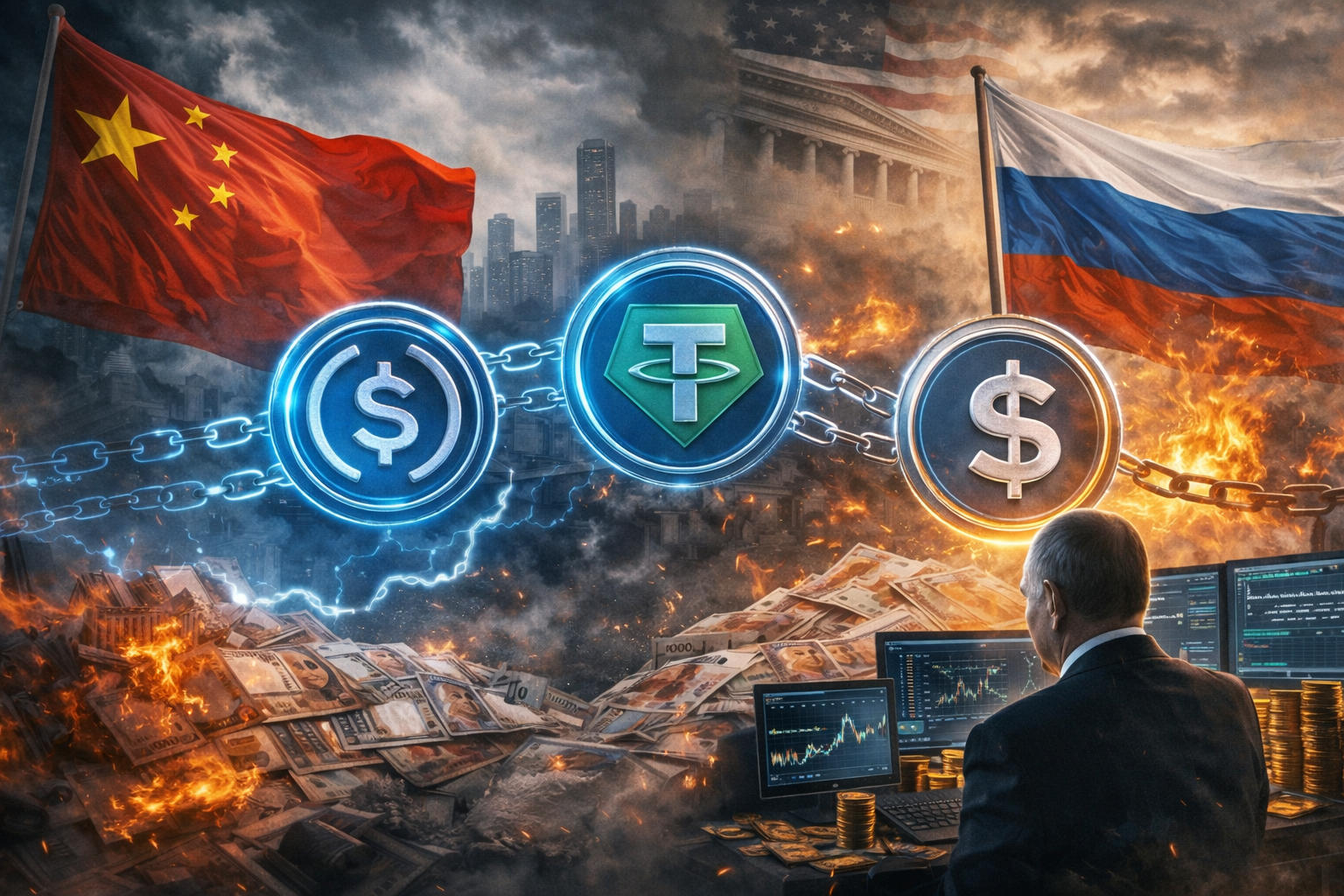

On March 10, 2026, Central Bank of Russia’s Governor Elvira Nabiullina announced that the digital ruble was on-track to launch in September 2026. Since initial pilot testing in mid-2023, Russia’s central bank digital currency (CBDC) has often been thought of as a potential tool to counter Western sanctions, with this being even more important due to increased sanctions resulting from Russia’s full-scale invasion of Ukraine.
Despite these initial assumptions from both policymakers and analysts, these developments within Russia’s digital asset ecosystem suggest a different reality, especially due to the potential of secondary sanctions issued by the U.S. against China, which is Russia’s largest trading partner and ostensible economic lifeline. Privately-issued stablecoins like the A7A5 stablecoin have emerged as the more immediate tool for enabling Russian cross-border transactions and sanctions evasion.
This utilization of stablecoins demonstrates how financial infrastructure has become a critically contested domain within irregular warfare’s purview. The growing use of stablecoins by sanctioned actors reflects a broader transition to decentralized financial networks, with this enabling military operations and gray-zone activities while circumventing traditional instruments of economic pressure like sanctions.
Stablecoins
When discussing the use of cryptocurrencies in strategic competition, one must first understand the difference between the term “cryptocurrencies” in eponymous culture and stablecoins.
Technically, stablecoins are a digital asset that falls under the category of being a cryptocurrency. However, in popular culture, cryptocurrencies and stablecoins are often seen as fundamentally independent entities. When referring to cryptocurrencies, most individuals are often referring to digital assets like Bitcoin and Ethereum, with these very volatile assets serving as a decentralized store of value. In contrast, stablecoins are price-stable digital assets that have a one-to-one peg to fiat currencies like the U.S. dollar, Euro, or yen. Stablecoins are also typically issued by private, non-state entities.
In contrast to both cryptocurrencies and stablecoins, CBDCs are state-issued digital currencies that are managed directly by their associated nations’ central banks/monetary authorities, with two examples being the digital euro and the digital yuan (e-CNY). Due to their entire lifecycle being directly managed by the country’s main financial authority, CBDCs are often thought of as a tool of government surveillance and control.
With these definitions in mind, stablecoins, not CBDCs, have increasingly emerged as a practical tool for conducting cross-border transitions in sanctions-constrained environments. In this context, these financial instruments can help threat actors evade detection and support sustained operations even under sanctions pressure.
Sanctions evasion via the A7A5 stablecoin
Sanctions evasion has been a core tenet of the Russian payments industry, with the U.S. sanctioning 13 firms in early 2024 for enabling digital payments for the purposes of “enabling potential sanctions evasion,” with some of these actors specifically leveraging blockchain-based payments or virtual currencies to do so.
The A7A5 stablecoin, which is issued on both the Ethereum and TRON blockchains, was ostensibly created to enable further sanctions evasion. Launched in January 2025 in Kyrgyzstan by A7 LLC, the A7A5 stablecoin made history by being the first stablecoin pegged to the Russian ruble. Since that time, A7A5 has processed over $72b in volume.
A7 LLC itself is majority owned by Ilan Shor, a Moldovan political figure and oligarch who was previously sentenced for stealing $1b from Moldova’s banking system in a money laundering scheme in 2014. Shor was sanctioned by the U.S. in late 2022 and described as an “instrument of Russia’s global influence campaign.” A7’s minority owner is Promsvyazbank (PSB), a Russian state-owned enterprise (SOE) bank that was itself sanctioned in early 2022 for its role in acting as the key lender for Russia’s defense industry.
A7A5 is particularly valuable because it can act as a bridge between fiat rubles and the Tether (USDT) stablecoin, with USDT being easier to be off-ramped into international fiat currencies due to its dollar peg. Additionally, A7A5 can be purchased with PSB cards, with A7A5 also supporting a Stable pay, a virtual debit card, for online payments, while also offering digital promissory notes that can be redeemed for cash or converted back to tokens.
Furthermore, stablecoins like 7A5 can support operational logistics in sanctioned ecosystems. This could include the procurement of dual-use goods, payments to irregular forces, and even movement of funds across jurisdictions with weak enforcement mechanisms.
As a matter of fact, this mirrors historical patterns in illicit finance, where criminal networks, insurgent groups, and sanction states converge on shared decentralized financial infrastructure. For example, TRON has become the blockchain of choice for the global shadow economy to include participation from actors based in China, Iran, Russia, and Venezuela. TRM Labs reported that in 2023, nearly half of all illicit cryptocurrency volume occurred on the TRON blockchain due to its relatively low transaction fees and high liquidity.
Illicit finance between Russian and Chinese threat actors
An increase in international scrutiny via sanctions for Russian actors has driven a corresponding increase in trade between Russia and China, with bilateral trade volume nearly doubling since the beginning of the Ukraine invasion. Therefore, Russia’s reliance on “private” stablecoins highlights the increasing pressure that Russia is facing from Western entities.
While China has spent years developing alternatives to Western-dominated payment rails through programs like its Cross-Border Interbank Payment System (CIPS), the e-CNY, and the Blockchain-based Service Network (BSN), China is still significantly at risk for secondary sanctions. Allowing Russian banks to openly use official Chinese state-sponsored payment systems could jeopardize China’s own access to global markets, necessitating a plausible, albeit hardly believable, alternative.
As a result, China has effectively established a wall around its formal financial infrastructure. This caution has pushed Russian actors into a financial gray zone, forcing a reliance on digital assets like the A7A5 stablecoin and decentralized Asian crypto hubs. This enables a persistent economic relationship with Russia, albeit via arm’s length transactions rather than through official state-to-state financial channels.
This dynamic is a form of state-enabled deniability, a key hallmark of gray-zone competition. By avoiding direct integration of Russian entities into CIPS or other Chinese-owned payment systems, China reduces its own exposure to sanctions while implicitly tolerating alternative channels that sustain Russia’s economy.
As a result, this creates a hybrid ecosystem where private entities provide financial infrastructure that enable state-affiliated enterprises to execute transactions. This further blurs the line between traditional and illicit finance, complicating attribution and response for Western policymakers.
What’s next for Russia’s digital payments industry
While the A7A5 stablecoin appears to be the most popular way to evade sanctions currently, the rollout of the digital ruble could result in some competition within Russia’s digital payments ecosystem.
Freedom Finance Global senior analyst Natalia Milchakova highlighted that the digital ruble could become a major competitor to Russia’s domestic payment card system, the Mir card. The Mir card was rolled out in 2014, when the Bank of Russia established the National Payment Card System Joint Stock Company (NSPK). Interestingly enough, NSPK itself was sanctioned by the U.S., EU, and the UK in early 2024. The Mir system is particularly important for Russian payments after Visa and Mastercard suspended operations in Russia in early 2022 following the Russian invasion of Ukraine.
The digital ruble’s introduction could reshape Russia’s domestic payments landscape by introducing a state-controlled digital alternative to traditional card networks, potentially diverting transactions away from Mir while further consolidating the central bank’s role in the country’s financial infrastructure.
Conclusion
The digital ruble’s rollout represents an important step in Russia’s effort to build a sovereign financial infrastructure resilient to Western sanctions. However, current developments suggest that privately-issued stablecoins are playing a more immediate role in facilitating cross-border transactions between Russia and the rest of the world today, a much-needed economic boost in light of Russia’s stagnating economy.
The example of the A7A5 and the TRON blockchain demonstrates how digital assets can offer accessibility, flexibility, and liquidity in a rapidly-deployed package. This area is where state-controlled systems struggle, especially in environments shaped by Western sanctions and financial restrictions. This also highlights a critical vulnerability in modern economic warfare, with decentralized financial tools chipping away at the effectiveness of traditional sanctions.
All in all, as financial networks become more decentralized and adaptive, they will play an increasingly central role in irregular warfare. This trend shapes how states evade sanctions and how these same states can sustain conflict in an era of persistent economic coercion.