From Mandate to Execution: The Clear–Shield–Sustain Model for Contested Stabilization

Abstract
Contemporary stabilization missions often take place in environments where political agreements exist, but the structures needed to carry them out are weak. Drawing on lessons from Iraq and Afghanistan, this article proposes the Clear–Shield–Sustain (CSS) model as a practical framework built around a unified execution headquarters that controls transitions between combat, security, and reconstruction while maintaining strict accountability over aid and resources. Applied across different political conditions, the model shows how enforcing these transitions can help turn political agreements into more stable outcomes.
Introduction — The Execution Gap in Contemporary Stabilization
Modern stabilization missions increasingly occur in environments where political agreements exist, but the structures needed to carry them out remain weak. The central problem is rarely the absence of a political plan, but the difficulty of turning political decisions into coordinated action on the ground.
Experience in Iraq and Afghanistan showed that stabilization efforts often faced persistent execution challenges not primarily because objectives were unclear or resources unavailable, but because the shift from combat to security, and from security to reconstruction, was not well managed. Assistance programs expanded faster than conditions allowed, oversight proved inadequate, and responsibilities were divided among military, civilian, and international actors without a single structure able to keep activities aligned. Reviews by the Special Inspector General for Iraq Reconstruction (SIGIR), the Special Inspector General for Afghanistan Reconstruction (SIGAR), and other analysts repeatedly found the same problem: political direction existed, but the mechanisms needed to carry it out effectively were missing.
In Afghanistan, the International Security Assistance Force (ISAF) headquarters managed coordination across more than fifty contributing nations but lacked authority to enforce unified execution across military, diplomatic, and development activities. Resource allocation, transition decisions, and reconstruction sequencing remained distributed across national contingents and independent agencies, each operating under separate mandates. Multinational Force-Iraq (MNF-I) faced comparable structural constraints: unity of command existed within military operations but not across the broader stabilization enterprise. These structural gaps—not failures of individual commanders operating under significant multinational political pressure—produced the execution deficits that CSS addresses.
U.S. and international doctrine have recognized these challenges. Publications such as JP 3-24 Counterinsurgency and JP 3-07 Stability emphasize the need to coordinate military, political, and humanitarian efforts. In practice, coordination alone often proves insufficient, especially in unstable environments where many organizations operate under different authorities. When no single headquarters can control how and when activities move from combat to security, and from security to reconstruction, efforts can fall out of sequence. Aid may arrive before areas are secure, reconstruction may begin before local institutions are ready, and resources may end up in the hands of armed groups or corrupt networks, unintentionally strengthening the very forces stabilization is meant to weaken.
This article proposes the Clear–Shield–Sustain (CSS) model as a practical framework for managing these transitions. The model centers on a dedicated execution headquarters responsible for deciding when operations move from combat to stabilization and when reconstruction can safely expand. It also incorporates a hard-audit function to maintain visibility over how aid and resources are used, allowing leaders to slow, pause, or redirect programs when conditions deteriorate.
The author’s earlier work applied the CSS model to Gaza, where United Nations Security Council Resolution 2803 (UNSCR 2803) endorsed an international stabilization framework but did not specify a command structure. That gap—between political mandate and execution authority—is the problem CSS is designed to solve. This article extends the concept across three political conditions. It shows how a unified execution headquarters can be adapted to environments with strong, partial, or weak agreement among the parties involved.
Doctrine Evolution: From Clear–Hold–Build to Clear–Shield–Sustain
Modern stabilization doctrine grew out of experience in Iraq and Afghanistan, where military forces were required not only to defeat armed opponents but also to help restore security, governance, and basic services. Doctrine organized these efforts into phased approaches such as Shape–Clear–Hold–Build–Transition, reflected in counterinsurgency guidance and joint publications.
Later doctrine, including JP 3-07, emphasized unity of effort among military, diplomatic, and development organizations. In unstable environments, however, coordination alone is often not enough. Many participants operate under separate authorities, and no single headquarters may have the ability to decide when activities should advance, pause, or shift direction.
This gap between coordination and execution is where stabilization efforts most often fail. Plans describe what should happen, but provide limited guidance on how to control transitions between combat, security, and reconstruction when conditions change. The SIGIR final report on Iraq and the SIGAR lessons-learned series on Afghanistan both identify execution gaps between plans and implementation, between resource allocation and field conditions, and between military and civilian timelines as primary contributors to mission shortfall.
The Clear–Shield–Sustain model is intended to fill this gap. Rather than replacing existing doctrine, it adds an execution layer—a headquarters responsible for controlling transitions, keeping operations aligned with conditions on the ground, and maintaining visibility over how resources are used.
The Clear–Shield–Sustain Execution Architecture
Combat, security, and reconstruction often happen at the same time in different places, without a single structure able to keep them aligned.
The risk is that these activities move out of order, allowing instability, corruption, or armed groups to exploit the gaps between them. CSS is designed to manage transitions between combat, security, and reconstruction through a unified execution structure rather than assuming they will occur naturally.
Clear–Shield–Sustain
The Clear–Shield–Sustain model divides stabilization into three linked functions.
- Clear consists of combat or coercive action to reduce organized resistance and establish minimum security.
- Shield provides stabilization security. Constabulary, gendarmerie, or multinational forces maintain presence, secure routes, and prevent armed groups from returning. Shield forces may include combat-capable units maintaining route viability where residual armed groups remain active; short, sharp engagements to prevent destabilization and targeted operations against leadership networks are Shield functions where the security environment requires them.
- Sustain introduces humanitarian assistance, reconstruction, and governance support. Unlike traditional models, aid does not expand automatically. It increases only when security remains stable and when oversight confirms that resources reach their intended recipients.
Movement between these functions is based on conditions on the ground, not on a timetable. In practice, Clear, Shield, and Sustain activities will often occur concurrently across different areas of the operational environment; the model defines functional authority and transition criteria rather than a strict linear sequence. Transition criteria must also account for seasonal patterns: environments such as Afghanistan experienced predictable cycles of increased armed activity that temporarily reversed progress from Shield to Clear without negating overall trajectory.
Controlling Transitions
Stabilization often fails because no one has authority to decide when to move from one phase to the next. Plans assume progress, but conditions may not support it. CSS requires a headquarters responsible for deciding when areas are secure enough for stabilization and when reconstruction can safely expand. Indicators may include reduced violence, freedom of movement, or verified control of key infrastructure. If conditions are not met, activities do not advance. This keeps aid and reconstruction from outpacing security. The execution headquarters commander holds this decision authority. When indicators are mixed or political pressure favors premature advance, the default is to hold. Aid and reconstruction do not move forward until conditions on the ground, not timelines from capitals, support the transition.
Execution Headquarters and Hard Audit
CSS depends on a headquarters with authority over execution. This execution headquarters may be a Joint Task Force, coalition command, or multinational structure, but its role is the same: control transitions, keep operations aligned, and maintain visibility over resources. Unlike a conventional joint task force organized around J-staff functions and effects coordination cells, the CSS execution headquarters holds binding transition authority, the ability to halt or accelerate movement between phases based on audited conditions, regardless of national caveats or parallel agency timelines.
A key element is a hard-audit function—real-time tracking of resources, personnel, and progress metrics tied directly to transition authority—built into the command structure. Under CSS, audit and verification are used in real time to track aid, reconstruction funds, and supplies. Programs can be slowed, redirected, or stopped when resources are diverted or conditions deteriorate.
Matching forces to the phase of the mission is also critical. Stabilization forces require peacekeeping skills (defined here as monitoring compliance with an existing agreement, distinct from peace enforcement, the use of force to compel compliance, and peacemaking, diplomatic activity to produce a political settlement), while sustainment requires civil-military coordination and financial oversight. When roles do not match the task, transitions become unstable, a problem seen repeatedly in Iraq and Afghanistan.
By combining transition authority and resource accountability in one headquarters, CSS provides a practical way to keep combat, stabilization, and reconstruction aligned even when many organizations are involved. Managing these pressures in a multinational environment where contributing nations hold different mandates, rules of engagement, and domestic political timelines is among the most complex challenges in stabilization. CSS does not eliminate these tensions, but by vesting transition authority in a single headquarters it provides commanders with a structural mechanism to resist premature phase transitions driven by political pressure rather than operational conditions.
Political Conditions and Applicability
The Clear–Shield–Sustain model is not suited to every stabilization mission. Its effectiveness depends on political conditions, particularly the degree to which the main parties accept a common framework for security and reconstruction. Experience in Iraq and Afghanistan showed that even well-designed operations fail when political agreement is too weak to support coordinated execution.
For practical use, environments can be grouped into three broad categories based on the level of political agreement. These categories describe the conditions under which a unified execution structure can function, not the intensity of combat.
Tier 1 — Strong Political Agreement
Tier 1 environments exist when the main parties broadly agree on the desired outcome and accept a common framework for security and reconstruction. Security conditions may remain fragile, but there is enough consensus to allow a single command structure to coordinate military, stabilization, and aid activities.
Examples include Bosnia, East Timor, Sierra Leone, and Nepal, where international mandates were supported by regional or global agreement. In these cases, the main challenge was not defining the mission but carrying it out in a disciplined and coordinated way.
Tier 2 — Partial Political Agreement
Tier 2 environments are the most common setting for modern stabilization. Some agreement exists, but it is incomplete, and different actors pursue overlapping or competing objectives. These environments often include contested territory, weak institutions, and economic incentives that sustain conflict.
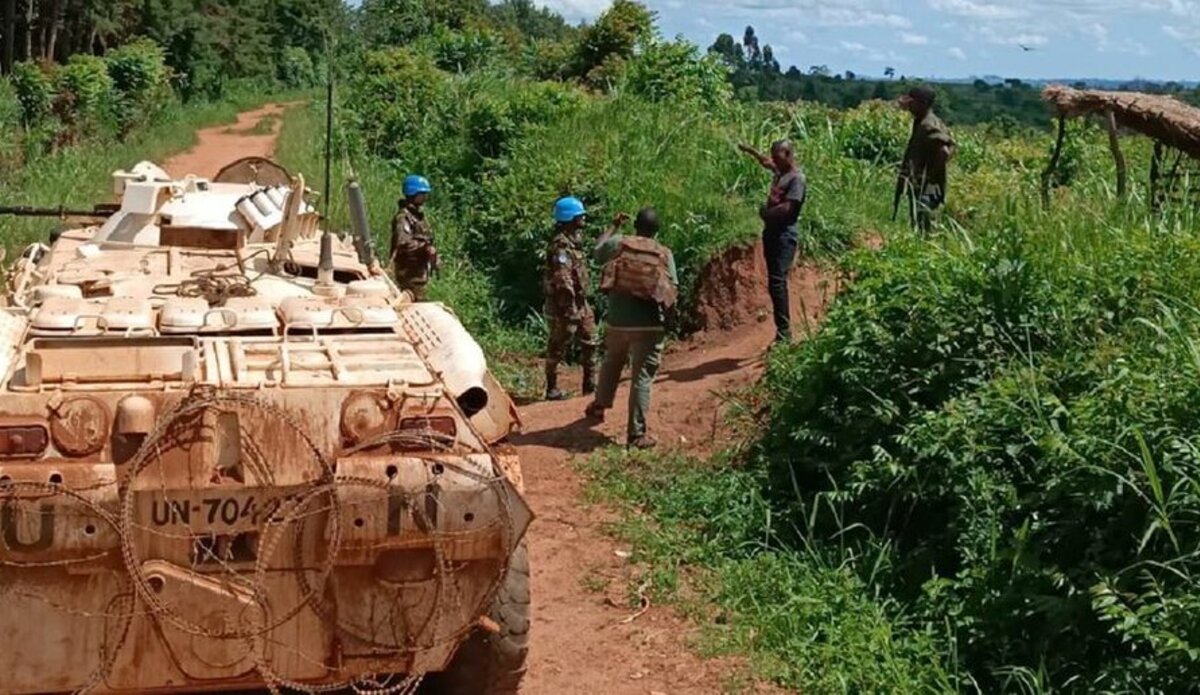
Eastern Democratic Republic of the Congo illustrates this condition. Regional political frameworks exist, and multinational forces operate alongside host-nation units, yet armed groups continue to exploit resource corridors and governance gaps. In such settings, stabilization depends on controlling when and where security operations, stabilization forces, and aid programs expand.
Tier 3 — Little or No Political Agreement
Tier 3 environments lack sufficient agreement to support coordinated execution. Parties disagree on the end state, institutions lack legitimacy, or outside actors cannot enforce common rules.
Examples include Somalia, Haiti, and periods of the Afghanistan campaign. In these situations, security operations, aid programs, and governance efforts often proceed without clear connection to one another, allowing corruption, diversion, and armed groups to exploit the gaps.
For the Global War on Terrorism (GWOT) generation: Afghanistan transitioned between tiers over the course of the campaign. Early post-2001 operations resembled Tier 1 conditions; by the mid-2000s most provinces had become Tier 2; Helmand and Kandahar operated under Tier 3 conditions through much of the surge period. Iraq similarly ranged from Tier 2 in the Kurdish north to Tier 3 in al-Anbar and Diyala at peak insurgency. Neither ISAF nor MNF-I constituted a CSS execution headquarters, both lacked binding transition authority across the full civilian-military enterprise, which is precisely the structural gap CSS addresses.
No execution structure can compensate for the absence of political agreement. In these environments, negotiation and political settlement must come before stabilization can succeed.
From Political Conditions to Operational Design
The tiered framework described above establishes the political conditions under which CSS can operate effectively. For example, CSS can be applied to the Goma corridor: Clear operations target M23 and ADF along priority axes; Shield transitions follow verified security thresholds; Sustain activities are gated through Track-Tag-Trace mechanisms linking aid delivery to security compliance.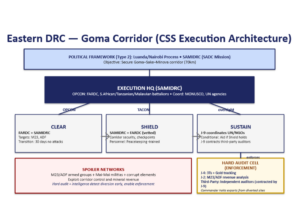
Acronyms: ADF – Allied Democratic Forces; AU – African Union; FARDC – Armed Forces of the Democratic Republic of the Congo; J-2 – Intelligence; J-4 – Logistics; J-9 – Civil-Military Operations; M23 – March 23 Movement; MONUSCO – UN Organization Stabilization Mission in the DRC; OPCON – Operational Control; SADC – Southern African Development Community; SAMIDRC – SADC Mission in the Democratic Republic of the Congo; TACON – Tactical Control; 3Ts – Track, Tag, and Trace
Hard Audit as Operational Enforcement
Traditional stabilization efforts treat auditing as an administrative function separate from operations. Experience in Iraq and Afghanistan showed that this separation creates a serious weakness. When oversight occurs outside the commander’s decision cycle, corruption and diversion are often detected too late, allowing aid and reconstruction resources to strengthen the same networks stabilization is meant to weaken.
The CSS model treats audits as part of execution rather than a post-hoc review. Resource flows are monitored in real time, allowing commanders to adjust, pause, or redirect aid when conditions deteriorate. This makes sustainment a controlled element of the operation instead of an automatic process driven by political timelines or funding cycles.
Hard audit relies on three basic tools encompassing both operational assessments of field conditions and financial tracking of resource flows against defined transition metrics. First, logistics tracking ensures that supplies and funds can be followed from source to recipient. Second, intelligence reporting helps identify patterns of diversion, taxation, or control by armed groups. Third, independent verification, including third-party or international auditors, provides credibility and reduces the perception of political bias. Together, these measures allow aid and reconstruction to expand only where security conditions can support them.
The main effect is to change incentives. Armed groups often depend on access to aid, infrastructure projects, or trade routes. When those resources can be monitored and restricted, the economic benefits of instability decline. At the same time, reliable and transparent delivery strengthens local confidence in stabilization efforts. In Afghanistan, Taliban shadow governance derived revenue from taxing reconstruction contracts and controlling access to aid distribution points. Hard-audit tracking of contractor payments and logistics routes would have surfaced these patterns earlier and enabled interdiction before they became systemic.
Hard audit does not eliminate corruption or political risk, but it reduces the chance that stabilization resources will undermine security gains. Its purpose is practical: to ensure that reconstruction and humanitarian assistance support stability instead of unintentionally prolonging conflict. In Helmand Province in 2010–2011, reconstruction funds were released on schedule rather than on conditions, contributing to infrastructure subsequently destroyed during seasonal fighting cycles. A hard-audit trigger linked to Shield-phase stability metrics would have held reconstruction funding until security conditions warranted—a straightforward CSS transition criterion the existing command structure lacked authority to enforce.
Conclusion
Stabilization efforts often fail not because doctrine is missing, but because the structures needed to carry it out are weak or absent. Experience in Iraq and Afghanistan showed the difficulty of coordinating combat operations, security forces, and reconstruction when transitions are not controlled and resources cannot be monitored in real time. When political agreement is lacking, no operational model can succeed. But when agreement exists, failure often comes from the inability to manage how and when activities move from combat to security to recovery.
The Clear–Shield–Sustain model treats stabilization as a problem of execution. By linking combat, security, and reconstruction under a unified command structure with integrated resource accountability, it provides a practical way to turn political agreements into workable results in difficult environments.
The central lesson is not simply that structures matter, but that the right structure—a unified execution headquarters with authority over transitions and real-time visibility over resources—must be designed before deployment, not assembled after problems appear. CSS gives commanders what current doctrine does not: a single headquarters that controls when operations move and whether resources reach their intended recipients, keeping combat, stabilization, and reconstruction aligned even when the organizations involved answer to different authorities.