





Vector Reverberations: Challenging the New Great Game in Conflicts’ Live Laboratory

Abstract
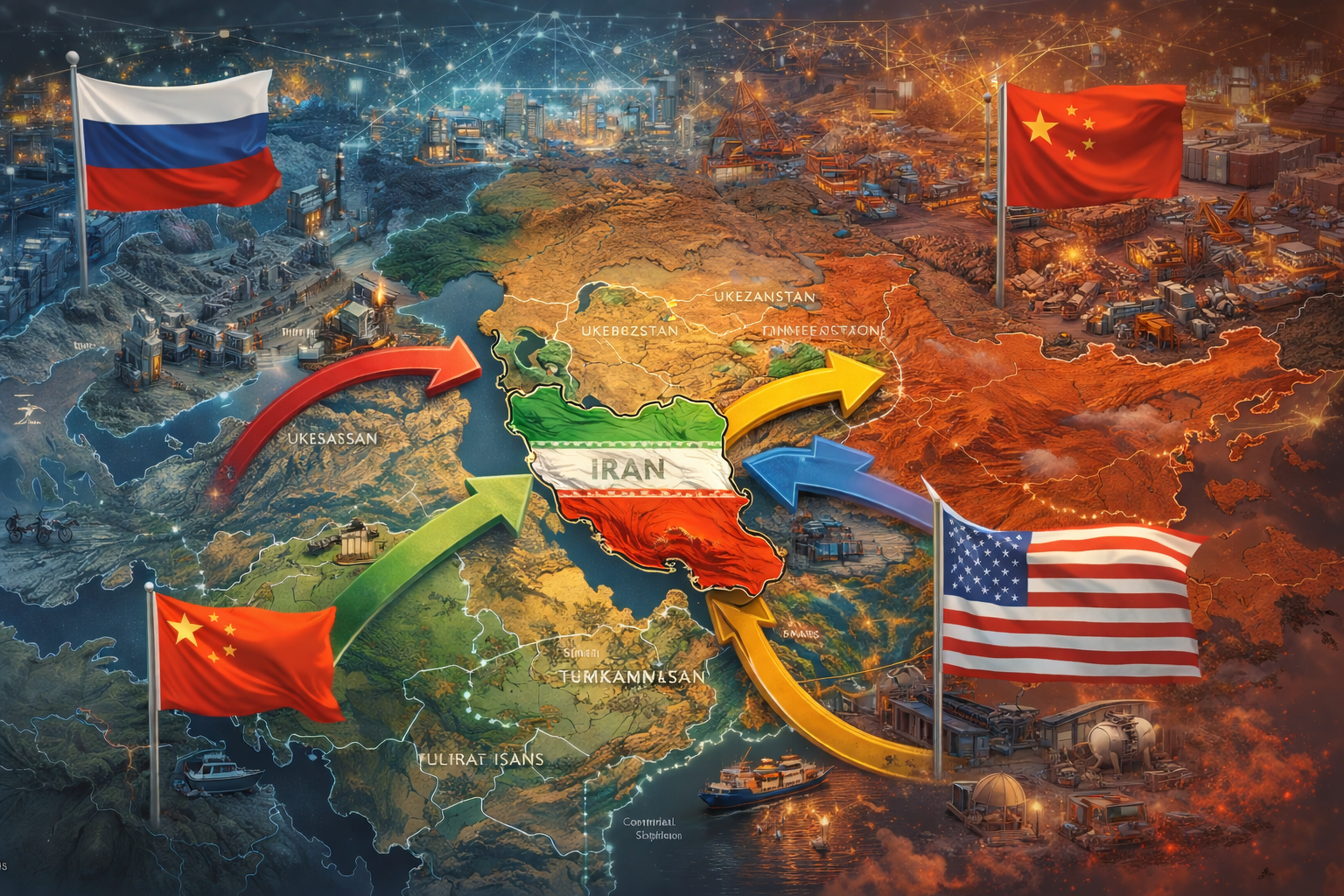
The “New Great Game” framework is insufficient for explaining contemporary geopolitical dynamics in Central and Southwest Asia, where power is increasingly shaped by interconnected, multivector relationships rather than zero-sum competition. If researchers and analysts expand this framework, the Iranian conflict provides an opportunity to understand the limitations of Central Asia’s balancing act among Russia, China, the United States, and emerging actors through pragmatic decisions tied to security, trade, and technological access. Ultimately, the study contends that influence in the modern “heartland” is defined less by territorial dominance and more by participation in adaptive, overlapping networks of power.
Introduction
The world pivot is shifting, and in studying Central and Southwest Asia, these shifts have become more nuanced and connective than many theories allow. Global powers are watching the application of military capabilities and security apparatuses in persistent and emerging conflicts. While some shifts are routine, others are products of context. Few are entirely unforeseeable if a wide enough lens is used. Adopting this lens reveals theories, such as the New Great Game, are inadequate. The conflict in Iran, when viewed through the interests of competing actors, provides insight not just into Iran itself, but into the behavior of Central Asian states – Kazakhstan, Uzbekistan, Kyrgyzstan, Tajikistan, and Turkmenistan.
The inclusion of Central Asia in the heartland necessitates its consideration for any actor pursuing global influence. Given the rivalry between Russia, China, and the United States, the New Great Game initially appears convincing. However, developments in the theory complicate this view, particularly the recognition of Central Asian agency through multivector foreign policy. States, especially middle powers, use multivector approaches to reap the benefits of investment and international involvement of more powerful states that seek to influence middle powers, which in turn requires the middle power to operate with respect to the tensions that exist between powerful states. In practice, this approach reveals two realities: first, the United States has failed to provide sufficient vectors to counterbalance regional alignment with Russia, China, and increasingly Iran; and second, the New Great Game framework oversimplifies what are circuitous and overlapping relationships.
Current Vectors
China and Russia maintain a sustained military presence in Central Asia, while the United States no longer does, following the closure of bases in Uzbekistan and Kyrgyzstan. Economically, the region is also tied primarily to Russia and China. Recent agreements with the United States – such as Uzbekistan’s $100 billion purchase commitment and Kazakhstan’s participation in the Abraham Accords – demonstrate the persistence of multivectorism. Yet without competitive and durable Western engagement, these agreements risk becoming symbolic rather than structural. Multivectorism, at its core, is a balancing act. As conflicts to the north and south deepen, that balance becomes harder to sustain, pushing states toward choices tied not just to strategy, but to survival.
Future vectors in a self-sustaining system
Trade routes illustrate this dilemma clearly. The closure of the Strait of Hormuz has triggered global economic disruptions, increasing the urgency of alternative corridors such as the Trans-Caspian International Transport Route, also called the Middle Corridor. However, the Middle Corridor lags in both infrastructure and air defense capacity. While Western support could strengthen this route, alternative vectors with Russia or even Iran remain viable. The decision is not ideological but practical.
Security dynamics further reinforce this shift. Drone warfare has emerged as a cost-effective and scalable capability across the region. Russia, China, Iran, and Turkey dominate the supply and development of drone technology to Central Asia. Tajikistan hosts an Iranian drone production facility, while Uzbekistan and Turkmenistan procure from Russia, and Kyrgyzstan partners with China. In this environment, maintaining military relevance may require trading degrees of autonomy for access to technology.
The diffusion of drone warfare also exposes the limitations of the New Great Game. The conflict in Ukraine is linked to Iranian-inspired drone production, which in turn feeds Russian capabilities, supported by Chinese research and manufacturing inputs. These same systems then become available to Central Asian states. What emerges is not a competitive triangle, but a network of reinforcing relationships. Even as Russia’s direct influence in Central Asia may decline due to Ukraine, its indirect role in facilitating broader cooperation with Iran and China remains significant.
Russia continues to benefit, albeit indirectly. Drone warfare has demonstrated Iran’s resilience and its ability to threaten critical infrastructure. Meanwhile, shifts in U.S. arms allocations and the easing of Russian energy sanctions suggest that global crises can redistribute leverage rather than eliminate it. Within this context, Russia retains the ability to reassert influence in Central Asia through economic and security channels.
Conclusion
It is within these circuitous relationships that the limitations of the New Great Game become most apparent. Framing Russia, China, and the United States as primary competitors implies a zero-sum system in which one actor’s gain is another’s loss. A wider lens suggests something different: a networked system in which power is redistributed, recycled, and repurposed across overlapping relationships. Influence does not disappear – it mutates.
If the heartland once represented control through dominance, it now reflects control through connectivity. The emerging “game” is not about occupying territory, but about embedding oneself within the networks that sustain it – trade, technology, and security. For 2026 and beyond, the challenge is not simply which power will prevail, but whether any power can operate effectively in a system where agency is diffused, alliances are transactional, and even adversaries can become enablers. In that sense, the New Great Game has not ended. It has dissolved into something far more complex, and far less predictable.



This article provides a thought-provoking analysis of the evolving geopolitical dynamics in Central and Southwest Asia. The shift from a zero-sum perspective to a multivector approach highlights the complexities of international relations today. The emphasis on interconnected networks rather than mere territorial dominance is particularly insightful. It will be interesting to see how these sports games dynamics unfold in the coming years.