





Book Review | Flawed Strategy: Why Smart Leaders Make Bad Decisions
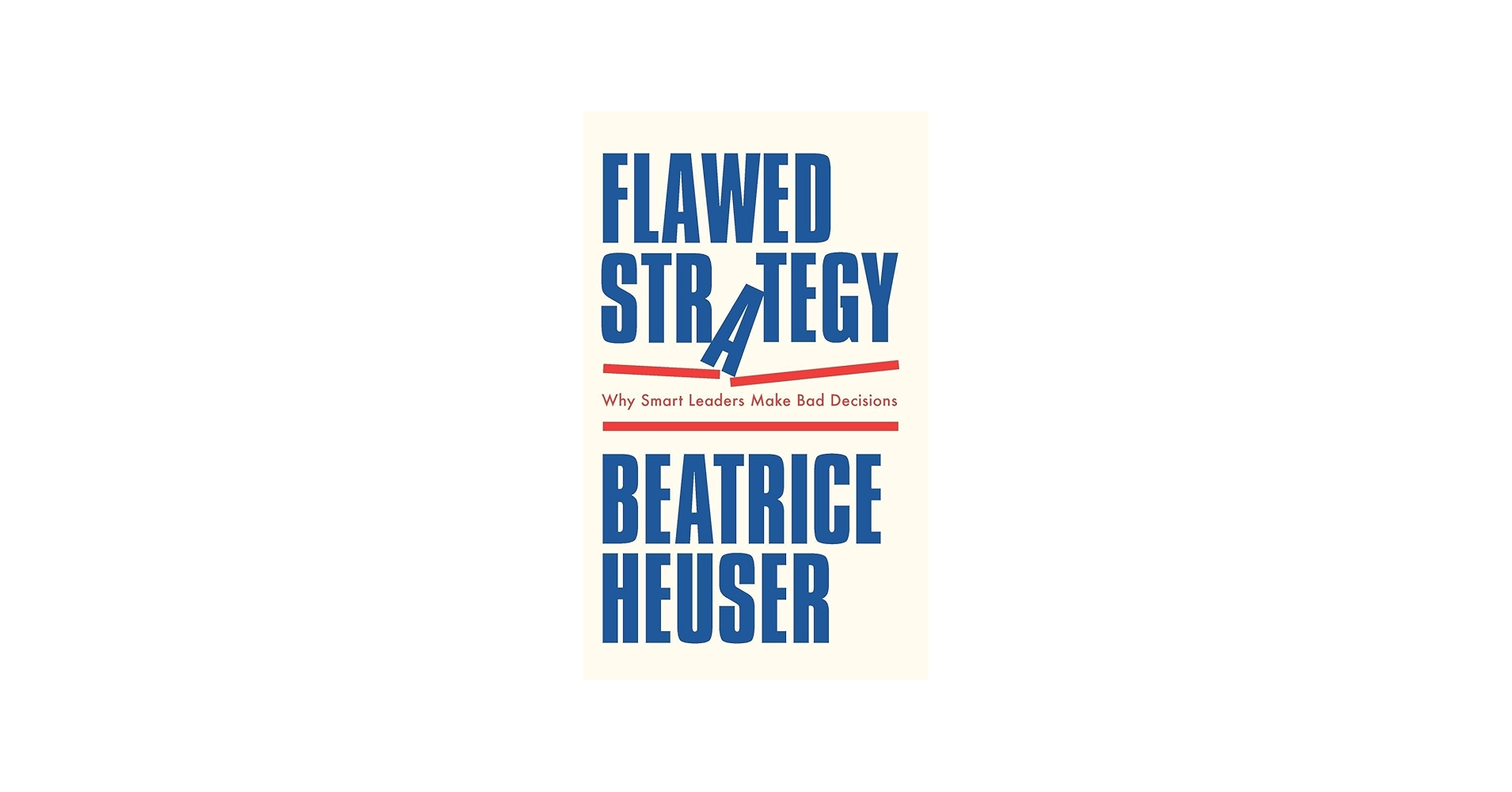

Flawed Strategy: Why Smart Leaders Make Bad Decisions. By Beatrice Heuser. Cambridge: Polity Press, 2025. ISBN-13: 9781509566709. pp. 208. $16.6.
The decision-making process in national security can feel like looking through a kaleidoscope. Every time you look through the mirrored tube, things have changed: there are new shapes, colors, and perspectives to consider. There is little that feels certain, everything is in flux, and options are plentiful. In Flawed Strategy, Beatrice Heuser, Distinguished Professor at the Free University of Brussels and Professor of Strategy at the General Staff Academy of the German armed forces, explains this conundrum by examining common biases and assumptions that explain why strategic decisions are so frequently ill-founded.
Heuser writes from a place of frustration, fed up with the perpetual churn of published academic papers that draw on international relations theory to purport monocausal explanations of complex events in international affairs. In the book, she seeks to discredit the rational actor model and instead demonstrate through historical examples the reasons it’s almost impossible to predict an adversary’s next move, much less craft a strategy to counter it. Heuser’s analysis offers valuable insights into strategy and decision-making that benefit both students and national security professionals alike. However, like the subject matter itself, the book can feel fragmented, leaving readers to synthesize much of the content themselves.
The book is divided into four chapters, each focusing on challenges to national security decision-making. Heuser includes a chapter on the “irrationality” of the rational actor model, common biases, the difficulty of assessing knowns and unknowns, and perennial quandaries of strategy making. Most useful to the reader is the epilogue, where she summarizes her arguments into guidance for decision-makers seeking to avoid common pitfalls in strategy formulation.
The rational actor model, which represents the focus of Heuser’s first chapter, presumes a common thought process that transcends time, culture, beliefs, and values. Heuser contends that unlike in classical economics, where there is a stronger basis for a simple cost-benefit prediction, the same is not true in international relations. Take, for example, Russia’s invasion of Ukraine in 2022. Despite the evidence that Russia was amassing troops at the border, and the United States declassifying intelligence proving their preparations, many remained skeptical that Russia would invade. The rationale was that it would be too costly for Russia to conduct a full-scale invasion, and – at least from a Western perspective – irrational. However, as Heuser argues, it is more prudent to first understand the beliefs and values of a state, then ask how they would act on them logically and coherently. Putin, in countless speeches, has clearly articulated his belief that Ukraine must be part of Russia; a keen analyst should have assumed that he would act in accordance with that belief.
While the book makes a compelling case for the flaws of the rational actor model, to use a colloquial phrase, she ‘throws the baby out with bath water.’ Heuser does not adequately dispel counterarguments to the utility of the rational actor model. She rejects the view of states as “black boxes.” While many realist scholars who subscribe to this view concede that the rational actor model may not explain the cause of a particular conflict, rather argue for its usefulness in explaining the recurrence of conflict throughout time in the international system. While Heuser does well to discuss the shortcomings of the rational actor model, she does not give enough credence to its usefulness as a framework for understanding meta-dynamics in international affairs.
Decision-makers are also subject to personal bias that can result in irrational beliefs. Heuser touches on a few of these biases in her second chapter, including confirmation bias and anchoring bias, common in psychology literature. More relevant to U.S. national security professionals today, she argues that Western decision-makers succumb to materialism bias – an overreliance on the material cost-benefit of an action. As a result, Western cultures underestimate the importance of ideology in some cultures, including “a willingness to make huge personal sacrifices for the sake of religion or the glory of a nation.” This assumption is clear in the example of Western analysis on Russia’s invasion of Ukraine, and it is instructive for U.S. analysts trying to predict China’s next move in light of its stated goal of “national rejuvenation.”
For all the book’s discussion on biases, ironically, Heuser succumbs to her own. While criticizing the political scientist’s use of the rational actor model, she over indexes on the use of historical examples, revealing her own proclivity as a trained historian. The result is a narrow analysis, over-saturated with historical examples, that at times obscures her argument and reduces the memorability of the book.
In her final two chapters, Heuser argues convincingly that there is a myriad of factors that make good analysis and decision-making in international affairs challenging. However, her analysis falls short by not contextualizing it within the concept of strategy itself. While her last chapter, Flaws and Quandaries of Strategy Making, provides a helpful accounting of the pressures of bureaucratic politics, organizational culture, and the impact of incentive structures on strategy formulation, the book does not contextualize the previous three chapters in the strategy-making process. The book is entitled “Flawed Strategy,” but Heuser does not deal directly with the oft-debated question: What is strategy? Or, how biases in decision-making relate to strategy formulation. This leaves the reader to synthesize many of the core themes for themselves.
Despite these omissions, Flawed Strategy provides a unique contribution to the field, drawing on literature from multiple disciplines and using historical examples to illuminate perennial challenges to decision-making and strategy. The book will provoke the reader to examine how biases and faulty assumptions may be impeding their work. Heuser’s book is accessible to a large audience and would be especially useful as course content for students of international relations. More experienced national security professionals may find that this book is of little value, explaining in too many words the reality they already know to be true of decision-making. For younger scholars of strategy, this book offers practical insights, equipping them with valuable guidance to help avoid the missteps that contributed to the flaws of the past.


