Operational Exposure in the Age of Attribution: GRU Lessons for Digital Force Protection
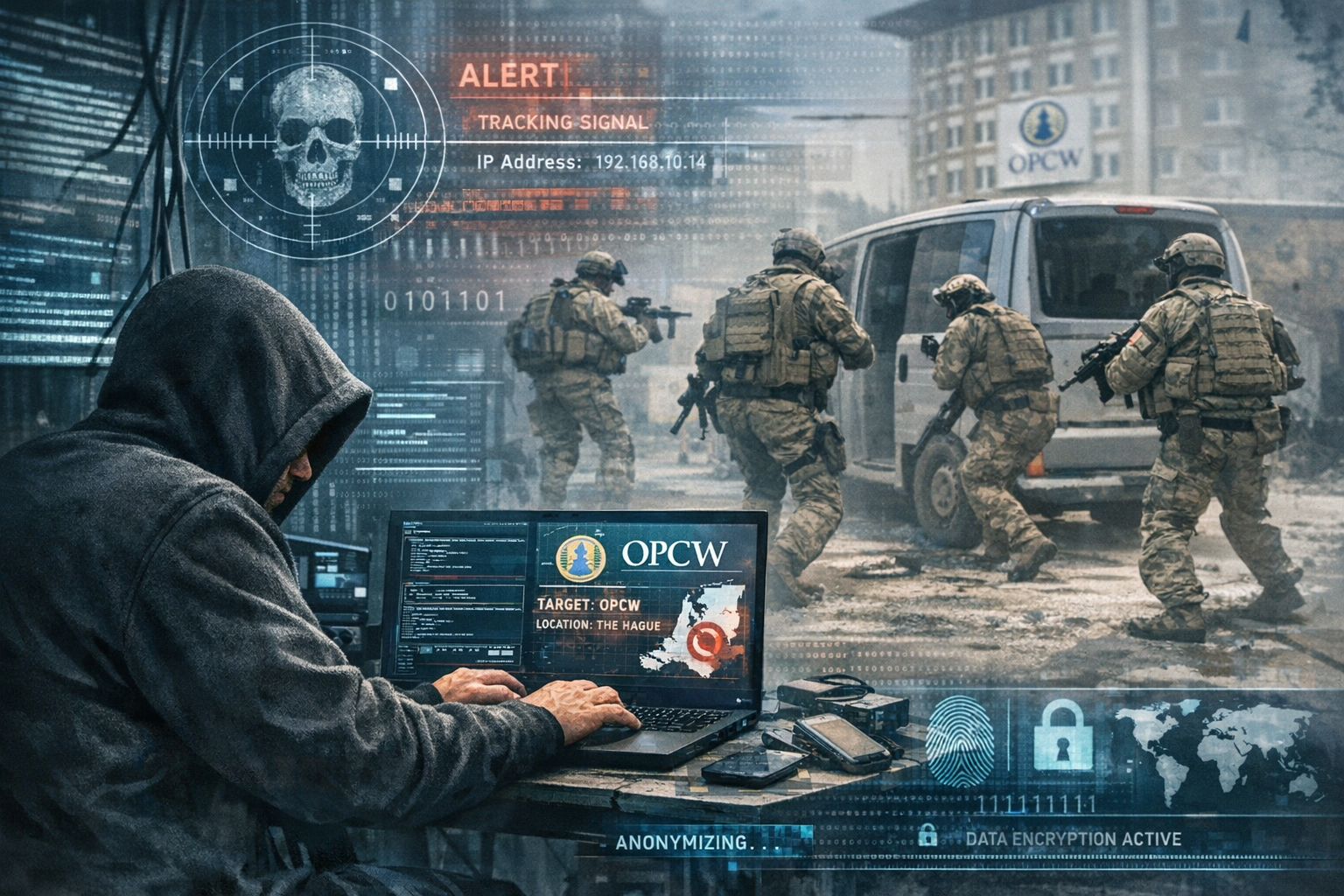

Building on previous signature reduction pieces, this article examines digital force protection as the operational expression of signature reduction doctrine under ubiquitous technical surveillance (UTS). Using the failed GRU intrusion against the Organization for the Prohibition of Chemical Weapons as a case study, it highlights how adversary tradecraft exposes persistent vulnerabilities across digital vectors. The article argues that counteroffensive digital force protection preserves SOF freedom of maneuver, reduces attribution risk, and extends survivability by shaping digital observability before and during deployment.
The Wrong Lesson From The Hague
When Dutch security services detained four Russian intelligence officers in The Hague in 2018, they uncovered a rental car filled with burner phones and close-access hacking equipment. Two human intelligence specialists and two cyber operators had been conducting reconnaissance against the Organization for the Prohibition of Chemical Weapons (OPCW). Dutch authorities had identified them as officers of Russia’s military intelligence agency (GRU) upon arrival in Amsterdam and documented their movements for days. Arrested, publicly exposed, and expelled, the officers of GRU Unit 26165 appeared almost amateur. But the operation did not fail because they lacked technical skill – it failed because they were observable.
The GRU’s 2018 setback demonstrates that in an era of ubiquitous technical surveillance (UTS), operational success depends less on capability than on signature management. Dutch counterintelligence was competent, but the decisive outcome was due not to Dutch brilliance but rather Russian omission. In the age of attribution, failure begins before the operation starts: in the poor cyber hygiene, the unmanaged travel pattern, and the digital footprints left behind. Tradecraft that might once have sufficed proved inadequate in an environment where aggregation begets attribution.
For special operations forces (SOF) seeking freedom of action within a commercial surveillance economy, the wrong lesson is that the GRU failed because it was sloppy. The pressing lesson is that operators are observable by default well before they reach the operational area. The age of attribution necessitates renewed digital force protection, understood not as a series of reactive operational security measures but as a counteroffensive tool for maneuver.
The OPCW and Operational Exposure
The Russians operatives arrived in The Hague ready to obtain access to OPCW networks. The OPCW had recently identified the highly toxic nerve agent weaponized by the Russians in a failed assassination attempt against a defector and his daughter seeking asylum in the UK, and was also investigating claims of Russian chemical warfare in Syria. Everything was in place when the GRU officers had filled the trunk of a rental car with hacking equipment and parked within range of the OPCW. They already had plans for their next target in neighboring Switzerland once this mission was completed. What went right ought not to be overlooked: the Russians traveled under protected diplomatic status and looked the part. Their hotel was adjacent to their target, offering them plausible movement throughout the area. They displayed adequate security awareness by removing trash from their hotel rooms. Necessary equipment was purchased with large reserves of cash in either dollars or euros. Reconnaissance of the target and its surroundings occurred gradually and incrementally over a several days period. Hacking equipment was visually concealed within the trunk of the rental car, which was parked at the hotel where they were staying. No overtly military-grade equipment was present, as they relied strictly on commercially available technology. When Dutch counterintelligence approached to make their arrests, the Russians attempted to physically destroy their devices.
From a technical perspective, the team was well-versed in close-access hacking operations and had remote reconnaissance support in Moscow. According to a Department of Justice indictment, the same cyber operators had previously traveled to Rio de Janeiro, Brazil, and Lausanne, Switzerland, to breach their WiFi networks without getting caught. The Russians had demonstrated adequate tradecraft and technical operational capability up to this point. But what had worked in previous operations failed at the OPCW. What failed was not necessarily these hallmarks of operational security and tradecraft. Rather, the fundamental error was a failure to understand exposure in the digital domain. This failure demonstrates how quickly following those digital footprints unearths years-long operational foundations.
What followed the team’s arrest was not the exposure of a single failed operation but the unraveling of years of operational activity. The digital footprints the team left behind allowed investigators to correlate identities, movements, and operations across multiple countries. In the months following their arrest, what was publicly available through digital technology became a series of nails in the coffin of various indictments across the Dutch, British, and American governments of Russian gray zone warfare. What started as a failed hacking operation became a roadmap to broader GRU tradecraft.
What Failed: Signature Management Discipline
In the age of attribution, classified sources and methods remain necessary but are dwarfed by publicly available information, commercial surveillance, open source intelligence, and other core features of the digital domain. Operators require an understanding of how the physical and digital domains converge personally and operationally. The conditions of UTS aggregate and correlate data across online, electronic, visual-physical, travel, and financial vectors. Signature management is the discipline which exposes this hidden risk. In the case of the GRU, it was precisely what failed. The Russians could not have been saved by more operational or cyber security. Better encryption or access to alias personas were not lacking.
Rather, the failure was one of signature management discipline across the full operational lifecycle. The GRU officers arrived in Amsterdam with diplomatic passports, two of which were sequentially issued. They carried burner devices that were activated through the closest cell phone tower to the GRU barracks in Moscow. They used the same operational computers across operations, failing to wipe or reset them. Internet browser history was not cleared and revealed online reconnaissance of their next hacking targets. Names and addresses on rental car receipts correlated to known GRU locations in Russia. They carried a taxi receipt from a GRU site in Moscow to the airport. Operator names corresponded to GRU-affiliated addresses and automobile registration info in leaked Russian databases. Individually, these artifacts are risky but not necessarily compromising. Aggregated and correlated across vectors in the digital domain, however, they paint a compelling operational picture. Each of these artifacts corresponds to travel records, telecommunications metadata, and publicly accessible information that revealed the identity, operational history, and future operational plans of the individuals themselves. Further, they expose broader patterns regarding the GRU unit itself. The lesson is not simply that mistakes were made; it was that unmanaged digital signatures directly lead to inevitable attribution and exposure.
The SOF implication: Deployment Begins Before Movement
Digital force protection directly confronts UTS attribution risk through digital signature management. Rather than treating operational security as a pre-deployment checklist item, it treats digital signature management as a counteroffensive tool for maneuver in the digital domain. It arms operators to deliberately shape their observable presence across UTS vectors before operational activity begins. In this sense, digital force protection is the operational expression of signature reduction doctrine in the digital domain. To be an effective tool for maneuver, it must be proactive and occur prior to deployment or operational activity.
The GRU officers were operationally exposed before they ever accessed the OPCW networks. Likewise, SOF teams are observable before they ever depart home station. This applies to travel bookings to financial transactions to persistent device identifiers to family social media posts, and more. In a UTS environment, deployment begins with your data. SOF require digital force protection as maneuver under UTS conditions. These adjustments apply at home station but with operational consequences. Successful SOF teams would:
- Incorporate digital attribution risk into mission planning and analysis
- Assess adversary access to commercial surveillance data
- Consider correlation and attribution risk in movement planning
- Implement and practice individual and collective signature management
- Conduct pre-deployment signature shaping by auditing observable digital footprints, reducing predictable patterns
Attribution is the Decisive Contest
In gray zone warfare, the objective is not yet destruction but rather exposure of adversary capability. Attribution is the decisive contest, and the digital domain is the key terrain. Attribution enables legal indictments, provides diplomatic leverage, boosts narrative dominance, and degrades adversary credibility. The GRU’s operational defeat was primarily public exposure. GRU unit 26165 continues its technical operations to this day but now bearing this strategic defeat. Digital force protection, then, is not simply operational survivability in a UTS environment but directly enables strategic positioning.
Technical competency and a track record of relative operational successes founded on adequate tradecraft cannot compensate for the effects of data aggregation in the age of attribution. Maneuver here depends on reducing attribution risk across time and space. This implies a means by which to limit data aggregation in the first place. Digital force protection is the disciplined maneuver tool that effects this. Digital force protection manages signatures, and thus, observability in the digital domain. The Russians were not out-matched in tradecraft or technical capability – they were out-attributed following the aggregation of a long-unmanaged trail of digital footprints which inevitably gave way to their attribution, exposure, and strategic defeat. For SOF operating under persistent surveillance, digital force protection as a key for maneuver may determine not only operational success, but strategic outcomes as well.