Why Pakistan’s Once Little-Known Baloch Insurgency Now Matters in Washington

Introduction
In December 2025, Acting US Ambassador to Pakistan Natalie Baker announced in a video message that Washington had approved $1.25 billion in financing from the US Export–Import Bank for Pakistan’s Reko Diq copper-gold project in the country’s restive southwestern province of Balochistan. Pakistani and US officials welcomed the decision, hoping the financing would unlock up to $2 billion in US mining equipment exports and create an estimated 6,000 jobs in the US and 7,500 in Balochistan, Pakistan’s poorest province, but rich in minerals.
The announcement was a rare moment of optimism in US–Pakistan relations after years of mistrust, particularly following President Donald Trump’s accusations during his first term that Pakistan had given Washington “nothing but lies and deceit.” Relations between Islamabad and Washington have been strained since a US military raid on an al-Qa’ida compound in Abbottabad, 30 miles northeast of Islamabad, killed Osama bin Laden, America’s most wanted terrorist.
Signs of renewed engagement emerged during President Trump’s second tenure. In September, photographs circulated widely on social media showing Pakistan’s Prime Minister Shehbaz Sharif and Army Chief Field Marshal Syed Asim Munir presenting a wooden box containing rare earth mineral samples to President Trump at the White House. The images coincided with a series of memoranda of understanding between Pakistani and American firms. In September, Pakistan’s Frontier Works Organization, the country’s largest military-linked miner of critical minerals, signed a $500 million investment agreement with Missouri-based US Strategic Metals to explore collaboration, including the establishment of a polymetallic refinery. The deal happened weeks after Washington and Islamabad had reached a trade agreement to help develop Pakistan’s largely untapped oil reserves.
Many of these ambitious US-linked commercial and strategic initiatives are centered in Balochistan, a province that is hard-hit by a long-running violent separatist insurgency. That contradiction came into sharp focus on January 31, when the Baloch Liberation Army (BLA), designated by the United States as a Foreign Terrorist Organization and banned in Pakistan, launched a series of unprecedented, coordinated attacks across the province, including in areas rich in untapped mineral reserves where Washington has expressed growing investment interest. This was one of the most devastating coordinated campaigns in the two-decade-long Baloch insurgency that began in the early 2000s.
Pakistan’s military media wing, the Inter-Services Public Relations (ISPR), announced on February 5 that clearance operations had concluded. ISPR said 216 fighters were killed. The BLA disputed both the timeline and the toll, claiming its offensive continued until February 6 and involved more than 76 coordinated attacks across 14 locations. Washington strongly condemned the January 31 attacks that lasted for six days.
Violence broke out in a province central to Beijing’s $60 billion China–Pakistan Economic Corridor, part of the Belt and Road Initiative, as well as to Washington’s new efforts to challenge Beijing’s dominance in critical mineral supply chains.
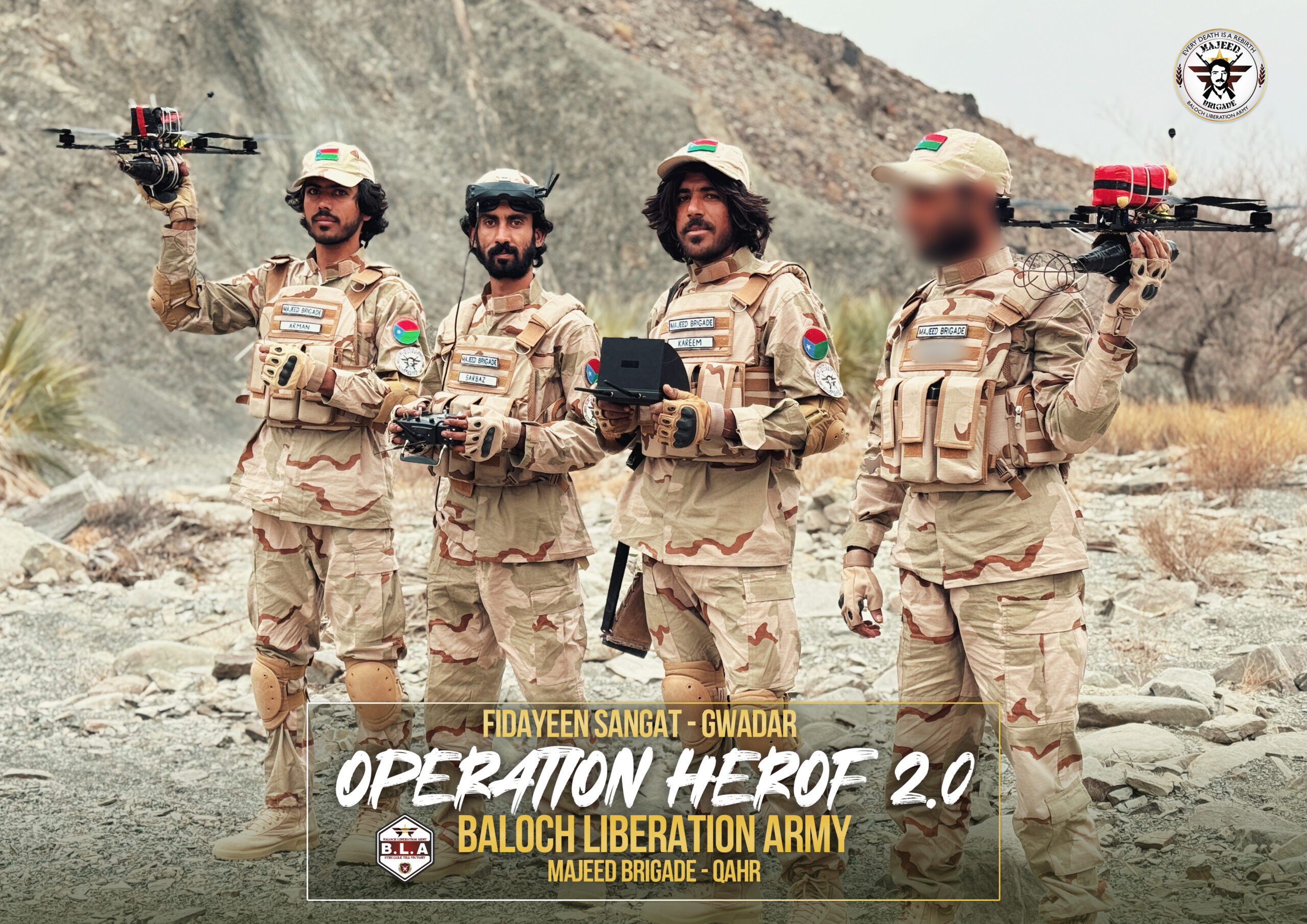
Balochistan is home to vast, untapped reserves of copper, gold, and rare earth minerals. Canada’s Barrick Mining Corporation has committed $7 billion to the Reko Diq project, and US policymakers see the province as strategically important. Despite growing global interest, an insurgency, once considered low-level, has intensified in scale, coordination, and lethality, especially after Baloch armed groups accessed abandoned US weapons following the fall of Kabul in 2021. The arsenal has included American-made M4 and M16 rifles, as well as other equipment left behind after years of conflict. BLA has called its latest campaign “Operation Herof 2,” or “Black Storm.” The operation, which began in August 2024, has now entered a new and dangerous phase, threatening not only Pakistan’s future economic ambitions but also wider US strategic interests in South Asia.
Diplomacy in Washington, Suicide Bombings in Balochistan
As violence erupted across Balochistan in early February, with insurgents clashing with Pakistani security forces in the mineral-rich province, Islamabad continued to lobby in Washington to invest in Balochistan’s mineral sector. On 3 February, Pakistan took part in the inaugural Critical Minerals Ministerial at the US Department of State, aiming to attract foreign investment and build strategic partnerships with the United States and other global firms in the minerals and energy sectors. While fighting continued in Balochistan, Pakistan’s Federal Minister for Energy, Ali Pervaiz Malik, was seen with senior US officials, including Vice President J.D. Vance, Secretary of State Marco Rubio, Senior Director for Global Supply Chains David Copley, and Under Secretary of State for Economic Affairs Jacob Helberg.
As Pakistani officials were promoting Balochistan’s vast mineral reserves as an investment opportunity for the United States, the BLA was busy intensifying its insurgency. The group said 93 of its fighters were killed during the offensive, including 50 fedayeen, militants prepared to carry out suicide attacks. This was a rare example in South Asia, and possibly beyond, where a separatist group deployed so many suicide attackers in a single campaign. The BLA supported its claims by releasing photographs, videos, and biographical details of those killed, including several women in their twenties, a married couple, an d a woman in her sixties.
No armed group in the region, including the Liberation Tigers of Tamil Eelam, the Kurdistan Workers’ Party, the East Turkestan independence movement, or Islamist organizations such as Tehreek-e-Taliban Pakistan and the Afghan Taliban, has previously mounted a campaign with so many suicide attackers at once. This was an unprecedented shift in BLA’s tactics and organizational capacity, which reveals both increased manpower and a move from hit-and-run attacks in rural areas to coordinated suicide operations in urban centers and economically and geopolitically important locations. Pakistan’s inability to contain the BLA will have growing implications not only for its own stability, but also for US interests in critical minerals, supply chain security, and the safety of American investments in a region where violence now challenges Washington’s strategic objectives.
Conflict at the Crossroads of Global Interests
BLA’s latest offensive deliberately targeted locations tied to major international economic and geopolitical interests. Among the fourteen areas attacked were Gwadar, Pakistan’s emerging port city and the heart of the China-Pakistan Economic Corridor (CPEC); Dalbandin, the district headquarters of Chagai; and the Reko Diq mining site, home to an estimated $60 billion copper and gold reserves. These sites sit at the crossroads of China’s Belt and Road Initiative and emerging US efforts to diversify global critical mineral supply chains.
Islamabad has actively engaged Western governments, particularly the United States, by offering access to Pakistan’s critical and rare earth mineral reserves, but militants with American made weaponry stand in the way.
Against this backdrop, the BLA chose to launch suicide attacks and armed assaults in and around these strategic sites. The impact was immediate. Following the January 31 attacks, Reuters reported that Barrick Gold CEO Mark Bristow stated the company’s board was reviewing all aspects of its Balochistan projects due to serious security concerns.
For the BLA, creating uncertainty among foreign investors and drawing international attention serves its strategic goal. For Pakistan, the attacks amount a deeper failure: the inability to contain a long-running insurgency, even in areas considered vital to the country’s economic future. For more than two decades, Islamabad has relied mainly on military force to address the Baloch conflict. The latest wave of violence suggests that this approach has not only failed but has also contributed to the rise of a more lethal, organized and ideologically driven militant movement, one that threatens Pakistan’s internal security as well as Washington’s geostrategic interests.
Successive Pakistani governments have attributed unrest in Balochistan to a range of internal and external forces. Officials initially blamed tribal chieftains, and later accused foreign involvement, particularly Afghanistan and India. Over time, the list grew to include Iran, Israel, and, more discreetly, the United Arab Emirates. Islamabad has never formally accused Abu Dhabi, given Pakistan’s financial reliance on Emirates, but pro-government commentators and journalists have often made such claims. As one Baloch politician stated wryly, if Baloch armed groups received financial support from the UAE and technological or lobbying help from Israel, the conflict with Pakistan “would have ended within days.”
The CPEC Paradox
When the CPEC was launched in 2015, officials widely promoted it as a potential economic game-changer, promising major infrastructure projects, greater connectivity, and the transformation of Gwadar from a remote, impoverished port into a regional hub competing with Singapore, Dubai, or Shenzhen. However, many of these promises have yet to materialize.
In the years after CPEC’s launch in 2015, Islamabad reduced avenues for political engagement and dialogue with disgruntled Baloch youth and nationalist leaders. Authorities increasingly adopted a hardline security approach and started viewing the Baloch conflict as an external conspiracy against CPEC rather than an internal conflict. Security operations intensified, and allegations of enforced disappearances and extrajudicial killings saw a dramatic uptick, with missing youths later branded as insurgents killed and dumped in deserts in “fake encounters”.
In March 2018, a political party called Balochistan Awami Party (BAP) was formed overnight and brought to power in elections that July, a move widely seen as an effort to shape political narratives rather than address underlying grievances. The party, composed largely of politicians allied with the military, struggled to secure broad public support. Elections in 2024 were again reportedly manipulated, which further deepened political alienation and fueled resentment among Baloch youth. Many now oppose not only Pakistan, but all forms of foreign investment, including from the United States. For years, secular Baloch nationalists viewed the West, particularly the US, as an ideological ally, but now see Washington as an oppressor, much as they do Beijing and have switched to suicide bombing against the US and western interests.
The Evolution of the BLA’s Suicide Strategy
BLA, a secular ethno-nationalist militant group, historically avoided suicide bombings. Its first such attack occurred in December 2011 in Quetta, killing 13 people and injuring six. The BLA’s suicide wing, the Majeed Brigade, claimed responsibility.
The brigade is named after Majeed Langov, who died in 1974 while attempting to assassinate Prime Minister Zulfikar Ali Bhutto during a period of intense military operations in Balochistan, following the dismissal of the elected provincial government of nationalists and leftists National Awami Party (NAP). Armed only with an old Russian hand grenade, Langov was killed when it detonated prematurely.
Following the 2011 bombing, the group suspended suicide attacks amid internal debate over their legitimacy and effectiveness. That discipline ended in August 2018, when the BLA resumed suicide operations. This set the stage for the far more expansive and coordinated campaign witnessed today.
Leadership Choices and the Escalation of Militancy
BLA commander-in-chief Aslam Baloch, also known as Aslam Achu or Ustad Aslam, set a defining precedent in 2018 when he dispatched his 22-year-old son, Rehan Baloch, on a suicide mission targeting a convoy of Chinese engineers in the mineral-rich Dalbandin region. The act was widely glorified within militant circles and became a powerful recruitment symbol, motivating other young Baloch to volunteer for suicide operations.
Three months later, in November 2018, BLA militants attempted a suicide attack on the Chinese consulate in Karachi. Although the attackers were killed at a security checkpoint, the BLA claimed responsibility, explicitly framing China as an “oppressor” alongside Pakistani security forces. Aslam Baloch, who commanded both operations, was killed in a blast in Afghanistan’s Kandahar province in December 2018.
Pakistani authorities initially assumed his death would weaken the insurgency. Instead, the movement escalated. Leadership passed to Bashir Zaib, a former student turned guerrilla from the Nushki district, under whom the BLA adopted more aggressive tactics, including the operational induction of women.
That shift took an uglier turn in April 2022, when Shari Baloch carried out a suicide attack targeting Chinese instructors affiliated with the Confucius Institute in Karachi. In its statement, the BLA framed the institute as a symbol of China’s economic and cultural expansionism. The attack, carried out by a highly educated woman from with a well-off background, drew international attention and proved a powerful mobilizing tool for the insurgency.
State Repression and the Radicalization Pipeline
Pakistan’s ethnic Baloch minorities have expressed grievances and aspirations for independence since 1948. The previous four insurgencies dissipated relatively quickly, constrained by weak leadership, limited geographic reach, insufficient military training, and inadequate access to advanced weaponry. However, following the fall of Kabul, a large quantities of US-made arms fell in their hands through black market. Some of these weapons have reportedly reached Baloch militant groups.
Analysts also link the insurgency’s expanding capabilities to political and security developments since 2018. That year’s elections in Balochistan faced widespread criticism for alleged manipulation, narrowing political space as the province became increasingly militarized. Pakistan’s Counter Terrorism Department (CTD) received expanded powers and has been accused by human rights groups of enforced disappearances and extrajudicial killings of Baloch youth.
Public anger sharply grew in 2020 after tragic murder of Hayat Baloch, a university student, shot dead by paramilitary Frontier Corps in front of his ailing parents in Turbat. Earlier that year, the killing of Malik Naz, a young Baloch woman allegedly by men linked to state-backed militias, further inflamed tensions.
Resentment grew again in 2023 during protests led by Haq Do Tehreek as part of a mass civil rights movement calling for basic services and economic rights for Gwadar residents. Authorities responded with arrests and harsh crackdowns.
In November 2023, the custodial death of Balach Mola Baksh, a Baloch youth arrested, brought before an anti-terrorism court, and later killed in a fake security encounter, sparked province-wide protests.
Dr. Mahrang Baloch, a physician and activist recognized by BBC 100 Women and Time 100 Next, later emerged as a prominent non-violent advocate for Baloch rights. She organized massive demonstrations in Islamabad and Gwadar. In Gwadar security forces opened fire on non-violent protesters in July 2024, killing two people and detaining scores. Her arrest in March 2025 under maintenance of public order (3MPO) has, according to analysts, further radicalized segments of Baloch youth and accelerated recruitment into armed groups.
Conclusion
The scale and coordination of BLA’s latest offensive is a dramatic shift in Pakistan’s long-running Baloch insurgency. What Islamabad once viewed as a low-level insurgency has evolved into a more organized, geographically dispersed, and ideologically hardened movement that threatens Pakistan’s internal security and foreign investment. The BLA’s ability to strike multiple urban centers and mobilize younger, middle-class educated men and women suggests a protracted conflict rather than a temporary security challenge.
For the United States, this escalation is important. Balochistan lies at the heart of several US economic ventures, including competition with China over critical mineral supply chains. Pakistan’s continued reliance on military tactics and crackdowns on non-violent movements has repeatedly failed to stabilize the province and has instead broadened the insurgency. While military operations may temporarily disrupt militant networks, they cannot address the underlying grievances that fuel militancy.
For Washington’s economic and strategic engagement in Balochistan to succeed, it will depend less on security guarantees and more on Pakistan’s willingness to pursue political reconciliation with the Baloch. Achieving lasting stability will require reopening political space, addressing human rights concerns, and ensuring that large-scale mineral and infrastructure projects deliver tangible benefits to locals. Without such changes, Balochistan is likely to remain a source of instability, threatening both Pakistan’s economic ambitions and the US’s strategic interests in the region.