Oil Revenues as the IRGC’s Center of Gravity: The Case for Strikes on Kharg

Abstract
The April 7 ceasefire follows extraordinary U.S.-Israeli-coalition military results but leaves the IRGC’s true center of gravity untouched: its commercial empire. This analysis argues that compelling the IRGC to accept the administration’s core terms requires economic pressure on that empire — specifically, Kharg Island’s oil export infrastructure, the mechanism through which 190,000 personnel are paid and the entire enterprise is funded.
The IRGC is not primarily an ideological force. It is a commercial empire and Kharg Island oil infrastructure serves as its direct payroll mechanism. Washington has struck Kharg’s weapons. It has not touched Kharg’s wallet. Iran’s most recent defense budget allocated over half of oil export revenues to the armed forces and security institutions, with the IRGC receiving the largest share. Kharg Island proves the perfect opportunity for Schellingian compellence: a credible escalation ladder starting with Kharg Island and ending, if necessary, in multinational maritime control of the strait. Such an approach requires none of the casualties and political risks that have complicated previous American military engagements in the region. Paired with an explicit transactional offer, targeting Kharg and ultimately the Strait if necessary, creates the conditions for a settlement on terms reflecting coalition military dominance.
A two-week ceasefire brokered by Pakistan on April 7 has opened an extended negotiating window. However, Iran’s official statement claimed “continued Iranian control over the Strait of Hormuz,” confirming the IRGC’s endurance strategy remains intact. The IRGC must be compelled to accept the core U.S. terms during this window. The compellence ladder described here is the enforcement architecture of the diplomatic phase, not a relic of the kinetic one. Building on the author’s prior Small Wars Journal (SWJ) analysis, “Iran in the Box,” this piece argues that the leverage exists, the supply-side mitigation is in place, and the compellence ladder must remain credible and visible throughout the negotiating window if any settlement is to reflect coalition military dominance rather than IRGC endurance.
Following the most intensive American and Israeli air campaign since the Iraq War, President Trump declared victory. The military results of Operations Epic Fury and Roaring Lion largely justify the claim — Iran’s nuclear infrastructure has been severely degraded, its navy decimated, and its proxy network significantly disrupted. What follows is the strategic architecture for how this ends — and why the moment to deploy it remains now.
The Strait of Hormuz remains effectively closed, at least until the April 7 truce terms are implemented. Iran’s parliament has codified its toll regime into law, charging ships $2 million per transit and banning U.S. and Israeli vessels permanently. Gas prices have surged sharply since the campaign began. Iran’s acceptance on April 7 of a temporary ceasefire under terms that reject the 15-point US plan confirms the IRGC’s calculation in real time: Time favors resistance, and no military pressure applied so far has changed that assessment. Crushing a military is not the same as changing a calculation.
The missing piece is not military. It is economic.
A negotiated outcome, not Iranian capitulation, is the realistic destination. The only question is whether we arrive on terms that reflect weeks of American and Israeli military dominance — or on terms Iran’s parliament is busy writing for us.
Understanding why requires understanding what the IRGC actually is. Reuters called it a “state-within-a-state.” Analysts at Clingendael calculate IRGC-affiliated enterprises account for more than half of Iran’s GDP — though the opacity of IRGC ownership structures makes precise measurement difficult. The IRGC controls oil, construction, banking, telecommunications, ports, and Tehran’s international airport. It does not fight to export revolution; it fights to protect a network worth hundreds of billions of dollars whose value collapses if Kharg stops flowing. China’s continued willingness to absorb Iranian crude at a discount is what currently allows the IRGC to believe time remains on its side — and what makes Kharg the pressure point that changes that calculation.
Although ideology matters, the IRGC has repeatedly demonstrated pragmatic behavior when institutional survival is threatened — negotiating secretly during Iran-Contra, tolerating sanctions workarounds, building a vast patronage economy. It behaves less like an apocalyptic movement than a regime elite with assets to protect.
The de facto leader Washington is negotiating with, parliamentary speaker Mohammad Baqer Qalibaf, is not an ayatollah. He is a builder — commander of Khatam al-Anbiya, the IRGC’s engineering conglomerate, then Tehran’s mayor for twelve years. New IRGC commander Ahmad Vahidi participated in covert contacts with Reagan administration intermediaries linked to Iran-Contra, secretly negotiating with Washington while publicly denouncing it. These men understand that public posture and private calculation are different things — as Iran demonstrated when it accepted the Joint Comprehensive Plan of Action (JCPOA) limits on enrichment in 2015 while simultaneously expanding its regional proxy network. The conditions for a deal exist again — at the right price. The right price runs through Kharg Island.
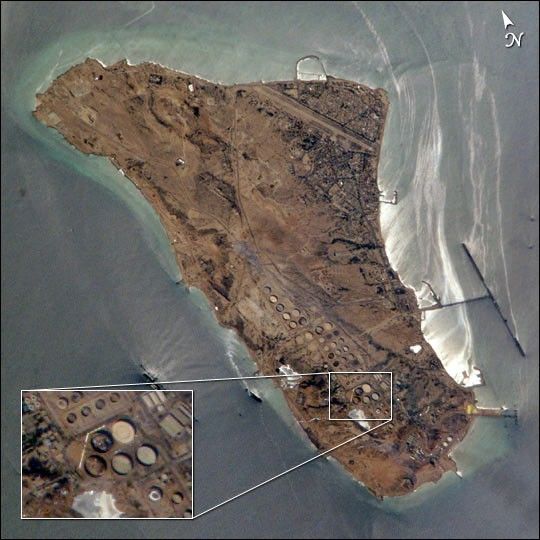
Kharg is a small coral island twenty miles off Iran’s coast, handling 90 percent of its crude exports — approximately 1.5 million barrels per day. Iran’s most recent defense budget allocated over half of its oil export revenues to the armed forces and security institutions, with the IRGC receiving the largest share. It is the mechanism through which 190,000 personnel are paid, and the enterprise is funded.
This matters because what Washington has struck on Kharg and what it has deliberately spared are categorically different assets. A CENTCOM large-scale precision strike destroyed naval and air defense infrastructure — the military assets Iran uses to threaten shipping. More than 90 military targets were struck. Left untouched: the 55 crude oil storage tanks, the loading terminals, and the subsea pipelines to Iran’s mainland oil fields. Washington has struck Kharg’s weapons. It has not touched Kharg’s wallet. Those are not the same target. The second target is the one that matters. Israel has since struck steel factories and petrochemical facilities — assets that brought an estimated $18 billion to the IRGC in the past two years — but the oil export terminal that funds the entire enterprise remains deliberately untouched.
The standard objection — that striking Kharg sends oil to $200 a barrel — rests on a conflation of two separate problems. Iran exports approximately 1.5 million barrels per day through Kharg — roughly 8 percent of normal Hormuz flows. Saudi Arabia alone holds more than two million barrels per day of spare capacity. A coordinated GCC production surge, announced simultaneously with any Kharg action, fully replaces the Iran-specific shortfall. What no combination of bypass infrastructure, GCC production, or U.S. output can do is replace the broader Hormuz closure affecting 20 million barrels per day. The IEA estimates bypass pipelines cover 13 to 28 percent of normal flows. Washington should pull the Kharg lever, knowing broader Hormuz pain continues — that combination of pressures is what makes a negotiated outcome increasingly likely.
The strategic architecture is Schellingian compellence: a credible escalation ladder, each rung more costly than the last, each leaving Iran a rational off-ramp.
The first rung is a surgical demonstration strike on Kharg oil infrastructure — justified by the Iranian budget’s direct allocation of oil revenues to IRGC military operations. Any such strike requires rigorous Law of Armed Conflict review — but Kharg’s oil export terminals have a direct, documented nexus to IRGC military funding, making them a dual-use military objective rather than purely civilian infrastructure. The target sequence is calibrated by repair timeline: loading equipment repaired in days to weeks; offshore terminals requiring weeks to months under sanctions; storage tanks requiring months; the subsea pipeline network — repair timeline months to over a year. At each stage, the offer remains open. At each stage, the cost of refusal compounds. This is not escalation for its own sake. It is compellence with a ledger. Within the ceasefire negotiating window, a calibrated demonstration strike on Kharg’s loading equipment serves as the immediate enforcement mechanism for any material deviation from agreed terms — against an IRGC whose navy is decimated, air defenses destroyed, and nuclear infrastructure severely degraded.
If Iran still refuses, the second rung is full Kharg interdiction. Within weeks, the IRGC’s revenue mechanism would face severe and potentially terminal pressure. Iran holds approximately 200 million barrels of crude on tankers near China — roughly five months of supply — but new production with nowhere to go shuts in within 30 to 60 days, and the IRGC’s domestic patronage network begins to fracture.
If Iran still refuses to keep the strait open under the terms of the truce, the third rung is coalition tanker escort — the United States, GCC partners, European allies, and Asian importers forming a coalition to prevent the IRGC from violating the April 7 truce and escort tankers through the strait. The Dallas Federal Reserve models a sustained closure, cutting global GDP by 2.9 percentage points annualized; at that level of pain, coalition formation is an economic necessity, not diplomacy. Coalition tanker escort requires no ground invasion and none of the casualties and political risks that have complicated previous American military engagements in the region. It is a maritime enforcement operation with clear precedent — the United States escorted Kuwaiti tankers through these same waters under Operation Earnest Will in 1987.
If Iran fires on multinational coalition escorts, the fourth and final rung is multinational maritime control of the strait — requiring no permanent occupation of Iranian territory, only control of a 21-mile passage. An organization that fires on Chinese, Indian, and Japanese naval vessels simultaneously has placed itself in an untenable strategic position from which no deal can rescue it.
This is game theory with a credible escalation ladder. Schelling taught that compellence requires not just capability but credibility — the adversary must believe each rung will be climbed if necessary. An organization whose institutional survival depends on that commercial empire does not sacrifice it indefinitely for the right to charge ships a $2 million toll and call it victory. The deal is the only rung where Iran preserves anything.
Iran’s state television has already declared the United States “forced to accept” its April 7 ceasefire terms. This is the self-assessed victory narrative of an institution whose commercial foundations survived the air campaign. Washington does not need Iran to admit defeat. It needs Iran to comply. Any material deviation from agreed terms must trigger immediate movement to the next rung without negotiation or warning. A single unanswered infraction resets the endurance calculation to zero.
Washington must be precise about what it requires. The ceasefire framework does not reflect the core U.S. demands that Witkoff and Kushner presented through Pakistan. Iran’s counterproposal omits each of Washington’s core demands while adding conditions Washington cannot accept — reparations, sanctions removal, Iranian toll authority over Hormuz, and continued nuclear enrichment. The non-negotiable terms are clear: verified nuclear dismantlement with full IAEA access; no reconstitution of ballistic missile or drone production; end to IRGC funding and direction of proxy forces; unconditional Hormuz passage without tolls or coordination requirements; cessation of the death-to-America-and-Israel posture; and an immediate end to executions and lethal force against protesters. In exchange, sanctions relief, Kharg restored, strikes ended, and normalized relations. These are not opening positions. They are the conditions the compellence ladder enforces.
Washington is not negotiating with Iran’s civilian government. It is negotiating with the IRGC’s institutional leadership. With Supreme Leader Mojtaba Khamenei reportedly incapacitated, a de facto coup has placed IRGC commander Vahidi and his colleagues in operational control — the same men who blocked President Pezeshkian from the negotiations because he would give up too much. Washington is negotiating with what the IRGC has always been: a self-preserving commercial empire that has captured the Iranian state and operates it as a personal investment fund, divorced from the Iranian people and from any interest beyond institutional survival and the perpetuation of its own wealth. The wallet threat is the main instrument that reaches this adversary. The IRGC will comply when Kharg’s revenues are at risk. It will not comply because Pezeshkian asked it to.
The campaign declared the IRGC crushed — militarily, and that assessment was not wrong. But military dominance and changed calculations are different things. The IRGC’s endurance strategy survived thirty-eight days of strikes with its commercial foundations intact. A temporary truce to negotiate comprehensive terms is not a concession — it is the moment the compellence architecture described here becomes most critical. Washington must enter the negotiating window with Kharg’s wallet visibly threatened, GCC spare capacity coordination publicly announced, and the escalation ladder intact and credible at every rung. The ladder must not be dismantled as a goodwill gesture. It is the only instrument that gives the IRGC a cost-benefit reason to comply with whatever is agreed, rather than simply using the pause to reconstitute.
The IRGC has a price. The leverage exists. The supply-side mitigation is ready. The compellence ladder remains available, executable, and necessary. The question is whether Washington keeps it visibly loaded throughout the two-week negotiating window that commenced April 7 and beyond — or discovers, when the window closes, that the IRGC’s endurance strategy survived the truce as it survived the air campaign.