





The Erosion of Distinction: Participatory Warfare in Ukraine and Its Implications for International Humanitarian Law
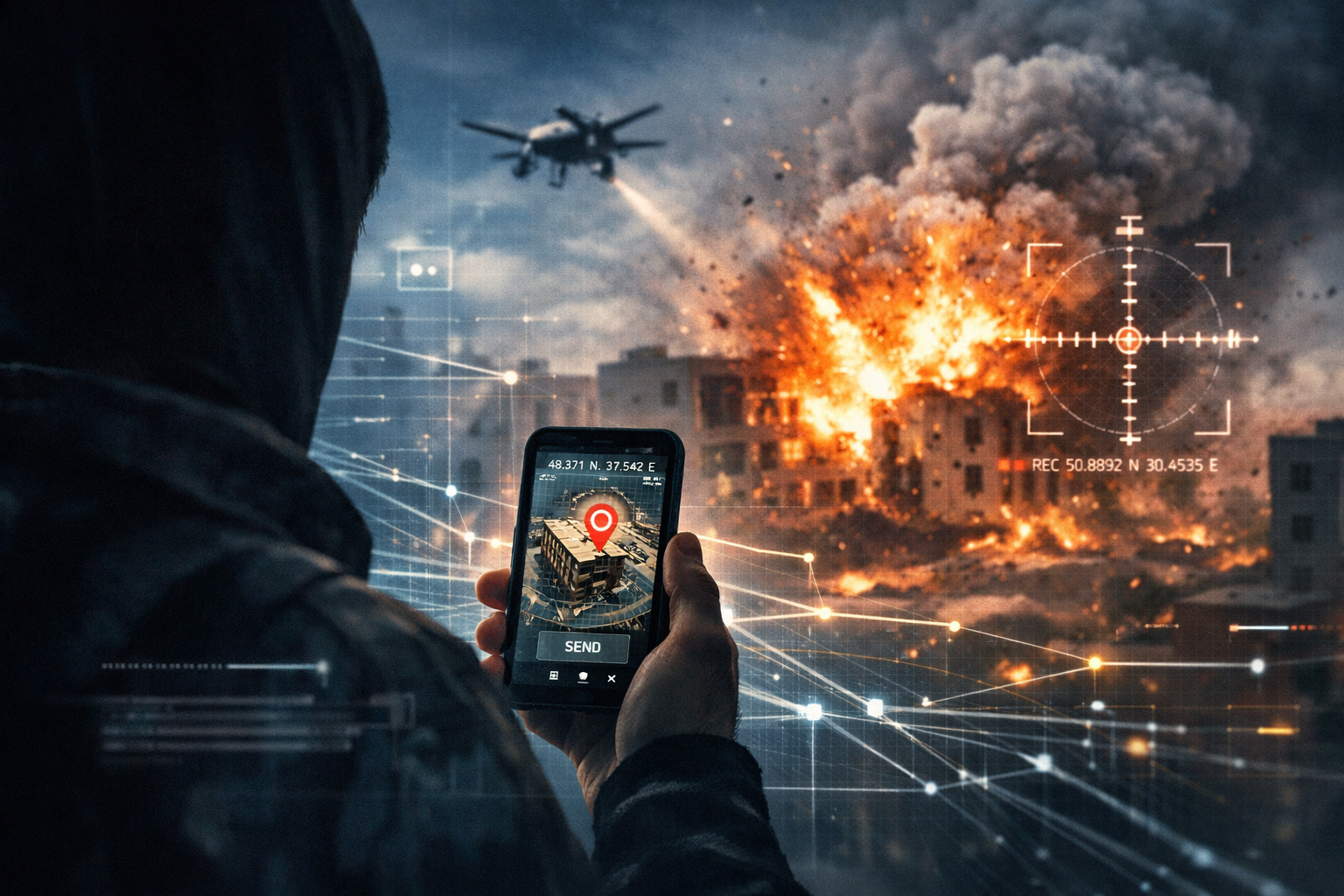

The “crowdsourced” and “networked” nature of Ukraine’s war against Russia has received significant attention, but its most explosive implication has not yet been confronted: it collides with the architecture of international humanitarian law by eroding one of its core principles –the distinction between civilians and combatants.
Ukraine’s participatory warfare model is not just innovative; it is quietly rewriting who can be killed, when, and why under the law of armed conflict. It also shows that modern conflicts are outpacing the existing international humanitarian law doctrine, designed for more traditional wars.
Consequently, without sharper definitions and updated legal frameworks, governments encouraging participatory defense models will either risk lawfully placing their population in the crosshairs or handing their adversaries a ready-made excuse for atrocities.
Introduction
Somewhere in Russian-occupied Ukraine, a citizen spots a Russian armored vehicle concealed inside a building. He then pulls out his smartphone and reports the location and description of the target to eVorog, a government chatbot available on Telegram. In just a few minutes, artillery shells rain on the building, destroying the vehicle.
This fictional scene illustrates the latest development in a model of participatory warfare that has reached an unprecedented level in the Russo-Ukrainian conflict. This model, although efficient, blurs the civilian–combatant distinction and exposes civilians to heightened risks on a scale that existing international humanitarian law (IHL) frameworks struggle to regulate.
Ukraine’s participatory warfare case study
In early 2014, when war between the Ukrainian government and pro-Russian separatist militias backed by Moscow broke out, Ukraine’s armed forces were in shambles. From the early days of the conflict, many civilians volunteered to help the country’s military.
Since then, and increasingly since Russia started its full-scale invasion in February 2022, the cooperation between the military and the civilian population and the fast public-private technological innovation in the defense sector have been two of the most notable features of Ukraine’s war effort. And also two of the key reasons for its survival.
For the purpose of this analysis, the term “participatory warfare” will be defined as a new model of national defense based on the direct, organized, digitally mediated, and state-enabled involvement of civilians in activities supporting the military effort. In Ukraine’s case, this involvement can be classified into four primary categories: civil-military cooperation in technological innovation, the crowdfunding of the defense budget, the mobilization of volunteers in the cyber domain, and the use of the civilian population as a battlefield sensor network.
Civil-military technological cooperation
The Armed Forces of Ukraine (AFU) and the country’s defense industrial base work together seamlessly. This collaboration includes volunteer-based NGOs, such as Aerorozvidka, which developed the Delta battle management system; Murashky, which provides food and supplies for the military; and UA Drone Group, which produces attack drones for the AFU.
It also includes defense tech startups that keep direct contact with the units fighting on the frontline through Brave1. This initiative, launched in April 2023, seeks to help the AFU by creating a unified coordination platform and technology cluster that provides organizational, informational, and financial support for defense technology projects that meet the real needs of combat units.
Crowdfunding of the defense effort
Another crucial factor for the survival of Ukraine has been the collection of capital from both national and foreign donors. This has taken the form of a genuine crowdfunding of the nation’s defense budget, carried out through both public and private fundraising initiatives such as United24, a personal initiative of Ukrainian President Volodymyr Zelenskyy, or civilian platforms dedicated to raising funds for purchasing and delivering supplies and drones to the AFU, such as Army of Drones or Stand for Ukraine.
To date, United 24 alone has raised more than $3.5 billion in donations from around the world. The highly decentralized nature of crowdfunding platforms makes pinning down a precise aggregate amount almost impossible. However, some initiatives have raised over a billion dollars on their own.
Mobilization of cyber volunteers
Ukraine’s adoption of a participatory warfare model is represented in cyberspace by the IT Army of Ukraine. This group is a “hybrid construct that is neither civilian nor military, neither public nor private.” It includes both national and foreign civilian volunteers and military and intelligence personnel from the AFU, who are assigned to conduct more complex attack operations.
Hacktivists within the IT Army of Ukraine generally target the websites of Russian regional telecommunications companies, banks, and state-owned energy companies. Since 2024, it also supports drone attacks against Russian refineries by disabling CCTV systems, hindering the Russian response.
To execute these attacks, volunteers just need to download the IT Army Kit, a set of user-friendly, plug-and-play DDoS (distributed denial of service) tools available on the organization’s Telegram channel. Additionally, at the onset of the invasion, the IT Army of Ukraine and the LvivIT technology cluster partnered to develop Play for Ukraine, a browser-based game designed to launch DDoS attacks against Russian websites.
This game, which was available from February to June 2022, was a modified version of the popular 2048 puzzle in which each hour of gameplay resulted in approximately 20,000 requests being sent to target sites. Users didn’t know either which sites were being attacked, or when the attack really began.
Civilians as battlefield sensors
There are many historical examples of civilians serving as information sources for military forces in the past. However, the war in Ukraine has transformed civilian participation from isolated informants to networked, real-time intelligence contributors.
This transformation has been facilitated by the creation of government chatbots that allow citizens to submit geotagged photos, videos, or messages regarding Russian military activity or alleged war crimes.
The most notable example is eVorog (e-Enemy), a bot available on Diia, Ukraine’s e-governance portal, and Telegram. The information provided on this chatbot is then validated and transmitted to Delta, the software used by the AFU for target and battlefield management. This means that a report sent by a citizen from their mobile phone can become the first step in a process that ends with an artillery or drone strike on a real target.
Protection of civilians and participatory warfare in IHL
IHL gives civilians a special protection that rests on the principle of distinction between combatants and non-combatants. This tenet is established by Article 48 of Additional Protocol I of 1977 to the Geneva Conventions: “the Parties to the conflict shall at all times distinguish between the civilian population and combatants and between civilian objects and military objectives and accordingly shall direct their operations only against military objectives.”
Article 51 elaborates on this special protection granted to civilians, and Article 52 defines military objectives as those “which by their nature, location, purpose or use make an effective contribution to military action and whose total or partial destruction, capture or neutralization, in the circumstances ruling at the time, offers a definite military advantage.”
Moreover, the 1949 Fourth Geneva Convention establishes the status of “protected persons” in the hands of a party or occupying power and provides detailed regulations on humane treatment, internment, and occupation, and Common Article 3 to the four Geneva Conventions and Article 13 of the Additional Protocol II also provide this special protection for civilians in non-international armed conflicts.
In addition to treaties, customary IHL concludes that the principle of distinction and the prohibition of attacks against civilians have become customary rules that apply in both international and non‑international conflicts. This means that this special protection is not merely conventional but forms part of the general law of armed conflict, binding all parties, regardless of treaty ratification.
IHL also dictates that civilians shall enjoy this special protection “unless and for such time as they take a direct part in hostilities.” However, neither treaty nor customary IHL defines the concept of direct participation in hostilities (DPH). This, along with the current context of participatory warfare, makes it particularly challenging to clearly identify when a civilian is protected by IHL and when they are considered combatants.
In December 2010, the International Committee of the Red Cross (ICRC) issued an interpretative and non-binding report regarding the conditions that should be met in order to determine DPH. In this case, a civilian would lose their special protection granted by IHL and would be considered a legitimate target.
The ICRC has concluded that, for qualifying as DPH, a specific act must meet three cumulative criteria. First, it must meet the “threshold of harm.” This means that the act must have the potential to adversely affect military operations or inflict harm on individuals or objects protected against direct attacks. Second, there must be a “direct cause”, a direct cause-effect relationship between the act and the harm. Third, the act must meet the “belligerent nexus.” This means it must be designed with the specific intent of directly causing harm in support of a party to the conflict.
Assessing direct participation in Ukraine’s defense effort
By examining each category of civilian participation within the Ukrainian model of participatory warfare outlined in this article against the framework for determining the conditions that must be met for an act to amount to DPH, we can determine whether the civilians involved forfeit their special protection and could be regarded as legitimate targets.
The model of civil-military technological cooperation implemented in Ukraine doesn’t amount to DPH because the ICRC report explicitly states that “scientific research and design, as well as production and transport of weapons and equipment” is considered indirect causation, even if the ultimate goal of those is to execute actions that cross the threshold of harm and clearly meet the belligerent nexus criterion. Their act would be considered DPH only if the delivery of the weapons or equipment developed by a civilian organization were carried out by its members directly to the units on the frontline. As a result, the civilians involved would no longer be protected and could be attacked legally.
Similarly, the ICRC considers that donations made to Ukraine’s defense effort through crowdfunding don’t amount to DPH either since they don’t meet the direct cause criterion.
The use of civilians as battlefield sensors through chatbots to report enemy positions and movements constitutes a clear case of DPH, especially since some of those chatbots are directly integrated with the Ukrainian military targeting system and might result in a direct attack against Russian forces.
Consequently, the civilian who submitted the report becomes a direct and immediate link in the kill chain, meeting the requirement for direct causation set by the ICRC (“the harm in question must be brought about in one causal link”). It also crosses the threshold of harm (“transmitting tactical targeting information for an attack” is explicitly considered in the report as an example of adversely affecting the military operations) and meets the belligerent nexus criterion.
Finally, the mobilization of cyber volunteers is slightly more complex to analyze. According to the threshold of harm criterion, cyberattacks targeting websites of civilian entities such as banks or regional IT companies don’t amount to DPH. However, the DDoS attacks targeting CCTV systems of Russian oil refineries in support of kinetic drone attacks do directly support the damage of non-military targets that are protected against direct attack, thus qualifying as DPH.
The main problem then is that the hacktivists carrying out these operations may not be aware of their true target. As a result, they could be actively participating in hostilities, losing the special protection afforded to civilians. Therefore, Russia might legally take retaliatory action against them, even if they are unaware of their status as enemy combatants, as they have not been informed of the real target of their cyberattacks.
Conclusion
Participatory warfare in Ukraine has proved to be an effective response to offset its conventional disadvantages against Russia. It allows the state to harness the ingenuity, resources, will to fight, and commitment of its society in order to resist a larger aggressor. At the same time, by blurring the line between civilians and combatants, this model is reshaping warfare in ways that IHL was not originally designed to address. As a result, the traditional binary distinction between combatants and civilians, one of the cornerstones of IHL, faces growing practical and conceptual strain, exposing the population to unprecedented risks.
From the perspective of treaty and customary IHL, most forms of civilian engagement described in this article remain forms of indirect support that do not amount to direct participation in hostilities and therefore do not deprive those involved of their protection against attack. But civilians who report geolocated tactical information through government chatbots or who engage in certain cyber operations do cross the threshold of harm, satisfy the requirement of direct causation, and clearly meet the belligerent nexus criterion, thereby temporarily becoming legitimate military targets.
In practice, this means that an individual can move in and out of the category of “civilians directly participating in hostilities” depending on the specific action they take, who they’re targeting, and how their actions integrate into military operations.
The Ukrainian experience shows not only the operational advantages but also the legal, physical, and ethical risks of participatory warfare, particularly when those involved may not fully understand the consequences of their actions or the moment at which they lose and regain protection.
Looking ahead, the Ukrainian case underscores the urgency of clarifying the notion of direct participation in hostilities. This includes areas like cyber operations, crowdsourced intelligence, and public‑private technological ecosystems and incorporating them into treaty IHL.
Absent such clarification, states that encourage participatory warfare risk exposing large parts of their population, and even foreign volunteers, to lawful targeting. At the same time, adversaries may exploit this ambiguity to justify unlawful attacks on civilians under the pretext of their alleged involvement in hostilities.
Ultimately, the challenge is to find a way to combine the strategic benefits of whole‑of‑society defense architectures with the need to preserve the civilian–combatant distinction that lies at the heart of IHL. The Ukrainian model suggests that this reconciliation is possible only if states assume a proactive responsibility by designing participatory schemes that channel civilians toward forms of support that remain clearly indirect, avoiding the direct integration of civilian tools into targeting processes, providing transparent information about legal and physical risks, and using emerging technologies in a way that strengthens the law’s protective role.



I am increasingly wary of claims surrounding “novel” problems in Ukraine.
Up front, I agree with the author’s premise that participatory warfare increases legal/physical risks for those who take part.
That said, the history of wars fought amidst populations suggests the line between combatants and civilians has been blurry for a very long time. The American Revolution, Napoleonic Wars (esp. in Spain), Franco-Prussian, WWs, Vietnam, etc. all included partisans, informants, spies, and civilians providing material assistance in various forms – Each applied the technology of their time to do so.
If the challenge of distinction (indirect support v. direct participation) pervades histories of “war amongst the people” (apologies to R. Smith), the burden is on the author to explain what is truly new here.
We should focus less on speed, scale, or use of technology unless the application thereof materially changes an enduring characteristic of warfare. If everything in the environment occurs with greater speed/scale/connectivity, a cell phone is just a new way of doing old things.
Yes, the challenge to IHL is real…but perhaps just as real as it’s ever been.