From Bargain to Breakdown: Five Strategic Futures for the Iran War

Introduction: Strategic Uncertainty in the Iran War
Wars rarely end as their participants expect. Military campaigns launched to achieve clear political objectives often produce ambiguous, incomplete, or entirely unforeseen outcomes. The outcome of the conflict involving Iran, Israel, and the United States will shape not only Iran’s nuclear ambitions but also the balance of power in the Middle East and the security of one of the world’s most vital energy corridors.
As Carl von Clausewitz reminds us, “war is ultimately a continuation of policy by other means.” Military operations may reshape the battlefield, but the outcome of war is determined by political decisions and strategic adaptation. Rather than predicting a single outcome, strategists often explore multiple plausible futures to understand the risks and opportunities that may emerge. As President Trump took office, we offered our thoughts on potential scenarios for the Russian-Ukrainian War, and we do so here again.
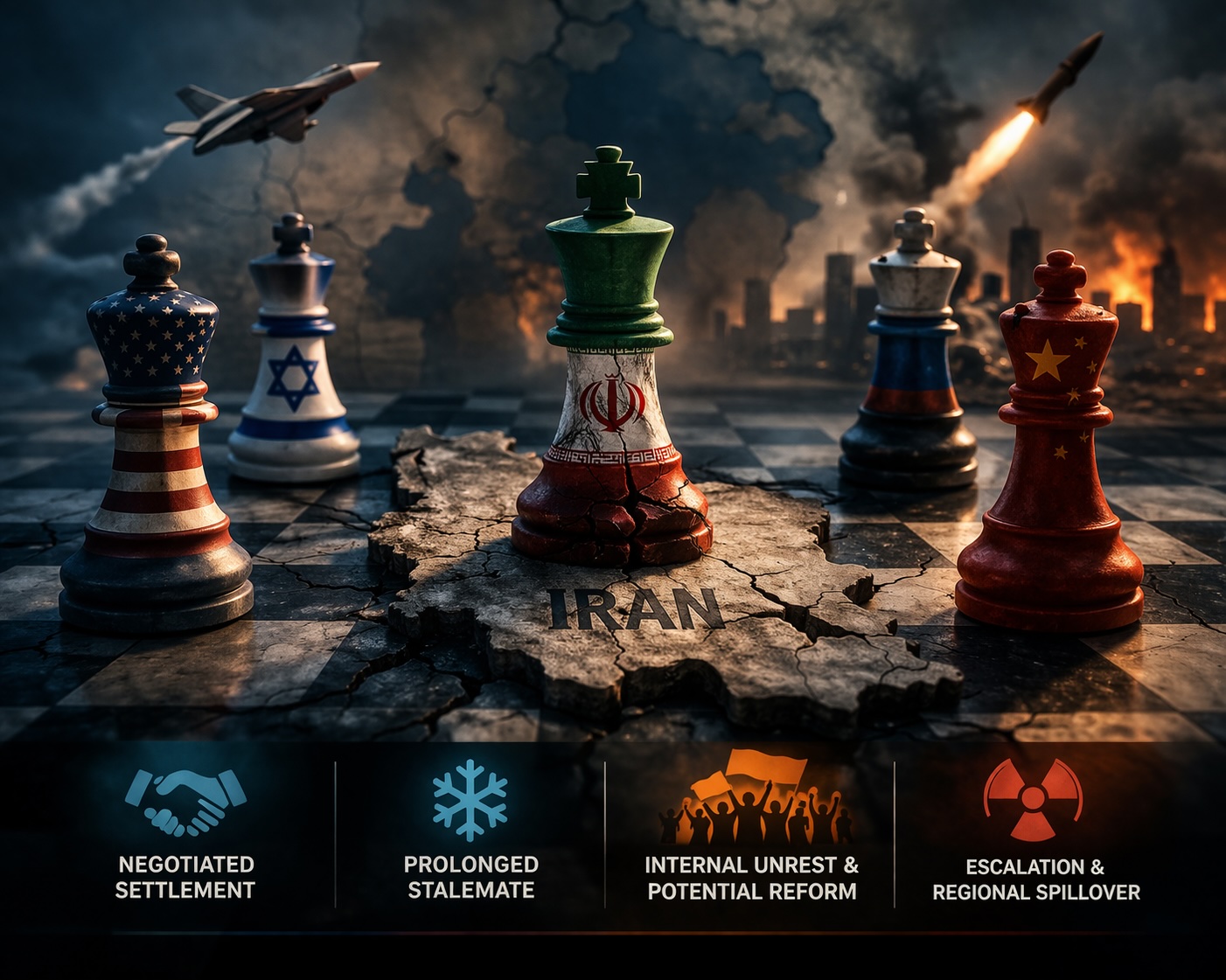
Three key variables will likely shape the trajectory of the Iran war. First, the cohesion of the Iranian regime; second, the scale and duration of Israeli and American military pressure; and third, the degree of regional escalation, particularly as it affects the maritime domain and regional stability. These dynamics suggest several possible outcomes, including a negotiated settlement, internal political reform, regime collapse, or a protracted regional confrontation. The sections that follow examine the strategic drivers shaping the conflict, apply strategic frameworks, and explore five plausible scenarios for the trajectory of the war.
Strategic Drivers of the Conflict
Understanding how the conflict might evolve requires examining five noteworthy drivers: Iranian regime cohesion, Israeli and U.S. objectives, regional escalation dynamics, maritime energy security, and great power competition. The first driver acknowledges that leadership stability and succession dynamics may influence Iran’s willingness to negotiate or escalate. A second driver is the Israeli and U.S. strategic objectives, which may remain limited or expand toward broader political objectives. The third driver acknowledges that, although degraded since October 2023, Iran’s proxy network still creates a risk of regional escalation. Fourth, 20 million barrels of petroleum flow through the Strait of Hormuz daily, making energy security and maritime trade another significant driver of how this war may end. Finally, Iran is part of an “Axis of Upheaval” that chafes at a U.S.-dominated international order and seeks to erode U.S. influence globally. Thus, Russia is reportedly sharing intelligence with Iran, and Russia and China are certainly considering how they might benefit from this conflict. The degree to which Iran can lean on its Axis partners will inform its decision-making.
Strategic Frameworks
These drivers define the strategic environment in which the conflict is unfolding. To analyze how they might shape future outcomes, three complementary strategic frameworks are useful: Art Lykke’s ends, ways, means strategy framework, Clausewitz’s concept that resistance is a product of means and will, and the actors’ theories of victory.
Beginning with the first framework of ends-ways-means, the U.S. strategy appears focused on three primary goals (ends): 1) destroying Iran’s nuclear program, 2) eliminating or seriously degrading Iran’s ability to project power outside its borders, and 3) setting conditions for regime change in Iran. Note this last goal appears to be the most flexible given US statements since the beginning of the war. To achieve these ends, the U.S. and Israel are waging a sustained strike campaign (ways) employing a range of air and maritime forces (means).
For the Iranians, their strategy is one of regime survival (ends) relying on their ability to endure the U.S. and Israeli strike campaign while maintaining control of the population and “setting the region ablaze,” to create political pressure for conflict termination (ways). To date, this strategy has depended primarily on Iran’s missile and drone capabilities (means), its naval and mine threats to the Strait of Hormuz, and the Islamic Revolutionary Guard Corps’ (IRGC) willingness to oppress the population. Additionally, Iran is leveraging its proxy network regionally and globally. Given the above, there is a clear asymmetry of interest in this conflict that will ultimately influence negotiating space and war termination. In sum, Iran’s ends correspond with the highest intensity-level of interests (regime survival) while the U.S. and Israel are pursuing more limited ends (weakening Iran’s power projection capabilities and the regime), congruent with vital level interests.
A second key framework shaping the evolution of the conflict is the Clausewitzian concept of resistance as a product of an actor’s means and will (R = MxW), an essential formula when war is ultimately a clash of wills. As a revolutionary, theocratic regime, facing a survival-level interest, Iran is likely to exhibit a tenacious will, suggesting it will resist as long as it retains sufficient means. If regime cohesion holds and the IRGC maintains control of the population, this may mean the U.S. and Israel will be confronted with the need to impose their will with escalated means, typically requiring ground troops.
Competing Theories of Victory
Colin Gray emphasized that victory reflects the achievement of political objectives rather than purely military success. The U.S. and Israel are using military force to destroy Iran’s force projection capabilities and deny them the means for continued resistance, thus coercing them to accede to U.S./Israeli demands. Meanwhile, Iran is pursuing a “decentralized mosaic defense” that seeks to endure external military pressure while expanding the conflict regionally and threatening the global economy in a way that brings political pressure on the U.S. and Israel to end the conflict. In this clash of wills, both sides are attempting to use force to negotiate.
These theories of victory are both grounded in what Thomas Schelling described as coercive bargaining. Tami Biddle describes coercion theory concisely as involving the use of force, or threats of force, combined with incentives to compel another actor to decide that further resistance is against their own interests. Given the belligerent actors’ reliance on coercion and respective ends, war termination becomes complicated.
War Termination Pathways
With these theories of victory in mind, it is essential to consider how wars end historically. Data from 21st-century conflicts show that interstate wars rarely (30% of the time) end with a clear military victory by either side. Drawing on Fred Ikle’s classic “Every War Must End,” there are many ways that wars end, five that are germane to our analysis: 1) military victory, 2) negotiated settlement, 3) armistice or ceasefire without political resolution, frozen conflict, 4) one side abandons the war, or 5) internal collapse of a belligerent. Using Ikle’s work as a starting point, we explored several scenarios for how this war might end.
Scenario Planning Framework
Fortune 500 companies use scenario planning to mitigate potential future risks. Likewise, military planners employ this disciplined method for exploring multiple plausible futures amid uncertainty. Focusing on a set of the most salient parameters can distill complex scenarios and enable useful forecasting as to how a conflict might evolve.
Examining the aforementioned drivers of Iranian regime cohesion, Israeli and U.S. strategic objectives, regional escalation, maritime trade, and geopolitical competition suggests that the future of the conflict will depend on how military pressure interacts with Iran’s internal political dynamics and the broader security environment. As such, we constructed a 2×2 planning matrix (see figure 1) that plotted wartime escalation vs. Iran’s willingness to negotiate. Then, we considered the low-probability but high-impact possibility that a rogue actor, such as Russia or North Korea, determines that enabling Iran to acquire a nuclear weapon would be in their interest, to construct a “wildcard” scenario.
|
Iran Willing to Negotiate |
Iran Refuses Negotiation |
|
| Limited War |
The Grand Bargain |
The Strategic Freeze |
| Escalated War |
Tehran’s Spring |
Iranian Fragmentation |
Wildcard: Iran Gets a Nuke
Figure 1: Strategic Futures of the Iran War
The Grand Bargain
This scenario may emerge in two primary ways. First, U.S. and Israeli military pressure sufficiently erodes the Iranian means and/or the will to resist to the point they are willing to compromise (unconditional surrender). Alternatively, if Iranian actions convince the U.S. and Israel that further military action will provide diminishing returns, a window of opportunity for negotiations could emerge, perhaps spurred by a third party such as Qatar, China, or the EU.
Negotiated settlements are the most common way for interstate wars to end historically. The Korean War, Vietnam War, and Iran-Iraq War are all examples of how interstate wars typically end in negotiated settlements. The Camp David Accords offer another example where negotiations ended years of military confrontation between Egypt and Israel, reshaping regional politics.
A negotiated settlement would likely stabilize the regional balance, at least in the short term. It would most likely include some form of the current Iranian regime, but one willing to compromise on core U.S. goals related to the elimination of the Iranian nuclear program and diminishment of the Iranian missile and proxy threats to the region. In such a scenario, the U.S. would likely transition security responsibilities to regional states, freeing up forces to focus on higher-priority interests, outlined in the National Security and National Defense strategies. This scenario would likely benefit the U.S. and the current Iranian regime. The specific details of any compromise would be critical to determining how this outcome might be viewed in terms of Israel and other regional actors’ interests, as well as those of the Iranian people.
The Strategic Freeze
Here, the intensity of military operations decreases, or overt military operations even halt, without a clear victory or a compromise that terminates the conflict. In this scenario, the U.S. and Israel, unwilling to intervene decisively with ground troops and unable to compel the Iranians through airpower alone, declare victory. Calculating diminishing returns, the U.S. and Israel would leave a severely degraded Iranian regime in power, motivated to rebuild its missile and proxy network and potentially more committed to the eventual acquisition of a nuclear weapon. While a battered Iranian regime might remain vulnerable to popular unrest, its mere survival would be characterized as a victory. This scenario would also likely lead to increased insurance costs and a potential need for military forces to restore maritime traffic in the region.
Historical examples of this “frozen conflict” type of outcome include the Operation Northern Watch and Russia-Ukraine conflict in the Donbas from 2014-2022. Operation Northern Watch (1997-2003) involved U.S. enforcement of a no-fly zone over northern Iraq for over 11 years and involved regular engagements with Iraqi forces. The conflict in the Donbas saw 75,000 troops face off and over 14,000 people killed over eight years.
In this scenario, Iran would remain a threat to regional stability, and the U.S. would likely be forced to retain some forces in the theater to reassure regional partners and contain the Iranian threat, thus limiting the U.S. ability to focus elsewhere. This would appear to be a sub-optimal outcome for Iran, which would be severely degraded, as well as the U.S. and Israel, which would have expended billions on military operations, but still facing a protracted stalemate not dissimilar to that which existed prior to the war. Arguably, the biggest winners in this case might be Russia and China, who would have watched the U.S. expend critical munitions needed in Ukraine or the Indo-Pacific, while facing continued demand for critical U.S. forces in the Middle East.
Tehran’s Spring
In this scenario, the people of Iran follow President Trump’s encouragement to rise up. The elite Islamic Revolutionary Guard Corps (IRGC), which reports directly to the Supreme Leader, finds its means diminished by intense U.S. and Israeli aerial bombardment. Meanwhile, the Artesh, the territorial Iranian army that does not possess the ideological fervor of the IRGC, sides with the population, leading to a rapid collapse of the regime without a long civil war. This scenario would find the people of Iran emboldened to act after the U.S. and Israel complete their strike missions as underlying economic grievances worsen. Protests would occur, but the regime would be unable to crack down on the people because they are defended by their military.
Historical parallels include Tunisia, which successfully overthrew its government. Mass protests forced President Ben Ali to flee Tunisia in 2011 and opened the door to a democratic transition. Also in North Africa, Egypt’s military, perhaps its most trusted institution, supported popular uprisings in 2011 and 2013. Considering Iran’s willingness to massacre its own people by the tens of thousands, the Artesh could provide necessary protection for the citizens.
If this scenario were to unfold, the new Iranian leadership would likely be more moderate and reform-oriented. This new government would likely reduce confrontation with the West and be much more amenable to U.S. negotiations. The U.S. would find an Iran seeking to rebuild, renouncing its nuclear program, and severing ties with its proxy network. With a non-revolutionary Iranian regime, regional stability would increase, allowing the U.S. to shift forces out of the region to focus on the broader geopolitical competition. This situation, although desirable by Israel and the U.S., remains uncertain as the current strikes have appeared to harden the Iranian regime’s commitment to the conflict and have warned the Iranian people against any form of dissent.
Iranian Fragmentation
In this scenario, the Iranian regime’s grip on power is fatally undermined by U.S./Israeli targeting of the IRGC and other levers of regime control. The Iranian people follow President Trump and Prime Minister Netanyahu’s advice to rise up and take back their country. Organized resistance emerges from many factions, and competition for power ensues. The regime loses absolute power with a fragmented population competing to govern Iran, perhaps fracturing along ethnic lines. Given the opportunity, Iran’s ethnic groups, supported by regional actors, compete for power, leading to civil war and regional instability.
This scenario would be similar to the North Atlantic Treaty Organization’s bombing campaign in 2011 that set conditions for the Libyan Civil War. Following the fall of Muammar Gaddafi, Libya fragmented into competing political and militia factions, with the ensuing power vacuum leading to the civil war in Libya. Like Libya, authority inside Iran would be fragmented, limiting Iran’s ability to rebuild its government, infrastructure, and institutions. Like Libya, we could expect Iranian oil production to fall significantly and its petroleum infrastructure to suffer widespread damage with longer-term implications for Iran and the global economy. In this scenario, the U.S. and Israel would achieve a less coherent Iranian threat, but regional instability, global economic friction, and a loss of Iranian control over residual elements of its nuclear program could threaten U.S. and Israeli interests. Meanwhile, the Iranian regime and people would clearly lose as the country would descend into chaos.
Iran Gets a Nuke
In our wildcard scenario, Iran achieves the capability to employ nuclear weapons. This could occur either by Iran “sprinting” to a nuclear weapon based on its pre-existing program or by receiving the technology (or weapon) from an existing nuclear power like Russia or North Korea. Although this scenario is unlikely, it is possible given Russia and North Korea’s resentment of U.S. power and emerging partnerships amongst the Axis of Upheaval.
Iran recently demonstrated that their current ballistic missiles can reach Tel Aviv, making this scenario an important one to consider. Iran might not even use a nuclear weapon against a target, but simply test one while threatening to vertically escalate the conflict. Iran’s acquisition of a nuclear weapon would dramatically increase the means available to it and certainly impact U.S.-Israeli calculations about continuing the war. This scenario would leave a battered, but now arguably more powerful Iranian regime in place. It would also radically change the regional balance of power and result in a more unstable Middle East, as Iran would be able to intimidate its neighbors the way that North Korea does. Given the U.S. and Israeli goals, this scenario would represent a clear defeat, requiring a substantial reassessment of U.S. and Israeli political and military strategy for the region.
Implications for Strategy and Policy
The above scenarios represent different possible futures. While strictly illustrative, they highlight a range of strategic implications for policy makers and military leaders.
First, military operations and political objectives must be aligned. Militarily, the U.S. and Israeli military operations are achieving clear success. They have achieved air supremacy over all of Iran, are in the process of degrading or destroying the Iranian missile threat and residual nuclear program, and continue to disrupt Iran’s internal security and external proxy forces in Iraq and Lebanon. However, many critics of the war highlight the lack of clear political objectives and a flawed expectation that the Iranian regime would quickly capitulate to U.S. and Israeli demands. While continued military pressure may work, the history of airpower as a mechanism for regime change is unproven. Since the Iranian regime appears willing to endure continued conflict and hold the global economy at risk, it only highlights the importance of ensuring political and military objectives are aligned when beginning a conflict. As we teach at the U.S. Army War College, risk increases when the ends and means are misaligned.
Second, the scenarios outlined above highlight the importance of preparing for potential instability in Iran. In three of the five scenarios outlined – Tehran Spring, Strategic Freeze, Iran Fragmentation – the internal stability of the Iranian regime was uncertain as power transitions occur and factions compete for power. Furthermore, given the U.S. and Israeli targeting of IRGC and regime security forces, a level of instability, even in the event of regime survival, should be anticipated. Given Iran’s place in the region, revolutionary ideology, and proxy networks, internal instability comes with risk to regional stability as well. Thus, the U.S. and its regional partners must plan for both internal and external instability related to the conflict.
Third, war remains inherently unpredictable, shaped by fog, friction, and chance. Once unleashed, war can evolve in ways difficult for military professionals or policy makers to predict. With such ambiguity, design thinking is useful: understanding the strategic guidance, the operational environment, the differences between the current and desired future environments, and broadly how to approach managing the trade-offs. Yet, once war begins, one must continuously reassess whether military actions are achieving desired political outcomes and adapt accordingly.
Tell Me How This Ends
Strategic forecasting cannot predict the future with certainty. What it can do is illuminate the range of possibilities that policymakers and military leaders must be prepared to confront. Military operations may alter the battlefield, but the outcome of war depends on political decisions made in response to changing strategic conditions. As Clausewitz observed, war is ultimately a contest of political wills in which military force serves broader political purposes. For strategists and policymakers, the enduring challenge is captured in a quote attributed to David Petraeus, “Tell me how this ends.”
(Disclaimer: The views expressed are those of the authors and do not reflect the official position of the Department of the Army, Department of the Navy, or Department of War)