Empires Rise and Fall. Will Ours?
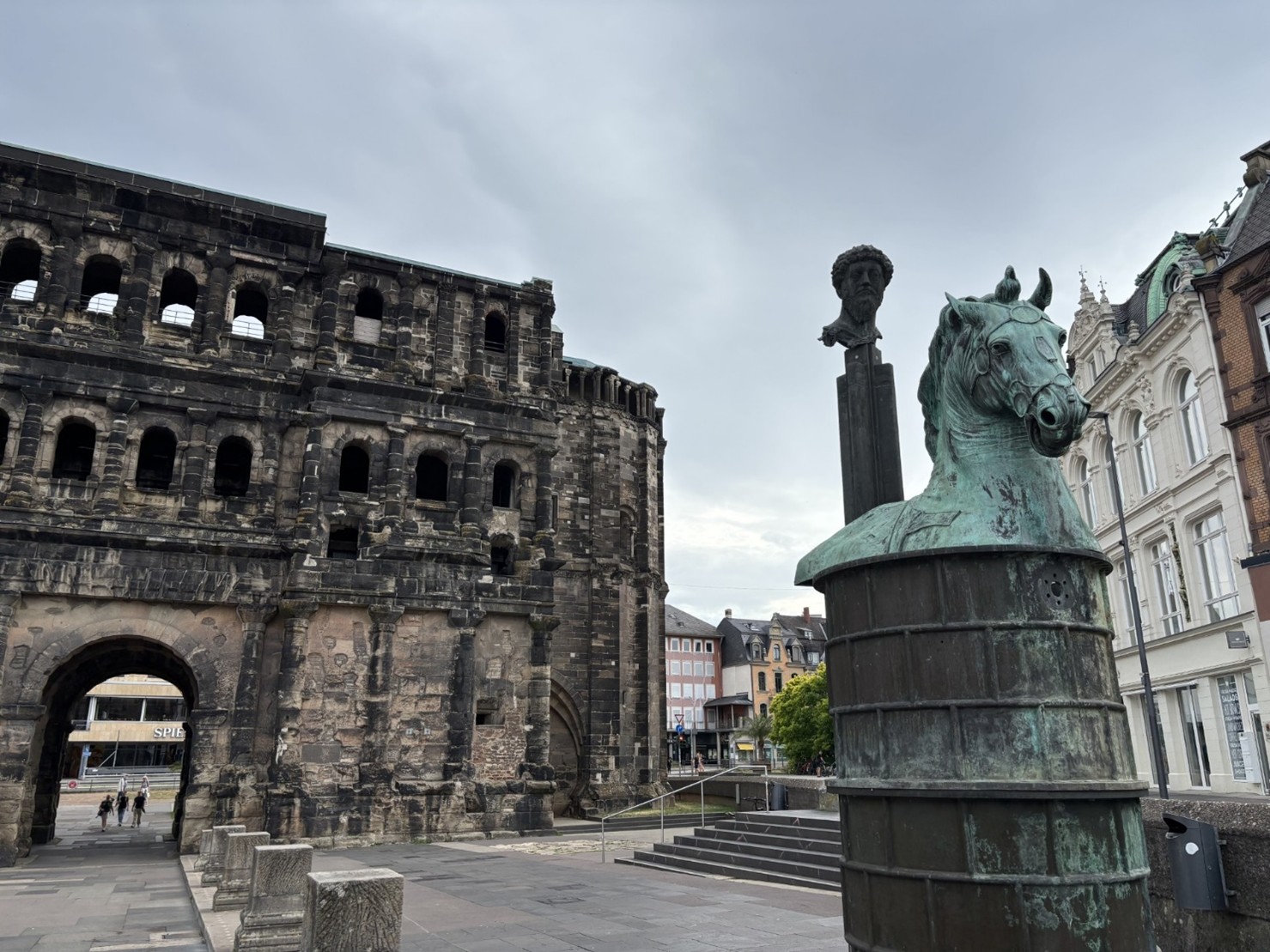

Trier—” Augusta Treverorum”, as the Romans called it, or “The Rome of the North”, as historians call it today—is one of the most interesting places to evaluate the role of the United States in the world, and to question the future of the world it created in the wake of the Second World War.
A little history first. Augusta Treverorum was the capitol of Belgian Gaul (“omni Gallia divisa in tres partes”, per Julius Caesar) and was a city of some note during the Roman Empire, with as many as 100,000 inhabitants. One of the eight city gates, the “Porta Nigra”, still stands, as do the remnants of two large public baths and a coliseum that seated 20,000 for gladiatorial contests. Frescos and mosaics preserved in the city museum depict a flourishing culture that centered on sports and wine, at least for the people who could afford frescoes and mosaics.
Trier’s Roman era can be dated from 17 BCE, when a bridge was built across the Mosele River that, astoundingly, is still in use today. Trier thrived until it was sacked by German invaders in 256 CE, sacked again in 360, and then four times between 410 and 435, finally falling to the Huns in 451.
The reasons for the fall of the Roman Empire, which at its height stretched from the Atlantic Ocean to the Euphrates River and from Scotland to the Sahara, remain hotly debated. Explanations include climate change, widespread plague caused by disease, environmental damage (perhaps linked to lead in water pipes), poor political leadership, a decline in the size and ability of the Roman army, and failures of the Roman civil administration, among others. What is inescapable is the crushing impact of the end of the Roman empire; Trier’s population fell to perhaps 5000 people in the fifth century, living a much diminished existence among the ruins of a civilization that had preserved the peace, created an extraordinary system of global trade, and provided room for culture (and fine winemaking) to flourish. It took a thousand years for Europe to even begin to recover from the Dark Ages that followed Rome’s fall.
In the absence of the Roman Empire’s efforts to keep barbarians at bay, a balance of power system emerged in a Europe marked by near-continuous military conflict. Napoleon tried to recreate the Roman Empire and briefly succeeded before falling to Wellington at Waterloo, beginning a century of British dominion over much of the planet. The British empire was already waning a century later when the cream of England was bled dry at the Somme, but Pax Britannica followed closely by Pax Americana spurred the creation of an idea titled “Hegemonic Stability Theory”. Often attributed to Charles Kindleberger and his book The World in Depression 1929-1939, the theory was developed further by Robert Gilpin and Stephen Krasner and named by Robert Keohane, who ironically is somewhat skeptical of its central claim that the world works best when a dominant power provides public goods that ensure the smooth functioning of the global system.
Keohane is a terrific scholar of international relations, but the evidence suggests that he is wrong to be skeptical of HST. In the absence of a single great power able to set and enforce the rules of the international system, global order can only be enforced by an ad hoc coalition of lesser powers. The difficulties inherent in this system can be clearly perceived in the fate of Trier (and the rest of Europe) for the thousand years after the fall of Rome and the inability of Pax Brittanica to stand in the face of rising German power in the years before the First World War. In the wake of that tragedy America, flush with latent power but uninterested in playing a leading role in world affairs, built a wall of tariffs and excused herself from the League of Nations; World War II, called by some “The World War Part II”, was the unfortunate result.
In the wake of the most horrible war in human history, an America that alone among the great powers had been strengthened by the conflict decided to work diligently to prevent its recurrence. In an extraordinary decade of institution building that the Romans would have admired, a United States that produced 50% of the world’s GDP in 1946 paid the price to build an international trade and security system marked by accomplishments like the General Agreement on Tariffs and Trade (GATT) and the North Atlantic Treaty Organization (NATO). While the United States paid a disproportionate share of the cost of the these arrangements, it also received substantial rewards as the world enjoyed the greatest period of peace and prosperity in its history.
But today, that extraordinary accomplishment is under threat. The current US administration has a very different approach to international trade than the one America has followed since the Second World War, and serious scholars are suggesting that the United States should withdraw its troops from Europe, where they have kept the peace for four generations. China aspires to remake the international system to one more favorable to its own interests, and is collaborating with what has been called an “Axis of Upheaval” of countries that are similarly opposed to the American-led international system.
Standing silent guard against this foolhardy notion is the Porta Nigra, Trier’s black gate, which once protected a city and an empire against forces of disruption and destruction that ultimately triumphed over the institutions that had stood for centuries. Our own empire is less than a century old, younger even than the Pax Britannica that died in Flanders Fields on the Western Front during World War I. One day Pax Americana may end as well, but we should do all that we can to delay, not hasten, the destruction of such good work that has done so much for so many.
This article reflects his views and not those of the United States Army War College or the United States Army.