Is the United States Drifting Toward Rogue State Perception?

The term “rogue state” entered U.S. foreign policy discourse during the late Cold War period to describe governments viewed as operating outside the restraints expected within the international system. In its early usage, the label was applied primarily to states whose threat derived from the pursuit of weapons of mass destruction, the sponsorship of international terrorism, or both (most commonly including states such as Iraq, Iran, and North Korea).
A rogue state is not a “failed state.” A failed state lacks the institutional capacity to exercise authority within its own borders. Rogue states, by contrast, possess functioning governing structures but are seen as using their power in ways that reject or selectively ignore the rules others treat as binding.
Over time, the rogue state label expanded as policymakers and analysts associated the designation with broader patterns of state behavior viewed as destabilizing the rule-based order the United States and its like-minded partners sought to sustain. These included the habitual use of coercive tools untethered from shared legal or institutional constraints, selective compliance with international commitments, resistance to accountability mechanisms, and the treatment of international rules as discretionary rather than binding.
Although the term has no formal standing in international law and no universally accepted definition, in practice, rogue-state reputations most often form when repeated actions lead other governments to conclude that international rules and constraints are being treated as optional rather than binding.
Rogue-State Perception and Reputational Dynamics
Reputational judgment about state conduct emerges through two pathways: gradual accumulation of conduct and high-salience events that compress interpretive judgment. Gradual accumulation, which is the most typical pathway, reflects repeated patterns of behavior that, taken together, signal that rules are being treated as negotiable rather than binding. High-salience events, by contrast, can rapidly reshape how prior conduct is understood by reframing a state’s relationship to prevailing norms.
Within the gradual accumulation pathway, there are several recurring behavioral patterns that help explain how such reputational drift becomes visible across different domains of statecraft:
- The normalization of coercion occurs when instruments such as military force, economic sanctions, regulatory pressure, or diplomatic threats shift from conditional responses tied to identifiable violations into routine tools of policy.
- Rules become optional when states remain formally embedded in international institutions but treat procedural and substantive constraints as discretionary.
- Precedent displaces justification when prior actions are invoked as sufficient rationale for new departures from established norms, reducing the need to ground conduct in shared legal or institutional principles.
- The use of coercive leverage in asymmetrical relationships can reshape how cooperation itself is perceived, as compliance reflects necessity rather than reciprocal alignment.
Gradual accumulation can be observed in Libya (sustained external militancy and institutional defiance), North Korea (withdrawal from multilateral commitments, repeated weapons testing, and coercive brinkmanship), and Iran (sustained nuclear defiance, sanctions resistance, and selective engagement with international oversight), where these patterns produced reputational judgments through iterative conduct over time.
These indicators are analytically significant not in isolation, but in their cumulative effect. When similar patterns appear across multiple domains of conduct, they can signal a shift in governing posture from adherence to shared constraints toward a more discretionary approach in which rules are applied selectively.
In contrast to gradual accumulation, high-salience events derive their significance from their ability to compress interpretive judgment and rapidly reframe how prior conduct is understood. Iraq’s invasion of Kuwait (territorial seizure in violation of core sovereignty norms), Argentina’s invasion of the Falkland Islands (use-of-force escalation in a sovereignty dispute), and Russia’s annexation of Crimea (territorial revision by force) each functioned as catalytic breaches that rapidly consolidated external perceptions.
Whether through gradual accumulation or a high-salience event, the result is the same: rogue-state reputational drift.
Observable U.S. Policy Patterns Relevant to Drift
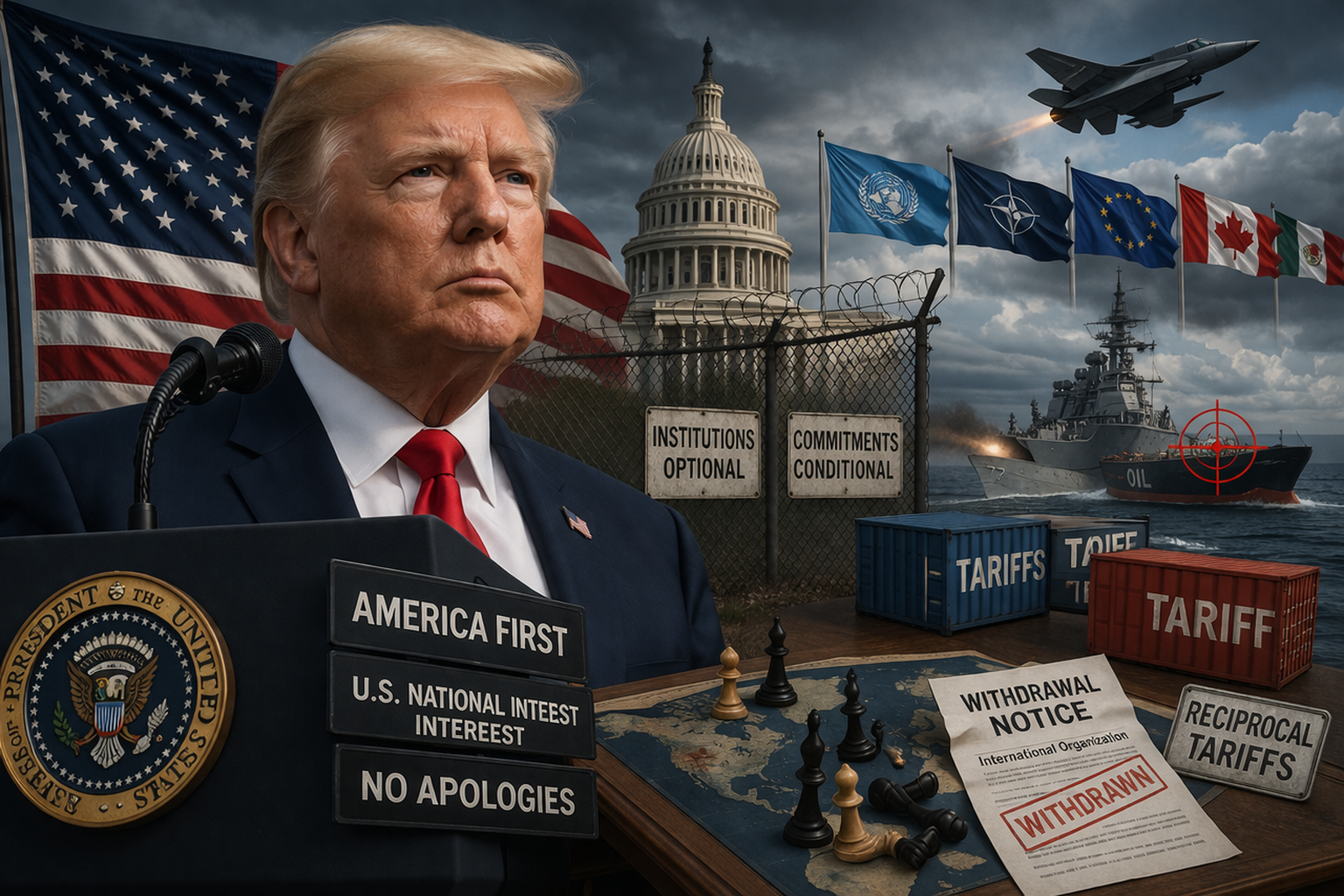
The current administration has articulated a governing posture, commonly described as “America First,” in which multilateral cooperation is acceptable only when it advances U.S. objectives, but national discretion prevails when institutional processes constrain desired outcomes. What distinguishes the present period is not simply the occurrence of such behavior, but the density, tempo, and cross-domain concentration with which it appears.
- Economic Coercion as Statecraft
While economic leverage has long been a routine instrument of statecraft, its use to compel unrelated political concessions reflects a shift toward coercion as a governing posture. This shift is visible in the expanded use of tariff authorities and their deployment to secure broader policy alignment (reciprocal tariffs to allies and partners; Section 301 redeployment; secondary tariffs tied to Venezuelan oil), as well as in the willingness to leverage unrelated critical economic infrastructure as pressure points (Gordie Howe International Bridge dispute). In combination, these actions reflect a transition from negotiated economic tools to unilateral coercive leverage. - Institutional Constraint as Conditional
Engagement at the multilateral level has become increasingly selective, with participation treated as contingent on alignment with U.S. policy priorities rather than as a structural commitment. This posture is reflected in the withdrawal memorandum directing U.S. withdrawal from sixty-six international organizations, combined with public rhetoric questioning the relevance and reliability of multilateral institutions (including the September 2025 United Nations General Assembly address). Institutional membership remains available when it advances national objectives but is curtailed when constraints are viewed as limiting policy flexibility—through withdrawal, reduced participation, or funding cuts—when constraints are viewed as limiting policy flexibility. - Force Signaling
The potential use of force has increasingly been presented as a direct instrument of statecraft rather than a contingency of last resort. This is reflected in territorial signaling (Greenland acquisition rhetoric), expanded willingness to conduct or threaten unilateral operations in the Western Hemisphere (Venezuela actions; Colombia-related force signaling), intensified pressure linked to regime outcomes (Cuba energy restrictions and political framing), and escalation dynamics in the Middle East (strikes inside Iran culminating in leadership targeting). Collectively, these actions signal a broader acceptance of force as a routine policy instrument to change the status quo with no respect for international law. - NATO Commitments and Emerging Conditionality
Security commitments within NATO have increasingly been framed as conditional rather than structural. Public questioning of alliance reciprocity, combined with the linkage of U.S. support to alignment with broader policy objectives, has introduced uncertainty into long-standing defense assumptions. This includes repeated public statements declining to affirm automatic U.S. defense obligations under Article 5, as well as suggestions that U.S. protection could depend on circumstances or policy alignment rather than operating as a standing commitment.
This dynamic is reflected in the framing of support for Ukraine as contingent on engagement in negotiated outcomes, illustrating how security commitments central to alliance credibility can be used as leverage rather than maintained as durable guarantees. Even where support ultimately continues, this conditional framing reflects a shift from structural commitments toward more transactional arrangements.
* * *
These patterns all illustrate how a sovereignty-first posture can produce discretionary behavior across economic, institutional, and military domains when existing constraints are perceived to limit policy flexibility. Considered collectively, they correspond to several of the behavioral indicators historically associated with the emergence of rogue-state perceptions.
Consequences of Rogue-State Drift
Continued drift toward rogue-state perception can carry significant consequences for the functioning of the international system. Contemporary American power operates within a framework that depends heavily on voluntary cooperation. While the United States retains unmatched material capabilities, many of its most consequential instruments—financial sanctions, export controls, intelligence coordination, basing rights, maritime enforcement, and regulatory alignment—function effectively only when partners choose to participate. Legitimacy reduces friction, reciprocity lowers coordination costs, and shared rules convert preference into sustained cooperation.
When those perceptions weaken, cooperation changes character. Commitments once treated as reciprocal become conditional, and institutional procedures once viewed as binding become negotiable. Alignment persists, but it becomes increasingly calculated rather than presumed.
As this shift unfolds, states hedge. Supply chains diversify, financial actors explore alternative settlement mechanisms, and long-standing partners expand engagement with strategic competitors such as China to reduce exposure to uncertainty. Regulators build insulation against extraterritorial reach, negotiations lengthen, and coordination that once flowed from expectation must be renegotiated case by case. Power remains intact, but its ability to convert capability into coordinated outcomes declines as cooperation becomes more transactional.
Recent events following U.S. and Israeli strikes inside Iran illustrate how these dynamics can emerge in practice. Disruptions in the Strait of Hormuz created pressure to secure maritime access, yet the United States faced reluctance from partners to assume operational risk, requiring direct pressure on allies to contribute. Public criticism of allied reluctance—including statements describing partners as “cowards,” characterizing NATO as a “paper tiger,” and warning that the United States would “remember” their lack of support—further exposed the friction that arises when unilateral action is followed by demands for collective participation. Such episodes reflect the practical consequences of declining confidence in shared constraint.
The post-war system has never been perfectly symmetrical, and major powers have historically exercised greater latitude than smaller states. That asymmetry has been tolerated in part because the system provided stability and predictable cooperation. When confidence in that stability weakens, however, tolerance for asymmetry can erode quickly.
As exemplified in the last year, the America-First doctrine is not inherently incompatible with rules-based international leadership. The decisive question is whether strategic autonomy is exercised within reciprocal constraint or in ways that signal exemption from it. When the system’s leading power treats rules as discretionary, other states internalize that discretion as precedent, increasing the likelihood that norms once treated as shared constraints become negotiable instruments.
Under favorable conditions, the effects of such drift can remain contained. If alternative institutional frameworks remain fragmented, if dollar centrality continues to anchor global finance, and if allies lack credible diversification pathways, cooperation can persist despite declining legitimacy. Material dominance allows friction to be absorbed for extended periods.
Over time, however, repeated signals of discretionary behavior can narrow institutional legitimacy even as formal structures remain intact. As confidence in shared constraint weakens, existing institutions may persist in form but lose their coordinating authority, with cooperation increasingly shaped by negotiated alignment rather than embedded rules.
The risk is not immediate collapse but gradual realignment by allies and other cooperating states—sometimes slow, sometimes accelerated by catalytic events that compress perception into a single interpretive frame. Reputational drift can emerge well before any measurable decline in underlying capabilities becomes visible.
Recalibration requires more than policy adjustment; it depends on restoring reciprocity and constraint in ways that visibly alter expectations. The United States retains unparalleled alliance networks, institutional influence, and capacity for internal correction. But credibility—once shaped by accumulated perception—resets more slowly than policy itself. As a result, if perceptions of discretionary behavior harden into expectation, the effort required to restore confidence may prove significantly greater than the policy changes that triggered the drift in the first place.