Germany’s Military Reawakening and the Future of European Security

Introduction
Germany’s military modernization represents one of the most significant strategic turning points in Europe since the Cold War’s end. For decades, Germany maintained a restrained defense posture shaped by historical experience, domestic political culture, and embedded reliance on NATO. German force structure, operational culture and procurement strategies reflected a belief that Europe’s security environment had entered a stable, post-conflict era where diplomacy and economic integration mattered more than military power. That assumption has collapsed, and the transformation now underway is reshaping the foundations of European security.
The Zeitenwende, declared by Chancellor Olaf Scholz in February 2022 following Russia’s full-scale invasion of Ukraine, was not merely an emotional reaction to a single crisis but rather an articulation of a deeper structural reorientation in German strategic thinking. Berlin recognized that its defense posture was inadequate for an era marked by great-power rivalry, contested geopolitics, and a return to high-intensity warfare on the continent. With rising doubts about long-term U.S. security commitments and growing pressure from European partners, Germany has embarked on the largest military modernization effort in its modern history.
This shift encompasses increases in defense spending, revitalization of land, air and naval forces, expansion of industrial production, strengthening of cyber and space capabilities, and reintegration of Germany as a central pillar of NATO’s deterrence posture. It has also triggered new debates about European defense leadership, the balance of power within NATO, and the future of the continent’s strategic autonomy.
From Strategic Restraint to Zeitenwende
Germany’s defense posture since 1945 was anchored in demilitarization, alliance dependence, and deliberate political caution. During the Cold War, the Bundeswehr played a central role in NATO’s forward defense; however, it operated strictly within alliance command structures and avoided independent strategic projection. After reunification in 1990, Germany assumed that its geostrategic environment had stabilized. As a result, defense spending declined sharply throughout the 1990s and 2000s, reaching levels significantly below the NATO 2 percent benchmark, while troop numbers and equipment readiness deteriorated.
Russia’s annexation of Crimea in 2014 began to erode these assumptions, leading to modest increases in defense budgets and participation in NATO reassurance initiatives. Even then, Berlin remained hesitant to engage fully in hard security tasks. The Russian invasion of Ukraine in February 2022 shattered what remained of Germany’s post-Cold War strategic optimism. Chancellor Scholz announced a €100 billion special defense fund and committed Germany to meeting NATO’s 2 percent spending target. Subsequent developments have deepened this shift. According to Business Sweden’s 2025 analysis, Germany intends to increase its defense budget from €86 billion in 2025 to €152 billion by 2029 and align its long-term expenditures with NATO’s updated guideline of allocating 5 percent of GDP to defense by 2035, with at least 3.5 percent dedicated to core military capabilities.
The Zeitenwende has therefore evolved from an emergency announcement into a structural transformation backed by cross-party consensus, industrial reform, and institutional adjustments. It reflects the acknowledgment that European stability—once assumed—can no longer be guaranteed without credible German military strength.
Expansion and Modernization of Military Capabilities
Germany’s modernization program spans all major military domains and reflects a long-term commitment to rebuilding the Bundeswehr as a credible, high-readiness force capable of operating across the full spectrum of warfare. Each domain is being transformed through new procurement, modernization of existing systems, infrastructure enhancements, and improved readiness standards.
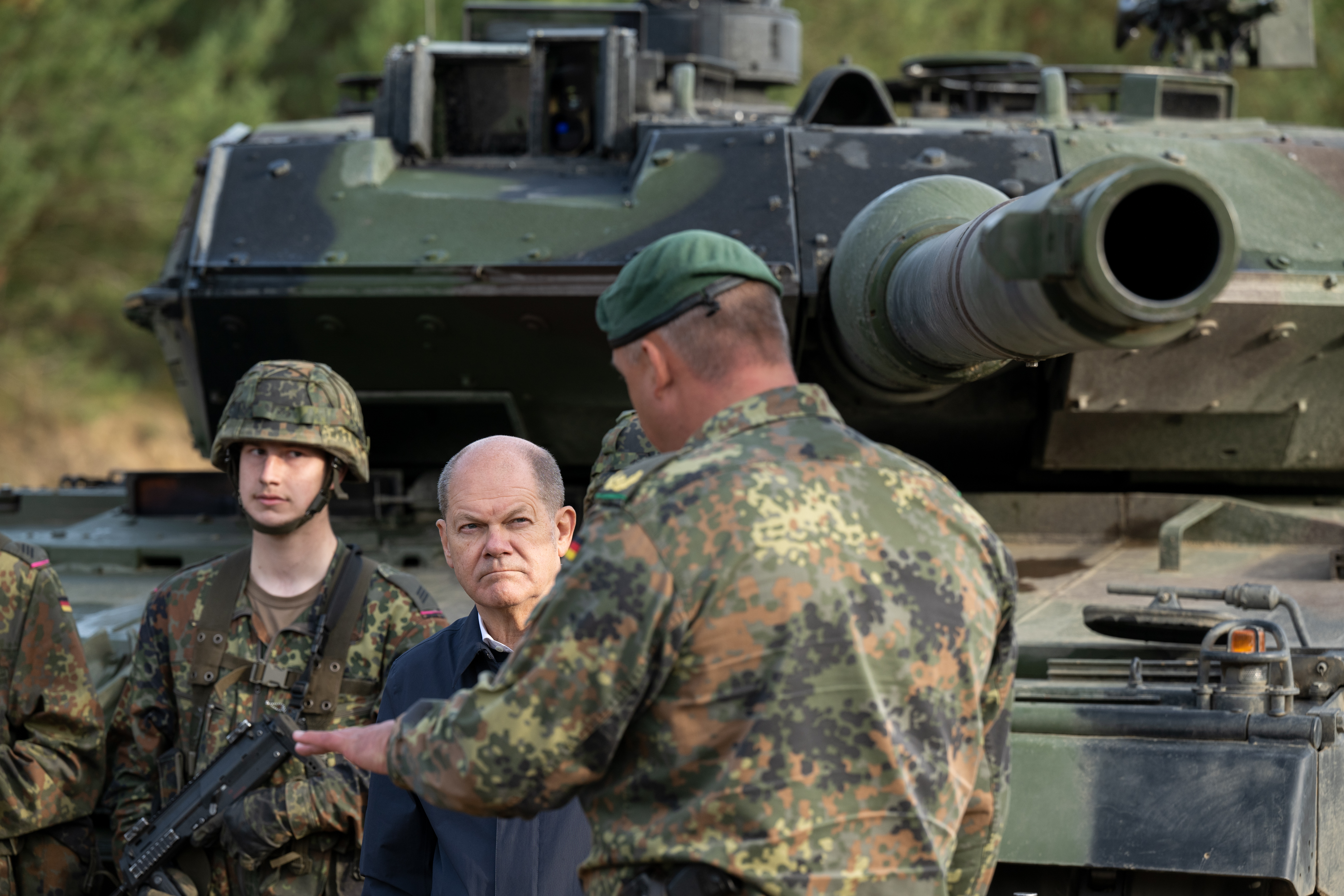
On land, Germany is engaged in the most comprehensive rearmament of its ground forces in decades. The government has authorized multibillion-euro investments in Armor, artillery, mobility, and sustainment. The long-term plan includes the acquisition of several hundred upgraded Leopard 2 tanks, intended to preserve Germany’s traditional strength in armored warfare and ensure that it remains Europe’s foremost tank power. Germany also plans to procure up to 5,000 Boxer armored personnel carriers in various configurations, including air defense variants, and to replace older Fuchs APCs with 3,500 new-generation vehicles. The same report highlights that €70.3 billion is allocated specifically for ammunition production, reflecting lessons drawn from Ukraine regarding the scale of munitions consumption in high-intensity conflicts.
In the air domain, Germany seeks to rebuild both capability and credibility. It has committed to purchasing F‑35A aircraft to fulfil NATO nuclear-sharing obligations and enhance interoperability with allied air forces. The long-term modernization program includes the acquisition of twenty additional Eurofighter Typhoons to reinforce air superiority, multirole, and air-policing missions. Germany is simultaneously investing €34.2 billion in aircraft, missile systems and integrated air defense infrastructure, positioning itself as a central contributor to NATO’s collective air and missile defense posture. This is complemented by its leadership role in the European Sky Shield Initiative (ESSI), which aims to create a multi-layered continental missile defense architecture incorporating systems such as Patriot, IRIS‑T, and Arrow‑3, an area that has gained urgency due to growing missile and drone threats.
Naval modernization is equally significant. Germany is expanding its maritime presence in the Baltic and North Seas while reinforcing its ability to support NATO’s northern flank. Investments totaling €36.6 billion are dedicated to naval vessels, including new frigates, submarines, and auxiliary ships, designed to secure supply routes, enhance maritime domain awareness, and strengthen Germany’s strategic reach. Germany’s recent Indo-Pacific deployments demonstrate its intent to contribute to global maritime security while reinforcing alliances and partnerships across critical sea lanes.
Beyond traditional military domains, Germany is investing in cyber defense and space capabilities. Germany has strengthened its Cyber and Information Domain Service, consolidating and expanding national cyber‑defense, reconnaissance, and secure information‑systems capabilities. It has expanded threat‑monitoring capacities through new federal measures—including enhanced cyber‑defense powers, joint civil‑military monitoring, and development of the national “Cyber Dome.” It has also invested in secure communications and satellite‑based reconnaissance through the Bundeswehr’s dedicated communications and geoinformation commands. Chatham House reports indicate that Germany is integrating whole-of-society defense concepts, enhancing infrastructure resilience and accelerating construction and procurement timelines to ensure strategic continuity in wartime conditions. The “Operational Plan for Germany” (OPLAN DEU) reflects an Estonian-inspired model aimed at ensuring civilian and military sectors can respond cohesively to crises, thus broadening Germany’s definition of national security beyond conventional military considerations.
Defense Spending and Industrial Transformation
Germany’s spending trajectory marks the most dramatic reversal of its post-Cold War defense posture. The €100 billion special fund created in 2022 jump-started emergency procurement, but the broader objective is long-term structural readiness. According to Business Sweden’s 2025 briefing, Germany’s defense budget will rise to €152 billion by 2029, supported by a constitutional amendment enabling temporary suspension of the debt brake to accommodate higher spending levels.
More ambitious still is the €350 billion long-term modernization plan announced by Germany’s Ministry of Defense and which extends to 2041 and represents the most extensive military investment program since the Cold War. This plan outlines sustained increases in procurement, infrastructure development, and industrial augmentation. Its priority areas include ammunition (allocated €70.3 billion), combat vehicles (€52.5 billion), aircraft and missile systems (€34.2 billion), and naval assets (€36.6 billion). The government emphasizes the need for a resilient, scalable defense-industrial base capable of meeting both German and allied requirements during extended conflict cycles.
Germany’s industrial transformation rests on its National Security and Defense Industry Strategy adopted in late 2024. This strategy aims to reduce dependency on external suppliers, increase European defense autonomy and ensure procurement processes are efficient, timely, and aligned with Germany’s operational priorities. Furthermore, projects such as the Future Combat Air System (FCAS) and the Main Ground Combat System (MGCS), undertaken with France, exemplify Germany’s ambition to shape Europe’s next generation of military platforms, even as these collaborative efforts occasionally face political and industrial friction.
| Germany’s Military Modernization Plans and Strategic Initiatives | |||
|---|---|---|---|
| Category | Modernization Plan / Strategic Initiative | Details | Primary Sources / Weblinks |
| Defense Spending Growth | Long-term expansion of defense budget | Germany intends to increase defense spending from €86 billion in 2025 to €152 billion by 2029, and align with NATO’s future 5% of GDP defense target by 2035 (3.5% for core military funding). | Business Sweden (2025)Business Sweden |
| €350 Billion Modernization Plan (to 2041) | Largest rearmament since Cold War | Long-term Bundeswehr modernization valued at €350 billion, including major investment peaks in 2029–2030 surpassing €52 billion/year for procurement. | Defense News |
| Armored Forces Modernization | Leopard 2 expansion & armored fleet renewal | Acquisition of several hundred upgraded Leopard 2 MBTs, up to 5,000 Boxer APCs, and 3,500 new-generation Fuchs replacements to rebuild heavy land forces. | Defense News |
| Ammunition Production Surge | Strategic munitions expansion | €70.3 billion allocated to ammunition production to address European stockpile shortages exposed by the Ukraine war. | Defense News |
| Airpower Reinforcement | Nuclear-sharing & air superiority | Procurement of F‑35A fighters for NATO nuclear-sharing, acquisition of 20 Eurofighter Typhoons, and €34.2 billion for air and missile systems. | Defense News |
| European Sky Shield Initiative (ESSI) | Continental Air & Missile Defense | Germany leads ESSI, integrating Patriot, IRIS‑T, and Arrow‑3 into a layered missile shield across Europe in response to evolving missile/drone threats. | DW |
| Naval Expansion | Baltic & Indo-Pacific force projection | €36.6 billion allocated to new frigates, submarines, and maritime surveillance systems; increased deployments in the Baltic Sea and the Indo-Pacific. | Defense News |
| Cyber and Space Capabilities | Hybrid warfare and resilience | Expansion of Germany’s Cyber Command, space surveillance assets, strategic communications security, and whole-of-society defense planning. | Chatham House |
| Forward NATO Defense | Permanent German brigade in Lithuania | Stationing of a permanent German armored brigade in Lithuania as part of NATO’s Enhanced Forward Presence, demonstrating commitment to frontline deterrence. | Chatham House |
| National Defense Industry Strategy (SVI) | Strengthening defense industrial base | Adoption of a 2024 national defense-industrial strategy to increase autonomy, accelerate procurement and fortify European defense manufacturing. | Business Sweden |
| Strategic Autonomy & Burden-Sharing | Preparing for possible reduced U.S. footprint | Analysts highlight Germany must expand military readiness as the U.S. shifts strategic focus toward the Indo-Pacific, requiring Europe to fill capability gaps. | Heritage Foundation |
Drivers of Policy Shift
The most immediate driver of Germany’s reorientation is Russia’s war against Ukraine, which directly challenged European security and exposed the inadequacy of existing German force structures. Analysts across multiple think tanks, including the Heritage Foundation, underline that the conflict demonstrated the limits of diplomacy and energy interdependence as tools for constraining Russian aggression. Germany’s political leadership concluded that national and continental security required credible hard power, not symbolic contributions or modest deployments.
A second driver is the strategic uncertainty surrounding the United States. While Washington remains committed to NATO, its long-term focus is shifting toward countering China in the Indo-Pacific. The Heritage Foundation notes that the U.S. is preparing to reallocate resources away from Europe, placing greater responsibility on European allies—especially Germany—to manage continental defense. This trend has spurred German policymakers to prepare for scenarios where U.S. presence in Europe may be reduced or reprioritized.
A third driver involves Europe’s broader pursuit of strategic autonomy. France, EU institutions, and several Nordic and Central European states have argued that Europe must develop independent capabilities to manage crises without relying exclusively on U.S. leadership. Germany’s rearmament is increasingly seen as essential to this vision. It is also influenced by a growing consensus within German political parties and public opinion that national security demands a strong military, marking a cultural shift away from the deeply ingrained pacifist tendencies of earlier decades.
European Reactions: France, the United Kingdom, and the United States
France has responded to Germany’s military resurgence with a mix of encouragement and caution. Paris views German rearmament as indispensable to strengthening European defense but remains wary of Germany’s growing dependence on U.S. platforms such as the F‑35, which could undermine efforts to build European technological sovereignty. Disagreements over the pace and direction of FCAS and MGCS highlight enduring tensions in Franco-German defense cooperation. Nonetheless, France recognizes that Germany’s increased defense commitments significantly bolster Europe’s capacity to act collectively in deterrence and crisis management.
The United Kingdom, though no longer an EU member, remains one of Europe’s principal military powers. London generally welcomes Germany’s expanded defense posture, viewing it as a vital reinforcement of NATO’s European pillar. The UK, however, continues to assert its own leadership role through initiatives such as the Joint Expeditionary Force, while simultaneously working to ensure coherence between British and German contributions to NATO. Germany’s growing military weight offers opportunities for bilateral collaboration, particularly in northern European defense planning.
The United States strongly supports Germany’s modernization initiatives. Washington has long called for European allies to assume a greater share of NATO’s defense burden, and Germany’s recent commitments address long-standing American concerns about European underinvestment. The U.S. officials nonetheless monitor developments closely, seeking to ensure that European strategic autonomy initiatives remain complementary to NATO rather than creating parallel structures that could weaken alliance cohesion.
Implications for European Security Architecture
Germany’s military modernization is reshaping Europe’s security landscape in several fundamental ways. First, it strengthens NATO’s front-line deterrence posture, particularly on the eastern flank. Germany’s decision to station a permanent armored brigade in Lithuania is an unprecedented step that demonstrates Berlin’s willingness to assume greater operational responsibilities within NATO’s most exposed region. Chatham House identifies this deployment as one of the earliest, tangible manifestations of Zeitenwende in operational terms, signaling a departure from Germany’s historically cautious approach.
Second, Germany’s transformation is redefining the industrial foundations of European defense. Sustained investment in munitions, vehicles, and advanced technologies enhances Europe’s capacity to sustain prolonged conflict and reduces vulnerabilities arising from fragmented supply chains and decades of underproduction. This industrial renaissance positions Germany as a central node in Europe’s defense-industrial ecosystem.
Third, the cultural dimension of German security policy is undergoing significant change. Europe is shifting from the post-Cold War reduction of armed forces toward rebuilding deterrence, resilience, and readiness. Hybrid threats, cyberattacks, and space-based vulnerabilities are now central considerations in German defense planning, reflecting the diverse challenges of the current strategic environment.
Finally, Germany’s evolving role raises new questions about leadership and coordination in Europe. As Berlin assumes greater responsibility, it must navigate delicate relationships with France and the United Kingdom, ensuring that its modernization efforts complement rather than compete with broader European defense strategies. The future effectiveness of European defense will depend on Germany’s ability to exercise leadership while maintaining cohesion among its partners.
Conclusion
Germany’s military reawakening marks a historic transformation in European security. Driven by the war in Ukraine, evolving strategic realities and the need for Europe’s largest economy to assume greater responsibility, Berlin is reshaping its defense institutions, industrial capacities, and strategic objectives. The combination of increased defense spending, comprehensive modernization programs, and technological innovation reflects a long-term commitment to strengthening both national and collective security.
Germany’s new defense posture is not a turn toward militarism but an adaptation to an increasingly volatile and unpredictable international environment. By enhancing its capabilities, Germany aims to reinforce NATO, contribute to European stability, and maintain diplomatic engagement where possible. Its rearmament will influence alliance structures, industrial cooperation, strategic leadership, and Europe’s ability to defend itself in an era of renewed geopolitical competition.
For Europe, Germany’s transformation offers reassurance but also places new responsibilities in Germany. A stronger Bundeswehr strengthens deterrence and stability, yet it requires careful alignment with European and transatlantic partners to ensure unity of purpose. As Germany moves decisively from strategic restraint toward active military engagement, the future of European security will increasingly depend on how Germany balances capability, leadership, and cooperation.