





Review: Raising the Bar – The School of Advanced Military Studies and the Introduction of Operational Art in U.S. Army Doctrine
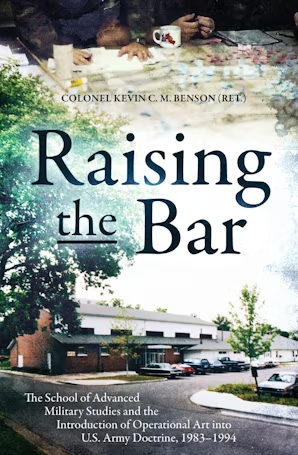

Colonel Kevin M. Benson’s Raising the Bar: The School of Advanced Military Studies and the Introduction of Operational Art in U.S. Army Doctrine, 1983–1994 is more than a history of a military school. It is a study of intellectual reform inside a great institution, key for the U.S. armed forces’ development. The book shows how ideas, when paired with disciplined education, can reshape doctrine and change the conduct of war.
I have to admit my professional bias. I graduated from The Advanced Military Studies Program of SAMS in 1996, and I believe it shaped my thinking for the remainder of my Army career to this day.
Benson tells the story of how the School of Advanced Military Studies (SAMS) emerged at a moment of doctrinal crisis. In the late 1970s, the Army struggled with the limits of tactical thinking. The service had mastered the mechanics of battle but often failed to connect tactical actions to strategic objectives. Brigadier General Huba Wass de Czege saw the gap. Drawing lessons from World War II and from the disproportionate number of Command and General Staff College graduates who later became senior commanders, he argued that the Army required a cadre of officers educated in the operational level of war.
SAMS was created to meet that need. The school’s purpose was not to produce staff officers who could simply follow process. Its mission was to cultivate practitioners of operational art. These officers would understand how campaigns link battles to strategic objectives. They would think across domains and across time. They would see war as a system rather than a series of isolated engagements.
Operational Art and the Transformation of Army Doctrine
Benson places the rise of SAMS in the broader transformation of U.S. Army doctrine during the early 1980s. The publication of FM 100-5 Operations in 1982 introduced the concept of operational art into America’s army doctrine. The manual helped shift the Army away from the rigid logic of the earlier “Active Defense” concept and toward the more dynamic ideas that shaped AirLand Battle.
This doctrinal shift required officers who could apply the theory. SAMS produced them.
From the first class in 1984, students studied operational theory, history, and doctrine in a demanding intellectual environment. They debated strategy in small seminars. They walked battlefields. They wrote deeply researched monographs on operational problems. They planned campaigns at the division and corps level. The goal was simple but ambitious. Officers had to learn how to connect tactical action with strategic purpose.
Benson explains how this educational process built a new professional culture. Officers trained at SAMS became known across the Army as the “Jedi Knights.” The nickname was half humorous and half serious. These officers possessed a rare skill set. They could frame complex problems. They could visualize campaigns. They could translate strategic intent into operational design.
The proof came quickly.
During Operation JUST CAUSE in Panama in 1989 and during Operations DESERT SHIELD and DESERT STORM in 1990 and 1991, SAMS-educated planners played decisive roles in campaign design. Their ability to think operationally allowed commanders to synchronize maneuver, fires, logistics, and joint capabilities in ways that produced rapid and decisive outcomes.
Benson argues convincingly that these successes were not accidents. They were the product of education.
The SAMS Method
One of the most valuable contributions of Raising the Bar is the detailed explanation of how SAMS taught officers to think.
The school relied heavily on seminar-based learning. Small groups of officers debated military theory, history, and doctrine under the guidance of experienced faculty. These sessions forced officers to challenge assumptions and defend their ideas.
Historical case studies formed another pillar of the program. The staff ride to the Vicksburg campaign of Ulysses S. Grant stands out as a powerful example. Students walked the ground where operational decisions shaped the course of the Civil War. The lesson was clear. Tactical actions gain meaning only when linked to strategic objectives.
Planning exercises formed the practical core of the program. Students designed campaigns at the division and corps level. They worked through complex scenarios that required them to apply the Military Decision Making Process. These exercises forced officers to operate in environments where the problem was not fully defined.
Each student also produced rigorous monographs on operational topics. This requirement pushed officers beyond briefing slides and into serious scholarship. They had to research deeply, write clearly, and defend their conclusions before faculty and peers.
The effect was cumulative. SAMS produced officers who were analytical, creative, and comfortable with complexity. They learned to frame problems before attempting to solve them. That habit remains one of the school’s most enduring contributions to the profession of arms.
Overcoming Institutional Resistance
Benson also captures the resistance that greeted these reforms. The Army had long emphasized tactical excellence and procedural competence. The concept of operational art, influenced partly by Soviet military theory, initially seemed foreign to many officers.
Some saw SAMS as an academic institution detached from battlefield realities. Others feared that intellectualism might undermine the Army’s practical culture.
The school overcame these doubts through performance. As SAMS graduates demonstrated their value in real operations, skepticism faded. By the mid-1990s the institution had established itself as the Army’s premier program for advanced warfighter education.
Relevance for Army Transformation Today
One of the most powerful themes in Benson’s book is the enduring importance of education in military transformation. Doctrine can change quickly. Organizations can reorganize. But intellectual culture changes slowly.
SAMS changed that culture.
The Army Transformation Initiative today faces challenges similar to those of the early 1980s. The character of war is shifting toward multidomain operations, information warfare, and large-scale combat against peer competitors. The operational environment is more complex than ever.
Victory will depend on leaders who can think operationally. Leaders who understand systems. Leaders who can integrate land, air, maritime, cyber, and space capabilities into coherent campaigns.
Institutions like SAMS are essential to that effort. They create the intellectual capital that modern war requires.
Technology alone will not win future wars. Artificial intelligence will not design campaigns. Data will not replace judgment.
Educated commanders will.
Final Assessment
Raising the Bar is an outstanding contribution to the study of military education and doctrinal change. Benson combines careful research with clear narrative and deep professional insight. The book explains not only what SAMS accomplished but why it mattered.
It reminds the reader that the transformation of an army begins in the classroom as much as on the battlefield. Doctrine emerges from ideas. Campaigns emerge from doctrine. Victory emerges from commanders who understand both.
The lesson is simple and enduring.
Armies that invest in intellectual development win wars. Armies that neglect it eventually pay the price.
SAMS raised the bar for the U.S. Army. Benson’s book shows why that achievement still matters today.


Great review. I am an ’87’ grad of CGSC and did not attend SAMS, however I had a few friends who were SAMS grads from that era and they were truly “Jedi Knights”. Thanks Dave for giving the topic both reference and relevance to its time and how important the school is even more so currently.