





CSIS Report | Assessing the Air Campaign After Three Weeks – Iran War By the Numbers
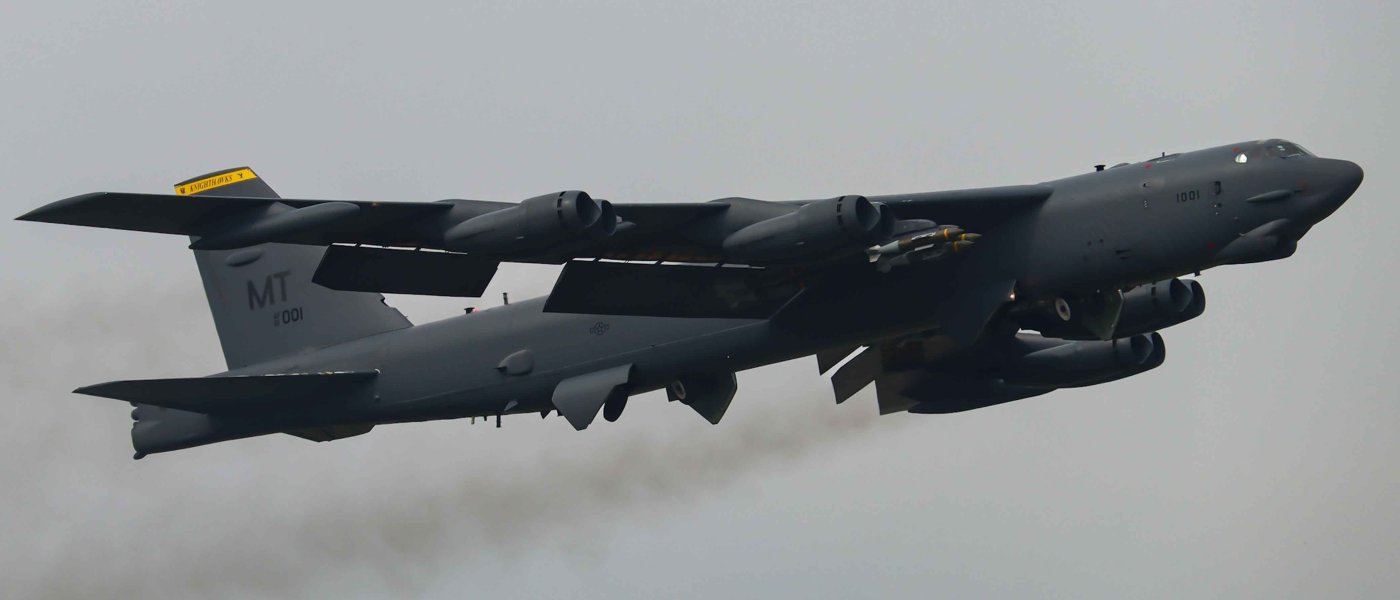

In “Assessing the Air Campaign After Three Weeks: Iran War By the Numbers” from CSIS, Mark Cancian and Chris Park analyze early data from the U.S. and coalition air campaign against Iran to assess operational trends and strategic intent. Data from the report reveals that the campaign has shifted from an initial surge of high-intensity strikes to a sustainable tempo supported by cheaper munitions and air superiority. The data also shows there has been a sharp decline in Iranian missile and drone launches alongside high interception rates by Gulf partners. Altogether, while coalition strikes have degraded Iran’s capabilities, Iran retains enough capacity to continue limited attacks and shape the conflict’s trajectory.
Reflecting on the data, Cancian and Park conclude that the air campaign continues to degrade Iran’s military capabilities while expanding its target set. However, Iran shows no clear intention to cease hostilities and continues to launch limited attacks against Gulf states and Israel. The key uncertainty remains Iran’s remaining missile and drone inventory and its ability to disrupt regional stability, particularly in the Strait of Hormuz. Future escalation, including potential U.S. operations to secure maritime routes, remains unclear and will shape the next phase of the conflict.
“Iran in the Box: The Coercive Architecture of the 2026 Campaign” from Small Wars Journal provides a complementary perspective by framing the air campaign as part of a broader coercive strategy against Iran. In the article, Lance Gordon argues that sustained strikes on military infrastructure, leadership targets, and economic assets aim to systematically constrain Iran’s operational freedom and strategic choices. The campaign does not simply seek to degrade capabilities, but rather to reshape Iran’s behavior and limit its ability to escalate. Together, these analyses suggest that the conflict reflects both an operational effort to reduce Iran’s capacity and a strategic effort to control its decision space moving forward.
U.S. Strike Campaign
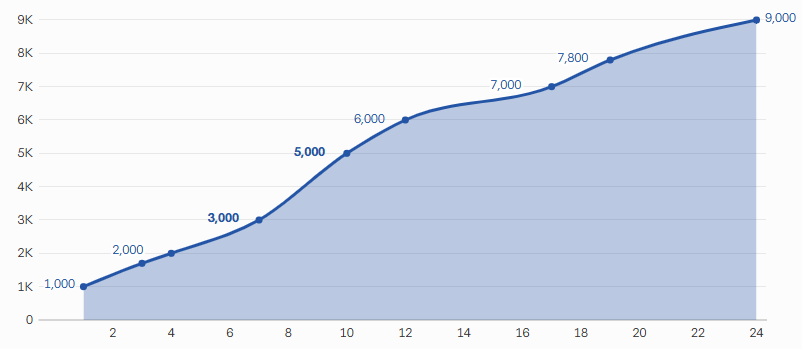
U.S. and Israeli forces began with a high-intensity strike phase, hitting over 1,000 targets in the first 24 hours, followed by a transition to a steadier operational pace. The campaign now sustains 300–500 targets per day, reflecting logistical realities such as aircraft maintenance, crew rest, and target development cycles. The data also shows a key shift toward less expensive munitions like JDAMs, enabled by degraded Iranian air defenses and increased operational freedom.
Figure 1 – Aggregate Number of Targets Struck by U.S. Forces, Days 1-24
Air Defense Campaign: Iranian Launches
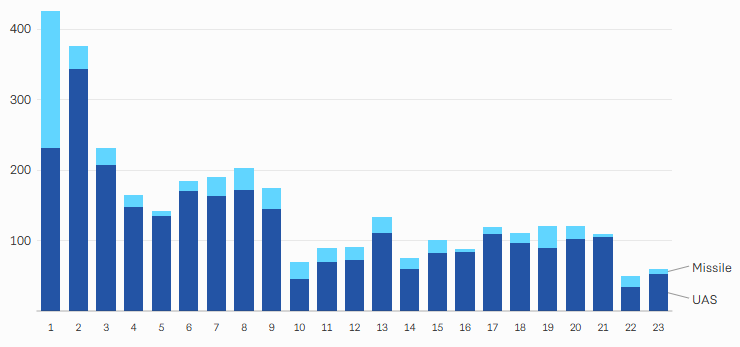
CSIS notes a steep decline in Iranian drone and missile launches after the first few days, attributing this to successful strikes on launchers, stockpiles, and command structures. By Day 14, launches had dropped dramatically, with reported reductions of up to 95 percent for drones and 90 percent for missiles. However, Iran retains a “lingering launch capacity” and appears to be conserving remaining assets while continuing selective strikes.
Figure 2 -UAS and Missile Detections or Interceptions from Days 1 to 23
(as Reported by Bahrain, Kuwait, Saudi Arabia, and the UAE)
Air Defense Campaign: Gulf Reporting and Targeting Patterns
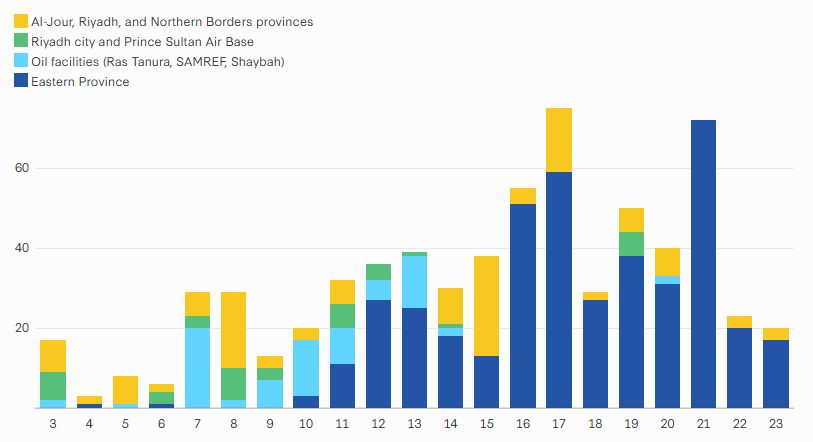
Data from Bahrain, Kuwait, Saudi Arabia, and the UAE show that Iranian attacks peaked early and then declined, but occasional surges have reappeared later in the campaign. Saudi reporting also indicates a shift in Iranian targeting toward oil infrastructure and economic assets, rather than purely military targets.
Figure 3 – Saudi-Reported Location of Interception or Likely Target from Days 3 to 23
Air Defense Campaign: Interceptions
Reports of high interception rates of 80–90 percent or higher across Gulf states are comparable to top Ukrainian performance. Coalition forces have relied on layered defenses, including Patriot missiles for ballistic threats and alternative systems for drones. However, the authors note a growing concern: interceptor inventories are being depleted, which may require resupply from U.S. stocks and could trigger policy debates.

