





Corporate AI as the Military’s Weakest Link
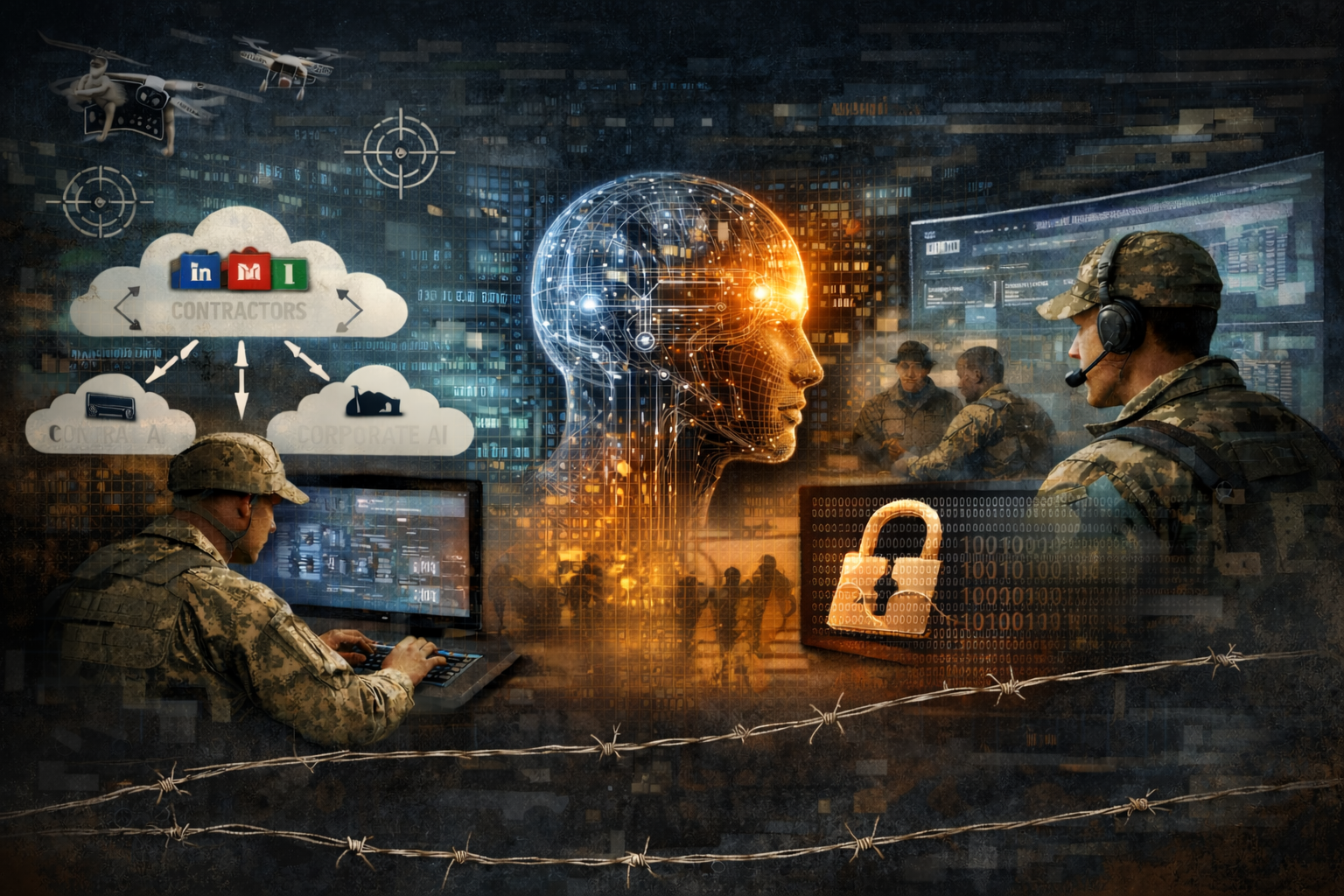

The military doctrine now seeks to employ artificial intelligence as part of its operational arsenal, framed largely as a question of speed, efficiency, and competitive necessity. This framing is familiar and, in some ways, understandable. Large institutions tend to adopt new technologies first as tools, only later as systems that require governance of their own. The problem is not that the Department of Defense is experimenting with generative models, but that this experimentation is already being normalized as routine infrastructure rather than treated as a fragile and high-risk intervention. Defense reporting indicates that the Department is already tracking more than one million unique users on its enterprise generative AI platform within months of launch, a scale that would have been unthinkable for experimental systems only a few years ago. That imbalance matters, because data control, operational language, and internal reasoning patterns are not abstract assets. They are the connective tissue of military power, and once they are externalized through probabilistic systems, they cannot simply be pulled back inside by policy assurances or procedural checklists.
It is important to be clear about what this concern is not. This is not an argument about model autonomy, emergent behavior, or speculative future intelligence. The dominant risk does not arise from what large language models might decide to do on their own. It arises from how humans use them when they become convenient. The Department of Defense has decades of experience managing classified information, enforcing compartmentalization, and responding to breaches. There is no reason to believe that this institutional knowledge has vanished. The risk is not ignorance, it is normalization. When tools are framed as assistants, productivity aids, or drafting supports, they are pulled into everyday workflows, and everyday workflows are where discipline erodes. Temporary allowances become standard practice, and standard practice becomes invisible. This pattern is well documented in studies of automation bias and institutional over-trust, particularly in military contexts where decision support systems acquire authority through repetition rather than formal delegation. The commercial-first character of recent military AI adoption sharpens this concern rather than alleviating it. Public disclosures and official statements indicate that the Department of Defense is relying heavily on externally developed models, integrated through enterprise platforms and contractor-managed environments, rather than on sovereign systems developed and trained fully in house. This is not merely a procurement detail but a strategic signal. It suggests that speed has been prioritized over autonomy, and availability over control. Federal risk frameworks already acknowledge that third-party AI supply chains introduce cascading vulnerabilities that are difficult to model and harder to contain once systems are deployed at scale. When reasoning, drafting, and analysis are mediated through tools whose training data, update cycles, and security postures are outside direct military control. The boundary between military infrastructure and corporations becomes increasingly blurred through the corporatization of data intelligence. This porous posture creates new national security risks through various AI systems that leadership must now accept and address.
The history of military and federal cybersecurity failures reinforces this point. Major breaches have rarely occurred because of novel or ingenious attacks. They have occurred because of ordinary human behavior interacting with complex systems that were assumed to be safe enough. Misconfigured cloud services, overprivileged accounts, reused credentials, and informal data sharing have done more damage than any exotic intrusion technique. Government oversight bodies have repeatedly documented gaps between stated security policies and actual practice, noting persistent failures to implement even basic recommendations across large agencies . Generative AI systems add a new layer to this familiar story. They lower the friction for producing, transforming, and transmitting text, which is precisely the medium through which operational intent, priorities, and assumptions are expressed. In that sense, they amplify existing weaknesses rather than introducing entirely new ones. What makes this moment distinctive is not just the accumulation of risk, but the comfort with which it is being absorbed. Governance mechanisms are presented, certifications are cited, and access levels are defined, all of which create the impression that the problem has been addressed. Yet procedural compliance is not the same as custodianship. Risk management frameworks are valuable, but they do not prevent drift. They document it after the fact. This pattern mirrors earlier critiques of institutional reliance on simulated accountability, where procedural structures provide reassurance without materially constraining risk. Treating generative models as neutral utilities rather than as sensitive cognitive infrastructure invites a repetition of past mistakes, only at greater scale and speed.
The deeper issue, then, is cultural rather than technical. Institutions often prefer solutions that allow momentum to continue while signaling responsibility. Procedural safeguards provide reassurance without demanding restraint. They allow leaders to say that controls are in place, even as everyday use expands beyond the scenarios those controls were designed to govern. The danger is not a dramatic single breach that forces a reckoning. It is a slow erosion of discipline, in which exposure becomes normal, convenience becomes justification, and the absence of immediate failure is mistaken for safety. When that happens, accountability arrives only after damage has already been done. The question is not whether the military understands these dynamics, it almost certainly does. The question is whether it is willing to act as if understanding them carries a cost, and to slow down accordingly, before normalization makes that cost unavoidable.


