





Cue, Not Confirmation: Air Sensing in Irregular Warfare

Abstract
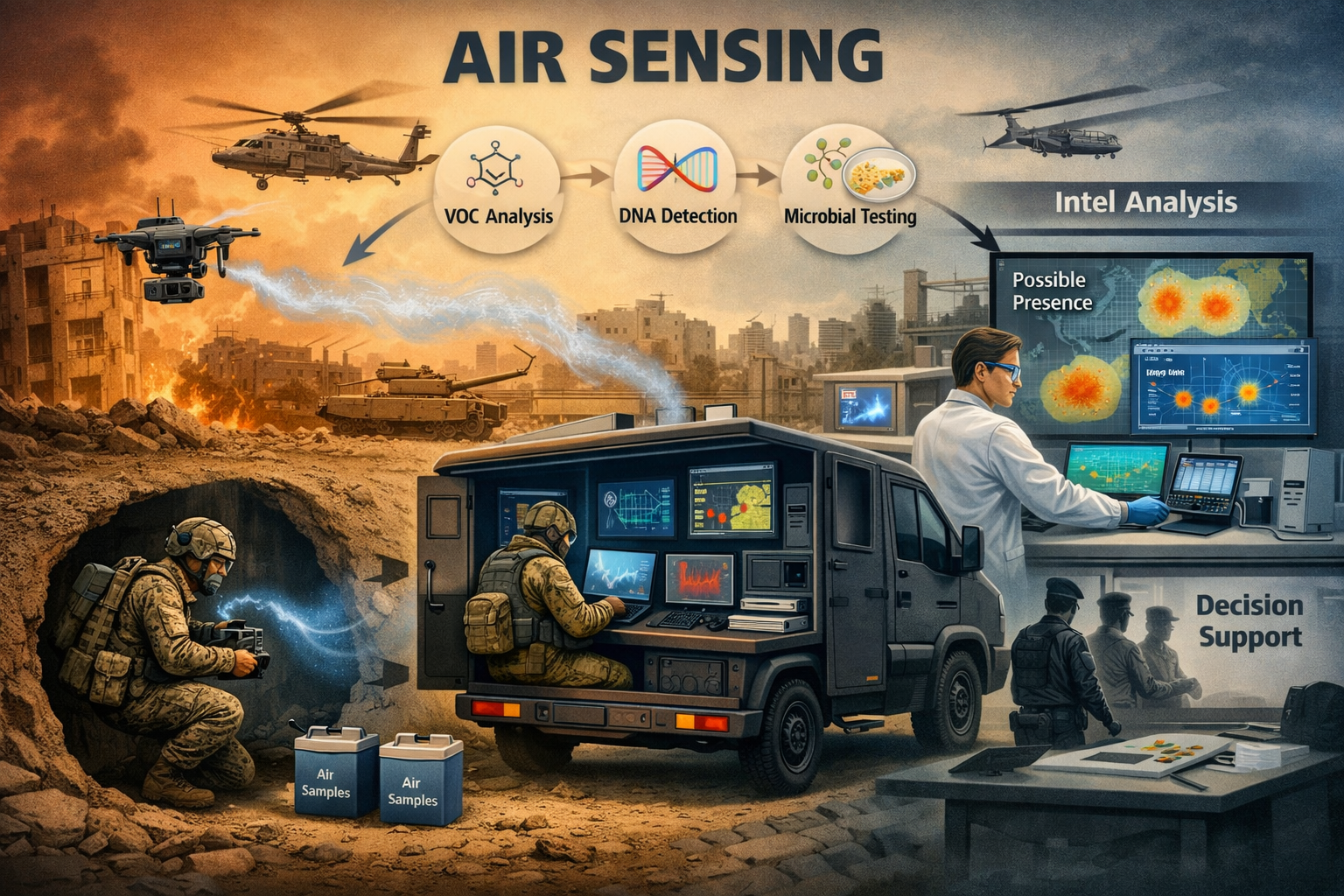
In the messy reality of urban combat, the hardest task is not finding a target, but to distinguish them from everyone else. While airborne sensors can sense biological traces, these signals are far from a fingerprint and cannot distinguish one person from another. Because wind and interference create noise, we must treat air data as a nudge for where to look, rather than a reason to strike. To humanize this technology, we need strict guardrails: independent proof before action, transparent error rates, and constant “red team” testing to keep our tech humble. We should not let a sensor’s confidence replace human common sense.
In irregular warfare, finding the enemy in open terrain is rarely the problem. The harder problem is discrimination: finding the right person in dense cities, tunnels, and subterranean networks without harming civilians. In these settings, small intelligence mistakes cascade into civilian harm, mission failure, and strategic backlash.
One emerging concept is airborne sign of life sensing: sampling air for chemical or biological traces that may indicate human presence. Humans constantly shed molecules, cells, and microbes; in confined spaces, some materials may even persist long enough to capture. The danger is interpretive: treating a probabilistic cue as identification collapses uncertainty into certainty.
Air sensing can narrow where to search; it should not, by itself, support detention, targeting, or irreversible action without independent corroboration.
Three Claims, One Dangerous Collapse
Airborne sensing generally supports three levels of inference:
- Presence: People are likely nearby or were nearby recently. This is the triage function; prioritizing where to search.
- Persistence: People were present at some point, though timing is unclear. Traces linger, mix, and travel.
- Attribution: A specific person is present.
In operational settings, these distinctions collapse. The first two levels are plausible under controlled conditions. But the third, attribution, identifying a specific person in real time, becomes exponentially harder when civilians, fighters, and hostages occupy the same contested space.
A Cautionary Analog: Kunduz
On October 3, 2015, a U.S. airstrike hit the Médecins Sans Frontières trauma center in Kunduz, Afghanistan, killing 42 people. A U.S. Central Command investigation found that personnel did not recognize it as a protected medical facility at the time. The incident reflected compounding failures; from equipment and communications problems to human error under stress, that resulted in disrupted access to no-strike information. The takeaway here is the failure pattern: once an early assumption is treated as fact, later inputs can reinforce it rather than correct it, producing false confidence in layered decision stacks.
Here is where the danger starts: when decision makers mistakenly convert probabilistic presence into a certain identity present, uncertainty vanishes. On the battlefield, that compression can kills civilians, wrecks raids, and destroys public trust. And it gets worse. Real decisions rarely depend on a single sensor. Teams typically layer air cues with thermal imaging, acoustic or vibration detection, and radar-based respiration monitoring.
When one sensor’s misinterpretation feeds into the next, errors do not just add up, they multiply across the entire stack.
What Can Be Sensed, How and What It Means
Two primary approaches exist for detecting human presence through airborne signals:
- Chemical sensing. Detects volatile organic compounds (VOCs) that humans emit through breath and skin. These invisible chemical signals can reveal early signs of disease under controlled conditions. However, in dense urban environments, these signals dilute and overlap, affected by stress, diet, and illness. Chemical sensing may indicate presence but cannot reliably identify specific individuals in contested civilian areas.
- Biological sensing. Captures genetic and microbial material shed through skin flakes and respiratory droplets. While DNA can support specific identification in forensic labs, the operational challenge is capturing uncontaminated samples from air in complex environments with acceptable error rates.
Two collection methods exist: “collect now, analyze later” prioritizes quality control through lab analysis, and “near real time sensing” provides rapid on-site information but trades precision for speed. Both approaches face spoofing risks since adversaries can introduce false compounds, disperse unrelated genetic material, or co-locate civilians to overwhelm detection systems.
Critical point: Airborne sampling is fundamentally a forensic operation requiring rigorous collection protocols, contamination screenings, and a documented chain of custody. These signals should never drive targeting or detention decisions without lab confirmation and independent corroboration. Because these tools are often layered in urban and subterranean searches, their comparative strengths, limits, and escalation risks are mapped (Table 1).
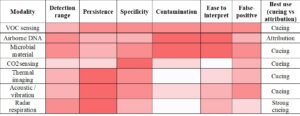
Table 1. Operational comparison of sign-of-life sensing modalities (air and comparators). Operational heatmap comparing sign of life modalities. Non air comparators (thermal, acoustic or vibration and radar respiration) are included because they are often co-deployed in urban or subterranean searches and shape how airborne signals are interpreted and escalated. White to red scale indicates low to high risk, respectively.
Strategic Impact in Civilian Proximate Operations
The core question is not whether air sensing works in a laboratory, but how it affects mission success. When used properly, airborne sensing can reduce blind entry, sending troops into buildings or tunnels with little real information about who or what is inside, and to limit unnecessary troop exposure. But the risks of misinterpretation are severe: ambiguous signals may justify kinetic action, increase civilian harm in dense neighborhoods, or undermine legitimacy when post-strike reviews reveal weak evidentiary grounding. In population-centric campaigns, legitimacy is operational capital; the practical test is whether this technology reduces blind entry without increasing actions later judged unjustified.
From Detection to Decision: Policy Implications
The fastest way to make guardrails usable under pressure is to map them to a familiar D3A ladder: Decide–Detect–Deliver–Assess. Operationally, the point is a workflow that converts a ‘hit’ into a defensible decision: context checks, confirmatory analysis, and independent cross-check, with two STOP gates (Figure 1). That means building in quick reality checks (space layout, airflow, crowding, time since possible occupancy), treating any air signal as a cue, not a conclusion, and requiring confirmation plus independent cross-checks before actions that affect people.
Rules of use:
- DECIDE (authorized use): Air cues support search prioritization and force protection only, not identification.
- DETECT (collection discipline): Standardize sampling, log conditions (e.g., time, place, airflow, crowd), run blanks, seal and label.
- HARD STOP A: Chain of custody issues drives no escalation.
- DELIVER (decision thresholds): Entry allowed with air cue, in addition to basic reality checks (space, airflow, occupancy, time).
- Detention: Requires independent corroboration (non-air) and documented handling.
- Targeting: Lethal action requires a higher evidentiary threshold than air cues can provide.
- HARD STOP B: No independent corroboration means no targeting (status = “cue only”).
- ASSESS (learning loop): Track false positives by environment, red-team spoofing, set post-operational review triggers.
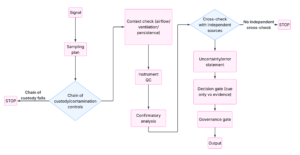
Figure 1 legends. From Detection to Evidence (Air Sensing). Flowchart from initial signal to defensible output, highlighting context checks, confirmatory analysis, independent cross-validation, and explicit uncertainty. Two STOP gates block escalation if chain of custody fails or no independent cross-check exists.
With that framework in place, units should decide upfront what each signal can actually inform, and how reliable that signal is. Early signals might justify search prioritization. Higher consequence actions need higher proof. Lethal targeting should require a higher evidentiary threshold than airborne cues can provide; independent corroboration plus a documented chain of custody when samples are part of the justification.
The goal is not to ban the technology. It is to ensure commanders understand what they are looking at, and what they are not, before making decisions that cannot be reversed.
A Measured Conclusion
Airborne sign-of-life sensing can improve search efficiency in dense, civilian-heavy environments if treated as cueing, not identification.
Commanders should adopt three decision rules:
(1) Authorize air cues only for search prioritization and force-protection posture, and prohibit using them as sole justification for detention or targeting.
(2) Require independent corroboration before escalation, with “hard stops” when corroboration is absent.
(3) Institutionalize governance proportional to consequence, document chain of custody when samples are used, track error rates by environment, and red-team the system for spoofing and contamination before fielding.
In small wars, legitimacy is operational capital; the point is not to add another sensor, but to prevent a cue from becoming false certainty.


