





Combat Debut of the Precision Strike Missile (PrSM): Implications
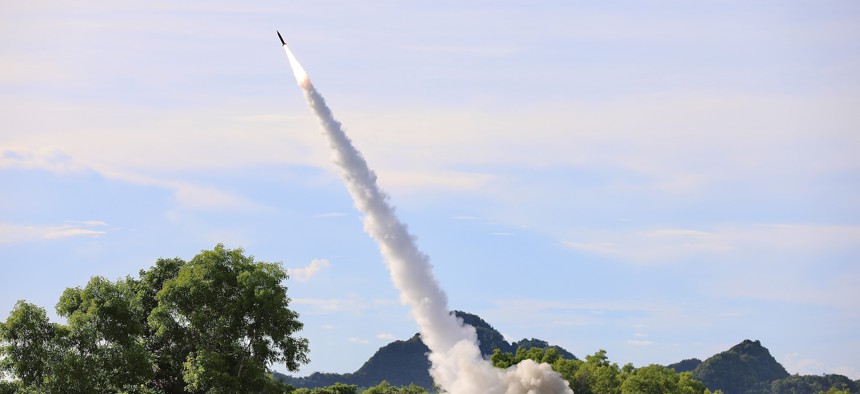

The Precision Strike Missile (PrSM) has now entered combat, write Ryan Brobst and Bradley Bowman of Defense One. U.S. forces employed the system in the opening phase of strikes against Iran, confirming its role as a ground-based, long-range precision fires capability. Senior military officials acknowledged its use in early operations targeting air defenses and command networks.
Operational Role
PrSM extends the range and capacity of existing systems such as ATACMS while remaining compatible with HIMARS and MLRS launchers. Its smaller size allows for increased missile loads per platform, and its range exceeds prior treaty limits.
In practice, PrSM fills a critical gap in the early stages of conflict. It enables ground forces to conduct precision strikes against high-value targets before air superiority is established. This reduces reliance on aircraft and naval platforms during initial operations.
Its mobility and survivability complicate adversary targeting. Launchers can reposition rapidly, sustain operations, and strike time-sensitive targets with short flight times.
Theater Utility
The system’s employment in the Middle East demonstrates its flexibility. From positions in the Arabian Peninsula, PrSM can reach key targets across Iran, including air bases and command infrastructure. This expands the range of options available to commanders and distributes strike capacity across domains.
The authors argue that the same characteristics apply in other theaters. In Europe, PrSM builds on lessons from Ukraine, where similar systems have degraded advanced Russian air defenses. In the Indo-Pacific, future increments with maritime targeting capability will extend its relevance to naval operations.
Production Gap
Despite demonstrated effectiveness, procurement remains limited. Annual acquisition totals in recent budgets remain low relative to demand and anticipated operational use.
This mismatch reflects how U.S. munitions inventories are being drawn down by ongoing operations while production capacity has not scaled to meet sustained demand.
Implications
PrSM has proven its value in combat and addresses a specific operational requirement: long-range, survivable, ground-based precision strike in contested environments.
Quantity is the only constraint. Without rapid expansion of procurement and production, the system’s impact will remain limited. Current demand across multiple theaters requires a larger inventory and a more responsive industrial base.
Read “This missile just proved itself in Iran. The US needs more, ASAP” for the full analysis.

