





A Contest of Wills: China and the Quad

ABSTRACT
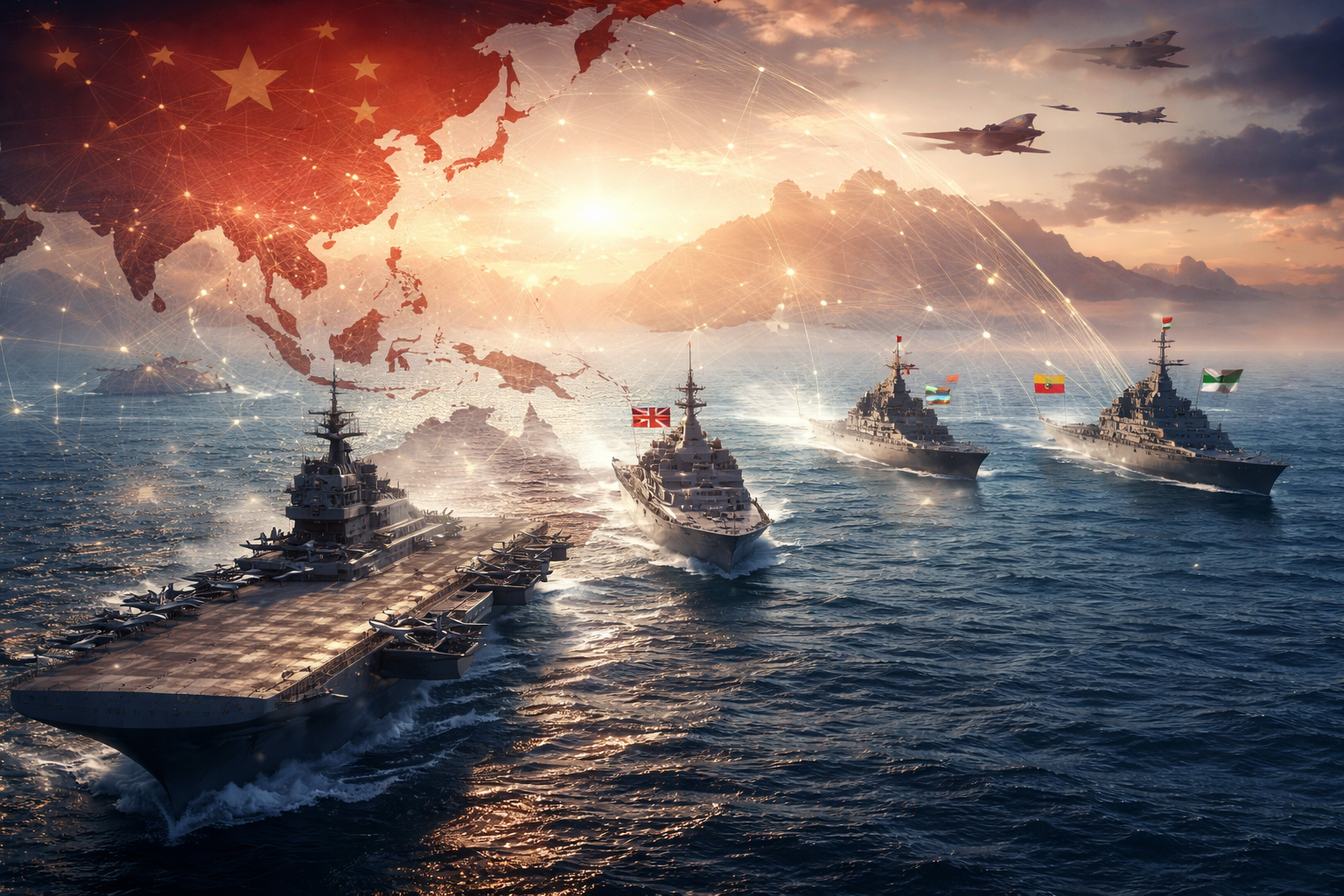
The United States is at an inflection point; a rising China and a shifting political landscape in the Western Hemisphere have created great strategic tension in Washington. China remains the pacing threat, but senior leaders’ focus is shifting to affairs in the Western Hemisphere. Defending the Homeland will include improving US posture in the Indo-Pacific as expanding Chinese power may reach uncomfortably close to Guam or even Haiwaii sooner rather than later. In varying degrees of virulency, a considerable portion of the Chinese Communist Party (CCP) supports a restoration of Chinese power and the burial of the century of humiliation. This creates an environment and opportunity for Beijing to take advantage of a distracted international body to rewire the world to its benefit. The US and its partners have the tools, such as existing partnerships in the Indo-Pacific, to guard against Chinese aggression but must change how it uses them. To defend the Homeland and ensure “a free and open Indo-Pacific,” the US should confront the China challenge by working with Allies and Partners to transform the Quadrilateral Security Dialogue (Quad) from an informal security cooperative into a community of collective defense.
China’s global engagement is driven more by economic interests and less by ideology. The CCP provides labor, materiel, and funding to developing nations to ostensively aid economic interdependence and, in turn, impose concessions against the receiving nation’s interests. For example, the CCP’s involvement in Sri Lanka’s pursuit of infrastructure funding resulted in China taking over Hambantota port on a 99-year lease. This bears an ironic resemblance to the 99-year lease of Hong Kong by Victorian Britain following the Opium Wars in the late 19th Century. The PRC pursues a similar unequal relationship with Panama in the eastern Pacific. Beijing has long considered Latin America as integral to its strategy due to increasing economic interdependence between the Indo-Pacific and the Western Hemisphere. In a policy paper published in late 2025, China portrayed itself as a developing country and a member of the Global South alongside Latin America. Despite the tyranny of distance, years of “people-to-people” exchanges brought China and Latin America closer together. Pushing a narrative of unity, Beijing continues to press soft-power advantages in Latin America. This is most evident in Hong Kong-based CK Hutchison Holdings operating two ports, Cristobal and Balboa, at both ends of the Canal even after the 25-year contract expired. To further express enduring interest in Panama, Chinese Foreign Minister Wang Yi and Panamanian Vice President Isabel Saing Malo de Alvarado held a joint press conference in September 2017 to affirm initiatives from the Silk Road Forum earlier in May. Wang Yi remarked that “Latin America had always been seen from a long-term strategic position.” However, Pablo Baisotti, notes “this is the opposite of what has been demonstrated in recent years, unless China considers that Latin America’s strategic position to be that of a producer of primary products.” The PRC’s endeavor to collect on Panama’s debt were stymied by President Cortizo, it was simply “too much China, too fast.” Following rejection of its unwanted advances, Beijing moves towards coercion. China’s attempt to impose economic costs on Panama, demonstrates its propensity for expansionism beyond its traditional borders.
Chinese expansionism includes its commercial footprint and will protect its interests in critical sectors such as telecommunications, technology, and manufacturing. Protecting these overseas interests, such as the Suez Canal and the Horn of Africa, falls to the People’s Liberation Army (PLA). In 2009, the PLA transitioned from a regional anti-access / area denial posture to a global one. As the PLA’s military capabilities expand, so do the PRC’s commercial interests in a self-perpetuating economic expansion cycle, requiring military augmentation to protect those interests. In the last decade, China’s economic activity in the Horn of Africa increased in terms of port infrastructure and trade. Citing a vulnerability, the PRC built its first overseas military base in Djibouti, extending its operational reach and “strategic influence.” China sees its cultural concepts as relational, not absolute. As Chinese power expands, it deserves more deference and is entitled to greater power-based responsibilities. Increasing influence and reach drives global engagement between Beijing and diverse potential partners.
The array of nations engaging the PRC continues to surge, but many are increasingly subject to a junior partner role. The junior partnership is not inherently disadvantageous; many US partners, such as Panama and Mexico, reap tremendous benefits ranging from infrastructure to defense. It is the mutual trust between partners that matters more than status. Due to its reputation for heavy-handed responses to domestic troubles, the PRC struggles to build trust with new suitors, particularly in the global South. For example, the CCP manufactured a crisis during the 2019 Hong Kong protests when it labeled many of the protestors as foreign agents to justify its disproportionate response. These draconian measures diminished Beijing’s hard-won diplomatic capital, throughout the world and in particular, the Global South. The regime’s behavior ran counter to its outward message as a fair and just partner, unwilling to bully its neighbors. Despite public image setbacks, the real power in China continues to be held by the CCP, which openly regards any form of governance different from its own as an adversary. This view contrasts with the US’ preference for states pursuing their national interests but remaining tolerant of other systems if the benefits outweigh the costs.
The Taiwan issue is central not only to China’s security strategy but also to Sino identity. CCP leadership is consistent in its messaging that Chinese identity is linked to Taiwan and the Chinese story will remain incomplete until reunification. The CCP declared its intentions to return Taiwan to the fold on numerous occasions but is reluctant to identify a specific date. On the first day of the Lunar Year, President Xi Jinping affirmed that “the reunification of the motherland is a historical inevitability.” The date for such a reunification ranges from 2027 to the turn of the next century. Many analysts in Washington, however, believe that 2049 is the target deadline for reunification. A focus on date specificity is more in tune with Western thinking than Chinese but the PRC is cognizant of a window of opportunity and its ephemeral nature. Regardless, 2049 is the year that the PLA will become a world-class military if prerequisites are met successfully. The major step prior to 2049 is the PLA of 2035. This roughly matches the US’ Multi-Domain Operations glide-path for 2030. This parallel is not by accident; by mirroring US strategic developments, China aims to not only match US capabilities but exceed them. This would allow Beijing to drive change from a position of strength. Though not specifically named in Chinese strategy, the US is the “great power” that China is competing with, explaining many similar steps in modernization and partner outreach by both countries. Taiwan will continue to be a critical pillar in the strategic competition between the PRC and the US with its partners and allies, particularly the Quad.
The Quad is an international forum composed of Japan, the US, India, and Australia. The Quad began as a response to the 2004 tsunami in the western Pacific but has evolved into the multifaceted organization it is today. The Quad’s interest in Taiwan is far from one dimensional but a shared concern is not only China astride Asia as a colossus but posing a direct threat to regional security. Japan identified China as the most significant strategic challenge to its national security posture. This marks the first time that Japan publicly identified China as the preeminent threat and could indicate a willingness of some Quad members to emphasize an allied defense rather than mere security cooperation. Australia sees Taiwan as a middle power with whom it shares a common philosophical interest. However, Canberra is hesitant to antagonize Beijing as China buys nearly 100% of Australia’s natural resources. In preserving its economy while defending its stance on democracy, Canberra is attempting to walk and chew gum at the same time. India is in a similar position, reliant on China economically but opposed to it politically.
For India, the stakes are higher as it shares a long border with the PRC. The Galwan incident in 2020 resulting in multiple casualties along the Line of Actual Control highlights these equities. India’s historic relationship with China runs far longer than the US and Australia and as deep as Japan’s. Any move that New Delhi makes must be calculated with great accuracy to avoid escalation between two nuclear armed countries in such proximity.
The Quad was designed to address the soft security needs of the Indo-Pacific region, and particularly the maritime domain. Soft security, like soft power, is an effective tool but may not possess the range of capabilities needed for strategic competition in the Indo-Pacific. Topics like global health security, emerging technology, infrastructure, space, and cyber domains are the key areas where the Quad can maximize its influence in the region and reduce China’s. The Quad draws its strength not from iron-clad corollaries etched in stone but its flexibility which allows its members to engage in some areas but not others. This flexibility is derived from the informal nature of the Dialogue which allows the coalition to sidestep potential points of conflict. For example, India has refused to condemn Russia for its invasion of Ukraine in contrast to the three other members which expressed their concern early. However due to the informal nature of the Quad, this dissonance does not prevent likeminded coordination in other areas. China is another area where New Delhi is cautious as it shares a long and contested land border. This caution is understandable, but in overabundance, could jeopardize an enduring peace if Beijing interprets prudence as weakness. India and other members of the Quad should be prepared to co-exist with China from a position of strength.
Peace through strength is not a new concept, despite recent rhetoric, but it is rooted in historical precedent. From the golden age of the Han Dynasty to Pax Romana and Pax Britannica, peace, at least for the dominant power, is secured through strength. The CCP understands the US is wary of China’s expanding influence in the Indo-Pacific and the Western Hemisphere. Yet, it is not China’s growing power that concerns the Quad, but its coercive actions toward junior partners. The PRC is developing an “exclusionary area of primacy” in the Indo-Pacific at the expense of smaller nations. For example, China continues to unilaterally build infrastructure at key points in the region, including the Straits of Malacca and embed its nationals in a privately owned port facility in southern Argentina. The implications are considerable, the Chinese can put commercial ships at risk in the Straits of Magellan or even Cape Horn, therefore disrupting global trade at a potential cost of billions of dollars. This economic cost is driving stakes higher and highlighting the need for enhancing the Quad’s capabilities.
The Quad is an effective international security cooperation construct due to its flexibility, informal nature, and ability to leverage soft power. However, given the PRC’s coercive expansion, soft power alone may be inadequate. Enhancing the Quad with additional powers such as a broader set of conditions for deeper military cooperation will improve interoperability between Quad members. For example, exercises such as the Rim of the Pacific are key to enhancing interoperability and demonstrating resolve on maintaining a “free and open Indo-Pacific.” The 2022 Rim of the Pacific exercise was the globe’s largest naval war game and was anchored by the Quad. Involving 25,000 personnel, 38 surface ships, four submarines, and 170 aircraft, this exercise improved not only interoperability, but flexibility required to deter and defeat aggressive moves by nations in the region spanning all domains and echelons of conflict. The Quad should continue this type of wide-reaching exercise that not only challenges members’ expeditionary and sustainment capabilities but increases the level of granularity in their execution. The US must continue to take the lead in building the Quad’s capability by leveraging its strengths, malleability, and informality, and increasing the quantity and quality of cooperation at every echelon.
Improving cooperation within the Quad must extend far beyond military exercises alone but reach a whole of government approach. The Chinese foreign office has labelled the Quad as an “Asian NATO.” This does not reflect reality but maybe it should. If the principal adversary of the Quad is convinced that the existing dialogue is really a military alliance, what do Quad members have to lose from pursuing a vehicle of collective defense? The problem set China presents, however, is not just a military one but is primarily geopolitical and economic. This means that a purely military-focused alliance would be an ineffective counterweight. To ensure a free and open Indo-Pacific, the Quad must maintain its security cooperation and increase intra-trade within the coalition. Decreasing reliance on China as a singular trade partner will improve Quad members’ ability to resist Chinese aggression. An example is Australia’s dependence on China’s purchase of raw materials. Despite the tyranny of distance, Quad members must look to each other, rather than Beijing, for the bulk of their trade.
The Quad, expanding a growing network of Allies, Partners, and Friends is critical to preserving a free and open Indo-Pacific. Beijing’s declaration of the South China Sea as its sovereign territory and its attempt to defend it continues to threaten free trade. Taiwan is a critical component of China’s security posture and should be one of the Quad’s top trading targets. Taiwan’s colossal presence in semiconductor manufacturing will carry even more weight as the growth of Artificial Intelligence pushes demand for computing power. Taiwan will continue to be a key part of the supply chain for not only semiconductors but information technology at large, which is a key component of US strategy. Taiwan is a democracy in the shadow of an authoritarian regime, and it’s looking for friends. These factors should make Taiwan a prime candidate for expanded trade and strategic engagement. Though no Quad members recognize Taiwan diplomatically, they share considerable unofficial relations, particularly the US. Supporting Taiwan as a friend demonstrates the Quad’s commitment to a “free and open Indo-Pacific.”
The CCP feigns sensitivity to world opinion and argues against the narrative that it is prosecuting a war of position. It contends that its capture of “key positions in strategic minerals including lithium in Argentina, Bolivia, Chile, and Mexico, and niobium in Brazil” is harmless. Expansion of space architecture in Latin America and a “significant share of the region’s energy transmission and generation infrastructure and strategic positions in maritime logistics” is just good business. The island building in the South China Sea is inconsequential and will not negatively affect global trade, according to Beijing. However given the CCP’s past rhetoric, Taiwan is still the first major piece to come off the board in this game of position. Through a forced reunification with Taiwan, China seeks to fulfill its public promise to the Chinese people and the world. Xi Jinping makes this clear but also asserts that the Moon and Mars are Chinese sovereign territories in addition to the South China Sea. These statements are seemingly absurd but are affirmed by many (but not everyone) in the Party. Only the solar system itself will satisfy him; the sanity of the plan is of no consequence because he believes he can do it. Xi is pursuing this aggressive path to preserve sovereignty for China because a return to the Century of Humiliation would be unfathomable. Many in the CCP are convinced that if China is not growing, it is contracting. For the most fervent believers, Tianxia is the endgame; no other outcome is acceptable on China’s path to re-wiring the world order to its sole advantage.
Tianxia is not the only ancient concept that drives the thinking of the CCP; Xi is a loyal follower of Mao who drew much of his inspiration from the Warring States period. The 36 stratagems include how to defeat a stronger opponent, use his strength against him, and, most importantly, convince him there is no conflict in the first place. In an unguarded moment, a Chinese official close to the Party declared that China must destroy the US. The parallel to an earlier conflict in the Mediterranean is unmistakable: the Third Punic War. Cato the Elder ended his every oratory in the Senate by stating that “Cartago delenda est,” Carthage must be destroyed, a sentiment fueled by his concern about Carthage’s resurgence. Many scholars believe that CCP leadership will endeavor to dominate the international scene, presiding over a global “exclusionary area of primacy.” If the idea of national sovereignty is to survive, the Quad must commit to reciprocity and support each member’s right to defending their interests.
The US continues to support allies and partners in preserving their sovereignty. It does this by encouraging mutually supporting measures such as the widening of the Panama Canal, completed in the late spring of 2016. Forward-thinking Martin Torrijos, then President of Panama, proposed the widening of the Canal to double its capacity. Leveraging warm relations with the US and his Texas A&M education in political science, Torrijos reaffirmed security guarantees against foreign intrusion. Chinese investment in Panama during later administrations arrived with many conditions, leading to distrust and cancellation of many projects, including a high-speed rail link between the capital and David in Chiriquí. This setback for Chinese diplomacy is an indicator of deeper tensions within the CCP and its mission to rewrite the rulebook.
From a public facing perspective, the CCP wants nothing less than Tianxia, all under heaven. It aims to complete its conquest with as little violence as possible. Clausewitz reminds us that all conquerors are peace-loving, from Darius to Bonaparte. However, an attempt by the Quad to pre-empt Beijing’s march through armed provocation in the Indo-Pacific is both undesirable and unlikely due to concerns about red lines and uncontrolled escalation. China has been clear through words and deeds that it desires to avoid escalation, preferring to operate below the threshold of armed conflict. There is evidence of considerable portions of the CCP which are open to more modest goals, focused on maintaining national wellness and regional relevancy. These moderate views however are often drowned out by the influence of the Chairman.
Xi Jinping assumed sole responsibility for the nation’s fortunes when he rose to power in China. Xi systematically reduced and eliminated any potential competition to his reign. Consequently, nobody else is left to blame when the winds turn for the worse. A litany of disappearances and demotions throughout the bureaucracy and PLA are signs of instability. China is sinking into economic deflation, likely a result of a decrease in available credit due to over-investing in areas like real estate. This reality is inconsistent with Beijing’s purported rapid growth narrative. This audio-visual mismatch is only now becoming apparent due to grumblings from disenfranchised elites. As the COVID-19 pandemic swept the globe, the special treatment for traditional Chinese elites disappeared. The honey that kept the bees swarming the hive of Communism had gone, and the elites asked themselves why they were still supporting the Party. The CCP obscures nearly all data affecting the government, carefully curating its strategic messaging. However, with growing unrest and dissent, uncomfortable truths are finding daylight. China has the debt they discuss in public but also hidden debt. Gordon Chang, a leader in Chinese studies, believes this concealed deficit may be as high as 300% of GDP. The Middle Kingdom also has enough vacant apartments to house 1.4 billion people. Property investment represents 19% of GDP and 70% of household wealth. Real estate is tied inextricably to China’s economic engine but is far from the only worrying sign.
China’s rising debt from investing in non-profitable ventures such as vacant apartment blocks will start to become apparent despite the Party’s attempts to hide it. China’s default on debts is rising as its local governments fail to provide basic services. This is compounded by the ongoing demographic crisis, which, at the current rate, will cut China’s population by two-thirds by the end of the century. To correct course, Xi is taking China toward a state-dominated economy, eroding the advantages of the quasi-market economy of the last few decades. Xi is worried his opportunity to achieve his strategic goals is fading; achieving a world-class military by the centennial of the PRC may arrive too late. China stopped publishing unemployment data in 2022 for the 18-35-year-old cohort to mask the reality that the Chinese youth are opting out of employment. The last report was 19.7%, but economists insist the real rate could be 45%. The Party is also increasing social controls to contain dissent, which is driving considerable numbers of middle-class Chinese to the southern border of the US. China does not feel safe in a world with free societies; freedom opens too many avenues for dissent. Beijing markets itself as a sensible alternative to Washington for smaller nations searching for partners but its behavior is potentially cutting the strings on its expansive web of networked relationships.
The rise of China was fueled by a prudent shift away from a command economy to a market-driven system. The shift back to tighter state control alienates the economic entities that China strives to woo. In contrast, the US identifies mutually beneficial alliances and partnerships as its greatest strategic advantage. This network of friends, partners, and allies is the center of gravity for the United States, the hub of all power and movement. A balance point that focuses inputs from a diverse population of states and amplifies their power. The more friends, partners, and allies the US brings into its network, the more power it gains regarding military strength and economic might.
Carl von Clausewitz introduced the center of gravity with the familiar wheel analogy. “Out of these characteristics, a certain center of gravity develops, the hub of all power and movement, on which everything depends. That is the point against which all of our energies should be directed.” The key to understanding this concept is that the “hub” acts as a focal point, not a source of power. In the original German text, Clausewitz uses the word zentrum (focal point) to describe where sources of power converge and amplify. He does not use the word quelle (source) when describing the center of gravity. “Instead, he advised tracing the full weight (Gewicht) of the enemy’s force (Macht) to as few CoGs as possible.” The center of gravity is not a source of power but acts as a centripetal force holding dynamic agents together if they possess a sufficient level of interdependence. A modern example is a parcel delivery hub; packages arrive from trucks, are sorted in the hub, and are loaded in package cars for delivery. The hub is not the source of power but the central point of connectivity between goods and customers. Returning to Clausewitz’s original definition of the center of gravity, the US can determine how the enemy is interconnected instead of where his source of power may lie. The PRC’s level of connectivity between its expanding sources of power, such as rare mineral exploitation and transforming its domestic workforce, is increasing. However, an accurate assessment of China’s interconnectivity is difficult, given opaque Party politics.
If the US can ascertain the PRC’s level of interdependence, it can determine if identifying a center of gravity is appropriate. If so, a center of gravity analysis can help build a theory of victory, which is an assessment, not a condition. This can drive the Quad’s transformation from a security dialogue into a true security partnership committed to collective defense by raising the stakes and therefore the efficacy of each member’s performance. Unlike sports or games, no widely acknowledged set of conditions for winning a war exists. In many cases, both sides of a conflict can claim victory; for example, Saddam Hussein claimed victory in the Gulf War as his regime survived despite a cataclysmic tactical and operational loss. Conversely, the US claimed a strategic victory because it achieved its political objective: to push Iraqi forces out of Kuwait and reestablish Kuwait’s sovereignty. Establishing what winning looks like is foundational to a theory of victory and subsequent strategy. Gray offers a “scale of success,” running from defeat to victory with gradations in between. This spectrum extends from defeat through a loss, not a win, a tie, not a loss, a win, and finally, victory. Victory is a total fulfillment of a desired end state, and defeat is a catastrophe for the losing side. Winning falls just short of victory, implying battlefield success and achieving political objectives but not complete political satisfaction. The US must not only define what winning looks like but leverage its center of gravity in pursuit of a strategic outcome leading to a significant resolution of the political issues at stake.
To defend the homeland and the Western Hemisphere, the US must continue to be the partner of choice. It must sustain partnerships of mutual benefit and not abuse its power. By empowering Allies and Partners in Latin America, the US builds more capable colleagues in the “Home Hemisphere.” It must not only anchor the Quad but also enhance its security protocols and improve interoperability between members at all levels. Such enhancements would reshape the Quad from a flexible regional forum into a true international security vehicle. To secure a favorable peace that both Washington and Beijing can live with, the United States must work with Allies and Partners to transform the Quad from a paper tiger into a real animal. The dream of a “free and open Indo-Pacific” depends on it. The world will know it has achieved this vision when all nations can transit the Indo-Pacific without trepidation and when no state is striving to dominate this critical region of the globe.


