The Reckoning Coming for America’s Middle East Strategy

Abstract: Iran’s multifaceted responses to U.S.-Israeli strikes have exposed vulnerabilities at US bases throughout the region, a linchpin of America’s force posture and vital security partnerships. This article explores likely scenarios after the bombing subsides, as well as the implications for forward basing. U.S.–Israeli strikes on Iran are unlikely to produce regime collapse and instead risk triggering fragmentation or a hybrid regime outcome shaped by ideological militias and decentralized power centers. Iran’s fusion of ideology and security infrastructure makes transitions far messier than post–Cold War Europe, increasing the likelihood of prolonged instability rather than rapid democratization. A weakened Iran could generate a more complex threat environment for Israel, the Gulf, Azerbaijan, and Jordan, defined by gray-zone warfare, militia autonomy, and narrative conflict. The post-Iran environment exposes structural weaknesses in the U.S. forward basing model, as large, centralized installations become more vulnerable to missiles, retaliation, and information warfare. Heavy reliance on Qatar as a central operational hub creates intelligence, communications, and narrative risks for the United States, underscoring the need for distributed basing and tighter alignment with partners that share threat perceptions.
Introduction
The U.S.–Israeli campaign against Iran has reshaped the regional balance of power in ways that extend far beyond the battlefield. Military degradation of Iranian nuclear infrastructure and leadership networks alters deterrence equations, yet history shows that partial regime decapitation rarely produces clean political outcomes. Iraq after 1991, Libya after 2011, and Syria after the collapse of centralized authority — both after the civil war and in the aftermath of the fall of the Al Assad — all demonstrate the same trajectory. When coercive institutions sustain damage with no replacement, fragmentation is much more likely than liberalization. Iran is entering that historical pattern. The most plausible outcomes range from a Venezuela-style survival model driven by security-sector cohesion to a hybrid system where remnants of the Islamic Republic coexist with semi-autonomous military and economic power centers. Both scenarios extend instability rather than resolve it, creating an environment in which political fragmentation and narrative warfare matter just as much as military capability.
Lessons from the Post-Cold War Transition in Eastern Europe
Iran’s resistance to clean transition rests on the fusion of ideology and structure that defines the Islamic Republic. The regime is not a conventional authoritarian state that accumulated power gradually. It emerged from a revolutionary project that still shapes how its core institutions think and operate. The Islamic Revolutionary Guard Corps (IRGC) exists not only as a military force designed for a specific mission in the Iran-Iraq war, but as the armed guardian of the revolution, embedded across politics, the economy, intelligence networks, and foreign policy. Loyalty inside that system flows from belief as much as patronage, raising the threshold for elite defection and making fragmentation slower and more uneven. Where many regimes fracture along transactional lines, Iran’s fractures are more likely to follow competing interpretations of revolutionary legitimacy.
There is no organized civic counter-elite ready to step in and no integration framework pulling elites toward transformation. Historically, systems collapse into the structures that already exist, and in Iran those structures are ideological, militarized, and diffuse.
Eastern Europe’s post-Cold War transitions illustrate how different Iran’s foundations are. Poland’s Solidarity movement, Charter 77 networks, the Civic Forum in Czechoslovakia, and organized leadership across the Baltic states created parallel civic authority long before communist rule collapsed. These movements developed through years of underground organizing that produced credible leadership before the moment of regime failure. Even then, outcomes diverged. Romania’s violent overthrow of Ceaușescu produced years of elite recycling, while Bulgaria liberalized slowly under entrenched networks. Democratic consolidation in Poland and the Baltics required sustained reform, Western pressure, and the gravitational pull of EU and NATO integration. Iran enters any period of regime weakening without comparable anchors. There is no organized civic counter-elite ready to step in and no integration framework pulling elites toward transformation. Historically, systems collapse into the structures that already exist, and in Iran those structures are ideological, militarized, and diffuse.
The Decentralized Iran-Linked Threat Environment
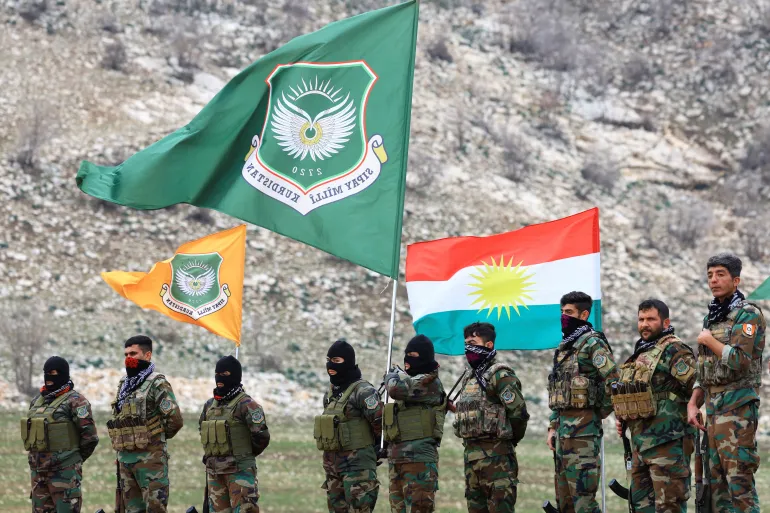
The outlines of that decentralized future are already visible. Regions such as Ahwaz and Sistan-Baluchestan as well as Kurdish areas have long existed at the edge of full central control. IRGC-linked economic networks dominate smuggling and logistics corridors that run through Iraq, Lebanon, Yemen, and the Gulf, creating entrenched ecosystems tied to militias and informal finance. If Tehran weakens further, authority will not simply dissolve. It will migrate outward into competing nodes of power that claim legitimacy in the revolution’s name.
The Iraqi militia ecosystem after ISIS offers a clear precedent: dozens of groups operating through overlapping loyalties and independent financing streams.
For Israel, this trajectory creates a deterrence landscape that grows more complex as Iran weakens. A degraded command structure reduces the likelihood of a tightly synchronized multi-front war directed from Tehran, yet fragmentation multiplies the number of armed actors capable of generating instability across several arenas. The Iraqi militia ecosystem after ISIS offers a clear precedent: dozens of groups operating through overlapping loyalties and independent financing streams. Hezbollah and Houthis could still gain greater operational latitude, and Iraqi militias could deepen localized revenue models rooted in trafficking and protection economies. Security in such an environment revolves less around preventing a decisive war and more around managing persistent gray-zone pressure.
The Gulf faces a different exposure that links physical vulnerability with perception. The 2019 Abqaiq strike demonstrated how a relatively small, precise attack could disrupt global energy flows overnight. Similar strikes against desalination plants, liquified natural gas terminals, or undersea cables could produce outsized strategic effects. A fragmented Iranian ecosystem increases the number of actors capable of launching such operations while muddying responsibility. Perception moves faster than proof in those moments, and Tehran has long understood the value of shaping early narratives. Countries along Iran’s periphery will feel these pressures first. Azerbaijan sits close to the fault line geographically and politically, given its border with Iran and its quiet intelligence relationship with Israel. Jordan faces an even heavier burden. It already sits at the intersection of Syrian militias, Iraqi smuggling routes, and Palestinian volatility, and Iranian-linked narcotics networks moving through southern Syria have turned parts of its frontier into a shadow conflict zone.
Challenges for U.S. Forward Basing Architecture
These pressures feed directly into the structure of U.S. power in the region. Al Udeid Air Base in Qatar remains the largest American military installation in the Middle East and a central hub for air operations and intelligence coordination. That concentration delivers efficiency, but it also creates a dense node of risk in an era defined by missile saturation and information warfare.
Once static installations become primary targets, the logic of forward basing changes.
The forward basing model that underpins this posture is entering structural stress. For decades, American power projection relied on large and centralized installations built in an era when adversaries lacked precision strike capabilities. Iran has spent years eroding that assumption through ballistic missiles, drones, and proxy saturation strategies designed to hold fixed infrastructure at risk. Once static installations become primary targets, the logic of forward basing changes.
Direct confrontation has accelerated that shift. U.S. and Israeli strikes on Iranian assets have pushed American infrastructure further into Tehran’s deterrence calculus. Iran has already demonstrated a willingness to strike U.S. facilities directly, and escalation cycles make fixed installations visible and symbolically attractive targets. The more centralized the posture, the more predictable the targeting logic becomes.
This structural shift intersects directly with intelligence and communications concerns. When operational hubs also function as political and informational chokepoints, risks compound across domains. Physical vulnerability, communications exposure, and narrative contestation will converge in the same geographic nodes, forcing planners to think about basing as a multi-domain risk environment rather than a logistics problem.
Qatar’s Role Under Microscope
That reality is now reframing the Qatar question. Doha has long combined state survival strategy with activist regional positioning, maintaining relationships with Islamist movements and preserving working ties with Tehran while hosting critical Western military infrastructure. Those choices shape the operational environment in ways that matter most to intelligence and communications.
Intelligence cooperation depends on confidence in the tight control of sensitive information. When core U.S. operations rely heavily on infrastructure embedded in a politically complex environment, planners have no choice but to adjust behavior. Intelligence needs to become more compartmentalized, disclosures will grow more selective, and coordination timelines may stretch in ways that rarely surface publicly but shape real outcomes. Israel and Bahrain voice the most direct skepticism toward Qatar’s regional posture, while Saudi Arabia, the United Arab Emirates, and Jordan manage more complex relationships shaped by normalization, economics, and regional politics. Riyadh restored ties with Doha after the Al-Ula Accords, which ended Anti-Terrorism Quartet’s blockade without securing any concessions, and now handles the relationship pragmatically. The United Arab Emirates engages economically with Qatar despite long-standing ideological differences. Jordan relies heavily on Qatari investment and financial support, which constrains how openly it can challenge Doha. These dynamics keep many concerns in private channels even as operational realities continue to evolve.
Qatar’s proximity to Iran and its long engagement with Islamist actors creates persistent exposure risks that planners cannot ignore when sensitive intelligence, operational coordination, and military communications move through infrastructure there.
The same logic applies to communications security. Coalition warfare depends on trusted communications environments where planners can safely assume coordination, timing, and protected digital signatures. Operational proximity alone can create friction even without espionage because modern intelligence ecosystems leak through inference as much as breach. In tightly monitored theaters, the distance between activity and awareness will compress quickly.
Washington must confront a hard reality: using Qatar as a central hub places U.S. communications and operations in a compromised security environment. Qatar’s proximity to Iran and its long engagement with Islamist actors creates persistent exposure risks that planners cannot ignore when sensitive intelligence, operational coordination, and military communications move through infrastructure there. Although Qatar is unlikely to face major scrutiny under the Trump administration, in the future, that environment will force U.S. decision-makers to assume vulnerability rather than full security, driving tighter compartmentalization, rerouted communications pathways, and more guarded operational coordination during crises.
Qatar As Information Space Liability
The information dimension deepens the challenge further. Qatar sits at the center of one of the most influential media ecosystems in the Arabic-speaking world, giving it outsized influence over the framing of crises in real time. Iran has long invested in narrative warfare that prioritizes early perception over factual precision, pushing emotionally resonant claims into the information space before forensic clarity emerges. When military operations rely on infrastructure embedded within a state that also anchors powerful narrative platforms, physical basing and informational terrain inevitably merge. Early framing narrows political space and complicates coalition messaging long before intelligence agencies complete their assessments.
For the United States, protecting regional assets now requires more than missile defenses and hardened facilities. It demands distributed basing, diversified communications architecture, and tighter alignment among partners that share threat perceptions.
Oman introduces a quieter but still relevant layer of complexity through its mediation channels and proximity to Tehran. Muscat’s diplomatic utility is real but its mediation networks – with multiple adversarial ecosystems – introduce additional uncertainty into already conflicted decision cycles.
For the United States, protecting regional assets now requires more than missile defenses and hardened facilities. It demands distributed basing, diversified communications architecture, and tighter alignment among partners that share threat perceptions. The legacy model of dense, static forward basing is giving way to a more fluid posture shaped by dispersion and redundancy.
The consequences of operations against Iran extend far beyond Tehran’s internal trajectory. Military outcomes now intersect with alliance design, basing geography, and information competition in ways that will shape the regional order for years to come. The Middle East is entering a prolonged period of systemic adjustment in which weakened central authority produces persistent instability rather than rapid resolution. Smuggling networks, militias, and competing narratives will fill the spaces centralized power leaves behind. The durability of U.S. regional influence will depend on how effectively Washington adapts its strategy to a landscape where legacy basing assumptions no longer hold and structural risks are at the center of power projection.