The Fragile Truce: Why the 1992 Consensus Risks Becoming Taiwan’s New Stamp Act

Abstract
This commentary compares the Stamp Act Repeal and the 1992 Consensus as tenuous agreements delaying conflict but failing to resolve core legitimacy disputes. Taiwan’s Consensus faces domestic rejection amid rising PRC coercion. The analysis critiques over-reliance on ambiguous frameworks, considers U.S. policy ambiguity, and offers recommendations such as dialogue, multilateral mediation, and transparency to avert a regional and global crisis.
Introduction
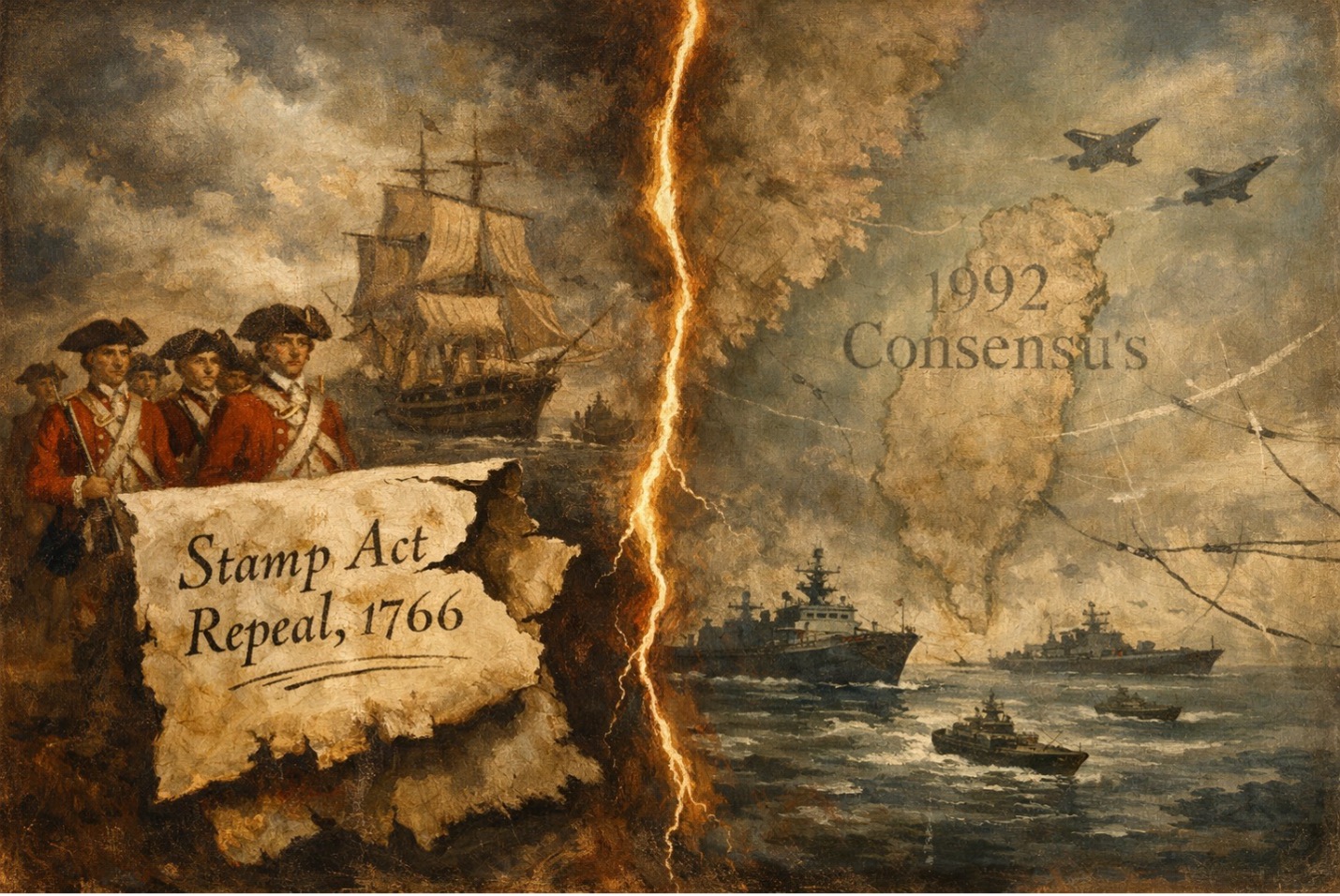
History often turns on quiet moments when political actors mistake a temporary pause for genuine stability. The Stamp Act Repeal of 1766 offered Britain and its colonies a fleeting calm, yet the underlying contest over authority and identity remained unresolved. The repeal reassured London that compromise had worked and encouraged colonists to imagine a future unconstrained by imperial limits. Within a decade, that misreading erupted into open rebellion.
This parallel is not mere metaphor but a structural warning. Ambiguous arrangements generate mismatched expectations over sovereignty and legitimacy: Britain versus the colonies on parliamentary authority, and today Beijing versus Taipei on the meaning and finality of “One China.” When identities consolidate, power asymmetries widen, or third parties intervene unevenly, ambiguity stops stabilizing and instead magnifies escalation risk.
This same pattern now haunts cross-strait relations.
The 1992 Consensus, once a pragmatic diplomatic shorthand and increasingly invoked as a political lifeline, serves mainly to buy time without resolving sovereignty disputes. Beijing treats it as a step toward eventual unification. A growing majority in Taiwan sees it as outdated and disconnected from democratic reality. Washington, caught between strategic ambiguity and alliance signaling, hopes it prevents miscalculation rather than produces resolution.
This divergence makes the moment especially dangerous. Rising People’s Liberation Army (PLA) pressure, uneven U.S. signals, and a consolidating Taiwanese identity create a landscape where one side’s reassurance appears as the other’s retreat. History warns that when rhetorical formulas outlive the realities they claim to manage, confrontation becomes more likely. Apparent calm often conceals accumulating structural strain.
Today, the Consensus’s ambiguity has shifted from stabilizing fiction to strategic liability. Beijing exploits vagueness to frame engagement as “good faith” progress while pressing for further concessions. At home, adherence increasingly reads as capitulation, eroding legitimacy, deepening divisions, and inviting sustained gray-zone coercion without crossing the war threshold.
As the region faces its own test of resolve, the lesson of 1766 is not nostalgia but warning: temporary settlements may delay reckoning, but unresolved legitimacy and identity turn delay itself into danger.
Stamp Act Repeal: Anatomy of a Temporary Truce
The Stamp Act Repeal of 1766 illustrates how limited concessions on secondary issues can temporarily defuse unrest without resolving core disputes over legitimacy. It offers a clear historical parallel for why ambiguous political frameworks like the 1992 Consensus may delay confrontation while tensions continue to accumulate.
After the Seven Years’ War, Britain faced acute fiscal strain and turned to its American colonies to share the burden. In 1765, Parliament passed the Stamp Act, taxing legal documents, newspapers, and other printed materials. Colonists interpreted the measure as a direct assault on political rights, rallying behind the slogan “No taxation without representation.” Because the tax penetrated daily economic and civic life, it transformed elite protest into mass resistance, turning a revenue dispute into a legitimacy crisis.
Resistance quickly became organized.
The Stamp Act Congress convened in New York in October 1765, uniting delegates from nine colonies to petition the Crown. Non-importation agreements curtailed British exports, demonstrating that dissent carried tangible economic leverage. Grassroots groups such as the Sons of Liberty pressured stamp distributors to resign, making enforcement untenable. Facing unrest and commercial losses, Parliament repealed the Act on March 18, 1766. The repeal, however, was paired with the Declaratory Act, asserting parliamentary authority “in all cases whatsoever.” London retreated tactically while reaffirming supremacy, leaving trust weakened rather than restored.
The truce did not last. The Declaratory Act fueled skepticism, and new taxes under the Townshend Acts deepened resentment. Violence followed: the Boston Massacre in 1770, the Boston Tea Party in 1773, and armed clashes by 1775 at the Battles of Lexington and Concord. Britain also relied on military presence and maritime pressure, a structural parallel to contemporary anti-access and area-denial (A2/AD) strategies employed by the People’s Republic of China in the Taiwan Strait.
In both cases, coercion short of war raised the costs of resistance and external intervention without resolving the underlying sovereignty dispute. The Stamp Act episode shows that temporary truces grounded in partial concessions and ambiguous authority rarely stabilize indefinitely.
By deferring legitimacy conflicts rather than resolving them, such arrangements demand constant recalibration and become increasingly brittle over time; a lesson that resonates when assessing the 1992 Consensus amid Taiwan’s current geopolitical uncertainty.
The 1992 Consensus: De Facto Truce in Cross-Strait Relations
Since 1949, Taiwan has lived in the shadow of the mainland while shaping an identity of its own. Martial law once muted local voices, but democratization in the late 20th century irreversibly reshaped political life.
By the mid-2020s, more than three-quarters of the population identified as “Taiwanese only,” a quiet but firm statement that challenges Beijing’s unification ambitions. Society now walks a delicate line: it seeks peace and engagement yet refuses to surrender autonomy. This identity-driven constraint gives the Consensus residual stabilizing value while steadily eroding its political viability.
The 1992 Consensus was founded on deliberate ambiguity. Both sides invoked “One China,” yet assigned it incompatible meanings. This “constructive ambiguity” enabled pragmatic cooperation by deferring the sovereignty question, allowing economic exchange to proceed without political resolution. Ambiguity functioned less as a settlement than as a tactical lubricant, permitting interaction without agreement.
The arrangement delivered tangible results, particularly between 2008 and 2016, as cross-strait integration deepened, and trade expanded into the early 2020s. But economic interdependence outpaced political trust. The same ambiguity that sustained cooperation also constrained durability by postponing rather than resolving questions of legitimacy. As Taiwanese identity consolidated across generations, the Democratic Progressive Party (DPP) moved decisively away from the framework, treating ambiguity as political liability rather than strategic asset.
The late-2025 election of Cheng Li-wun as Kuomintang (KMT) chair marked a renewed elite effort to revive the Consensus. She also criticized the DPP’s 2026 defense budget hike as insufficient without parallel dialogue, presenting the framework as a gateway to Track II engagement.
Commemorations of the Ma–Xi meeting reinforced this approach. Beijing welcomed the shift, while domestic critics dismissed it as outdated, underscoring deep political divisions. More critically, the episode exposed a widening elite–public legitimacy gap: what party leaders frame as pragmatic diplomacy is increasingly viewed by the public as misaligned with democratic agency and lived identity.
Internal and external pressures now reinforce one another. The DPP’s continued rejection of the framework coincides with sustained People’s republic of China’s (PRC) coercion. The PLA activity intensified through late 2025, including frequent sorties and repeated median-line crossings.
In response, President Lai Ching-te’s October 10 address reaffirmed sovereignty, further narrowing political space for compromise defined on Beijing’s terms. Taiwan has accelerated asymmetric deterrence rather than provocation. Its “T-Dome” multilayered air and missile defense system raises the cost of coercion while signaling defensive resolve.
Overtime, Beijing’s strategy has shifted toward persistent gray-zone pressure, including efforts to disrupt undersea cables and energy infrastructure. This reflects recalibration rather than restraint: less visibility, greater deniability, sustained pressure.
Taken together, these dynamics expose the core dilemma of the Consensus. It creates diplomatic space, but must operate amid coercion, polarization, and an identity that increasingly resists Beijing’s framing. Like the Stamp Act’s temporary reprieve, an ambiguous truce can delay conflict but cannot resolve deeper legitimacy disputes. The 1992 Consensus now survives as a narrow and fragile bridge; it is usable but structurally weakened by coercion and domestic rejection.
To keep it standing, Taiwan needs creative diplomacy, steady leadership, and policies anchored explicitly in the identity its people have chosen. Only then can ambiguity stabilize behavior rather than merely postpone crisis.
Strategic Parallels and Lessons
History and strategy rhyme across centuries. Temporary truces delay conflict, but when ambiguity replaces legitimacy, risk accumulates.
Authority remains contested, coercion tests resilience, and identity hardens. Diplomatic fragility, gray-zone pressure, and external signals now erode ambiguity’s stabilizing power across the Taiwan Strait.
Diplomatic Fragility
The Repeal and the Consensus illustrate the weakness of agreements built on unresolved authority. Britain repealed an unpopular tax to restore trade and calm unrest, yet paired it with the Declaratory Act, reaffirming parliamentary supremacy. Colonists welcomed relief, but legitimacy remained unsettled. Similarly, the Consensus enabled dialogue and trade while deliberately deferring the question of sovereignty and political identity.
Efforts by KMT leadership to revive the framework now face broad public resistance, with roughly 73 percent of Taiwanese opposed. Like the Declaratory Act, such revivals show that stability pursued without legitimacy may buy time but often deepens mistrust.
The problem is not ambiguity per se, but ambiguity operating under sustained PRC coercion. Beijing exploits vagueness to frame pressure as progress, while even limited Taiwanese flexibility is read domestically as capitulation, eroding credibility and accelerating polarization.
Gray-Zone Parallels
Britain pressured the colonies through taxation, troop deployments, and blockades without triggering war. Today, the PRC’s calibrated gray-zone operations serve a similar function: signaling dominance while avoiding open conflict. Taiwan’s “T-Dome” multilayered radar and missile-defense network counters A2/AD threats by raising the costs of coercion without provoking escalation. As with colonial militias deterring enforcement rather than conquest, Taiwan’s posture aims to resist pressure while keeping conflict below the threshold of war.
Identity and External Influences
Identity and external actors shape the durability of fragile truces. Colonial merchants and elites leveraged economic power to defend local autonomy. In Taiwan, a consolidated “Taiwanese-only” identity now constrains political maneuvering and sharply limits the KMT’s ability to operationalize the Consensus.
External pressures further strain ambiguity.
U.S. policy signals under the Taiwan Relations Act (TRA), combined with allied rhetoric such as Japan’s characterization of Taiwan as a “survival threat” amplify both domestic scrutiny and international stakes. Fragile truces are vulnerable not only to coercion by the dominant power but also to third-party signaling. Agreements that sidestep legitimacy and societal attachment tend to unravel under sustained pressure, regardless of strategic intent.
U.S. Policy Ambiguity and Consensus Over-Reliance
U.S. policy toward Taiwan remains uneven, creating strategic uncertainty that Beijing can exploit. Arms sales under the Trump administration signaled commitment by strengthening Taiwan’s ability to counter A2/AD threats. Yet the simultaneous withholding of $400 million in aid and blocked visits by Taiwanese officials, including Lai Ching-te, conveys mixed signals.
Beijing may read this inconsistency less as restraint than as hesitation, echoing how colonial Americans interpreted Britain’s post–Stamp Act concessions as weakness rather than reconciliation.
The November 1 APEC summit’s “G2” framing of managed U.S.–China rivalry, absent explicit assurances for Taiwan, reinforced perceptions of marginalization, even as Taipei faced sustained PRC gray-zone coercion.
A subsequent U.S. radar-focused arms sale on November 18 reaffirmed deterrence but also highlighted the stop-start nature of support. Likewise, the G7’s November 13 joint statement backing peaceful resolution and meaningful Taiwanese participation signaled normative support while exposing the limits of declaratory diplomacy without operational follow-through. Taiwan must therefore sustain credible deterrence while interpreting allied signals with caution to avoid miscalculation.
These mixed U.S. signals interact directly with Taiwan’s domestic legitimacy divide. Ambiguity weakens pro-Consensus elites, who frame the Consensus as a pragmatic stabilizer. When a public with a strong Taiwanese-only identity perceives U.S. hesitation as potential abandonment, compromise is recast as capitulation rather than prudence, widening the elite–public legitimacy gap and reinforcing resistance to Beijing’s terms.
Taiwan’s over-reliance on the Consensus compounds this risk.
Cheng’s revival criticized defense expansion and promoted renewed adherence as a diplomatic lifeline, but broad domestic opposition and Beijing’s rigid “One China” interpretation sharply constrain its utility. Excessive dependence on this ambiguity sidelines alternative crisis-management tools and cedes initiative to the PRC.
U.S. inconsistency thus destabilizes deterrence as it erodes extended deterrence credibility, invites gray-zone probing, and forces Taiwan into precarious hedging that deepens internal divisions rather than resolving them.
A more resilient approach must pair calibrated engagement with clearer deterrence, including a standing hotline linking military, civilian, and diplomatic channels. Such guardrails reduce miscalculations and ensure Taiwan is not left relying on a politically exhausted framework to manage escalation.
Counterarguments and Opposing Views
The piece adopts a calibrated realist perspective: while strategic ambiguity has historically reduced miscalculation, its stabilizing value erodes under consolidated Taiwanese identity, sustained PRC gray-zone coercion, and uneven external signaling.
Both confrontation and strict adherence to the 1992 Consensus carry risks. Escalation could trigger regional conflict and global economic shock, while over-reliance on ambiguity may weaken deterrence and hollow out domestic legitimacy. The most credible path lies in calibrated deterrence, selective engagement, and multilateral guardrails aligned with Taiwan’s political realities.
Some analysts advocate confrontation, arguing Taiwan requires a clear, unambiguous signal of resolve. They contend ambiguity invites coercion and that formal recognition would lock in deterrence by raising costs for Beijing. Beijing hardliners mirror this logic from the opposite direction, framing Taiwan as a test of national will and insisting calibrated pressure is necessary to shape outcomes.
Proponents of the 1992 Consensus counter that ambiguity lowers friction, preserves dialogue, and limits miscalculation. Yet the framework now faces broad societal rejection, increasingly viewed as constraining democratic agency rather than enabling peace. This elite–public legitimacy gap exposes the limits of relying on inherited formulas amid rapid political and strategic change.
Balancing these views requires attention to both power and identity. Escalation through recognition or coercion could disrupt global supply chains at trillion-dollar scale; while the Consensus, though stabilizing in theory, fails to accommodate Taiwan’s consolidated identity, with a clear majority identifying solely as Taiwanese.
Historical parallels suggest temporary settlements delay confrontation without resolving core grievances. While large-scale war remains unlikely, engineered concessions or gray-zone coercion could steadily erode autonomy without crossing war thresholds.
These risks underscore the need for de-escalation strategies grounded in diplomacy, credible deterrence, and societal legitimacy, rather than reliance on rigid or ideological frameworks, a concern increasingly emphasized by the G7 and other partners.
Avoiding War in Cross-Strait Relations
As cross-strait tensions persist, the window to prevent escalation is narrowing. Historical lessons from the 1766 Stamp Act Repeal and recent political shifts show that neither unchecked military buildup nor unilateral sovereignty assertions guarantee security. Stability requires diplomacy, credible deterrence, and domestic legitimacy reinforcing each other. A balanced mix of selective dialogue, transparent deterrence, and multilateral engagement offers the most viable path forward. This section outlines what dialogue can achieve, how de-escalation can be operationalized, and why delay compounds risk.
Feasibility of Dialogue
Cheng Li-wun’s revival of the 1992 Consensus opens a narrow space for Track II dialogue through think tanks and semi-formal channels. These allow Taipei and Beijing to test ideas without binding commitments. Domestic skepticism and DPP opposition sharply limit flexibility, while Beijing risks framing symbolic engagement as progress toward unification. Multilateral signals offer some cover but remain limited. Dialogue is feasible only if framed explicitly as risk reduction, not political convergence.
De-escalation Strategies
Temporary truces collapse without guardrails as seen in the Stamp Act Repeal. Ambiguity must be reinforced with concrete stabilizers:
- Crisis communication: Modernize the cross-strait hotline and embed it in a trilateral U.S.–PRC–Taiwan incident-prevention protocol, providing circuit breakers for routine encounters.
- Transparent deterrence: Establish a rolling, public exercise calendar with regional partners, coupled with explicit no-first-use statements to reduce misinterpretation.
- Critical infrastructure resilience: Diversify and harden energy and semiconductor networks through coordinated pacts with the U.S., Japan, South Korea, the Netherlands, and Taiwan, raising costs of gray-zone coercion without triggering conflict.
- Cognitive resilience: Strengthen early-warning and counter-disinformation mechanisms to blunt pressure campaigns that erode public cohesion.
Together, these guardrails shift the Strait from reactive crisis management toward proactive stability. Allied support for Taiwan’s integrated air/missile defenses reinforces this, but follow-through matters more than declaratory statements.
Consequences of Inaction
Neglect carries severe risks. Full-scale war remains unlikely, but gray-zone coercion and accidental escalation are immediate dangers. Unilateral moves toward formal independence could provoke sharp responses, while misread allied hesitation encourages coercive tests. Public rejection further weakens Taiwan’s negotiating leverage, while civic, institutional, and economic disruptions amplify vulnerability.
The global stakes are immense. Taiwan produces over 90% of leading-edge semiconductors, anchoring AI, HPC, and tech supply chains. Even limited disruption could trigger economic shocks exceeding $1 trillion. Policymakers increasingly view even contained conflict as a systemic threat.
As interdependence deepens, fragile truces like the 1992 Consensus are insufficient. Without proactive guardrails aligned with Taiwan’s democratic realities, delay favors coercion over stability and raises the eventual costs of resolution.
Conclusion
The parallels between 1766 and the current cross-strait moment point to an uncomfortable truth: neither ambiguous formulas nor symbolic concessions can bridge a divide rooted in sovereignty and identity. The 1992 Consensus may delay escalation, but it no longer functions as a durable stabilizer. The real danger lies in mistaking delay for resolution.
History shows that actors trapped in mismatched expectations often drift toward confrontation even while claiming to seek peace. Britain relied on firmness; the colonies on resistance. Both misread the other’s risk threshold. That same pattern now shadows Beijing, Taipei, and Washington, each interpreting restraint as weakness and reassurance as retreat.
Avoiding that outcome requires more than managing ambiguity. It demands proactive diplomacy anchored in legitimacy, transparent U.S.–Taiwan coordination, and credible deterrence paired with restraint. Taiwan and its partners should act first by implementing practical guardrails, including modernized hotlines, transparent exercise calendars, supply-chain resilience pacts, and multilateral confidence-building forums to reduce miscalculation and deny gray-zone opportunism.
Relying on Beijing to moderate coercion first risks further erosion of deterrence credibility and domestic cohesion in Taiwan. Sustained PRC restraint and reciprocal engagement remain essential, but time favors neither ambiguity nor inaction. With major powers calling for restraint, the window for action is open but narrowing. If illusions harden into strategy, the next rupture will be far more difficult and more costly to contain.