From Hormuz to Harvest: The Strategic Clock of Modern Agriculture

Abstract: Rising tensions in the Persian Gulf are beginning to ripple through global fertilizer markets just as shipments normally move toward farms ahead of the spring planting season. Because fertilizer deliveries are tightly synchronized with agricultural production cycles, disruptions during this window can shape harvest outcomes months before crops are even planted. If current instability continues to tighten fertilizer markets, the effects could reach the upcoming growing season sooner than policymakers or planners anticipate.
Rising tensions in the Persian Gulf are beginning to ripple through global fertilizer markets. Urea prices are climbing as markets react to the possibility that instability could disrupt fertilizer shipments moving through the Persian Gulf just as fertilizer normally moves toward farms around the world. The real problem is not price volatility. It is timing. When fertilizer supply chains are disrupted just prior to planting season, the damage is locked into the agricultural cycle months before harvest.
For the United States, the risk runs deeper than temporary price spikes. American agriculture has long been a strategic asset, underpinning global food markets and reinforcing U.S. economic influence. The United States remains one of the world’s largest agricultural exporters, supplying a substantial share of global grain, soybeans, and livestock feed markets. That strength rests on a system built for efficiency: high yields, specialized inputs, and tightly optimized supply chains. Disrupt the inputs that sustain that system and the very efficiencies that make U.S. agriculture powerful can become a source of vulnerability.
Fertilizer and the Structure of Modern Agriculture
Modern agriculture runs on synthetic fertilizer. Nitrogen derived from natural gas is one of the most important inputs in the global food system. Crops such as corn, soy, and wheat depend on it to reach modern yield levels, and nitrogen must be applied within defined windows tied to planting cycles and early crop development. Farmers cannot simply delay its use; miss that window and the decision is already made. Farmers can only reduce application, plant late, or switch crops (though other inputs may already be locked in). All of these choices reduce yield.
The structure of fertilizer production makes the system particularly vulnerable. Nitrogen fertilizer production depends heavily on natural gas and is concentrated in a relatively small number of regions. Cheap gas has turned the Persian Gulf into one of the world’s most important fertilizer production and export hubs. Producers in Qatar and neighboring states ship large volumes of urea and other fertilizers into global agricultural markets. Interrupt energy supplies or shipping routes in the region and the effects cascade through fertilizer markets and eventually into food production.
Agriculture runs on a schedule that does not adjust to geopolitics. Fertilizer purchases, deliveries, and application all move in rhythm with the growing season. If disruptions occur early enough or are resolved in time, farmers can adapt. If they occur later, options disappear quickly.
Fertilizer shipments leaving Gulf production facilities move in tight synchronization with planting cycles in major agricultural regions. When those flows are disrupted, the effects reach farms quickly. Even a delay of a few weeks can push fertilizer application past the point when yields are effectively determined.
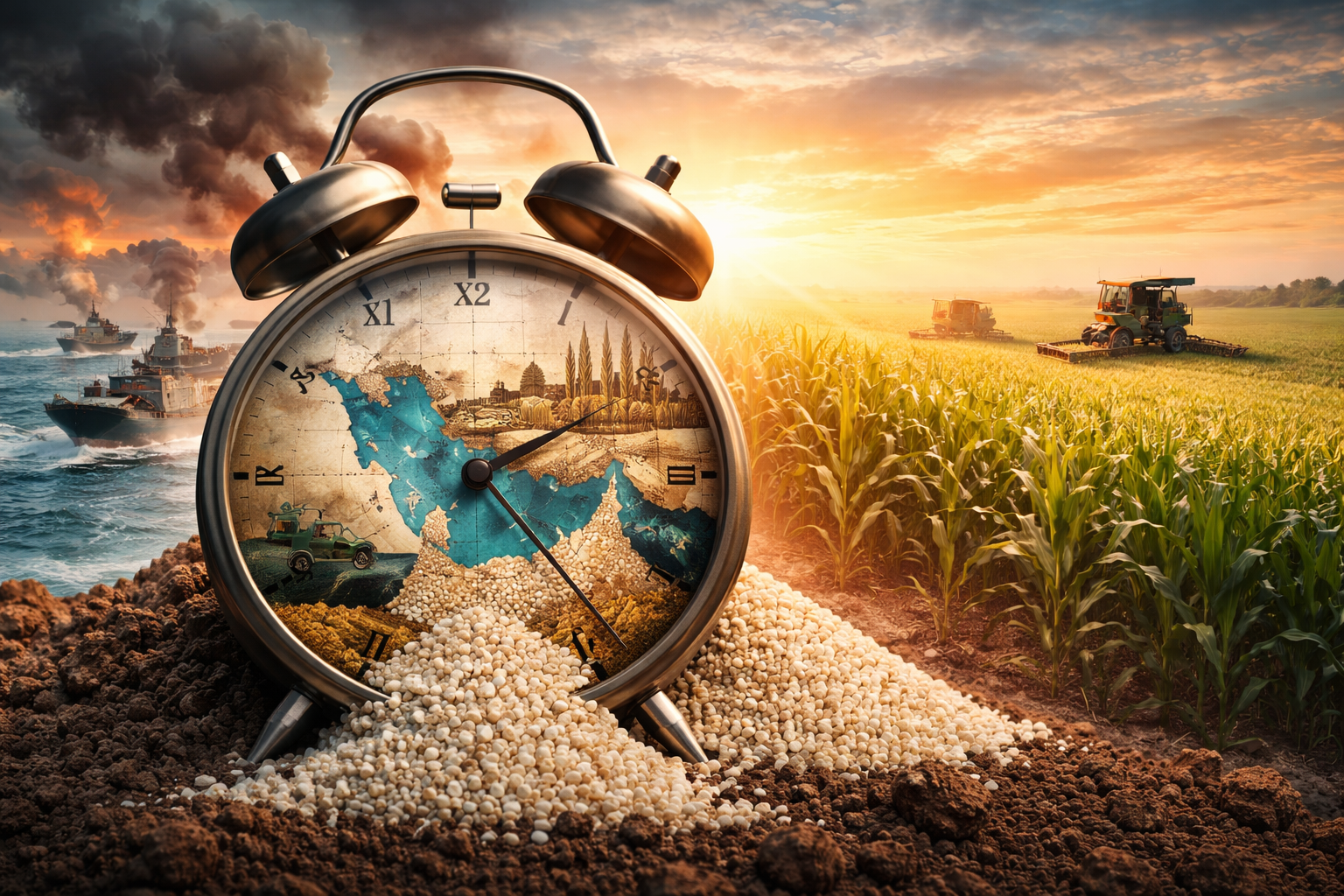
The agricultural calendar becomes a strategic clock. Interrupt input supplies at the wrong moment and the harvest is already decided.
A Warning from 2022
The world received a clear warning about this vulnerability in 2022. Russia’s invasion of Ukraine triggered an immediate shock to global fertilizer markets. Russia and Belarus are major exporters of nitrogen, potash, and other nutrients. Logistical disruptions in the Black Sea and Russia’s cutoff of natural gas supplies to European fertilizer plants sharply constrained production and exports. Farmers across multiple regions were suddenly forced to rethink fertilizer application rates and planting decisions.
Farmers in the American Southwest saw this pressure directly during that shock, when fertilizer costs surged and availability came into question just as producers were preparing to plant. Input markets stabilized quickly enough to prevent the worst outcomes, but the episode showed how quickly disruptions upstream can reach the farm.
Timing limited the broader damage. The invasion began in February, before fertilizer demand peaked across major U.S. growing regions. Markets adjusted, helped by the United States’ decision to exempt Russian fertilizer from sanctions regimes. Supplies moved before the disruption reached the Midwestern planting cycle, though producers in warmer regions felt the pressure sooner. The disruption was serious, but it did not arrive at the worst possible moment.
The Emerging Risk Window
The current situation is unfolding on a tighter timeline.
Instability in the Persian Gulf is already moving through fertilizer markets. Fertilizer shipments typically move in large seasonal batches weeks before planting, as distributors build inventory ahead of the April and May planting cycle in the Midwest corn and soybean belt. Some supplies are already positioned, but the system is still moving product through that distribution window.
If disruptions persist through the late-winter fertilizer distribution window, the consequences could reach the U.S. growing season quickly. The difference today is timing. The Ukraine shock began in February. The current disruption arrives closer to the Midwest planting window, leaving less time for markets and supply chains to adjust. The question now is whether the system has already secured the fertilizer it needs for the season ahead, or whether that assumption is being taken for granted.
Strategic Targeting of Food Systems
This dynamic highlights a broader shift in how conflict interacts with food systems. Scholarship and policy have traditionally treated food insecurity as a consequence of conflict, especially in import-reliant regions that depend heavily on global grain markets. Food itself has occasionally been used as a weapon of war, particularly in vulnerable areas, but it has more often been viewed as an outcome rather than a target. In recent years, however, food systems and the infrastructure that support them have increasingly become targets of strategic pressure.
The farms where agricultural production takes place are rarely the point of attack (Ukraine excepted). Pressure is applied earlier in the chain. Energy markets, fertilizer plants, shipping routes, and logistics networks all sit upstream of the harvest. Disrupt those systems and the effects show up in fields months later.
Fertilizer supply chains sit squarely inside that vulnerability. Actors seeking to exert pressure on food systems do not need to destroy crops or blockade grain shipments. They need only disrupt fertilizer production, energy supplies, or transportation routes to achieve the same result. Energy shocks, especially to natural gas, can idle fertilizer plants. Shipping delays can push deliveries past the narrow windows when fertilizer must be applied. Cyber operations targeting production facilities or logistics networks can grind production to a halt.
The consequences extend well beyond fertilizer markets. Modern agriculture depends on a tightly integrated network of inputs, from seeds and crop protection chemicals to livestock feed supplements and equipment parts. The system is extraordinarily productive because it is optimized. That same optimization makes it fragile. When disruptions hit any of these supply chains during critical production windows, the effects cascade quickly through agricultural output, tightening global grain supplies and driving price volatility.
Despite this, agricultural supply chains are only beginning to enter national security discussions about critical infrastructure and economic resilience. Strategic conversations often focus on semiconductors, energy systems, or rare earth minerals. Food systems rarely receive the same level of attention. The inputs that sustain agricultural production receive even less, despite their central role in both national resilience and global stability.
Conclusion
From the Strait of Hormuz to the cornfields of the American Midwest, agricultural supply chains now form part of the strategic landscape. For decades, the scale and productivity of American agriculture have been a source of economic strength and geopolitical influence. But that strength now depends on highly optimized input systems that can be disrupted far from the farm. These pressures are unlikely to fade; they reflect a broader shift in how economic systems are used in strategic competition. Ignoring that reality does not reduce the risk. It only guarantees the next crisis will once again arrive as a surprise.