





The Neuro-Tactical Debrief: Treating Cognitive Maintenance as a Logistics Function
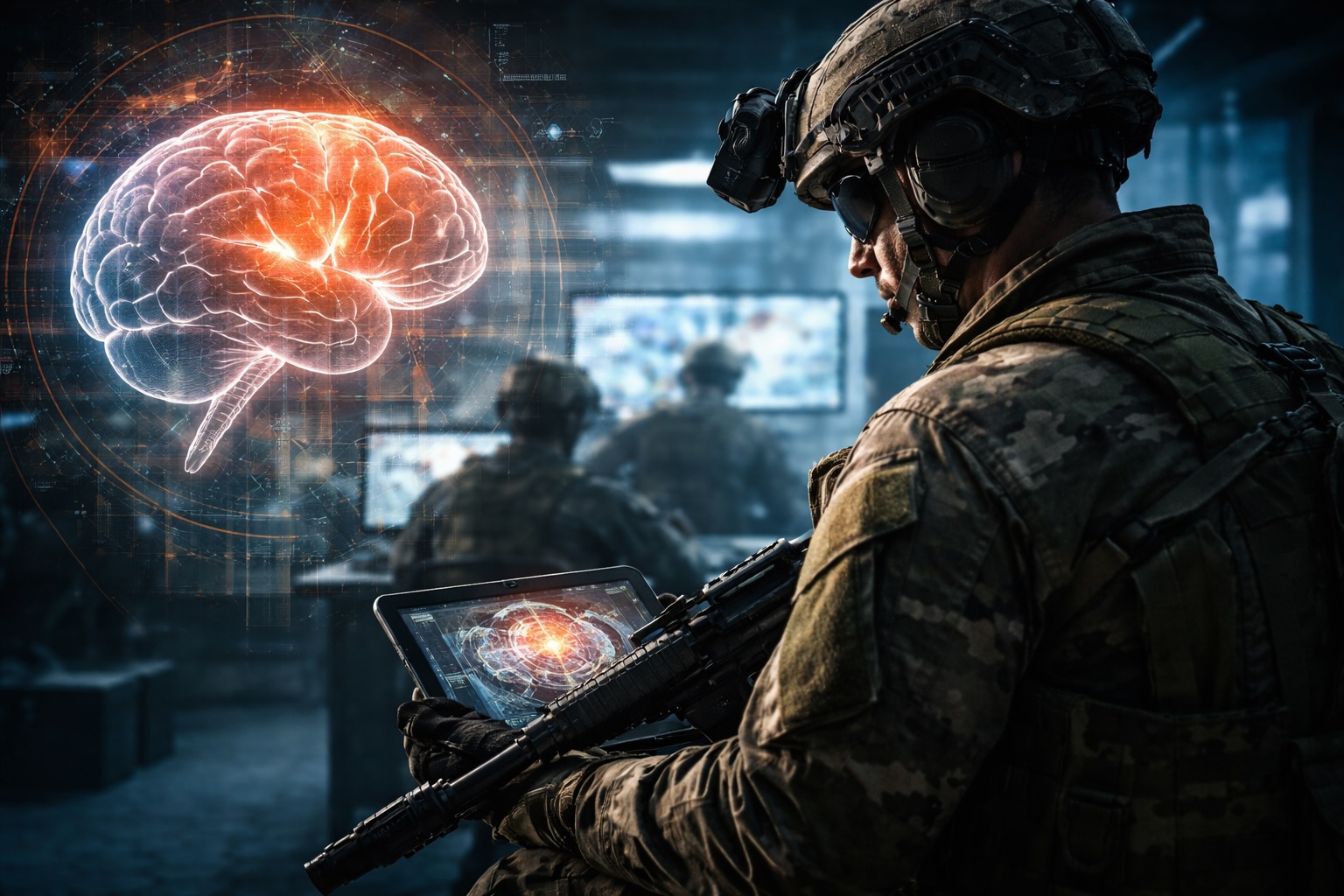

The raid was textbook. The entry team breached, secured the High Value Target, and exfilled in under 12 minutes. No shots were fired. In the parking lot, the Team Leader marks the mission a complete success.
He missed the point man, who is quietly vibrating against the bumper of the truck. Why? Because upon entry, a teenager reached for a cell phone. The point man recognized the threat, engaged, and applied four pounds of pressure to a five-pound trigger before his cortex overrode his amygdala. He didn’t shoot. But his biology doesn’t know that. His system just dumped the same cocktail of cortisol and adrenaline as if he had killed a child. The After-Action Review (AAR) says, “Good Discipline.” His physiology says, “Catastrophic Event.” Because the leader ignores this ‘biological debt,’ that operator walks through his front door and detonates on his spouse over a minor annoyance, destroying the very home front he fights to protect.
The Maintenance Myth
If a squad leader returned from that patrol and refused to let his team clean their weapons or service their vehicles because they “didn’t have time,” he would be relieved of command for negligence. We understand intuitively that mechanical friction, if left unaddressed, leads to failure in the next engagement.
Yet, that same leader will routinely ignore the maintenance of his most expensive and volatile weapon system: the human operator’s cognitive processing unit.
We currently treat the brain as a magic black box, something that either works or doesn’t. When it breaks, we label it a medical issue, post-traumatic stress disorder (PTSD), or a discipline issue (burnout). This is a strategic error. The degradation of decision-making capability under stress is not a “wellness” issue; it is a logistics issue. It is a predictable byproduct of operational friction, no different than sand in a rifle chamber.
As leaders, we need to stop admiring the problem of “mental health” and start executing “Preventive Maintenance Checks and Services” (PMCS) on our people. We need the Neuro-Tactical Debrief.
The Science of the “Hijack”
To understand the brain’s logistics, we must understand the cost of doing business. When an operator enters a high-threat environment, the amygdala initiates a “stress mobilization” response. This is the biological equivalent of redlining an engine.
The critical impact here is on the Prefrontal Cortex (PFC), the part of the brain responsible for logic, long-term planning, and ethical decision-making. Under extreme stress, the PFC essentially goes offline, allowing the faster, instinctual brain to take over. This is the Yerkes-Dodson law in action.
While necessary for survival in the moment, the failure point is the residual heat. When the mission ends and the “All Clear” is given, the operator’s biology does not simply snap back to baseline. They remain in a state of “Redlining in Neutral”; the engine is racing, but the car isn’t moving. This state is metabolically expensive. It erodes sleep, kills executive function, and slows the OODA (Observe, Orient, Decide, Act) Loop. If a leader debriefs a mission’s tactical errors but ignores this biological state, they are sending an impaired operator into the next fight. They are deploying a weapon system with a warped barrel and expecting it to shoot straight.
The After-Action Review Gap
The standard After Action Review (AAR) is one of the most effective learning tools in doctrine. It ruthlessly dissects what happened and why. However, it suffers from a fatal blind spot: It assumes the participants are rational actors recording data.
Traditional AARs focus on Tactical Execution:
- Did we maintain sectors of fire?
- Did communications hold up?
- Was the timeline met?
The AARs rarely address Cognitive Capacity:
- Why did the point man freeze for two seconds before breaching?
- Why did the Shift Supervisor scream at a teammate over a minor error post-incident?
These participant actions are not discipline problems; they are indicators of cognitive friction. By ignoring them, we allow “tactical debt” to accumulate. We are failing to “reset the bolt” on our human weapon systems.
The Solution: The Neuro-Tactical Debrief
Operators do not need more mandatory briefings from the chaplain or a presentation on resilience. There is a need for a tactical protocol that integrates seamlessly into the existing AAR battle rhythm.
The Neuro-Tactical Debrief is a “cognitive PMCS.” It consists of three questions asked by the immediate leader, not a doctor, at the end of the operational cycle.
1. “Where was the friction?” (Identify the Stressor)
Instead of asking “how do you feel?” (which invites silence), ask where the friction points were. This allows the operator to discuss stress in professional, operational terms.
- Operator: “The communications blackout in the stairwell spiked the friction. I didn’t know if we were compromised.”
- Result: The leader identifies a specific stress trigger, validating the biological response without forcing a “feelings” conversation.
2. “What is your ‘cool-down’ plan?” (Force the Reset)
Just as we have a plan for cleaning gear, we must have a plan for clearing cortisol. The leader demands a specific, tactical answer.
- Leader: “We spin up again in 12 hours. What is your protocol to dump the adrenaline before then?”
- Acceptable Answers: “Hard PT,” “20 minutes of silence,” “Calling home.”
- Unacceptable Answer: “I’m fine, boss.”
- Result: This shifts the cultural expectation. Recovery becomes a “duty to perform,” not a sign of weakness.
3. “Are you green?” (Assess readiness)
We check if our night vision goggles are good to go. We need to check the operator. This is a binary assessment of decision-making capability for the next shift.
- Leader: “Based on the friction today, are you Green for the 0600 brief, or do you need an admin cycle?”
- Result: It creates a permissible environment to admit to temporary cognitive fatigue before it causes a negligent discharge or a tactical error.
Counter-Measure: This is Not Therapy
The immediate objection from the “Old Guard” is predictable: “We don’t have time to hold hands. We have a mission to do.”
There is a fundamental misunderstanding of the purpose of this protocol. The Neuro-Tactical Debrief is not therapy; it is a status check. This status check is no different than asking a sniper, “Is your scope holding zero?” If the answer is no, the rifle is not berated; instead, it is reset or re-zeroed. If an operator’s prefrontal cortex is offline, they cannot effectively process the rules of engagement (ROE). Ignoring that reality is not “toughness”; it is a liability.
Conclusion: Lethality is the Goal
The “why” generation of warfighters and security professionals is not asking to be coddled. These professionals are asking to be led with competence. They understand that any leader who disregards the science of human performance puts lives at risk.
Integrating the Neuro-Tactical Debrief is not about being soft; it is about sharpening combat lethality. A unit that systematically clears its biological stress learns faster, shoots more accurately, and endures longer. It is time to regard the mind as a primary system and maintain it with the same rigor and respect we give our rifles. Keep it clean, keep it calibrated, and it will not fail you when the breach happens.


