





Book Review | Modern Hybrid Warfare: Russia Versus the West
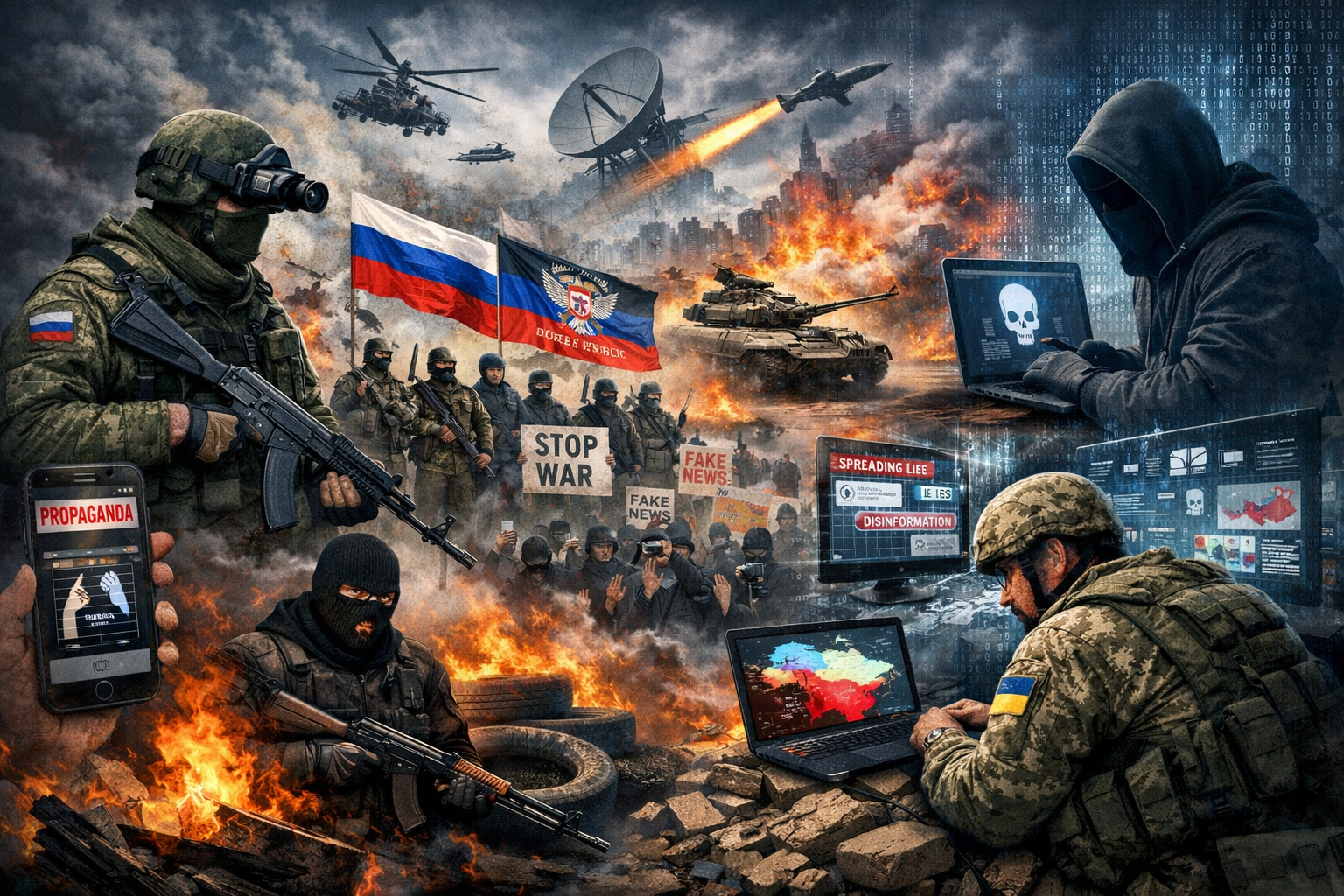

Modern Hybrid Warfare: Russia Versus the West. By Ryan C. Maness and Brandon Valeriano. New York: Bloomsbury Academic, 2025. ISBN: 978-1538198421. Pp. xv, 297. $39.00 at time of review.
Ryan C. Maness and Brandon Valeriano’s Modern Hybrid Warfare offers a rigorous empirical assessment of Russia’s hybrid warfare strategy against Ukraine and the West. The authors argue that while hybrid operations, such as cyberattacks, information warfare, and economic statecraft, particularly energy coercion, remain permanent features of modern conflict, they have failed as decisive strategic instruments. Contrary to widespread assumptions that advanced technologies – such as AI, unmanned systems, electronic warfare, and space assets – will revolutionize warfare, Maness and Valeriano argue that the Russo-Ukrainian War demonstrates that warfare’s fundamental nature remains unchanged: brutal, bloody, and highly dependent on adaptation and coordination rather than technological silver bullets. At a time when policymakers and military planners deal with questions about the future of conflict, this book provides essential analysis grounded in evidence rather than speculation.
Both authors bring substantial expertise to the subject. Ryan C. Maness is an Associate Professor in the Defense Analysis Department at the Naval Postgraduate School, researching cyber and information strategy, U.S. national security, Russian foreign and military policy, political warfare, and hybrid strategies. Brandon Valeriano, who passed away in 2025, was transitioning from Seton Hall University to the University of Southern California at the time of writing, having also served as a Distinguished Senior Fellow at the Marine Corps University and Senior Advisor to the Cyberspace Solarium Commission 2.0. His research focused on cyber-security, popular culture and conflict, race and ethnicity politics, and international conflict. This book builds on their previous collaborative works, including Russia’s Coercive Diplomacy (2015) and Cyber Strategy (2018). Their methodology combines quantitative analysis with qualitative case studies, leveraging over a decade of research on hybrid operations, such as the annexation of Crimea, the Donbas conflict, and Russian cyber operations against Ukrainian infrastructure.

The book follows a thematic structure: after an introductory chapter on the past and future of hybrid operations, subsequent chapters examine historical context in the post-Soviet space since 1991, Russian and Ukrainian military reforms, cyber operations, information and influence campaigns, and coercive energy policy, before concluding with lessons learned. The authors’ core argument is that Russia’s hybrid warfare strategy has failed to achieve Putin’s objectives of restoring Russian imperial influence and dividing the West, while Ukraine has demonstrated that adaptation, Western support, and decentralized command structures can counter a larger adversary. As the authors note, hybrid warfare enabled a state with no modern navy to neutralize much of Russia’s Black Sea Fleet, and Ukraine is now preparing to export these innovations to its Western allies.
The volume’s greatest strength lies in its empirical rigor and willingness to challenge prevailing assumptions. The authors directly confront what they call the “siren song of technology,” which has led analysts to predict transformative cyber warfare capabilities that have not materialized on the battlefield. They document how predictions that Russia would launch devastating cyberattacks to cripple Ukrainian command and control proved overstated. Instead, they find that cyber operations after the February 2022 invasion actually decreased in severity compared to the pre-invasion period. Rather than achieving operational advantage through cyber means alone, Russia opted to destroy Ukrainian infrastructure with conventional missiles, rockets, and drones, while electronic warfare, including GPS jamming and communications disruption, proved a more persistent tool on the battlefield than offensive cyber operations. The authors are merciless in their criticism of analysts who made “bombastic predictions” about cyber warfare’s decisive potential, arguing that “there should be consequences for analytical failure as there are for strategic failure.”
Beyond its empirical contributions, Maness and Valeriano effectively dismantle several Kremlin narratives while also correcting Western oversimplifications. They document how Russian information operations, despite their reputation for sophistication, have largely failed internationally, while Ukraine has proven far more effective in maintaining Western support through public diplomacy campaigns. They also provide valuable context often missing from popular coverage: for instance, they explain that the war began not in February 2022 but in March 2014, culminating in the annexation of Crimea, and they detail how the Minsk Agreements turned the conflict into a stalemate until Putin’s decision to escalate to full-scale invasion in 2022. Their treatment of coercive energy policy is particularly illuminating, demonstrating that Putin’s gamble that Europeans would continue buying Russian gas even after a bloody invasion has “backfired”: Russian pipelines to Europe are largely shut down, except for TurkStream, and alternative markets in China and India have not compensated for lost revenue.
While the book excels as empirical analysis, it has some limitations. The authors themselves acknowledge that their conclusions are necessarily provisional given the ongoing conflict. Written with data through early 2025, significant developments may have occurred by publication, and as they note in the preface, the battlefield continues to change rapidly. Additionally, although the book briefly references the hybrid warfare capabilities of China and Iran, a more systematic comparative framework examining how these authoritarian states are learning from Russia’s failures would have strengthened the book’s implications for future conflicts beyond the European theater.
Ultimately, Modern Hybrid Warfare is a valuable resource for multiple audiences. Military professionals and defense analysts working on NATO and the future architecture of European security will find essential context for understanding Russian capabilities and limitations. Scholars and students of international relations or security studies will appreciate its methodological rigor and willingness to challenge consensus views. Policymakers will benefit from the authors’ clear-eyed assessment that technology offers no shortcuts to victory, that “taking and holding territory is still critical.” The book’s central insight, that Russia’s hybrid warfare strategy has made Putin weaker, poorer, and more isolated while uniting Ukraine and the West, offers a sobering corrective to those who overestimated Russian capabilities or underestimated Ukrainian resilience. As the authors conclude in a Clausewitzian tale:
“War is as dirty and destructive as ever.”


