





Beyond the Kingpin: What El Mencho’s Death Reveals About Cartel Resilience
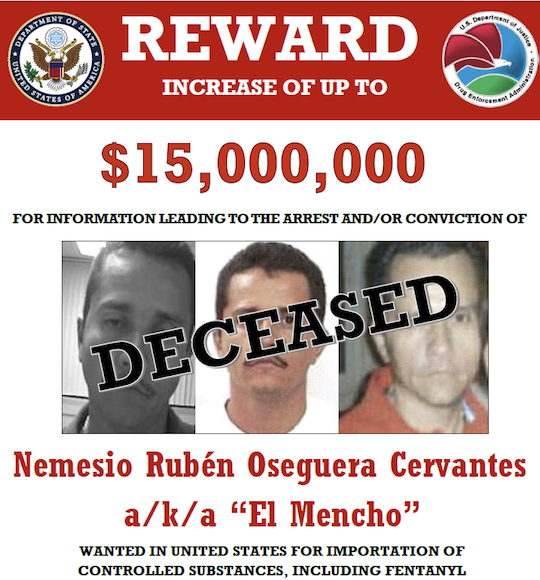

For years, Nemesio Oseguera Cervantes, alias El Mencho, was one of the most wanted men in the Western Hemisphere. His death on February 22, 2026––confirmed by Mexico’s Secretary of National Defense––removes a figure around which a significant portion of Mexican organized crime orbited. Yet, while the man is gone, the Cártel de Jalisco Nueva Generación (CJNG) remains. The urgent question for security analysts is not whether CJNG will survive, but what form its survival will take.
Read politically, Oseguera’s death is also a political crisis trigger. It can reopen questions about who governs, who taxes, and who provides protection in territories where the state’s authority has long been partial. In that sense, the post Mencho moment is not only about cartel adaptation. It is about how shocks reshape contested governance in Mexico.
This transition provides a rare empirical test for observers of organized crime. Because CJNG’s resilience depends on its internal structure, i.e. how roles are distributed and authority is reproduced, Oseguera’s absence will reveal whether the cartel’s power was rooted in a single man or in a resilient system of criminal governance. Put differently, leadership decapitation tests not only cartel resilience, but also the broader political crisis of authority and legitimacy that criminal governance both exploits and deepens.
The post-Mencho CJNG is unlikely to follow a linear path, but rather a mixture of three analytical scenarios.
Scenario 1: Managed succession
Like states, criminal organizations can develop institutional responses to survive leadership transitions. CJNG has shown signs of this institutionalization through standardized recruitment, training practices and a coherent ideological framing that positions the group as a “protective” entity against rivals like the Cártel de Sinaloa. Crucially, as we have documented in our comparative work on CJNG and Brazil’s Primeiro Comando da Capital (PCC), the organization functions based on a gendered division of labor.[1] While men and women often engage in distinct roles, these positions have become increasingly exchangeable toward the lower end of the cartel hierarchy, a structural flexibility that promises resilience. If the different mechanisms hold, authority could be consolidated quickly by a family member or trusted cadre. The figure potentially best positioned to guarantee cohesion, Oseguera’s son Rubén Oseguera González, is currently imprisoned in the United States. Other viable alternatives for succession include his stepson, Juan Carlos González (R3 or O3), his wife, Rosalinda González (La Jefa), or powerful regional leaders such as Audias N (El Jardinero) or Hugo Gonzalo (El Sapo). In this scenario, CJNG remains a coherent and structurally intact actor, though weakened at least in the immediate short term.
Scenario 2: Fragmentation
Personalist leadership creates inherent vulnerabilities. Loyalty networks woven around a single figure often unravel upon their disappearance. Regional “plaza bosses” who once responded to Oseguera out of respect, fear or calculated deference may now reassert their positions. Historical records suggest this is the modal outcome, seen in the fragmentation of the Beltrán Leyva Organization after Arturo Beltrán Leyva’s killing in 2009, the cascading fissions of Los Zetas after the death of Heriberto Lazcano in 2012, and the Medellín Cartel after Pablo Escobar.
Fragmentation often appears to be a security problem, but it also functions as a subnational political crisis. As violence becomes more dispersed, public authority is contested block by block, and local officials face stronger incentives to accommodate, collude, or exit. The immediate outcome is less governability, even when the state increases force.
Scenario 3: Competitive absorption
The Sinaloa Cartel remains a structurally resilient organization with deep territorial roots, despite its internal friction between “Los Chapitos” and the factions aligned with Ismael Zambada. A weakened CJNG represents a significant opportunity for takeover. The key factor here is timing: if Sinaloa is itself too fractured to absorb its rival, the result may instead be a multipolar landscape of violence of the kind that has characterized the states of Michoacán or Guerrero for years, or even resembling the 1990s following the massive fragmentation of cartels.
This is also the scenario most likely to strain coordination across levels of government and across agencies. When territorial conflict scales up, institutional fault lines widen, and crisis management problems multiply even in places where the state is present.
The implications for governance and strategy
CJNG’s ability to navigate this transition is a test of organizational resilience. A smooth transition suggests an organization built on stable internal rules, while violent fragmentation would indicate a group overly dependent on personal authority. This has a territorial dimension beyond Mexico. CJNG has invested heavily in external markets, particularly the Western US, parts of Europe and Central America.[2] The management of these supply chains and alliances require bureaucratic continuity. Fragmentation at the top increases the transaction costs of this international coordination and invites opportunistic defection by external partners.
Intellectual honesty requires acknowledging that real-time, open-source analysis has limits, as the Mexican authorities and intelligence services are still processing the circumstances of Oseguera’s death. Claims about the internal state of CJNG’s succession planning are, at this stage, necessarily speculative. What we can do is lay out the structural conditions that will shape which scenario unfolds, and flag the empirical indicators to watch: shifts in territorial violence patterns mainly in Jalisco and Michoacán, public statements from Mexico’s criminal intelligence apparatus, and whether a successor asserts public authority through the symbolic repertoire that Oseguera himself deployed strategically, that is, videos, social media and corridos.
Ultimately, the death of El Mencho is an event, not a resolution. As history has shown, Mexican organized crime is inherently more resilient than the elimination of any single actor might suggest. The central analytical question, and the one our prior research is positioned to address, is not whether CJNG survives, but what form it takes, and what that form reveals about the organizational logic of criminal governance in contemporary Latin America.[3] While the state has a moral and legal obligation to prosecute those responsible for the loss of life, scholarship has demonstrated that targeting only the most powerful in the drug hierarchy is insufficient at best and creates more violence at worst.
The broader implication is that criminal governance is not a parallel story to political crisis. It is one of its contemporary mechanisms, reorganizing authority and legitimacy in ways that standard security frames often miss. By treating this transition as the empirical test it is, we can move beyond the kingpin focus to gain a better understanding of the organization’s internal structures—an understanding that is essential for developing more effective strategies to dismantle them.
Endnotes
[1] Marcos Alan Ferreira and Nicole Jenne, “Women in Organized Crime: A Comparison of the Primeiro Comando Da Capital (PCC) and Cartel Jalisco Nueva Generación (CJNG).” Crime, Law and Social Change. Vol. 84, no. 1. 2026: p. 13, https://doi.org/10.1007/s10611-025-10261-2.
[2] Vanda Felbab-Brown, “The Foreign Policies of the Sinaloa Cartel and CJNG – Part V: Europe’s Supercoke and on-the-Horizon Issues and the Middle East,” Brookings. 16 September 2022, https://www.brookings.edu/articles/the-foreign-policies-of-the-sinaloa-cartel-and-cjng-part-v-europes-supercoke-and-on-the-horizon-issues-and-the-middle-east/.
[3] Carolina Sampó, Nicole Jenne, and Morcos Alan Ferreira, “Ruling Violently: The Exercise of Criminal Governance by the Mexican Cartel Jalisco Nueva Generación (CJNG),” Revista Científica General José María Córdova. Vol. 21, no. 43. 2023: pp. 647–65, https://doi.org/10.21830/19006586.1172.



