American Power Without Fiscal Alignment Is Not Sustainable Power
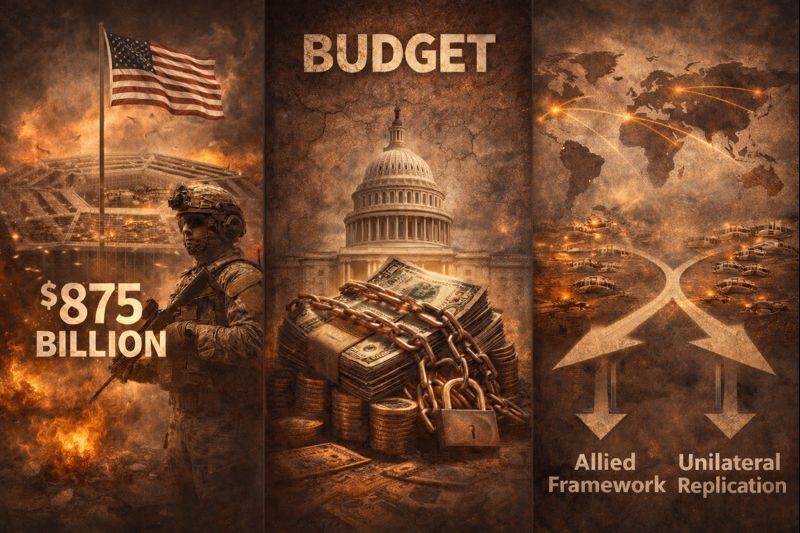

The United States is increasingly tempted by a blunt proposition: that it can disengage from allies, act unilaterally, and still preserve its global dominance through sheer scale. The argument is usually implicit rather than explicit, but it rests on a simple assumption—that American power is so overwhelming it does not require careful fiscal alignment.
That assumption is no longer credible.
Power that cannot be financed sustainably is not strength; it is leverage drawn against a shrinking balance sheet.
The Fiscal Constraint Is Structural, Not Cyclical
The United States has entered a decade in which much of the federal budget is effectively pre-committed before Congress even debates annual priorities.
In FY 2024, total federal outlays were approximately $6.75 trillion. Of that total, roughly $3.8 trillion (≈56%) was mandatory spending, and another $0.88 trillion (≈13%) was net interest—leaving less than one-third of the budget subject to annual discretionary choice.
Three realities define the constraint.
First, Social Security Faces an Automatic Policy Cliff
Under current law, the Social Security trust fund can pay 100% of scheduled benefits until 2033. After that point, incoming payroll tax revenues are projected to cover only about 77% of promised benefits absent legislative action. In FY 2024, Social Security outlays totaled approximately $1.46 trillion, representing more than one-fifth of all federal spending.
The public has made clear—across parties and across decades—that it will not accept benefit cuts. In a 2024 Pew Research Center survey, 79% of U.S. adults said Social Security benefits should not be reduced in any way, with 77% of Republicans and 83% of Democrats opposing reductions; similarly, 77% of Americans oppose cutting benefits for current and future retirees according to recent public polling.
In practical terms, that means financing must change.
Second, Interest on the National Debt has Become a Dominant Budgetary Force
Net interest outlays of approximately $880 billion in FY 2024 was roughly equal to total national defense spending of approximately $850–875 billion. That is larger than any domestic discretionary category. Interest costs are projected to exceed $1 trillion annually within the decade as higher interest rates interact with a federal debt stock now exceeding $34 trillion.
Unlike defense or domestic programs, interest is not subject to annual appropriations decisions. It is the unavoidable cost of accumulated debt at prevailing rates—and it crowds out discretionary choices dollar for dollar.
Third, Discretionary Spending is a Shrinking Share of Total Federal Outlays
Discretionary spending accounted for roughly between 26–27% of federal outlays in FY 2024. Within that discretionary portion, national defense ($850–875 billion) consumed close to one-half.
This structure matters because nearly every serious proposal to rebuild infrastructure, invest in productivity, or programs to reverse the shrinkage of the middle class rely on discretionary funding. That inevitably puts domestic priorities into direct competition with defense.
The Political Constraint Is Binding
The fiscal math is reinforced by a clear political reality.
The public broadly rejects two ideas:
- Cutting Social Security payments, which are earned, contributory compensation financed jointly by employees and employers over a working lifetime, and which remain modest (average monthly payments under $2,000).
- Maintaining tax preferences that disproportionately benefit ultra-high-income households, particularly when combined with calls for domestic austerity.
Taken together, these positions substantially narrow the available policy menu. They also force a conclusion many policymakers avoid: if benefits are protected and regressive tax preferences are politically untenable, then strategy must adjust to resources—or revenues must rise.
There is no other option that avoids tradeoffs.
Why Unilateralism Is More Expensive Than Alliance Leadership
The belief that the United States can simply “do less diplomacy and more dominance” misunderstands the economics of power.
In FY 2024, the United States’ own defense budget accounted for roughly two-thirds of total defense spending across NATO countries—a reflection of the United States’ unique global force posture, not a simple function of allied underinvestment.
At the same time, allied nations provide substantial in-kind, shared, and host-nation support that the United States would otherwise have to replicate on its own, such as:
- forward basing and access,
- host-nation financial support,
- logistics and infrastructure,
- intelligence integration,
- operational interoperability, and
- political legitimacy for collective action.
If the United States weakens or abandons alliances while attempting to maintain the same global posture, it must either:
- spend more directly to replace those advantages (additional basing, lift, force rotation, and readiness costs), or
- accept reduced presence, slower response times, and higher deterrence risk.
Neither option is fiscally neutral over time. In a period when net interest costs already rival defense outlays and domestic investment needs remain unmet, unilateral primacy is more expensive, not less.
The Core Tradeoff Cannot Be Avoided
The United States is attempting to sustain:
- a comprehensive social insurance system,
- growing domestic investment demands tied to productivity, infrastructure, and household economic stability, and
- a globe-spanning military posture,
without the revenue structure or demographic tailwinds—such as a rapidly growing workforce and a high worker-to-retiree ratio—that once made this combination easier.
For context, the United States collects roughly 25% of GDP in taxes, well below the 30s to mid-40s percent typical of peer advanced economies such as Germany, France, and the United Kingdom.
That tension was manageable when debt was cheap, the workforce was expanding, and discretionary spending was a larger share of the budget. Those conditions no longer exist.
There is, in principle, a more radical strategic path: the United States could choose to relinquish its role as the primary guarantor of collective defense among the world’s democratic alliances.
No democracy in the post–World War II era has ever assumed the fiscal burden of underwriting global security across multiple theaters. But this choice would represent not merely budgetary retrenchment, but a structural change in the international order—fewer forward commitments, diminished deterrence, weaker alliance cohesion, and a transfer of strategic influence to powers willing to fill the resulting vacuum.
Irrespective of the pathway the current or any future administration may choose to pursue, American power must be evaluated not by its scale alone, but by its alignment with what the country is willing to finance over decades rather than election cycles.
What Fiscal Seriousness Requires
A credible strategy requires honesty about the available levers:
- Revenue reform, particularly at the top of the income distribution and above the Social Security wage cap, if benefits are to be protected.
- Mandatory program financing reforms, focused on sustainability rather than blunt benefit reductions.
- Defense reprioritization, meaning tighter alignment between commitments and long-term fiscal capacity—not withdrawal, but realism.
Pretending that defense posture can remain untouched while everything else adjusts is not prudence. It is denial.
Conclusion
American leadership has never rested on military capability alone. It has rested on the ability to convert economic strength, domestic legitimacy, and alliances into durable influence.
A strategy that assumes unlimited freedom of action while ignoring fiscal constraints is not assertive—it is fragile.
Sustainable power requires alignment between ambition and the balance sheet.