





Where Power Begins: The Strategic Return of the Homeland
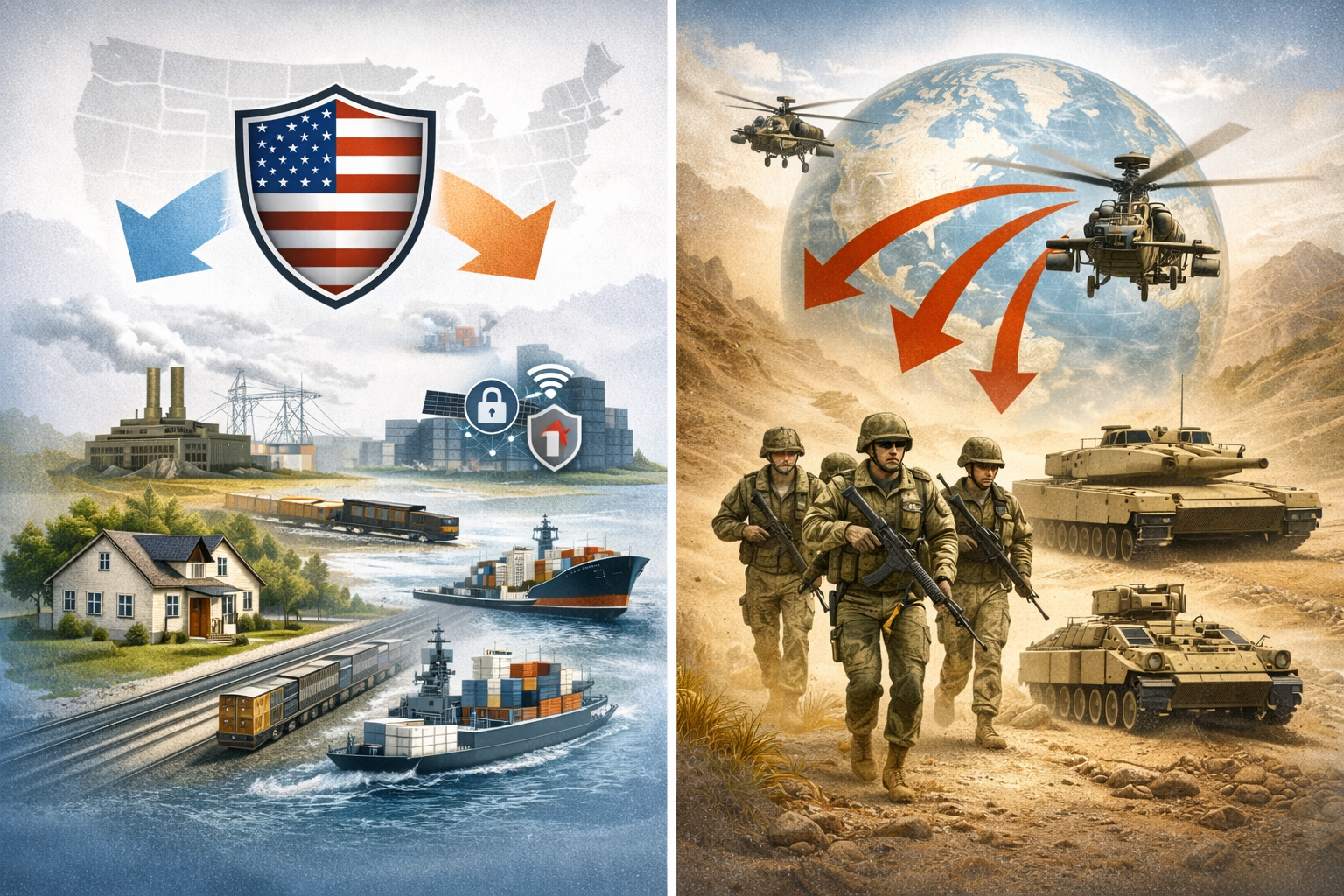

Abstract: The 2026 National Defense Strategy reestablishes homeland defense as a primary and contested mission, reflecting historical lessons that a secure interior is the foundation of American power projection. Drawing on the 19th‑century campaigns of the 7th Infantry Regiment, this article demonstrates that homeland defense has always been a persistent campaign requiring legitimacy, endurance, and protection of economic and infrastructural lifelines. These historical insights show that securing the homeland is an enabling condition for global reach and sustained expeditionary operations in today’s competitive security environment.
The Strategic Return of the Homeland
The 2026 National Defense Strategy (NDS) marks a consequential shift in American defense thinking. For the first time in decades, homeland defense has been elevated from an assumed condition to a contested mission, central to deterrence, resilience, and strategic endurance. In an era defined by great-power competition, cyber intrusion, information warfare, and attacks on critical infrastructure, the strategy recognizes that the homeland is no longer a sanctuary. It is an active domain of competition and campaigning. It is one where adversaries seek advantage below the threshold of armed conflict by targeting the foundations of national power rather than its forward-deployed forces.
This emphasis is often treated as a modern adaptation to new technology and emerging threats. However, the strategic logic underpinning the 2026 NDS is hardly new. It reflects an enduring American reality that a nation must secure its interior as a key and essential condition to sustain power abroad. This was learned early, repeatedly, and often painfully during the Army’s 19th-century campaigns to secure borders, enforce sovereignty, and enable national growth.
Few units illustrate this continuity more clearly than the 7th Infantry Regiment, known as the “Cottonbalers.” From persistent frontier operations to expeditionary campaigning in the Mexican–American War, this regiment’s experience demonstrates that homeland defense has never been a peripheral mission. It has always been the strategic foundation of American power projection.
These 19th century campaigns offer a useful historical lens for understanding why the new NDS refocuses on homeland defense. It is a reaffirmation of how the U.S has historically preserved strategic freedom of action.
The Cottonbalers are one of the oldest active infantry regiments in the U.S. Army, with continuous service dating back to 1812. The regiment earned its distinctive nickname when its soldiers used tightly packed cotton bales to reinforce defensive positions against British assaults during Battle of New Orleans in January 1815. The improvised defenses proved effective, and the image of infantrymen fighting from behind cotton bales became a lasting symbol of adaptability, endurance, and determination under pressure.

Distinctive Unit Insignia of the 7th Infantry Regiment “Cottonbalers”
Over the next two centuries, the Cottonbalers would serve repeatedly at the intersection of homeland defense and expeditionary warfare, from frontier campaigns and continental expansion to global conflicts. I served in the 7th Infantry Regiment from 2000 to 2003, a period characterized by this continuity and continuum. Following the September 11 terrorist attacks, the regiment supported homeland defense missions as the Army rapidly adapted to a newly contested domestic security environment. Less than two years later, those same soldiers deployed forward to participate in the 2003 invasion of Iraq. That experience transitioning directly from homeland security to projecting combat power abroad mirrors the historical pattern that has defined the Cottonbalers and other U.S. military formations since 1815. Furthermore, it reinforces the central argument of this article that homeland defense and expeditionary warfare are mutually reinforcing missions.
These 19th century campaigns offer a useful historical lens for understanding why the new NDS refocuses on homeland defense. It is a reaffirmation of how the U.S has historically preserved strategic freedom of action. By examining frontier campaigns and the Mexican–American War as complementary case studies, the article highlights homeland defense as a continuous campaign, not a contingency. It is one that remains essential in today’s competitive security environment.
Frontier Campaigns: Homeland Defense as Persistent Competition
The U.S. Army’s mission in the 19th century mostly centered around securing contested interior space. Expeditionary warfare against peer states was nascent and rare. The frontier was often an ambiguous, fluid zone where federal authority, economic expansion, local populations, and non-state violence intersected. The Army’s greatest challenge was establishing and maintaining control over space critical to national cohesion through sustained, low-level campaigning and persistent engagement.
This balance between restraint and enforcement was a central strategic challenge, not a tactical inconvenience.
The Cottonbalers’ frontier service illustrates this reality. Companies of the 7th Infantry were routinely dispersed across vast distances, tasked with manning isolated forts, patrolling lines of communication, escorting commerce, and responding to localized violence that rarely resembled conventional warfare. Strategic success was often measured in freedom of movement, continuity of trade, and the gradual extension of civil authority. Large, decisive clashes between opposing forces were few and far between.
These operations demanded persistence rather than episodic deployment. Units remained forward for years, sometimes decades, operating in legally ambiguous environments under intense political scrutiny. Excessive force risked delegitimizing federal authority while insufficient presence invited disorder. This balance between restraint and enforcement was a central strategic challenge, not a tactical inconvenience.
The Seminole Wars and Strategic Endurance
The Cottonbalers’ participation in the Seminole Wars highlights the enduring difficulty of homeland defense campaigns. These conflicts were characterized by elusive adversaries, sanctuary terrain, unclear end states, and growing political fatigue. Tactical engagements were frequent, but decisive victory proved elusive. Instead, the Army was forced into a prolonged effort to deny adversaries uncontested space, protect settlements, and maintain federal credibility.
The strategic lesson was sobering. Homeland defense often involves managing instability rather than eliminating it. Tactical success did not guarantee strategic resolution. Political legitimacy, endurance, and coordination with civil authorities mattered as much as battlefield performance. These dynamics mirror modern homeland defense challenges including countering cyber threats, malign influence, border security, and asymmetric disruption. Total victory is neither realistic nor required, but persistent pressure is essential.
Economic Security and Strategic Assurance
Just as frontier forts safeguarded trade corridors and territorial claims, modern homeland defense focuses on preserving the systems that underpin national power.
Frontier deployments were frequently tied to the protection of economic nodes including river crossings, trade routes, settlements, and emerging infrastructure. These locations were strategically vital to national growth. By securing them, the Army functioned as a guarantor of economic security, ensuring that commerce and migration could proceed despite persistent threats.
This role has a direct modern parallel. The 2026 NDS emphasizes the protection of critical infrastructure with the recognition that ports, transportation networks, energy systems, and information architectures are strategic centers of gravity. Just as frontier forts safeguarded trade corridors and territorial claims, modern homeland defense focuses on preserving the systems that underpin national power. In both cases, protection is tactically important, but strategic assurance remains critical to convince adversaries that disruption will fail to reassure the population that the state remains capable and present.
Legitimacy as a Strategic Requirement
Perhaps the most enduring lesson from the Cottonbalers’ frontier service is the centrality of legitimacy. Security achieved without legitimacy proved temporary. Heavy-handed enforcement risked resistance and political backlash while absence invited disorder. Navigating this tension required discipline, restraint, and adaptability. These qualities are as relevant to modern homeland defense now as they were to 19th-century frontier operations.
The Army’s ability to protect communities without appearing predatory directly influenced stability, public confidence, and long‑term success.
The Cottonbalers’ frontier experience shows that legitimacy was often as decisive as firepower. Too much force risked eroding federal credibility, while too little presence invited instability. During the Second Seminole War, elements of the 7th participated in broader Army tactics such as destroying crops and seizing livestock. These tactics were meant to deny Seminole fighters sanctuary but often swept in noncombatants. These measures fueled political backlash and reinforced perceptions that federal authority was coercive rather than protective.
At other points, small detachments of the 7th adopted overly cautious postures, remaining close to isolated forts. Seminole bands exploited these gaps to raid settlements and disrupt trade, leading settlers and territorial leaders to question whether the Army could provide consistent security.
Both patterns underscored that legitimacy was not a moral extra; rather, it was a strategic requirement. The Army’s ability to protect communities without appearing predatory directly influenced stability, public confidence, and long‑term success. These same pressures echo in today’s homeland defense environment.
The frontier campaigns demonstrate that homeland defense has always been a campaign, not a contingency. It requires patience, persistence, and acceptance of ambiguity. Warfighting can take many forms. On the frontier, it was quiet work that enabled national consolidation and long-term power projection.
The Mexican–American War: Homeland Security as the Enabler of Expeditionary Power
If frontier campaigns illustrate homeland defense as persistent interior competition, the Mexican–American War demonstrates its complementary role. Together, these cases challenge the false dichotomy between defending the homeland and projecting power abroad. In fact, homeland security served as the enabling condition for expeditionary success.
Ports, borders, transportation networks, and economic lifelines within the United States had to remain protected for the campaign to succeed.
The Mexican–American War was the United States’ first large-scale expeditionary conflict beyond its immediate borders. It required amphibious landings, extended logistics, sustained operations deep inside sovereign territory, and the political will to prosecute war far from home. This operational audacity rested on the crucial assumption that the homeland was sufficiently secure to absorb risk in foreign territory.
Ports, borders, transportation networks, and economic lifelines within the United States had to remain protected for the campaign to succeed. If instability at home had threatened logistics, legitimacy, or domestic cohesion, the entire operation from Veracruz to Mexico City would have been at elevated risk. The outcome of the war itself may have been different. The Cottonbalers’ participation in this important campaign echoes the strategic imperative reflected in the 2026 NDS that power projection begins at home.
Victory and Vulnerability: How Expansion and Infrastructure Shaped Strategic Risk
The Mexican–American War is often remembered as a decisive military success, characterized by rapid maneuver and battlefield dominance. Its strategic legacy was more complex. Territorial expansion brought new governance challenges, internal political divisions, and long-term security obligations that extended well beyond battlefield victory.
That historical reality mirrors modern homeland defense priorities. The security of today’s ports, rail networks, energy grids, data centers, and cyber infrastructure is just as essential to sustaining expeditionary operations as interior logistics were in the 1840s.
For the Army, the war revealed the tension between operational success abroad and strategic sustainability at home. Victory transformed but did not eliminate risk. This mirrors modern concerns about escalation management, legitimacy, and post-conflict obligations in an era of great-power competition. The lesson here is that expeditionary warfare should be anchored to a resilient homeland capable of absorbing second and third-order effects.
One of the most overlooked aspects of the Mexican–American War is its reliance on interior infrastructure. Ports, depots, roads, and rivers within the United States formed the backbone of sustained operations. Without secure domestic logistics and economic continuity, expeditionary success would have been impossible. That historical reality mirrors modern homeland defense priorities. The security of today’s ports, rail networks, energy grids, data centers, and cyber infrastructure is just as essential to sustaining expeditionary operations as interior logistics were in the 1840s. The Cottonbalers’ experience reinforces that homeland defense prevents attack and preserves freedom of action.
Complementarity, Not Competition
Where frontier campaigns emphasized legitimacy, presence, and endurance, the Mexican–American War rewarded speed, maneuver, and decisive action. However, both depended on a homeland secure enough to sustain risk and support prolonged military effort. This contrast is instructive. Homeland defense and expeditionary warfare can be simultaneous and mutually reinforcing tasks. One does not necessarily need to happen before the other.
This insight challenges modern assumptions that prioritizing homeland defense necessarily constrains global reach. History suggests the opposite. The United States has often been most effective abroad when it invested deliberately in securing its interior politically, economically, and militarily. The clearest illustration came during World War II, when the United States’ rapid expansion overseas was only possible because of a homeland secured through industrial mobilization, coastal defense, and continental air surveillance. The “Arsenal of Democracy” enabled the U.S. to project decisive power abroad without fear of domestic vulnerability undermining its campaigns.
Conclusion: Implications for the 2026 NDS
The U.S. has finite resources and it pays a premium for the best military in the world. Positioning and deploying forces for campaigns at home and abroad are difficult choices that consume combat power. Inability to deploy sufficient forces forward limits strategic options and can fail to reassure important allies. This is a valid argument and concern. However, if the U.S. Military tries to be strong everywhere, it will be strong nowhere. Consequently, the 2026 NDS seeks to prioritize limited military resources on the home front. The alternative could mean a weaker power base at home, risking U.S. Military credibility and deterrence around the world.
Securing the homeland is not a retreat inward. It is about preserving the strategic freedom of action on which military power depends for success.
The 2026 NDS reflects a recognition that strategic competition increasingly targets the foundations of national power rather than forward-deployed forces alone. Cyber intrusion, economic coercion, information warfare, and attacks on infrastructure represent modern equivalents of 19th-century threats that could have crippled expeditionary campaigns had they gone unaddressed.
The Cottonbalers’ 19th-century experience offers enduring insights for contemporary homeland defense. First, homeland defense is a campaign, not a contingency. It requires persistence, legitimacy, and coordination across military and civilian institutions. Second, homeland security enables expeditionary power. Securing ports, infrastructure, and economic lifelines is a prerequisite for sustained operations abroad. Lastly, strategic actions at home often enable decisive action abroad. Neglecting interior security degrades deterrence, invites external pressure, and constrains strategic choice.
The strategic environment has changed dramatically since the 19th century. However, the underlying problem remains unchanged. A nation that neglects its interior security risks strategic paralysis, regardless of how capable its forces may be overseas. The frontier campaigns and Mexican–American War service of the Cottonbalers remind us that homeland defense has always been central to American military success when employed as an active, enduring campaign.
In reframing the homeland as a contested domain, the 2026 NDS acknowledges a reality that earlier generations of soldiers understood. Securing the homeland is not a retreat inward. It is about preserving the strategic freedom of action on which military power depends for success. Its emphasis on homeland defense is a return to American strategic tradition.


