The Gathering Storm: U.S. and Israeli Military Posturing and the Coming Reckoning with Iran

Abstract
Less than nine months after the United States and Israel conducted joint strikes on Iranian nuclear facilities during Operation Midnight Hammer and Operation Rising Lion, both nations are again assembling substantial military force in the Middle East. As of February 2026, a dual-carrier strike group deployment is underway, F-22 Raptors are transiting to forward bases, and Western intelligence sources describe a posture that goes far beyond deterrence. This article examines the military buildup, analyzes the national interests and political calculus driving it, explores the strategic objectives of both Washington and Jerusalem, and assesses the consequences of success or failure across four critical domains: American domestic politics, the international world order, global oil markets, and regional stability. The situation validates the central thesis of this author’s prior work: that strategic restraint at the top of the escalation ladder does not produce peace, it produces more small wars.
The Buildup: What the Reporting Shows
The current U.S. military posture in the Middle East is not a routine rotation. It is an orchestrated escalation, confirmed across multiple credible reporting streams and corroborated by open-source intelligence tracking.
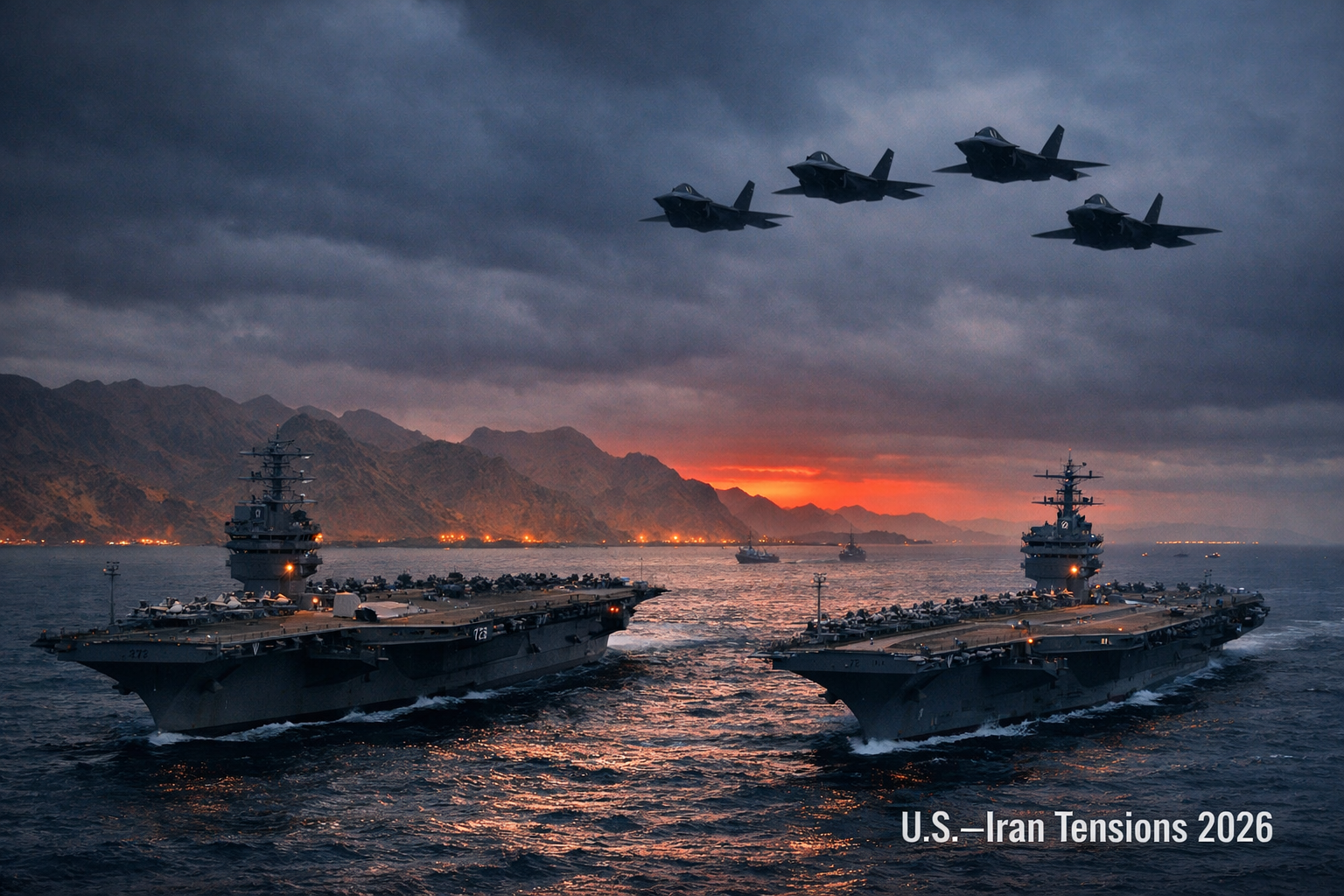
Beginning on January 26, 2026, the USS Abraham Lincoln Carrier Strike Group deployed to the northern Arabian Sea, sitting just south of Iran’s coastline. Satellite imagery confirmed by the BBC’s fact-checking unit documented the arrival and composition of this force in detail. The Abraham Lincoln went operational in the U.S. Fifth Fleet’s area of responsibility, flying combat sorties, conducting maritime surveillance with P-8A Poseidon patrol aircraft, and defending against Iranian provocations, including the shootdown of an Iranian Revolutionary Guard Corps (IRGC) Shahed-139 drone that approached the carrier on February 3, as confirmed by Reuters and CNBC .
The force has grown substantially since. The Wall Street Journal reported on February 11 that the Pentagon directed a second carrier strike group to accelerate its readiness cycle for immediate deployment. Days later, on February 13, the USS Gerald R. Ford was confirmed enroute to the Mediterranean, as reported by NBC News and the Times of Israel. The War Zone reported that by mid-February, the U.S. Navy had assembled approximately 12 surface combatants in the CENTCOM theater, including three littoral combat ships based in Bahrain suited for minesweeping in the Strait of Hormuz.
Perhaps the most operationally significant indicator came on February 17, when open-source aviation trackers documented six F-22 Raptor stealth air-superiority fighters departing Langley Air Force Base, transiting to RAF Lakenheath in the United Kingdom, and continuing toward Muwaffaq Salti Air Base in Jordan. As The War Zone’s definitive February 17 report documented in detail, defense analysts noted the precise precedent: four days before Operation Midnight Hammer in June 2025, F-22s made an identical Atlantic transit. The F-22 is not a simple show-of-force aircraft. It is designed to suppress enemy air defenses and protect penetrating strike platforms like the B-2 Spirit bomber, the same combination used to devastate Iran’s deeply buried nuclear facilities at Fordow and Natanz nine months ago.
CNN reported on February 16, citing multiple sources familiar with the matter, that the military buildup is designed for dual purposes: to pressure Tehran during the ongoing Geneva nuclear talks, and to have credible strike options in place should those negotiations fail. Several U.S. military units deployed in the region that were expected to rotate out have had their orders extended. One risk intelligence CEO told BBC that current U.S. preparations are ‘deeper and more sustained’ than even the pre-Midnight Hammer buildup.
Israel’s posture is equally telling. Israeli Prime Minister Benjamin Netanyahu declared in January 2026 that Israel will not allow Iran to reconstitute its missile or nuclear programs. The Critical Threats Project (AEI) documented on February 2 that Israel has formally requested the United States strike Iran’s ballistic missile production infrastructure, particularly the Parchin and Shahroud complexes, where satellite imagery shows Iran rebuilding planetary mixers essential for solid-fuel missile production. The United States reportedly intercepted a Chinese shipment of those same planetary mixers in the Indian Ocean in November 2025.
A Western source with knowledge of coordination talks told Iran International that the question in current U.S.-Israeli planning sessions is no longer whether military action will occur, but when. The source stated bluntly: ‘The decision has been made. This will happen. The only question is when.’
The National Interest Case: Why Washington Is Considering Another Strike
The U.S. national interest calculus for military action against Iran rests on three intersecting pillars: nuclear nonproliferation, regional stability through deterrence, and the credibility of American coercive power.
The Nuclear Reconstitution Imperative
The June 2025 strikes, Operation Midnight Hammer for the U.S., Operation Rising Lion for Israel, achieved significant damage but did not eliminate Iran’s nuclear potential. The Arms Control Association documented that while Fordow’s underground enrichment facility was severely impacted, and the Isfahan conversion site was struck by Tomahawk cruise missiles, the program’s institutional knowledge, its stockpile of highly enriched uranium, and its third undisclosed enrichment site remained intact. The International Atomic Energy Agency (IAEA)’s director general stated that Iran ‘retains the industrial capacity and knowledge required to resume enrichment work.’
Since then, satellite imagery reported by The New York Times shows Iran accelerating repairs at missile sites while making more limited repairs at nuclear facilities. If Iran’s ballistic missile production reconstitutes faster than diplomacy can constrain, Israel faces a rapidly closing window in which strikes remain feasible at acceptable cost. From Jerusalem’s perspective, each passing month of Iranian missile reconstitution is a month in which the deterrence calculus shifts against the U.S.-Israeli alliance.
Trump’s own language has been unambiguous. He told reporters in February 2026 that if Iran begins to re-establish its nuclear programs, ‘we’re going to have to knock them down.’ His characterization of the Gerald Ford’s deployment, ‘In case we don’t make a deal, we’ll need it’, defines the strategy in blunt transactional terms, as reported by CNN. The military force is the leverage behind the diplomacy, and the diplomacy is the fig leaf behind which a second strike can be justified.
Deterrence Credibility and Maximum Pressure
The Trump administration has staked its Middle East policy on a doctrine of maximum pressure, the same framework applied in Trump’s first term before the 2018 Joint Comprehensive Plan of Action (JCPOA) withdrawal. The January 2026 protests inside Iran, triggered by currency collapse and economic degradation, gave Washington an additional instrument of leverage. As Britannica’s 2026 Iranian Protests entry documents, Trump threatened to intervene if protesters continued to be killed, and the regime’s violent suppression under an internet blackout led to thousands of deaths. When the regime responded with violent suppression, Trump threatened direct U.S. intervention to protect protesters. The Iranian rial’s continued devaluation and Iran’s desperate diplomacy in Geneva are evidence that the pressure campaign is producing results at the strategic level even before a shot is fired.
Deterrence theory holds that coercive power is only as credible as its demonstrated willingness to act. Having struck Iran once in June 2025, the administration has established precedent. The House of Commons Library’s February 2026 briefing on the protests and U.S. military posture confirms that Washington has positioned its forces to signal that the precedent is not a one-time event but a repeatable policy response to Iranian noncompliance.
Strait of Hormuz and Energy Security
The Congressional Research Service and BloombergNEF both note that roughly 20-27 percent of the world’s crude oil and petroleum maritime trade transits the Strait of Hormuz, approximately 20 million barrels per day. During this week’s Geneva talks, the Iranian Revolutionary Guard (IRGC) conducted live-fire exercises in the Strait, temporarily closing sections of the waterway. Iran’s IRGC naval commander stated publicly that his forces are prepared to close the Strait entirely if ordered. For a Trump administration that has made energy dominance a centerpiece of its economic agenda, the scenario of Iranian forces mining or blockading the world’s most critical energy chokepoint is an existential threat to global economic stability, and to the low domestic fuel prices that underpin Trump’s political brand.
The Political Calculus: Why Now?
Understanding the Trump administration’s decision timeline requires examining the confluence of domestic and international political dynamics that make action attractive, or at least tolerable, in early 2026.
Domestic Political Architecture
President Trump enters his second midterm cycle with a political imperative to demonstrate strength and resolve, particularly on an issue, Iran, where Republican hawks and the pro-Israel donor base demand outcomes, not negotiations. As CNN’s January 28 report on Trump’s evolving Iran strategy documented, Trump has said he believes regime change ‘would be the best thing that could happen’ in Iran. A second-term president free of re-election pressures but deeply invested in his historical legacy has incentive to complete the mission he began. The administration also cannot afford to be seen negotiating from a position of weakness. Each week Iran spends in Geneva stalling, while continuing to rebuild its military infrastructure, is a week in which the administration’s credibility erodes.
Conversely, Trump’s instincts are transactional rather than ideological. He has left the door to diplomacy conspicuously open throughout the buildup, even as F-22s cross the Atlantic. This pattern mirrors his approach to North Korea, Venezuela, and the first Iranian pressure campaign: escalate to the edge, extract a concession or a deal, declare victory. The political ideal for Trump is not another war but a deal he can describe as historic capitulation by Tehran, brokered through maximum coercion.
The Netanyahu Factor
Benjamin Netanyahu’s political survival has long been intertwined with the Iran file. CNN’s February 13 reporting confirmed that Trump held lengthy talks with Netanyahu on February 12 and said he insisted to Israel’s leader that negotiations with Iran needed to continue, even as Netanyahu is urging the administration to press Tehran to scale back its ballistic missile program. CNN also reported that Israel is the only regional player actively urging the United States to strike, even as Gulf states, Qatar, Saudi Arabia, the UAE, Egypt, and Oman, have explicitly warned Washington against military action, citing fears of Iranian retaliation against their own territory.
The Arms Control Association’s analysis of the June 2025 strikes argued that Israel deliberately initiated the conflict knowing it lacked the bunker-busting capability to reach the deepest facilities, specifically to draw U.S. GBU-57 Massive Ordnance Penetrators into the campaign. The pattern is visible again: Israeli requests for U.S. targeting of ballistic missile sites indicate a continuation of the same strategy, initiating a conflict that can only be completed with American ordnance and American operational reach.
The Protest Window
The Iranian protests that erupted in December 2025, spreading to all 31 of Iran’s provinces as documented by Britannica and the House of Commons Library, introduced a new variable into the strategic calculus. Western governments and Iranian opposition figures have argued that the regime, faced with both external military pressure and internal unrest, may be at its most vulnerable in a generation. Reza Pahlavi publicly called for targeted military strikes to accelerate regime change. The Trump administration’s explicit references to regime change as a preferred outcome suggest the political ambition of any new operation may extend beyond facility destruction toward regime destabilization.
This is, strategically, extraordinarily dangerous terrain. As CNN noted, ‘the administration still does not appear to have a clear understanding of what would come next if it took action and removed the Iranian regime.’ A senior Israeli official cautioned Reuters that even eliminating Supreme Leader Khamenei would produce a successor, not a democratic transition.
Strategic Objectives: What Both Nations Are Trying to Achieve
A. Israel’s Objectives
Israel’s strategic objectives are layered and, in some respects, mutually reinforcing. In the near term, Jerusalem seeks to prevent Iran from reconstituting its ballistic missile program to a level capable of saturating Israel’s multi-tiered air defense architecture, Arrow 3, David’s Sling, and Iron Dome. The Critical Threats Project’s February 2 update documented that Iran has been rebuilding planetary mixer facilities at Parchin and Shahroud, and that Israeli media has reported Israel asked the United States to strike these facilities to limit Iran’s retaliatory capacity. The ‘use it before you lose it’ logic, strike now while Iranian air defenses remain degraded and before reconstitution is complete, is driving the immediacy of Israeli pressure on Washington.
Israel’s medium-term objective is to push Iran beyond the nuclear threshold in the opposite direction, not toward weapons capability, but toward international monitoring and control as the condition of any diplomatic deal. Netanyahu has stated he will not allow enrichment to resume under any circumstances. This maximalist position is designed both to constrain any U.S.-Iran deal that might emerge from Geneva and to maintain the military option as a live instrument rather than a last resort.
U.S. Strategic Objectives
Washington’s objectives are more complex and somewhat in tension. The administration’s declared goal is a nuclear deal that permanently forecloses Iran’s weaponization pathway, in Trump’s formulation, ‘zero enrichment,’ a demand Iran has formally rejected while signaling possible flexibility on the margins. The Arms Control Association has noted that the International Atomic Energy Agency (IAEA) director-general assessed Iran could resume enrichment in a ‘matter of months,’ a timeline that intensifies U.S. pressure.
A secondary U.S. objective is to destroy Iran’s ballistic missile production capacity sufficiently to reduce the threat to American bases in Qatar, Iraq, and Jordan, facilities that Iran struck in June 2025 in retaliation for Operation Midnight Hammer, as confirmed by the House of Commons Library. A strike package that degrades Iran’s long-range precision-strike capability would reduce the retaliatory threat to U.S. forces in the region.
A tertiary U.S. objective, one the administration has been explicit about but strategically unprepared for, is regime change. The problem, as the Middle East Institute’s analysis documented, is that the conditions that made the June 2025 operation successful may not replicate cleanly in a follow-on operation where the Iranian regime is cornered, desperate, and potentially less willing to accept a negotiated off-ramp.
The Ramifications: Four Domains of Consequence
U.S. Domestic Politics: The Dual-Edged Sword
If strikes succeed in achieving clearly defined, limited objectives, destroying ballistic missile production facilities and setting back any nuclear reconstitution, the Trump administration will claim a historic victory. The Middle East Institute’s report card on U.S. Middle East policy notes that even the June 2025 strikes saw only fragile U.S. public support, 38 percent backing, 45 percent opposition in subsequent polling. A second operation would rest on this already-precarious domestic foundation.
Mission failure presents the inverse scenario. If Iran successfully retaliates against U.S. bases causing significant casualties, or if Strait of Hormuz disruption triggers a fuel price shock, the political calculus inverts entirely. A prolonged engagement, something Secretary Hegseth declared he would never permit, would revive every ghost of post-9/11 strategic overextension. Democrats and libertarian-leaning Republicans would charge that Trump repeated exactly the error he campaigned against: an open-ended military commitment in the Middle East with no clear exit and no plan for the day after.
The International World Order: Fractures and Realignment
A second U.S.-Israeli strike on Iran would deliver a powerful signal about the durability of the rules-based international order, and not a reassuring one. Russia and China would condemn the action at the United Nations, and as Defence Security Asia documented, they are already conducting trilateral ‘Maritime Security Belt 2026’ naval exercises in the Strait of Hormuz in direct response to the U.S. dual-carrier buildup. China’s ongoing role in Iranian missile reconstitution, evidenced by the November 2025 planetary mixer interception documented by the Critical Threats Project, would likely deepen rather than recede if Iran emerges from another strike cycle as an isolated pariah state dependent on Beijing’s patronage.
For America’s Gulf partners, the calculus is acutely uncomfortable. As the Middle East Institute’s analysis of Oman’s mediation role documents, Saudi Arabia, the UAE, Qatar, and Egypt have all explicitly warned Washington against military action, and Gulf capitals jointly pressured Washington to pause a military strike in January 2026. The Abraham Accords framework, already under strain from the Gaza war, could fracture entirely if Gulf Arab states conclude that aligning with the United States means inheriting its conflicts.
At the broader systemic level, the legal controversy surrounding an unprovoked strike, the Arms Control Association noted that there was ‘no imminent threat’ posed by Iran’s program before the June 2025 action, would further corrode the legitimacy of international law as a constraint on great power behavior. States contemplating their own nuclear programs would absorb a disturbing lesson: the Nuclear Proliferation Treaty provides no protection from military strikes by nuclear-armed states, and the only reliable deterrent is a nuclear weapon of one’s own.
Oil Economics: The Hormuz Variable
The energy market consequences of another Iran conflict are the most immediately quantifiable ramification. As of February 2026, BloombergNEF projects that if Iran’s oil exports were completely removed from the market starting in February, Brent could rise to an average of $71/barrel in Q2 2026, and if the disruption persisted through the rest of 2026, Brent could average $91/barrel in Q4 2026. A separate analysis by Columbia University’s Center on Global Energy Policy projects price spikes in the $80–$100 per barrel range if even a 20%–30% drop in GCC exports occurs due to transit delays or Iranian retaliation against Gulf infrastructure.
Iran has now twice closed portions of the Strait for military exercises since the U.S. military buildup began, most recently in conjunction with Tuesday’s Geneva talks, as confirmed by The National and CNN. The IRGC stated publicly that its forces are prepared to close the Strait entirely if ordered. The oil market scenario maps directly back onto the domestic political scenario: if a strike is calibrated and Iran’s retaliation is contained, markets absorb the shock. If Iran mines the Strait or attacks Saudi export terminals, the global economy faces an inflationary shock not seen since the 1970s oil embargoes.
Even the current period of military posturing carries costs. As Bloomberg reported on February 18, this narrow waterway handles about a quarter of the world’s seaborne oil trade, and any disruption would trigger a spike in oil prices and potentially destabilize the global economy. Shipping insurance premiums for vessels transiting the Strait and surrounding waters have already spiked. These friction costs are already working their way into supply chains regardless of whether a shot is fired.
Regional Stability: The Fragile Equilibrium
The Middle East Institute’s January 2026 analysis offered a sobering assessment: ‘the decision calculus of an Iranian regime that is increasingly cornered and desperate has changed significantly since last June and any lessons taken from the 12-Day War must be considered in this context.’ The analysis specifically warned that Iran’s proxy network, weakened but not destroyed, may now be ‘more amenable to coordinating wider attacks against US interests across the Middle East’ precisely because their survival is at stake.
The Houthis in Yemen remain the most visible example. Despite years of U.S., UK, and Israeli strikes, the Houthis have maintained operational control of most of Yemen, as documented by the House of Commons Library’s Yemen analysis. A new Iran strike that further radicalizes surviving proxy networks could produce asymmetric retaliation campaigns across the region, not a conventional war that the U.S. military is designed to win, but a sustained guerrilla campaign against soft targets, shipping, and energy infrastructure.
Gulf Arab states’ opposition to military action is informed by this calculus. The Columbia University energy analysis documents that Iranian retaliation against Gulf Cooperation Council (GCC) infrastructure, as occurred in 2019 at Saudi Arabia’s Abqaiq and Khurais facilities, would strand spare GCC production capacity and create a deeper physical deficit that no American carrier strike group can fully neutralize.
At the same time, a diplomatic success, a genuine, verifiable nuclear agreement emerging from Geneva, would not automatically produce regional stability. As Bloomberg reported on February 17, West Texas Intermediate fell to settle near $62 a barrel after Iranian Foreign Minister Araghchi said the two countries reached a ‘general agreement’ on the basis of a potential nuclear deal. Hamas, under pressure to disarm in Gaza, has not committed to doing so. The Houthis have rejected every ceasefire framework. A weakened but not destroyed Iran, channeling resources from economic recovery rather than proxy warfare, might actually be more destabilizing in the medium term than a militarily suppressed Iran.
Conclusion: The Small War Hypothesis Confirmed
In the preceding articles in this series, published in Small Wars Journal and in Foreign Policy, I argued that U.S. strategic restraint would not produce a more peaceful world, but would produce more frequent, more ambiguous small wars, as adversaries probed the edges of American resolve and competed in the space below the threshold of major conflict. The Iran crisis of February 2026 is a direct expression of that thesis, but with a significant complication: what began as an adversary probing the gray zone has now drawn the United States back into a potential kinetic campaign that may not qualify as ‘small’ by any reasonable measure.
The dual-carrier buildup, the F-22 deployments, the extended unit rotations, and the intelligence suggesting a decision has already been made represent something qualitatively different from the gray-zone competition my earlier analysis described. The United States and Israel are not countering a Houthi drone swarm or a Hezbollah missile barrage. They are contemplating a direct attack on a nation-state that has already demonstrated the will and the capability to strike American military bases in response. The distinction matters enormously.
If strikes proceed and succeed on limited terms, this episode will be cited as evidence that American power, applied precisely and with clearly defined objectives, can reshape the strategic environment without triggering the catastrophic escalation that critics fear. If strikes fail, or succeed militarily but trigger economic and political consequences that dwarf the tactical achievements, his episode will be cited as the moment when the Trump administration learned the hardest lesson of American strategic history: that coercive power without a coherent political strategy for the day after is not strategy. It is theater.
The Strait of Hormuz is open today. The Geneva talks are still underway. The USS Gerald Ford is still days away from the operational theater. The window for diplomacy has not yet closed. But every indicator, from the tonnage of naval steel in the Arabian Sea to the transatlantic flight paths of America’s most sophisticated air superiority fighters, points toward a reckoning that is no longer theoretical.
The storm is gathering. Whether it breaks into a controlled squall or a regional catastrophe depends not on the weaponry being assembled, but on the strategic judgment of those who must decide when, and whether, to use it.