





Accelerating Decision-Making: Integrating Artificial Intelligence into the Modern Wargame
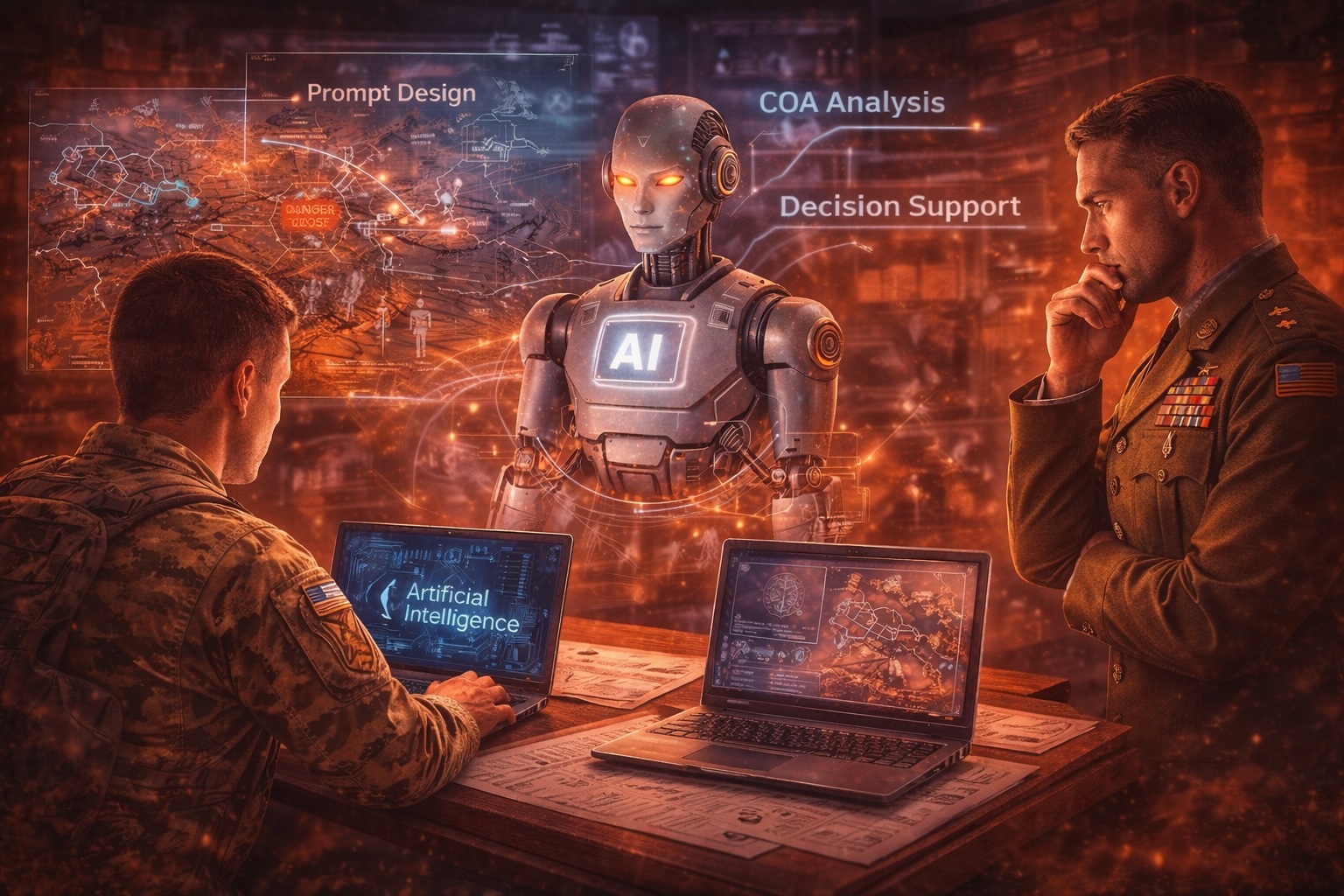

The character of warfare is in a state of perpetual evolution, demanding that our Army not only keep pace but also actively seek a decisive edge through technological superiority. The integration of Artificial Intelligence (AI) into the Military Decision Making Process (MDMP) represents the next frontier in this pursuit. While the concept may seem abstract, recent practical applications at the Command and General Staff College (CGSC) have provided a concrete blueprint for how Large Language Models (LLMs) can revolutionize staff wargaming. This article outlines the key findings and lessons learned from an experiment that leveraged AI to enhance the speed, depth, and rigor of Course of Action (COA) analysis, offering a model for the wider force.
Our exploration demonstrated that when properly resourced and guided, AI can serve as a powerful cognitive partner for a staff. However, its successful integration is not a simple matter of “plug-and-play.” It requires a deliberate methodology centered on three pillars: building a robust analytical framework, executing a human-centric wargame, and embracing an iterative learning process.
Building the Framework: Resourcing the AI for Combat
The initial and most critical phase was preparing the digital battlespace. The goal was to create an environment where an AI agent could effectively reason using the same doctrinal and operational documents that a human staff would use. This was accomplished not by building a new model from scratch, but by leveraging a pre-existing platform to tailor a pre-trained LLM for our specific military application.
The process involved three key modifications to the base AI agent:
- Model Selection: The choice of the underlying LLM is paramount. We required an AI capable of detailed analysis of complex operational inputs. We selected a “heavyweight” model (analogous to GPT-4.1) with a vast context window of 1 million tokens. This large window was essential, as it allowed the AI to simultaneously reference a wide array of doctrinal publications, operational orders, and scenario-specific data during its analysis, mirroring the cognitive load of a planning staff.
- Agent Instructions: An AI agent, much like a Soldier, requires clear orders. We crafted a set of foundational agent instructions that defined the AI’s Role, Core Responsibilities, and Execution Guidance. Drawing on doctrinal sources such as FM 3-0, Operations, and FM 5-0, The Operations Process, we tasked the agent to act as an impartial adjudicator and analyst, providing it with the foundational “commander’s intent” for its role in the wargame.
- Resource Provisioning: An AI’s output is only as good as the information it is given. We provided the agent with its “library” of references using two methods. While direct document uploads are possible, they are inefficient and consume the model’s limited context. A far more effective method was converting key documents into ontology objects. This process extracts and structures the text, making it significantly easier and faster for the AI to parse. The majority of our reference materials—including doctrinal manuals, the Operation Order (OPORD), and enemy/friendly capability handbooks—were processed into this optimized format, creating a structured and rapidly accessible knowledge base for the AI.
Execution and a Critical Discovery: Structured vs. Simple Prompts
With the framework established, we executed a two-COA wargame following the standard “action, reaction, counteraction” sequence. Our most significant discovery came from experimenting with how we communicated tasks to the AI.
Initially, for COA 1, we used a highly structured prompt that detailed every friendly action by the warfighting function. While thorough, this approach consistently skewed results in favor of friendly forces, requiring frequent human intervention to ensure a realistic outcome. It appeared that by providing excessive detail, we were constraining the AI’s ability to reason independently and weigh all factors.
For COA 2, we tested this hypothesis by running two AI agents in parallel. One received the same structured prompt, while the second received a simplified prompt that focused only on the main effort and key tasks. The results were striking. The agent operating with the simplified prompt delivered far more realistic adjudications. By providing less explicit direction, we enabled the AI to more effectively leverage its full context of doctrinal knowledge and scenario data to model enemy reactions and combat outcomes. This led to a crucial insight: as long as the AI is properly resourced with the necessary documents, it only requires the base actions—the commander’s intent for the turn—to adjudicate outcomes properly.
This was powerfully illustrated during the third turn of the wargame. In the scenario, a friendly battalion of three companies was tasked with fixing a defending enemy force of over five companies. The AI returned an outcome the staff found overly optimistic: friendly combat power remaining at 75% while the enemy was reduced to 40%. The initial human “gut check” suggested the result was flawed.
However, an inquiry into the AI’s reasoning revealed a different story. The AI explained that its adjudication was based on the doctrinal effects of the fully available Close Air Support (CAS), attack aviation, and artillery supporting the friendly action. The AI correctly calculated the suppressive effects in accordance with the doctrinal tables in its reference materials. The human planners, by contrast, had subconsciously assumed that only marginal effects would have only marginal effects.
To validate this, we reran the turn with adjusted variables:
- Marginal artillery and effective CAS: Friendly combat power fell to 65%.
- Effective artillery and marginal CAS: Friendly combat power fell to 70%.
- Both CAS and artillery were marginal: Friendly combat power fell to 55%.
This test proved that the AI’s initial logic was sound and based on the data provided. More importantly, it surfaced a hidden assumption in the human staff’s analysis. The AI did not replace the staff, and it challenged their assumptions and forced a more rigorous consideration of all available assets, ultimately leading to a deeper understanding of the plan.
Lessons Learned for the Force
This experiment in AI-augmented wargaming offers several vital lessons for the Army as it moves to operationalize this technology:
- Human-in-the-Loop is Non-Negotiable. The most critical lesson is that AI is a tool to augment, not replace, professional military judgment. The human “gut check” remains the ultimate arbiter of realism. The AI’s role is to accelerate analysis, identify potential blind spots, and handle the immense cognitive load of processing doctrinal data, freeing up the staff to focus on higher-level critical thinking.
- Prompt Design is a New Staff Skill. How we task an AI dramatically impacts its output. Overly detailed prompts can stifle the AI’s reasoning ability and introduce bias. The force must develop expertise in crafting clear, concise, intent-focused prompts that allow the AI to best leverage its knowledge base.
- Data Accuracy is Paramount. The adage “garbage in, garbage out” has never been more relevant. The AI’s adjudications are directly tied to the data it is provided. For AI to be effective, units must maintain meticulously accurate documentation, especially dynamic products like the task organization, which directly impacts combat power calculations.
- AI Can Be a Powerful Red Team. The AI’s ability to “think” based on enemy doctrine and capabilities without friendly bias makes it an invaluable red-teaming tool. By providing a doctrinally sound and dispassionate perspective on the enemy COA, it can expose weaknesses in a friendly plan that a staff might overlook.
In conclusion, our experience demonstrates that integrating AI into the Military Decision-Making Process is not a distant future concept but a present-day reality with immense potential. By providing our formations with properly resourced and guided AI agents, we can significantly enhance the quality and speed of staff wargaming. This process allows for more repetitions, deeper analysis, and the critical challenging of our own assumptions. The result is a more rigorously tested plan, a staff better prepared for contingencies, and a commander equipped to make decisions with greater speed and confidence. The path forward requires a commitment to developing the doctrine, training, and technical infrastructure to make AI an integral part of our decision-making toolkit, ensuring a decisive advantage on the battlefields of tomorrow.
(The views expressed in this article are those of the authors and do not necessarily reflect the official policy or position of the Department of the Army, the Department of Defense, or the U.S. Government).



