The S-500 Factor: India’s Missile Defence Ambitions and the New Asian Security Dilemma
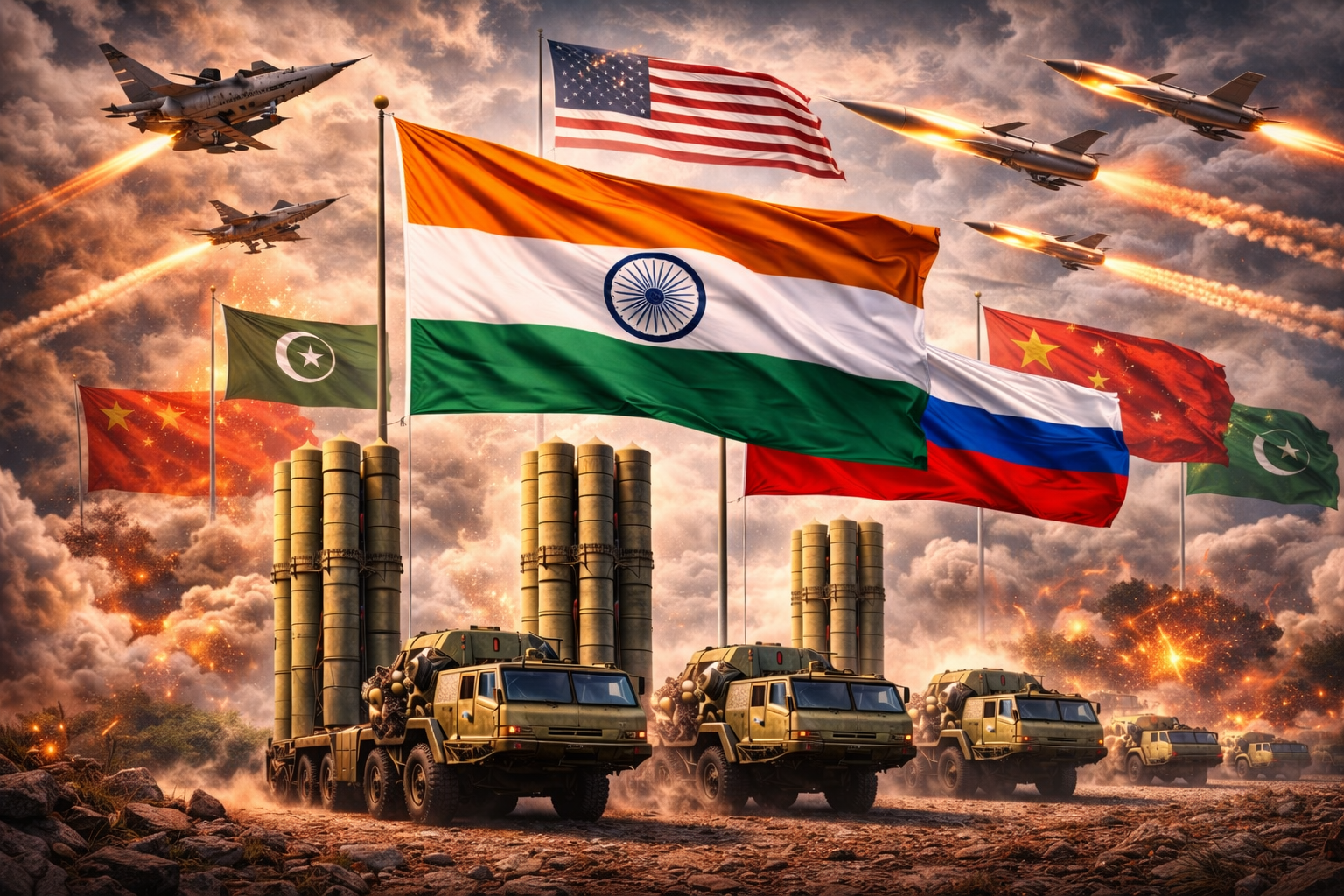

India is steadily modernizing its military capabilities and expanding its air defense network, entering a potentially transformative phase. After buying advanced fighter jets and multi-layer missile defense systems such as the S-400 missile system, India is once again focusing on the Russian S-500 missile system, which is at the top of the list for air and missile defense. The timing is important because the renewed push comes at a time when strategic competition is getting worse in Asia, threats from both conventional and non-conventional weapons are rising, and the global order is changing quickly. Vladimir Putin’s visit to India in 2025 has given this goal more energy by starting up talks again about buying high-end weapons and making weapons together.
This paper examines the potential benefits for India regarding a prospective S-500 acquisition, its integration into India’s overarching military modernization efforts, the anticipated responses from regional powers—particularly Pakistan and the People’s Republic of China—and the apprehension with which the United States is monitoring this strategic realignment.
Putin’s 2025 India Visit: A Strategic Reset
Putin’s visit to India in December 2025, which was his first in four years, came at a very important time. Reuters says that the visit was meant to strengthen energy and defense ties that had been strained by Western pressure after Russia’s war in Ukraine. Before the summit, there were credible reports that India was going to try to get new arms deals. It was interested in the S-500 missile defense shield and Russian fighter jets, in addition to more long-range surface-to-air missile (SAM) systems. The joint statement that came out after the summit did not finalize any deal for the S-500 or confirm the purchase of a new S-400/S-500 package. However, the fact that these high-end systems were even being talked about shows where India’s strategic thinking is going. The summit focused on a broader shift instead of just a buyer-seller contract. Both sides agreed to work together on making military hardware, spare parts, and co-production under India’s “Make-in-India” or “self-reliance” model.
Putin’s visit could be a turning point because it could lead to more than just renewing old deals. It could also lead to a new way of working together, where India gradually builds up its own capabilities while still getting high-end Russian technology.
Why the S-500 Matters for India: Strategic Gains and Doctrinal Shifts
Filling the Upper Tier of a Layered Defense Shield
The S-500 is often called Russia’s next-generation “upper-tier” air and missile defense system. It is meant to stop a wide range of aerial threats, including planes, cruise missiles, ballistic missiles, and even some near-space threats like hypersonic glide vehicles and low-orbit satellites. On paper, it can hit targets hundreds of kilometers away, making it one of the best long-range surface-to-air and anti-ballistic missile systems in the world. India already has the S-400 missile system, which is a bit older. They signed a contract in 2018 for five regiments, three of which have been delivered and the two remaining regiments are scheduled for delivery in 2026. The S-500 would be on top of or next to this network, giving India a real multi-layered air and missile defense system. With threats on the rise, like ballistic missiles being developed in Islamabad and China’s growing strategic arsenal, the S-500 would strengthen India’s top-tier defense, protect important hubs (cities, military bases, and major installations) better, and make it more expensive for an enemy to even think about a high-altitude, long-range strike.
Enhancing Deterrence, Not Just Defense
Acquiring the S-500 missile defense system is more than just a defensive move. In strategic theory, a robust defensive shield can facilitate deterrence by denial, thereby diminishing confidence in an adversary’s capacity to cause harm. In South Asia, where India, Pakistan, and increasingly China all have nuclear weapons, improving missile defense can act as a hedge by making limited conventional or even nuclear strikes riskier and less appealing to enemies.
Also, a strong air and missile defense shield gives India more operational flexibility as it upgrades its air force (for example, by modernizing its current fleet of fighter jets and getting new platforms) and expands its naval capabilities. It might let India think about being more aggressive, like with naval task forces or forward bases, because it would be better protected against air and missile attacks.
Signaling Strategic Autonomy and Great-Power Posture
A possible S-500 deal would also send a bigger message: India does not want small improvements. It wants the best technology available. The fact that voices are rising about the S-500 deal in 2025, when competition between great powers is growing, shows that India wants to stay independent while deepening its ties with the West. The recent summit also stressed working together to produce and share technology, which shows a desire to move from being a buyer to a co-developer, which is a sign of a rising defense power. This fits with India’s bigger goal of showing off its power not just in the region, but sometimes even around the world, so it can protect its most important interests and deal with new threats as they come up.
Regional Fallout: How Pakistan and China Might React
Pakistan: From Defensive Angst to Offensive Compensations
Pakistan may consider India’s interest in the S-500 as a developing challenge. In the past, Pakistan has seen India’s purchase of advanced SAMs, like the S-400, as a threat to stability. When India signed the S-400 deal, Pakistan formally criticized it and suggested ways to fight back. As India looks at the S-500 and maybe more SAM regiments, Pakistani strategic planners may have to speed up the modernization of their strike and deterrent capabilities even more. This could manifest in several ways:
- Doubling down on the development of ballistic missiles, including systems with multiple independently targetable reentry vehicles (MIRVs), to break through or saturate missile defenses.
- Investing in stealthy cruise missiles, hypersonic or quasi-ballistic systems, unmanned aerial vehicles (UAVs), decoys, or electronic warfare—tools that can get through or overwhelm layered air-defense networks.
- Looking for more technological cooperation with China (or even other countries) to make better strike systems.
This kind of response could make the region even less stable. Every time India upgrades its defenses, Pakistan responds in a way that is not equal, keeping the offense-defense spiral going.
China: Strategic Calculations, Not Panic — Yet
China is considering India’s plans for the S-500 as a new layer to the region’s deterrence dynamics, albeit as less existential than they are for Pakistan. China already has advanced SAMs and has advantages in many areas, such as numbers, range, airpower, and space-based assets. But if India gets the S-500, it could make planning for the PLA more difficult in some situations:
- Airpower: Long-range SAMs like the S-500 would make it more dangerous for planes to fly over or strike India from the air. Chinese assets that are very important, like bombers, surveillance platforms, and stand-off munitions, might have to change their routes or depend more on stand-off or space-based platforms.
- Escalation control: Both sides have nuclear weapons and long-range missiles. If India has a strong missile shield, it could give New Delhi more confidence, which could change China’s calculations about when to escalate.
- Strengthening the “arms triangle” between India, Pakistan, and China: China may increase military cooperation with Pakistan and speed up technology transfers (cruise missiles, hypersonic weapons, UAVs, cyber and intelligence, surveillance, and reconnaissance, or ISR) to make sure its South Asian ally has a strong deterrent.
China is unlikely to see India’s purchase of S-500s as a direct threat to its existence, though. Instead, China might see it as just one more piece in a complicated web of deterrence, competition, and power projection across South Asia and the larger Indo-Pacific.
The United States’ Dilemma: Partnership, Pressure, and Strategic Ambiguity
India’s purchases from Russia put the US in a strategic bind. America sees India more and more as a key part of its Indo-Pacific architecture on one hand. On the other hand, US laws like the Countering America’s Adversaries Through Sanctions Act (CAATSA) punish countries that make big arms deals with Russia, especially ones that involve advanced systems.
India’s purchase of the S-400 in 2018 caused a lot of debates in the US. Some people were worried that Russian radars and air-defense systems could make US-made platforms sold or leased to India less safe in the future.
The Indo-Russia summit in 2025 makes things even more complicated. As Russia and India work together to make things and produce things, the risk of technology spreading or at least being seen grows. This could make the US less likely to share advanced platforms (like stealth fighters, advanced surveillance, and electronic warfare systems) with India.
US policymakers are also probably keeping a close eye on whether Russia gets a stronger foothold in India’s defense sector. This could threaten US strategic influence in South Asia and the Indo-Pacific in the long term. However, the US is also likely to be very careful about how it responds in the near future. Punitive actions could put at risk the growing cooperation between the US and India on maritime security, intelligence sharing, and strategies against China. The balancing act could make Washington more involved in diplomacy while quietly pushing New Delhi towards “Western-aligned” or “indigenization” purchases.
Why, for Now, the S-500 Remains a Prospect — Not a Done Deal
Even though there is new interest, there are still major problems that make it impossible to buy the S-500 right away:
- No formal contract was signed: There was no MoU or procurement agreement for the S-500 (or any other S-400/Su-57 deals) in the joint statement after the 2025 summit. The main agreements were about making things together, making spare parts, and making trade and energy ties stronger.
- Sanctions, payments, and money problems: Normal arms deals in US dollars are still hard to do because of international sanctions on Russia. Analysts say that before India can place big strategic orders, it needs to either increase its exports to Russia or find strong ways to trade and pay in rupees and rubles.
- Trade-offs in terms of strategy and the economy: Getting and keeping S-500s (or even more S-400s) is expensive and would require a lot of money for logistics, maintenance, and training. New Delhi seems to want to cut down on its reliance on foreign supply chains by supporting joint manufacturing and “Make in India”. However, this approach takes time and can’t replace short-term capability.
So, the S-500 is still a top priority, not something that has already happened. The argument over it—whether India sees it as necessary, desirable, or a way to protect itself—says a lot about India’s changing strategic position.
Conclusion
Talk of high-end arms purchases, joint production, and deeper defense integration has come back up since Putin’s visit to India in 2025 and the subsequent summit reaffirmation of India’s special strategic partnership with Russia. The S-500, which is a symbol of next-generation air and missile defense, is probably the most important thing that analysts are informally talking about. If the S-500 were to be bought or made together, it would make India’s layered air and missile defense system stronger, make it harder for enemies to attack, and give India more power to defend itself and project power in a region that is always changing. It would be a big transformation for India’s defense capabilities and send a message to not only Pakistan and China, but also to the US and other major world powers. But the S-500 also highlights a long-standing strategic problem: every time a country improves its defenses, its enemies tend to respond with offensive measures, which could lead to an arms race instead of making the region more stable. Pakistan could speed up the development of ballistic missiles, cruise missiles, or hypersonic missiles. China could also work more closely with Pakistan on technology and strategy or focus more on asymmetric strike and surveillance capabilities. From Washington’s point of view, the S-500 raises big worries about technology transfer, compatibility, and long-term strategic alignment. India is trying to find a balance between keeping its defense ties with Russia and strengthening its ties with the US. The road ahead is not easy. The S-500 deal isn’t just about hardware; it is also about doctrine, deterrence, and the future of security in Asia. It is clear what India’s strategic goals are. But whether that goal leads to stable deterrence or an arms race that is hard to predict will depend on how New Delhi handles the timing of acquisitions, reactions in the region, and outside pressures, especially from the US.