





China aggression renews question of whether Trump would defend Taiwan with US military
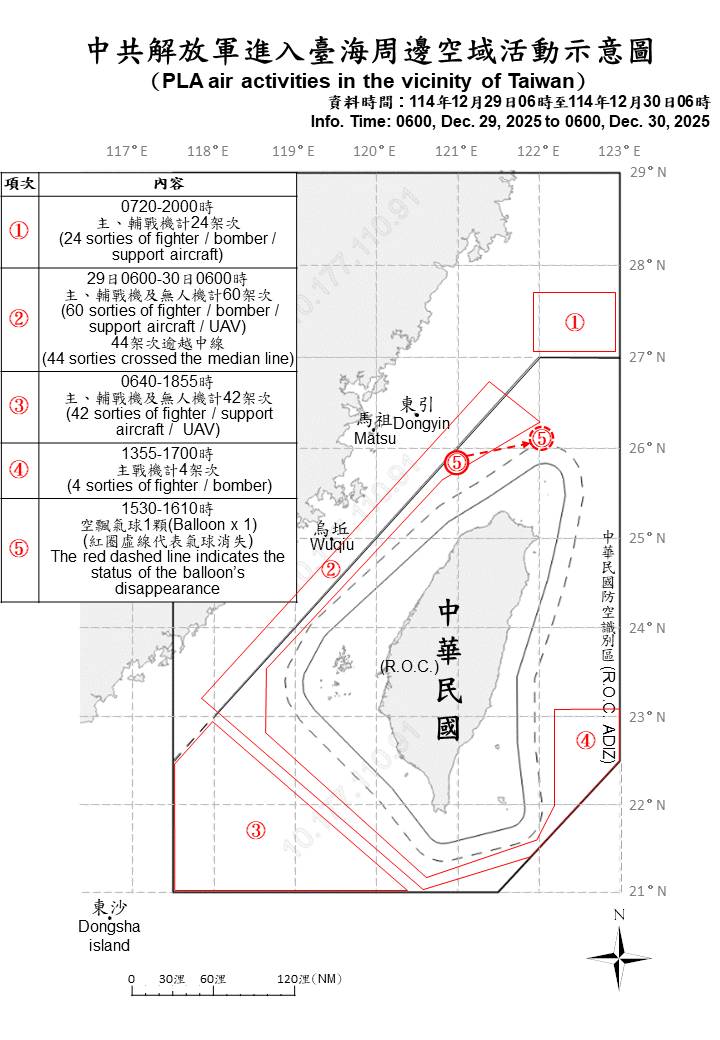

WASHINGTON – In a two-day operation in December, dozens of Chinese ships and aircraft surrounded Taiwan in what looked like a rehearsal for a blockade.
Taiwan’s military counted 90 aircraft sorties that crossed the center line of the Taiwan Strait on Dec. 29. Four amphibious assault ship formations were detected in international waters and 19 Chinese ships entered the island’s 24-mile buffer zone.
Small Wars Journal is pleased to introduce a new partnership with ASU’s Cronkite School of Journalism, launching the SWJ Cronkite Fellowship—a semester-long placement that embeds a Cronkite student journalist in Washington, DC to cover defense and national security with rigor and independence. Each term, the selected fellow reports from the center of U.S. policy debates, bringing on-the-ground journalism to the SWJ audience. Our inaugural fellow, George Headley, opens the program with a timely examination of Beijing’s escalating military pressure on Taiwan and the strategic uncertainty surrounding U.S. policy. This piece sets the standard for what the fellowship aims to deliver: serious reporting on consequential issues, minus the fluff and talking points.
The exercise continued the next day with more incursions by air and sea. Ten long-range rockets landed within 24 miles of the coast – the closest live projectiles China had ever fired, according to the Global Taiwan Institute.
“Justice Mission 2025” was one of China’s largest exercises ever around Taiwan, and the biggest since 2022, when it lashed out after Nancy Pelosi, then Speaker of the House, became the highest-ranking U.S. official to visit the self-governing island in 25 years.
The Taiwan Mainland Affairs Council called December’s exercise “provocative” and a threat to regional stability. The Chinese PLA Eastern Theater Command described the exercise as a success as it continues to “resolutely thwart the attempts of `Taiwan Independence’ separatists and external intervention.”
President Donald Trump downplayed the show of force. “They’ve been doing naval exercises for 20 years in that area,” he said at a White House news conference with Israel’s prime minister, Benjamin Netanyahu.
What would Trump do in case of invasion or an actual blockade? Can Taiwan count on his backing in a crisis? His trade skirmishes with rivals like China and friends like Canada, on and off support for Ukraine, efforts to bully Denmark into selling Greenland, and antagonism towards NATO add to the uncertainty.
Two months before Justice Mission 2025, after a meeting with President Xi Jinping, Trump had issued a vague but firm threat in case China tried to take back Taiwan by force. “I can’t give away my secrets,” he said on CBS’s “60 Minutes.” “You’ll find out if it happens, and he understands the answer to that.”
Two previous presidents declared outright that they would use the U.S. military to defend Taiwan.
Trump has not, hewing instead to the longstanding U.S. policy of strategic ambiguity – trying to deter a forceful takeover of Taiwan while refraining from recognizing its independence or explicitly promising a U.S. military response in a crisis, either of which would provoke Beijing.
An updated National Defense Strategy published Jan. 23 by the Department of Defense makes no mention of Taiwan by name, though it does refer to “a strong denial defense along the First Island Chain” – a Cold War-era reference to Taiwan, Japan, the Philippines and other maritime barriers.
“Trump is far too untraditional to be predictable, which makes predicting his actions – and therefore assessing his reliability with regards to defending Taiwan – especially difficult,” said J. Michael Cole, a senior non-resident fellow with the Global Taiwan Institute.
Trump has issued enough tough talk towards China to provide some reassurance to Taiwan. That includes some strong hints at a U.S. military response in case of invasion.
Xi “would be very unhappy if he did,” Trump told The New York Times in early January, shortly after the two-day exercise.
But he has remained vague enough to allow anxiety to persist in Taiwan and in Congress, where support for the island is widespread and bipartisan.
“I don’t know that you could easily predict what Trump’s reaction would be,” Sen. Tim Kaine, D-Va., a member of the Senate Foreign Affairs Committee, said in an interview.
Things Trump has said
Trump’s warnings in early January stand in contrast to uproars he caused shortly after winning the White House in 2016.
A month after his election, Trump spoke by phone with Taiwan President Tsai Ing-wen. Their 10-minute call was the first direct conversation between Taiwan’s leader and a U.S. president or president-elect since 1979, when President Jimmy Carter normalized relations with China.
China’s Foreign Ministry lodged a formal complaint with the U.S. over the Trump-Tsai call, demanding the U.S. “avoid causing unnecessary interference to the overall China-U.S. relationship.”
Tsai’s office said she congratulated Trump on his election and they discussed security. There were no hints as to any commitments he may have made.
Vice President-elect Mike Pence downplayed the conversation as a “courtesy call,” as did Trump.
“Interesting how the U.S. sells Taiwan billions of dollars of military equipment but I should not accept a congratulatory call,” Trump posted on X.
The president-elect further stirred the pot two weeks later by suggesting that once he took office, he would use China’s insistence on a “one China” policy as leverage.
“I fully understand the ‘one China’ policy, but I don’t know why we have to be bound by a ‘one China’ policy unless we make a deal with China having to do with other things, including trade,” Trump said on “Fox News Sunday.”
Outgoing President Barack Obama chastised Trump for comments that could push U.S.-China relations into “full conflict mode.”
“The idea of ‘One China’ is at the heart of their conception as a nation,” Obama said in a news conference a month before leaving office, “and so if you are going to upend this understanding, you have to have thought through what are the consequences.”
To Beijing, the “One China Principle” is non-negotiable. Nationalists fled to Taiwan after losing a civil war and took control in 1949. China sees Taiwan as a renegade province that it will eventually reabsorb.
The U.S. calls its own approach to the delicate issue the “One China Policy,” acknowledging the People’s Republic of China’s stance while also aiding Taiwan.
Days after taking office, after a call with Xi, Trump backtracked.
“President Trump agreed, at the request of President Xi, to honor our `one China’ policy,” the White House said.
It wasn’t the last time Trump would strain and then smooth out U.S.-China relations.
In 2018, Trump sparked a trade war, eventually pushing tariffs on Chinese imports to 21%. He turned to tariffs again in his second term. For about a month last spring, tariffs on Chinese goods hit 145%.
In the past year, the U.S. and China have also clashed over artificial intelligence, access to rare earths and semiconductors.
Although the U.S. condemned China’s massive military exercise in December, Trump’s own response didn’t sit well with Yuki Tatsumi, a senior director at the Institute for Indo-Pacific Security, a think tank focused on curbing China’s regional hegemony.
“Those statements condemning Beijing’s behavior have mostly come out of the State Department or the Pentagon,” she said. “That is a bit concerning to me.”
Previous Presidents
The two presidents who overtly vowed to deploy the U.S. military if necessary were Joe Biden and George W. Bush.
Three months after taking office in 2001, Bush told ABC News the U.S. would do “whatever it took” to ensure Taiwan’s security.
Biden pledged repeatedly and unequivocally that the U.S. would defend the island militarily.
In an August 2021 interview with ABC’s “This Week,” he likened the U.S. commitment to defend Taiwan to the “sacred commitment” to mutual self-defense among the U.S. and its NATO allies – even though the U.S. has no such treaty with Taiwan.
Those statements, though, were more a departure than the norm. And aides to both presidents tried to walk back or soften their bluntness.
In June 2023, national security adviser Jake Sullivan deflected questions about Biden’s apparently ironclad pledge by insisting that “our policy hasn’t changed. … We do not support Taiwan independence. What we support is an effort to ensure that there are not unilateral changes to the status quo by Taiwan or by the PRC.”
That’s in line with strategic ambiguity – leaving open the possibility of U.S. military intervention while avoiding any formal alliance with Taiwan or explicit promise that would anger and provoke China.
“China always wanted us to declare that Taiwan was a province of China, and they wanted us to break our treaty agreement with Taiwan and stop all our military assistance,” Carter said in a guest lecture at Emory University in 2018. “I also insisted that we continue to provide defensive assistance to Taiwan and that the differences between China and Taiwan be resolved peacefully.”
His successor, President Ronald Reagan, maintained the policy of remaining vague on whether and how the U.S. would defend the island. He also resisted China’s demands to cut arms sales.
In a 1982 memo that was declassified in 2019, Reagan wrote: “The U.S. willingness to reduce its arms sales to Taiwan is conditioned absolutely upon the continued commitment of China to the peaceful solution of the Taiwan-PRC differences.”
Formalities of U.S.-Taiwan relations
Under a 1954 Mutual Defense Treaty, the U.S. promised for decades to come to the island’s defense. Carter notified Taiwan in late 1978 that the U.S. was canceling the treaty effective at the end of 1979.
But other formal and informal U.S. policies offer security assurances, in particular the Taiwan Relations Act, the Six Assurances and the Three Communiqués with China.
- The Taiwan Relations Act: Congress approved the TRA three months after Carter normalized relations with China in early 1979. The law made it explicit that the U.S. was no longer obliged to defend the island but still pledged to “provide Taiwan with the arms of a defensive character,” and to continue to protect Taiwan through military and economic deterrence.
The TRA also codified the expectation that Taiwan’s future would be determined “by peaceful means” rather than force.
- The Six Assurances: These are promises articulated by Reagan aides in congressional testimony and other public appearances in 1982: The U.S. will not mediate the dispute, pressure Taiwan to negotiate with China, halt arms sales, consult with Beijing about arms sales, take a position on China’s claim of sovereignty over the island, nor revise the TRA.
- The Three Communiqués: In the first, signed in 1972, the U.S. acknowledged the Chinese position that there is only one nation of China and that Taiwan is part of it. The U.S. also agreed to withdraw its forces from Taiwan.
The second, signed in 1979, reflects a mutual commitment to avoid military conflict, and both agree not to seek hegemony in the region.
The third, signed in 1982, effectively sidestepped the unresolved issue of arms sales to allow the U.S. and China to focus on other issues.
Arms Sales and foreign assistance
Few presidents have sold more military equipment to Taiwan than Trump.
In his first term, the U.S. sold more than $18.7 billion of missiles, tanks, aircraft and other materiel to Taiwan.
That compares to about $8 billion worth under Biden and around $14 billion during Obama’s two terms.
Early in Trump’s second term, the U.S. sold Taiwan about $330 million in arms. In December, the administration announced an $11.1 billion deal – the largest U.S. arms sale to Taiwan ever, according to the Defense Security Cooperation Agency.
This package included missile systems, drones and helicopter parts.
Yet the backlog for arms sales continues to increase. The most recent package pushed the backlog to $32 billion in December, though once the sales are approved, deliveries could be swift, according to the Taiwan Security Monitor.
Trump paused $400 million in military aid to Taiwan during trade talks with China in September, despite commitments under the 2022 Taiwan Enhanced Relations Act. The law drastically increased such aid, up to $2 billion annually from 2023 to 2027.
In 2024, the U.S. provided $1.5 billion, according to federal data.
“In the past,” Cole said, the heightened pace of arms sales “could very well have frayed bilateral relations. Recognition that Taiwan needed a new defense posture, one that includes the ability to strike targets in China, has occurred gradually and silently.”
What Trump advisers say
Apart from Trump’s own statements and actions, statements from his top advisers also provide clues to how the U.S. might respond to a military threat to Taiwan.
As senators, both Vice President JD Vance and Secretary of State Marco Rubio were staunch critics of China.
During the 2024 campaign, Vance warned that the U.S. was effectively weakening Taiwan by shifting arms sales to Ukraine. He has kept a low profile on Taiwan since being sworn in as vice president.
In February 2025, Rubio told Fox News the U.S. needs to have the military capabilities to respond to a Chinese invasion but did not specify how he thinks the U.S. should or would respond besides honoring its “existing commitments.”
He gave a more forceful reassurance during trade talks with China in October.
“What people are worried about is we’re going to get some trade deal where we’re going to get favorable treatment on trade in exchange for walking away from Taiwan,” Rubio said. “No one is contemplating that.”
The National Defense Authorization Act signed into law in December directs the Pentagon to step up joint operations with Taiwan and to provide drone and anti-drone technology, and authorizes up to $1 billion for Taiwan’s defense.
Sen. Roger Wicker, R-Miss., chair of the Senate Armed Services Committee, called Justice Mission 2025 a wake-up call that justified accelerated arms sales to Taiwan.
“These increasingly complex short-notice rehearsals are designed to demonstrate the PLA’s ability to implement a blockade of Taiwan and allow the Communist Chinese Party to coerce Taipei,” he said in an X post.
At a Senate Foreign Relations Committee hearing in November, chair Sen. James Risch, R-Idaho, called China ”the greatest long-term threat to American interests” – a view that’s common among leading national security voices in both parties, though not necessarily official administration policy.
“We all know, for Xi Jinping, asserting China’s control over Taiwan is a legacy-defining issue,” Risch said. “His population is aging. His economy is faltering. China needs a victory, and Xi has set his sights on Taiwan. This is deeply troubling.”
Other Clues in Public Statements and Documents
Apart from the Six Assurances and other formal pillars of U.S.-Taiwan relations, two recent Trump administration policy statements provide insight into current doctrine.
The National Security Strategy issued in December by the White House calls for restoring a “favorable balance of military power” in the Indo-Pacific to deter Chinese aggression.
The 33-page document mentions Taiwan eight times – compared to seven times in the 2022 version issued under Biden. It stresses Taiwan’s importance because of its proximity to major shipping routes and dominance in the semiconductor industry.
“Deterring a conflict over Taiwan, ideally by preserving military overmatch, is a priority,” the document says. “We will also maintain our longstanding declaratory policy on Taiwan, meaning that the United States does not support any unilateral change to the status quo in the Taiwan Strait.”
Although the Jan. 23 National Defense Strategy only alludes to Taiwan – a significant shift from the previous version in 2022, which mentions the island four times – it does emphasize the need to put a check on China’s regional dominance.
“We will deter China in the Indo-Pacific through strength, not confrontation,” it says, calling for a build-up of forces by the U.S. and allies and partners sufficient to offset China’s capabilities.
Still, the shift toward the Western Hemisphere as the top strategic priority runs counter to the views of Elbridge Colby, the Under Secretary of Defense for Policy, who oversaw creation of the NDS.
Colby has long argued for prioritizing China.
A 2021 book, “The Strategy of Denial,” argues for shifting resources from other regions to support Taiwan and counter growing Chinese influence in the Indo-Pacific. He told senators during his confirmation process that ensuring “China will not attack Taiwan during his tenure” would be a “cardinal responsibility.”
“Trump has certainly been more non-committal to Taiwan than prior presidents, in particular in comparison to Biden and Bush,” said Benjamin Sando, a research fellow at the Global Taiwan Institute. But he added, “China has yet to invade Taiwan so it is impossible to definitely argue that one approach is stronger than another.”
Skepticism and Confidence in Trump amid recent international conflicts
A poll conducted in August from the Institute for National Defense and Security Research and the Chicago Council on Global Affairs found that only 51% of the island’s residents are confident the U.S. would provide boots on the ground – and only 43% of Americans would support sending troops.
Just 41% of Taiwanese expect U.S. Navy intervention in case of a Chinese blockade, though 47% of Americans surveyed would support that.
One reason for doubts about Trump’s follow-through on formal commitments to Taiwan and other assurances is his history of setting aside alliances and treaty obligations.
Trump critics point to his berating of Ukraine President Volodymyr Zelenskyy in the Oval Office last February and his inconsistent support for Ukraine’s war to repel the Russian invasion; his threats of trade wars with Mexico and Canada despite a North American trade deal; and his threats of force against Denmark – a NATO ally – over its refusal to turn over or sell Greenland.
Canada’s recent bilateral trade deal with China underscores the fear that Trump’s threats against U.S. allies have only strengthened China.
In the New York Times interview in early January, Trump asserted that only his “own morality” limits his foreign policy authority, regardless of international law.
“Trump’s responses to Ukraine and Greenland raise concerns about his administration’s fundamental view on U.S. commitment to its allies and partners,” Tatsumi said in a statement. “In particular, Trump’s approach to Greenland, threatening NATO allies, raises grave concern.”
Sando also sees Trump’s actions in Greenland as a problem because he has fractured trust with key U.S. allies.
“If Europe is less inclined to cooperate with Washington, the two sides may not be able to agree on a strategy for punishing China with economic means,” Sando said by email. “A lack of alignment will raise China’s incentive to invade, believing it will face fewer penalties.”



… [Trackback]
[…] Find More Informations here: smallwarsjournal.com/2026/02/03/china-aggression/ […]