The Limits of the China–Russia Strategic Partnership in Military Space Cooperation
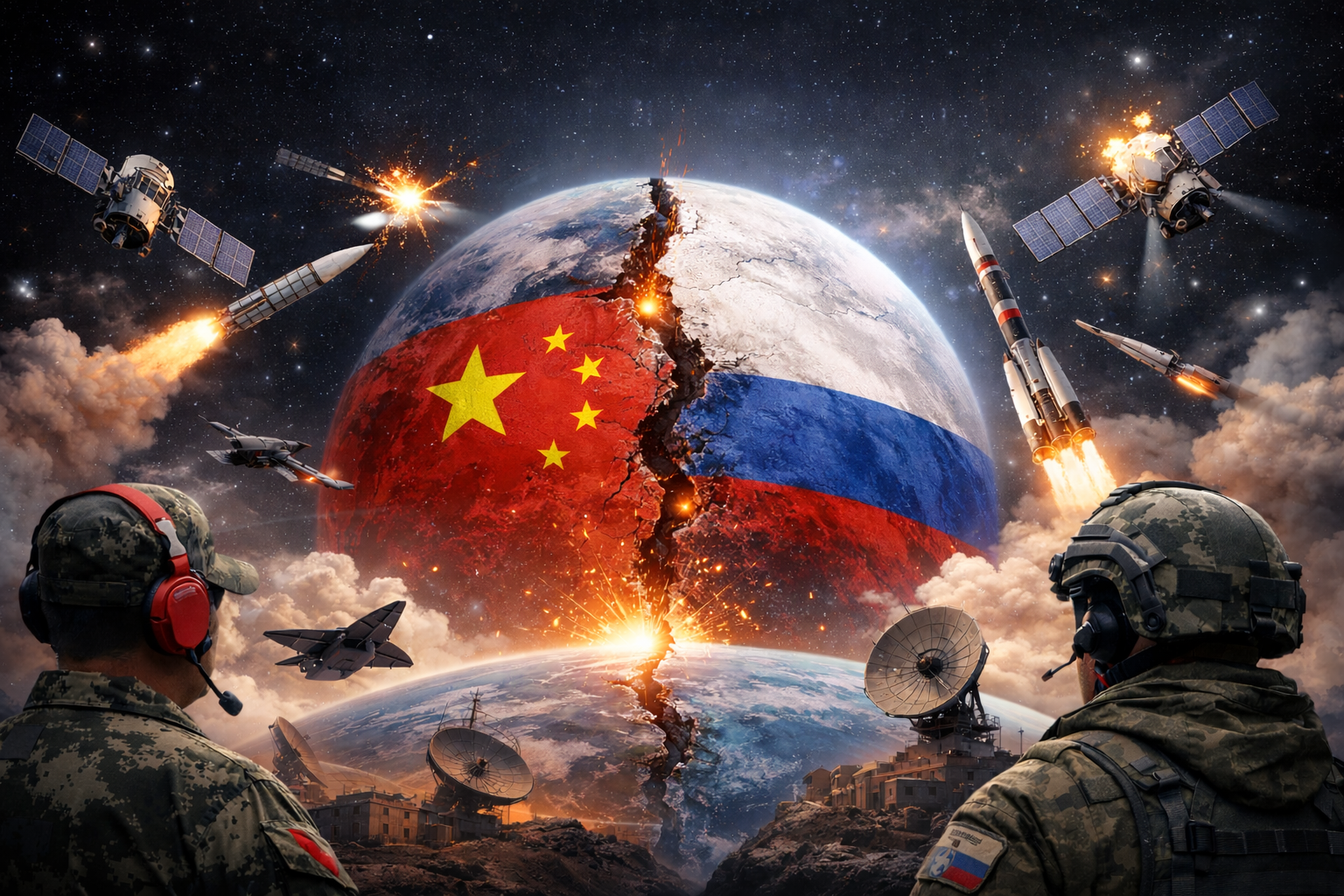

China and Russia are increasingly portraying their relationship as a stabilizing “strategic partnership”, defined by mutual resistance to US hegemony, and what both characterize as Western-led containment. This alignment is especially appealing in space because it is both symbolic and strategic, and it can be used for both military and civilian purposes. For example, satellites support precision strikes, intelligence, communications, missile warnings, and the resilience of command-and-control. They are also allowing civilians to navigate, monitor disasters, and provide commercial services. The official language stresses working together for a long time on lunar and deep-space exploration and getting China’s BeiDou and Russia’s GLONASS navigation systems to work better together. However, the same things that make space cooperation useful also make it risky. Military space capabilities are an important part of national security. They make countries more vulnerable to spying, technology leaks, operational dependence, and strategic weakness. So, China and Russia still work together a lot in military space, but only in certain areas. This is because of ongoing problems like differences in capacity and sanctions exposure, different strategic priorities, competition between bureaucracies and industries, and a long-standing lack of trust over the most sensitive technologies and operational concepts.
What Cooperation Looks Like in Practice
The International Lunar Research Station (ILRS) is the most visible space project of the partnership. It was officially started in 2021 with a memorandum between the China National Space Administration (CNSA) and Russia’s State Corporation for Space Activities “Roscosmos”. The ILRS is shown as scientific and open to participation from other countries, but it also has strategic signaling value as a non-US-led framework that is similar to US-linked coalitions around Artemis. Satellite navigation and timing are the second pillar. BeiDou and GLONASS offer precise navigation and timing services that are clearly useful for defense. Analysts say that there are more and more efforts to improve compatibility and performance through ground infrastructure and cooperation agreements. These can make systems more accurate and reliable. Third, there are times when people work together and talk about space security and strategic stability. A joint statement from China and Russia in 2025 about global strategic stability shows that both countries believe that US missile defense, “space militarization”, and high-precision conventional strikes make the world less stable. This is often why both countries focus on counterspace options and resilience. Lastly, there are sometimes public mentions of more in-depth military-technical cooperation. For instance, reporting has brought attention to Russian statements that encourage closer cooperation on military satellites and other high-tech areas. One example is Russia’s earlier help to China with its ballistic missile early-warning systems, which is a strategically important area that can help us understand both cooperation and its limits.
Western Assessments Emphasize Selective Sharing and Risk Management
Many analysts in the West think that China and Russia work together in space, but only to a certain extent. One constant judgement is that both sides are looking for practical benefits, like navigation redundancy, joint science missions, and diplomatic coordination, while limiting their exposure in the most sensitive military areas where dependence or leaks could be very expensive. A comprehensive study by the US Air University and the Chinese Aerospace Studies Institute (CASI) characterizes cooperation as a strategy to enhance influence and provide an alternative institutional route to US-supported norms. Simultaneously, it acknowledges that practical limitations and political prudence influence results. A second worry in the West is that the partnership could make strategic risk worse, even if there are no formal “alliance” commitments. Think tanks and policy analysts say that working together on space governance and dual-use technologies could indirectly make the military stronger by making it easier to understand the situation, navigate accurately, and operate in areas where there is a lot of competition.
At the same time, Western commentary often points out problems that make full integration harder. After 2022, Russia is relying on China more because of sanctions and the needs of war. This gives China more power in negotiations, while Russia becomes a more politically dangerous partner for China’s commercial space goals. This imbalance makes Moscow want to work together, but it also makes it want to protect its most important technologies. It also makes Beijing want to avoid making open-ended promises that could lead to secondary sanctions or damage its reputation.
Chinese Perspectives Emphasize Sovereignty, Multipolarity, and Regime Security
The official language of China often talks about space cooperation in terms of sovereignty, peaceful development, and opposition to “hegemony”, while also stressing autonomy in important technologies. The story of the ILRS is told in a way that makes it seem open and cooperative, but it also shows how China is becoming a leader in deep-space exploration and setting standards.
In Chinese strategic thought, space is becoming more and more important for “informatized” and “intelligentized” warfare, where strong networks, remote sensing, and positioning services give you a big edge. Working with Russia can be helpful, but China still values independence, redundancy, and variety more. That logic naturally sets limits: Beijing probably would not want to rely on Russian systems for operations, and it will protect technologies that are important for its own military modernization and business competitiveness.
There is also a political side to this: China wants to look like a responsible space power. Things that upset people around the world, like anti-satellite (ASAT) tests that make debris, can make it harder for China to get its diplomatic message across. This does not mean that Beijing does not want counterspace capabilities; it just wants to control how things look and limit its exposure to bad publicity. This can make it harder for China to openly support Russia’s more aggressive actions in space.
Russian Perspectives Emphasize Strategic Stability and Asymmetric Leverage
For a long time, Russian strategic discourse has linked space systems to strategic stability. This is because satellites make it possible to do precision strikes, missile defense cueing, and command-and-control. From this perspective, counterspace capabilities can be characterized as an “asymmetric” reaction to perceived US aerospace superiority. Arms control reporting illustrates this reasoning by highlighting how Russian military leaders and analysts rationalize counterspace tools as stabilizing within their preferred narrative.
Russia also has practical reasons that make sense. It still has a lot of engineering know-how and niche skills, but budget problems, sanctions, and problems in the industrial sector have made Moscow look for partners who can help it with big projects and keep its status. The ILRS and recent news about Russia’s plan for a lunar power system linked to the joint program show that Russia is interested in staying relevant in a field where China is becoming the leader. Still, Russian strategic culture also has a warning instinct: being too dependent can be risky. China is becoming a stronger partner in many industries that are important for space. Russia has reasons to work with China, but it also has reasons to limit the transfer of technology that could help China become more powerful in the long run, or make it harder for Russia to act on its own.
Where the Limits are Most Visible
The “ceiling” on cooperation is most clear in four areas:
- First, it’s unlikely that all of the most sensitive military space architectures, like those linked to strategic nuclear forces, will be shared. Early warning, secure communications, and specific space situational awareness capabilities are critical and require a lot of intelligence. Even if there is cooperation (as suggested by reports of Russian help with early warning), it is probably set up to keep both sides from getting too close and keep control of their own territory.
- Second, the rules and behavior in counterspace cause problems with reputation and operations. The direct-ascent ASAT test that Russia did in 2021 made a lot of debris and got a lot of bad press. Analysts reported that debris hazards do not discriminate; they can also threaten other space actors, like China, and make it harder for Beijing to project an image of being a “responsible power”.
- Third, sanctions and dual-use export controls put limits on how things can be done. Russia’s limited access to advanced parts and supply chains for launching pushes it towards China. However, this also makes it riskier for Chinese companies and institutions that are exposed to Western markets and finance. These dynamics foster low-visibility, meticulously defined collaboration instead of expansive, transparent amalgamation.
- Fourth, different strategic geographies are important. Russia’s main military focus is still Europe and the countries nearby, while China’s focus for planning and contingencies is still maritime Asia and the Western Pacific.
Working together in space can be good for both sides, but different operational priorities make interoperability requirements less strict. For instance, both value navigation and ISR resilience, but the architectures that work best in the Arctic and Europe may not work as well in the Indo-Pacific. This makes it less appealing to do deep operational fusion.
The Paradox of “All-Weather” Partnership in Space
Politically, China and Russia can be “all-weather friends”, but when it comes to technology, they can only be partial partners. The partnership is based more on a shared sense of threat than on shared values, especially when it comes to the US and its allies. This gives long-lasting reasons for countries to work together diplomatically and on projects that show that there are more than two poles of power.
However, it is very hard to build trust in military space cooperation. Both sides are smart intelligence players who know that a partner today could be a competitor tomorrow, especially in high-tech fields. China’s rise has also made things awkward: it needs Russia less and less as time goes on, but Russia needs China more and more because of sanctions. Instead of the smooth integration that alliance rhetoric suggests, that gap can cause anger, caution, and bargaining behavior.
Outlook
In the medium term, China and Russia are likely to work together more on military space projects that have a lot of benefits and manageable risks. These include lunar and deep-space projects that send strategic signals, navigation interoperability and ground infrastructure, and involve working together in international forums on space governance. The hard limits will still be around strategic nuclear enablers, the most sensitive counterspace capabilities, and any deals that make a state dependent on others for operations. The partnership will therefore remain best understood as selective integration under pressure: strong enough to complicate Western planning and to provide each side with diplomatic leverage but constrained by enduring mistrust, asymmetric dependence, and the unforgiving logic of space as a military high ground.