





The Impact of Chinese Organized Crime in Latin America on the Region’s Resources and Environment

In The Impact of Chinese Organized Crime in Latin America on the Region’s Resources and Environment, published by Legado a las Américas, R. Evan Ellis explains how Chinese organized crime poses a direct threat to Latin America’s natural resources, governance, and hemispheric security.
Drawing on testimony before the U.S. House Committee on Natural Resources, Ellis documents how criminal networks linked to the People’s Republic of China operate across illegal fishing, mining, wildlife trafficking, narcotics, and money laundering. He shows that these networks exploit weak institutions, degrade the environment, and generate illicit revenue streams that intersect with broader PRC strategic interests. The article concludes that expanded U.S.–Latin American cooperation on organized crime would protect regional sovereignty while strengthening U.S. national security.
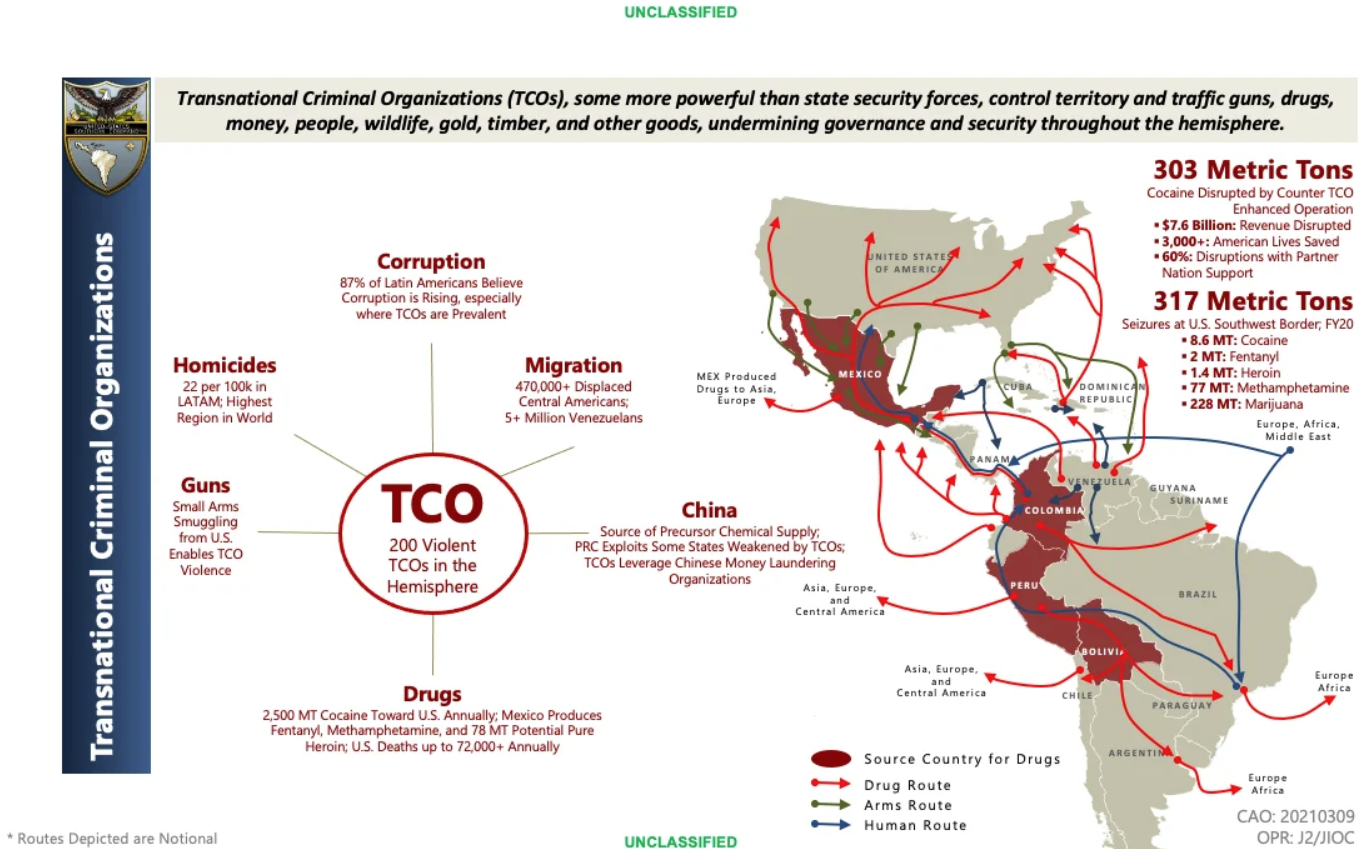
Transnational Criminal Organizations in The Americas (Image Courtesy USNI News)
Illegal, Unreported, and Unregulated (IUU) Fishing
Chinese criminal activities in the region include IUU fishing… IUU fishing costs South American economies an estimated $2.3 billion per year in lost revenues. Chinese vessels also engage in overfishing and illegal fishing techniques such as the use of trawl nets. Their activities have already caused the collapse of fisheries in Asia, put those in Africa under strain, and are currently contributing to hardships in Latin American coastal communities which depend on fishing for their livelihoods.
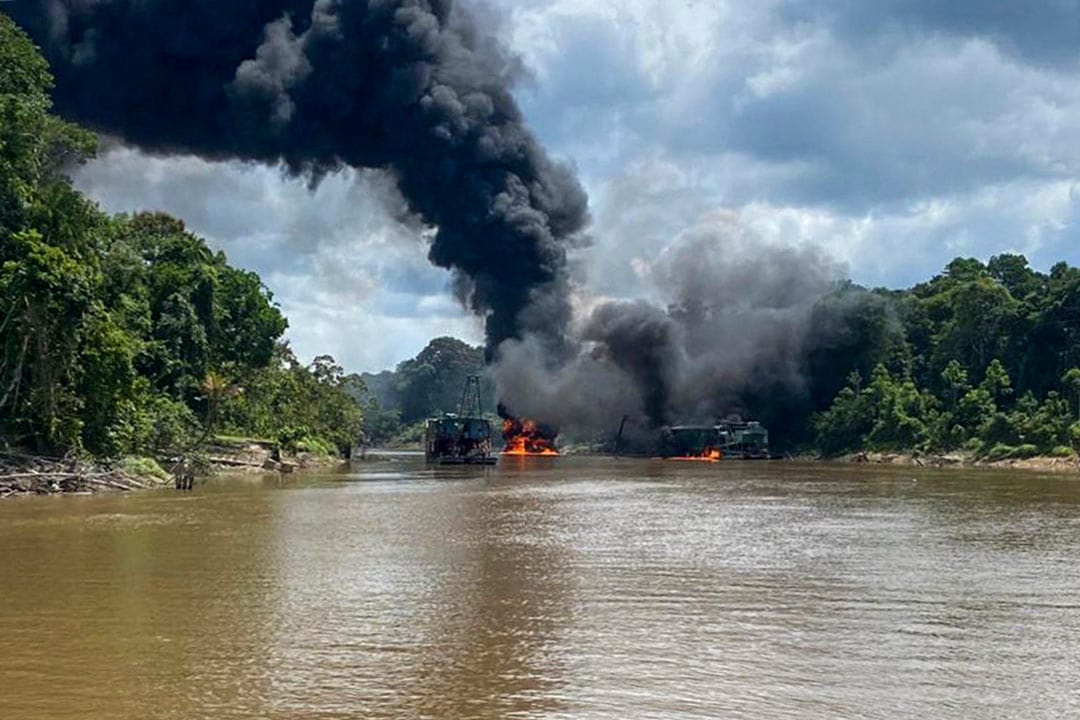
Illegal Mining
In illegal mining, Chinese entities are involved in purchasing gold and other products locally and globally, as well as supplying materials, tools, food and clothing to miners. Chinese involvement in illegal timber trafficking contributes to deforestation, is an enabler of illegal mining, and is used to smuggle materials involved in other illicit activities.
Wildlife Trafficking
In wildlife trafficking, PRC demand is particularly significant in Mexico. It includes reptile skins, shark fins, jaguar and puma skins, butterflies, totoaba swim bladders, and seahorses, among others. Chinese wildlife poaching increase the peril to endangered species, while generating illicit funds that undermine government control of the territories where they operate.
Narcotics and Precursor Chemicals
In narcotrafficking, PRC-based groups send precursor chemicals to laboratories in Mexico. Fentanyl from Chinese precursors kills an estimated 48,000 Americans per year.
Money Laundering
In money laundering, the activities of Chinese gangs, companies and financial institutions has proliferated opportunities for criminal groups to hide their illicit earnings in ways that are faster, cheaper, and harder to detect. In the Western Hemisphere, the U.S. Treasury, in 2024, stated that these organizations ‘have become more prevalent and are now one of the key actors laundering money professionally in the United States and around the globe. In one scheme ‘flying money,’ Mexican narcotrafficking gangs in the U.S. deliver bulk cash to Chinese mafia groups… completing a laundering cycle that is very difficult for authorities in the U.S. and the region to detect.”
Security Implications
Because Chinese illicit networks operate in both Latin America and the U.S., they potentially support PRC espionage activities in the U.S…In 2024, more than 30,000 Chinese were intercepted crossing the southern border, creating opportunities for PRC security services to use some of these for the purpose of espionage or sabotage in a future war. The phenomenon of informal PRC ‘police stations’ in the region shows that the PRC actively interfaces with its diaspora in the region in non-transparent and coercive ways.

