





Clausewitz and the American Center of Gravity: A Look at the National Security Strategy and National Defense Strategy Together
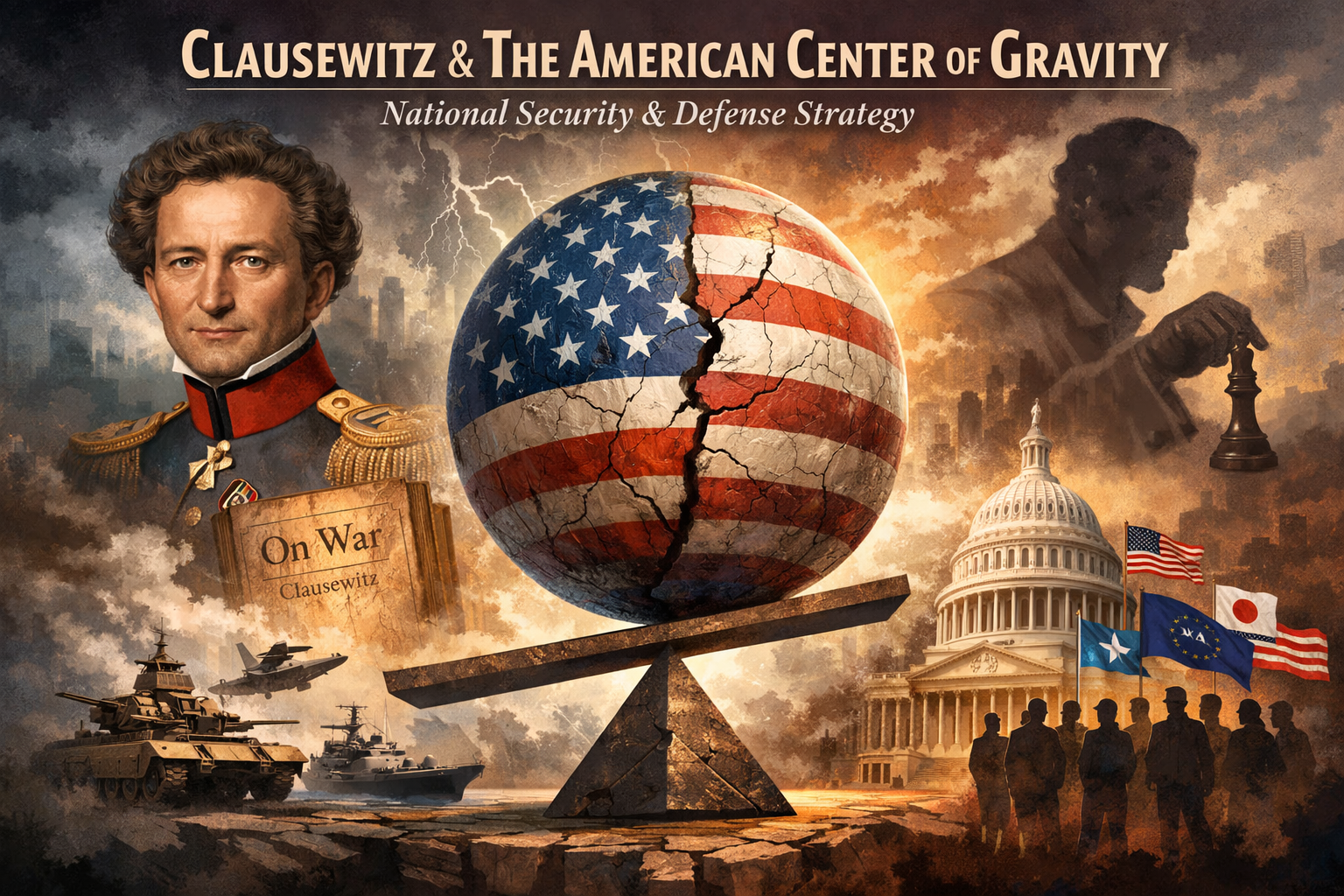

Carl von Clausewitz wrote about centers of gravity in an era of monarchies, armies, and capitals, yet his insight remains unsettlingly current. Power, he argued, does not rest everywhere at once. It concentrates. It binds. And when it fractures, the state weakens from within. His warning was blunt. The blow must be directed against those elements that hold a system together. When applied to the United States in the contemporary global geostrategic environment, this insight forces a hard reading of the 2025 National Security Strategy and the 2026 National Defense Strategy. Not as bureaucratic texts, but as signals of where American power truly resides, and where it is most exposed.
The center of gravity is real, and it is vulnerable. The question facing American strategy is whether it will defend that center deliberately or continue to assume it will hold on its own.
The question is not whether the United States faces threats. The NSS and NDS assume that as a given. The harder question is whether these strategies correctly identify America’s own center of gravity, and whether they protect it or unintentionally place it at risk.
Clausewitz’s Lens
In Chapter 4 (“Ends in War More Precisely Defined – Overthrow of the Enemy,”) of Book Eight of Clausewitz’s On War, Clausewitz wrote:
In countries subject to domestic strife, the center of gravity is generally the capital. In small countries that rely on large ones, it is usually the army of their protector. Among alliances, it lies in the community of interest, and in popular uprisings it lies in the persons of the principal leaders and in public opinion. The blow must be directed against these things.

Clausewitz offered a taxonomy. In states riven by domestic strife, the center of gravity lies in the capital and the cohesion of political authority. In alliances, it lies in the community of interest. In popular uprisings, it lies in leaders and public opinion. Each category is relational. Centers of gravity are not abstract assets. They are living bonds of legitimacy, trust, and shared purpose.
For the United States, none of these categories applies neatly in isolation. America is not a small country reliant on a protector. It is not a fragile state in the classic sense. Yet it is an alliance leader whose power depends on others believing that its commitments endure. It is also a republic whose strength rests on public consent at home. Clausewitz would likely see America’s center of gravity as composite but not diffuse. It lies in the alignment between political legitimacy at home, alliance cohesion abroad, and the credibility of American leadership to act.
The NSS and NDS both gesture toward this reality, but they do so unevenly.
The 2025 National Security Strategy
The 2025 NSS frames competition as systemic and enduring. It emphasizes democratic resilience, economic security, and alliance leadership across the Asia-Indo-Pacific and beyond. Its tone is political in the Clausewitzian sense. It understands that legitimacy, narrative, and shared purpose matter as much as material power.
From a center of gravity perspective, the NSS implicitly identifies domestic cohesion and alliance unity as decisive. As the following passages highlight, the NSS treats American leadership as inseparable from the health of democratic institutions, prosperity, and from the trust of allies:
“President Trump is building alliances and strengthening partnerships in the Indo-Pacific that will be the bedrock of security and prosperity long into the future.” (NSS 2025 p. 19)
“American diplomacy should continue to stand up for genuine democracy…” (NSS 2025, p.26)
This aligns closely with Clausewitz’s assertion that among alliances, the center of gravity lies in the community of interest. The NSS assumes that this community can be sustained through consultation, shared values, and predictable, strong leadership.
Yet there is a vulnerability here. The NSS places enormous weight on consensus, process, and normative appeal. Clausewitz would ask whether this emphasis strengthens the bond or masks its erosion. Community of interest is not declared. It is felt. When allies hedge, when partners doubt American staying power, the center of gravity shifts. The NSS acknowledges this risk but tends to treat it as a messaging problem rather than a structural one.
The 2026 National Defense Strategy
The 2026 NDS is more austere. It prioritizes homeland defense, military readiness, and the capacity to deter high-end conflict. It accepts that resources are finite and that trade-offs are unavoidable. In doing so, it implicitly narrows the definition of what must be defended first.
Through Clausewitz’s lens, this shift is profound. By elevating homeland defense above forward posture and alliance reassurance, the NDS risks signaling a relocation of the center of gravity inward. Not toward the capital in a revolutionary sense, but toward domestic political tolerance for risk and cost. The strategy appears shaped by an assumption that public opinion is brittle, that prolonged commitments abroad strain legitimacy at home.
Clausewitz warned that in popular uprisings, the center of gravity lies in leaders and public opinion. For the United States, public opinion is not merely a constraint. It is a strategic object. Adversaries understand this. They do not need to defeat American forces in battle if they can erode the will to sustain alliances and commitments. The NDS recognizes this threat implicitly through its focus on resilience and homeland defense, but it does not fully reconcile this with the need to preserve alliance cohesion as a center of gravity in its own right.
Alignment or Tension?
Taken together, the NSS and NDS reveal a strategic tension. The NSS treats alliance cohesion and democratic legitimacy as the core of American power. The NDS treats military capacity and domestic defense as the foundation upon which everything else rests. Clausewitz would insist that these are not separate centers of gravity. They are interconnected. A blow against one reverberates through the others.
If allies perceive that the United States is retrenching, the community of interest weakens. If domestic audiences perceive that alliances impose endless costs without clear purpose, public opinion turns inward. In both cases, the center of gravity shifts toward fragmentation. The adversary need not strike the capital or defeat the army. It need only exploit the seams between strategy documents, between political narrative and military posture.
Counterarguments and Risks
One could argue that the NDS is simply realistic. That without credible military power, alliance commitments are hollow. Clausewitz himself insisted that war is an act of force to compel the enemy to do our will. From this view, prioritizing readiness and homeland defense protects the ultimate guarantor of alliance credibility.
This argument has merit. A weak army undermines even the strongest community of interest. Yet Clausewitz also warned against mistaking means for ends. Military power supports political purpose. It does not replace it. If the defense strategy signals that alliances are conditional or secondary, it risks undermining the very political cohesion it seeks to defend.
Another counterargument is that domestic cohesion must come first. A divided polity cannot sustain global leadership. This too is true. But Clausewitz would ask a harder question. Is domestic cohesion strengthened by retrenchment, or by a clear articulation of why alliances matter to the American people? If public opinion is treated only as a limitation, rather than as a center of gravity to be cultivated, it becomes a vulnerability.
The Strategic Implication
From a Clausewitzian perspective, the greatest danger for the United States is not external aggression but internal misalignment. The NSS and NDS each grasp part of the center of gravity, but neither fully integrates them. The community of interest among allies, the legitimacy of leadership at home, and the credibility of military power abroad must reinforce one another. If they drift apart, the center of gravity fractures.
Adversaries operating in the gray zone understand this. They target narratives, elections, alliance debates, and burden-sharing disputes. They aim not at American tanks or ships, but at American confidence in itself and in its partners. Clausewitz would recognize this as indirect strategy aimed squarely at the center of gravity.
Questions Worth Asking
If the center of gravity lies in the community of interest, how does the United States measure whether that community is strengthening or eroding beyond formal statements and summits?
If public opinion is a strategic object, not merely a constraint, what obligations do national strategies have to educate and mobilize the American people rather than simply manage risk?
And if the NSS and NDS reflect different assumptions about where American power ultimately resides, which one would Clausewitz say an adversary is most likely to test first?
These are not academic questions. They go to the heart of whether American strategy aligns with its own sources of strength, or whether it leaves its center of gravity exposed to a patient and perceptive opponent.
Conclusion: Protecting the Center That Holds
Clausewitz reminds us that wars are decided not by the accumulation of strength alone, but by striking what binds a political system together. For the United States, that binding force is neither the capital in isolation nor the military as an instrument apart from politics. It is the alignment of public legitimacy, alliance cohesion, and credible power. When these reinforce one another, American influence endures. When they diverge, even unmatched military capacity cannot compensate for strategic fracture.
Read together, the 2025 NSS and the 2026 NDS expose a risk not of weakness, but of incoherence. One speaks the language of community of interest and democratic leadership. The other signals caution, prioritization, and inward defense. Clausewitz would warn that adversaries do not need to defeat both. They need only drive a wedge between them. Each doubt seeded among allies, each erosion of public confidence at home, shifts the center of gravity away from cohesion and toward fragmentation.
The strategic task, then, is not to choose between domestic resilience and global leadership, but to fuse them. American strategy must treat public opinion as a source of strength to be cultivated, not a constraint to be managed, and alliances as living political compacts, not optional force multipliers. If the United States fails to do this, others will apply the blow for us, quietly and persistently, against the very bonds that hold the system together.
Clausewitz offers no comfort here, only clarity. The center of gravity is real, and it is vulnerable. The question facing American strategy is whether it will defend that center deliberately or continue to assume it will hold on its own.



This is a profound recognition of an essential truth, especially among representative republics. While some view Clausewitz as outdated, there are truths which have been proven over centuries. What is disturbing is not the lack of coherence, as debate is essential, but what actually is happening here at home, regardless of whichever side one supports. A coherent strategy requires a fair degree of unity at the highest political levels, and in our country the issue is if the three government authorities can find common ground. The public is and always has been fickle, something our founders understood clearly. What we are seeing now is the result of several decades of deteriorating courtesy, lack of respect for opposing ideas, and now everyone is acting as though an opposing view is not only not worthy of serious consideration but of demonization and obliteration once the power resides fully in one’s choice of agency