Britain’s world: The strategy of security in twelve geopolitical maps

The Council on Geostrategy has just published Britain’s world: The strategy of security in twelve geopolitical maps, a geopolitical atlas designed to complement the UK’s National Security Strategy and the Strategic Defense Review.
The atlas includes 12 visualizations to explain the United Kingdom’s position and interests in the mid-21st century. The illustrations include: The national powerbase, National output, Global Britain, Undersea cables, Centers of world power, Rivals (The CRINK), Crunch zones, Allies and partners, Maritime reach, The strategy of security, Defending Europe, and The Wider North.
Key Sections
The Strategy of Security
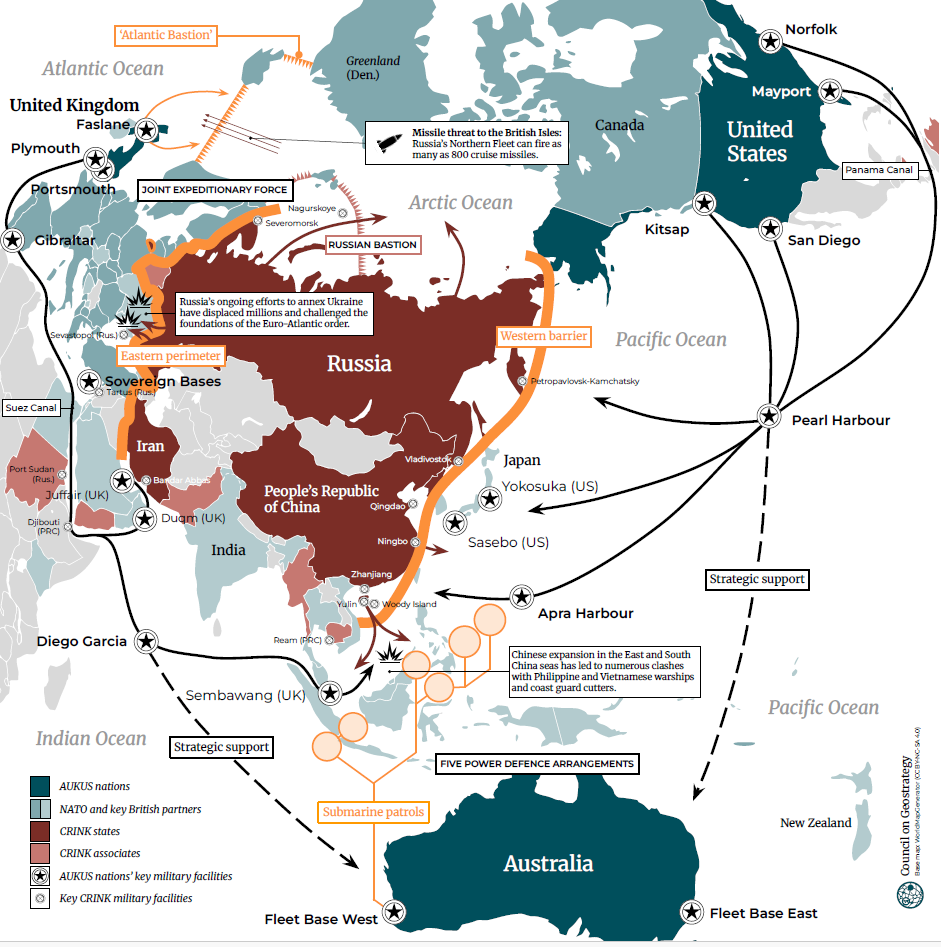
This section explains that Britain has long pursued “some sort of world order” to prevent “anarchy and war” and protect trade, even as this project mixed self-interest with a “genuinely idealistic impulse.” It argues that past successes came when international order was “founded on a physical dimension and grounded in geopolitical realities,” while failures followed when ideals lacked “the exercise of power to back it up.” Drawing on recent events, the section stresses the “indivisibility of the Euro-Atlantic and Indo-Pacific theatres” and affirms that “‘NATO First’ does not mean ‘NATO only’.” It concludes that “the physical elements of national power and national security will become ever more important,” and that geopolitics must again “play a prominent part in national strategy.”
Defending Europe
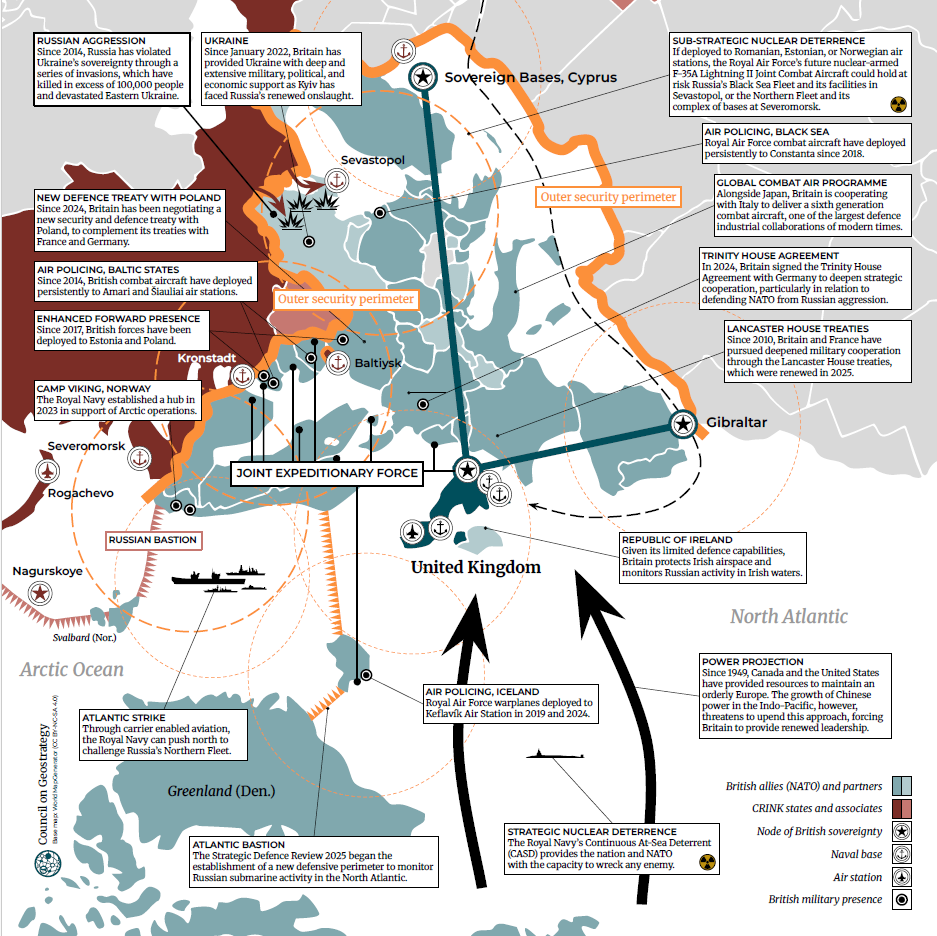
The “Defending Europe” section rejects the idea of a looming “fourth battle of the Atlantic” and argues that Russia does not prioritize cutting transatlantic sea lines, but instead focuses on protecting its SSBNs in an Arctic “bastion.” It explains that Russia uses “tailored naval assets to pursue distinct objectives in three different regions,” concentrating high-value forces in the Wider North, contesting the Baltic Sea, and projecting power across the Black, Mediterranean, and Red seas. The section also states that European NATO holds “a substantial numerical advantage against the Russian Navy” and can deter aggression through punishment and denial if readiness improves. It concludes that NATO must “come out of the habitual ‘defensive crouch’” and apply maritime and air power to pose “new and asymmetric challenges” to the Kremlin.
The Wider North
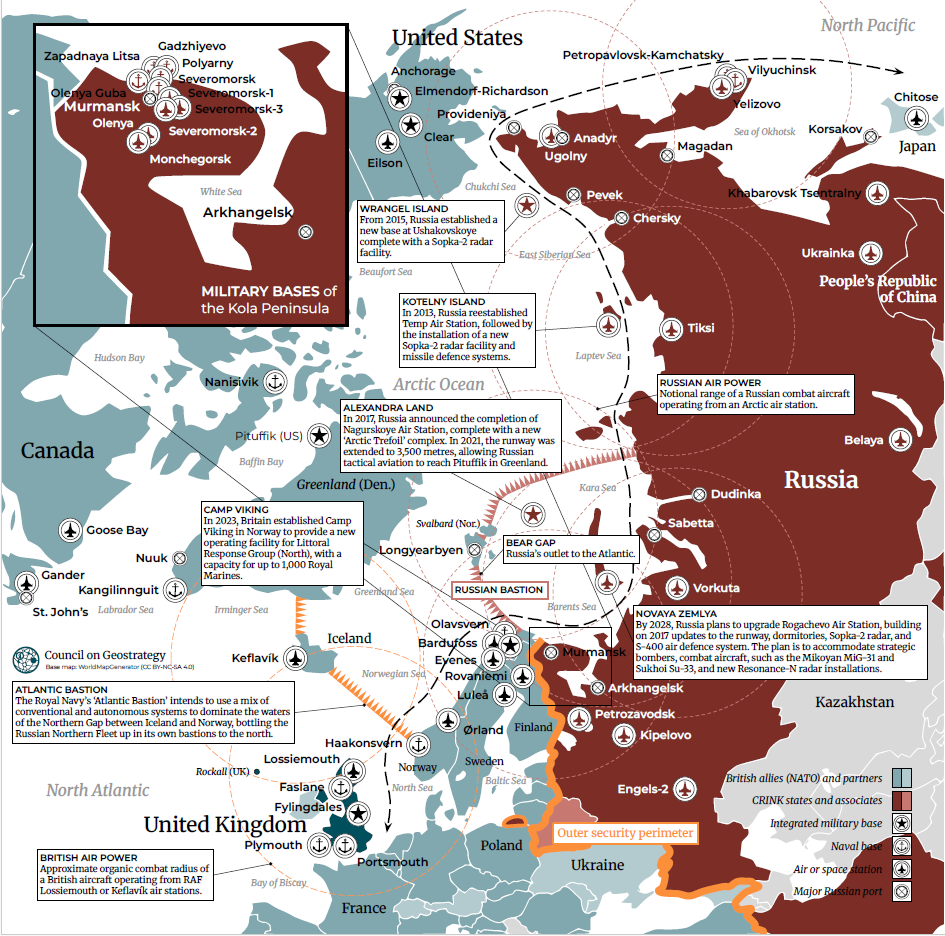
This section argues that the Arctic now faces “two fundamental forces–environmental change and geopolitical turbulence,” as rapid warming and ice loss “scrambling strategic knowledge of the Arctic.” It explains that Russia has re-centered its strategy on a revived bastion defense around the Kola Peninsula to protect the Northern Fleet and its nuclear deterrent, supported by A2/AD systems and an underwater surveillance net. The text shows that drone strikes and electronic warfare can “burst A2/AD security bubbles,” even as Russia escalates sub-threshold activity such as electronic interference and underwater sabotage. It concludes that Britain should “prepare for war in the Wider North,” combining NATO cooperation with stronger anti-submarine and maritime surveillance capabilities.