The Brotherhood, Turkey, and the Future of U.S. Counterterrorism Policy

Abstract
Islamist movements such as the Muslim Brotherhood, when combined with state sponsorship and governance vacuums, create resilient networks that challenge U.S. counterterrorism priorities. Turkey’s dual posture as a NATO ally and patron of Islamist networks complicates alliance cohesion and reshapes irregular warfare dynamics. Libya illustrates the limits of U.S. policy: By tacitly supporting a Brotherhood‑linked government, Washington aligned with a faction lacking legitimacy across much of the country, while Russia entrenched rival authoritarian forces. Contemporary developments – including Gaza’s propaganda battlefield and the rise of AI‑driven extremist recruitment – magnify these threats. This essay argues that U.S. policy must recalibrate to integrate governance resilience, institutional capacity development, and prosecutorial integrity into counterterrorism strategy, while anticipating new recruitment methods in the digital domain. Without these measures, Islamist networks will continue to exploit instability and erode fragile states.
U.S. Capitol and Muslim Brotherhood symbol (Reuters)
Introduction
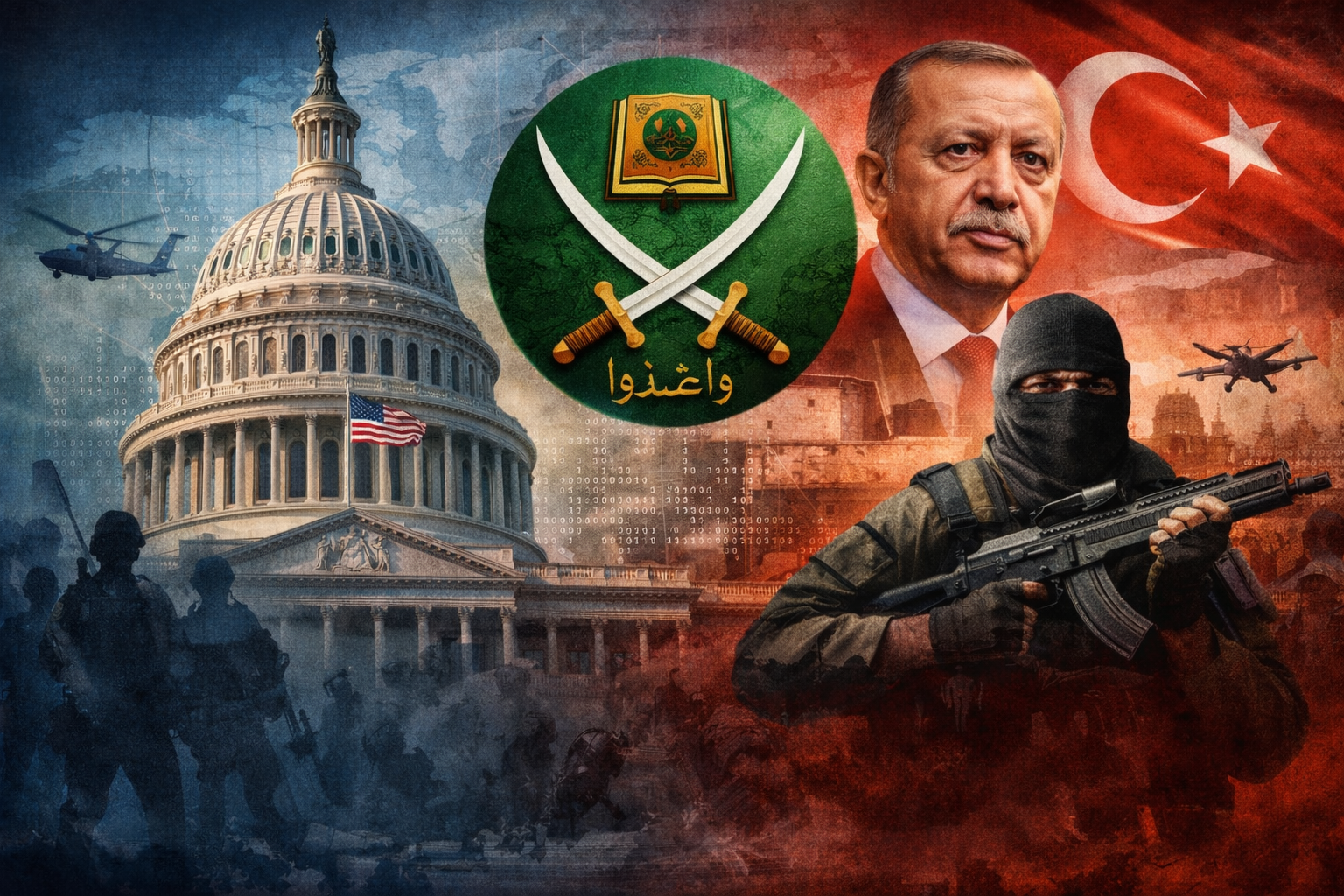
Ideology is the true battlefield of irregular warfare — a contest of minds as much as arms. While US strategy rightly emphasizes containing Russia, it risks neglecting Islamist threats whose tentacles extend globally. The Muslim Brotherhood, founded in Egypt in 1928, remains a transnational Islamist movement dedicated to reshaping societies and governments through political Islam. Its affiliates — from Hamas in Gaza to Ennahda in Tunisia — demonstrate how ideology, state sponsorship, and governance vacuums combine to create resilient irregular actors that undermine both US national security and international stability.
Great power competition and counterterrorism are not mutually exclusive. Russia’s support for authoritarian proxies, such as General Khalifa Haftar in Libya, intersects with Turkey’s cultivation of Brotherhood‑aligned movements, creating proxy battlegrounds where US policy risks being reactive rather than strategic.
Historical Context: The Brotherhood’s Ideology
The Brotherhood’s origins under Hassan al‑Banna blended religious revivalism with political activism, seeking to Islamize society through governance, education, and social institutions. Yet beneath this veneer lay a radical agenda: the imposition of its version of Islam across the Muslim world, and ultimately beyond.
Rejecting the Brotherhood is not rejecting Islam. It is rejecting a politicized movement that weaponizes religion for power, often through violence. This distinction is critical for US policymakers: Conflating Islam with politicized extremism risks alienating allies while empowering adversaries.
Libya Case Study
Libya illustrates the complexity of these geostrategic games. Its fractured camps — Brotherhood‑aligned forces backed by Turkey and Haftar’s forces supported by Russia — have long exemplified proxy conflict. Despite international recognition, the Brotherhood‑aligned Government of National Accord failed to consolidate authority or deliver stability.
The return of Saif al‑Islam Qaddafi, son of the late dictator, underscores Libya’s contested political landscape. His re‑emergence signals that large segments of the population remain disillusioned with Islamist‑aligned governance and are willing to rally behind a figure promising to “take Libya back again.”
This development exposes the limits of US policy: By tacitly supporting a Brotherhood‑linked government, Washington aligned with a faction lacking legitimacy across much of the country.. Meanwhile, Russia’s backing of Haftar entrenched a rival camp, creating a proxy battlefield where Turkey and Russia pursue competing ambitions. The result is a Libya caught between Islamist networks and authoritarian revival, with neither path offering genuine stability.
Turkey’s Dual Posture
Turkey’s ambitions complicate alliance management. As a NATO ally, Ankara benefits from Western security guarantees. Yet it simultaneously cultivates ties with Islamist networks as instruments of regional influence. Its willingness to provide political sanctuary, rhetorical support, and diplomatic cover for Brotherhood affiliates magnifies their resilience.
This dual posture creates friction within NATO and undermines cohesion at a time when alliance unity is critical. Turkey’s sheltering of Hamas and export of fighters from Syria to Libya illustrate how Ankara leverages Islamist networks to project influence. Erdogan’s broader strategy — reviving Ottoman influence and pivoting toward Africa and the Middle East — positions Turkey as both ally and challenger within NATO.
Contemporary Developments
The tragedies unfolding in Gaza have provided fertile ground for Islamist propaganda. The Muslim Brotherhood has capitalized on these grievances, portraying itself as the defender of the oppressed and positioning its narrative as a moral counterweight to Western policy. Reports suggest Brotherhood‑linked networks have even exploited Gaza fundraising campaigns, siphoning donations and reinforcing their claim to ideological leadership. This exploitation of human suffering underscores the movement’s ability to weaponize crises, turning legitimate outrage into recruitment fuel.
At the same time, extremist recruitment strategies are entering a new frontier. The rise of generative artificial intelligence, deepfakes, and synthetic media has given groups unprecedented tools to radicalize audiences. Research shows that AI‑driven propaganda now circulates in hyper‑realistic videos and fabricated narratives that blur the line between truth and deception. This evolution represents a profound challenge for counterterrorism: the battle is no longer only on the ground but also in the digital domain, where extremist narratives can be manufactured, amplified, and tailored to vulnerable populations at scale.
Practitioner Lessons
Experiences in Iraq and Afghanistan reveal how governance vacuums empower irregular actors. Rule‑of‑law integrity and prosecutorial frameworks are as vital as battlefield success. Conferences with judges, mentoring of legislators, and embedding legal advisors alongside military planners demonstrated that institutions must be fortified to resist ideological infiltration. Without governance resilience, irregular threats regenerate faster than they can be suppressed.
Strategic Warning
Egypt’s brief experiment with Brotherhood governance under President Mohamed Morsi from June 2012–July 2013 demonstrated how Islamist rule destabilized national institutions and provoked mass unrest, providing a cautionary precedent for U.S. policymakers. The Trump Administration’s designation of Brotherhood chapters as terrorist organizations was a step toward clarity. Yet clarity alone is insufficient. Policy must anticipate second‑order effects: how Turkey’s ambitions will shape Brotherhood resilience, how alliance politics will complicate enforcement, and how governance vacuums will invite irregular actors to exploit instability.
Policy Options
US policy must weigh overlapping approaches. A containment strategy would limit Brotherhood influence through sanctions and designations while bolstering regional actors who oppose politicized Islam. Yet containment alone risks leaving Turkey’s disruptive role unaddressed. A confrontation strategy would challenge Ankara directly, reassessing NATO’s dependency on Turkish bases and exposing the contradictions of an ally that shelters Hamas and empowers Brotherhood affiliates. But confrontation risks fracturing alliance cohesion at a time of great‑power rivalry. The most viable path is a hybrid approach: balancing deterrence of Russia with recognition of ideological threats, investing in counter‑propaganda and AI‑driven monitoring, and embedding governance resilience into fragile states. This hybrid vision acknowledges Turkey as both ally and challenger, while ensuring US counterterrorism policy anticipates the irregular threats of the next decade.
Conclusion
The Brotherhood’s ideological resilience, Turkey’s dual posture, and Russia’s authoritarian patronage converge to reshape irregular warfare priorities. For US policymakers, the imperative is clear: counterterrorism must integrate governance resilience and alliance accountability. Without these, Islamist networks will continue to exploit vacuums, and adversaries will weaponize ideology against fragile states.
Future policy must confront ideological threats early, balance great‑power rivalry with regional realities, and anticipate new recruitment strategies in the digital age. Redemption lies not in personal vindication, but in ensuring that rigorous analysis is heeded before threats metastasize into crises. The lessons of Iraq, Afghanistan, and Libya demonstrate that institutions, not militias, are the true bulwark against extremism. Embedding rule‑of‑law integrity, prosecutorial frameworks, and governance resilience into fragile states is not optional — it is the strategic imperative that determines whether irregular threats are contained or metastasize.
The United States must therefore recalibrate its counterterrorism vision. This means confronting Turkey’s disruptive role within NATO, distinguishing Islam from politicized extremism in all policy messaging, and investing in counter‑propaganda strategies that anticipate AI‑driven recruitment. It also means valuing dissenting practitioner analysis — the kind that warned against appeasing Brotherhood‑aligned regimes years before policy reversals validated those concerns.
In the end, the fight against irregular threats is not only about defeating adversaries on the battlefield. It is about fortifying institutions, safeguarding legitimacy, and ensuring that governance itself becomes the strongest weapon in America’s arsenal.
Check out all of Small Wars Journal’s great content.