





Flying Artillery: A Time-Dominance Fire Support Model

Introduction
Fire-support systems are struggling to keep pace with modern maneuver. Ground forces move quickly to survive, but artillery and aviation often cannot reposition fast enough to match that speed. Artillery delivers strong effects, yet its firing signatures are detected quickly, and counter-battery fire often arrives before guns can relocate.
Attack helicopters were once expected to provide mobile firepower. Still, conflicts like Ukraine show that low-altitude helicopters are routinely engaged by Man-Portable Air Defense System (MANPADS) and drone-enabled targeting. Several Russian Ka-52 helicopters were shot down while operating at low altitude, demonstrating that even advanced platforms cannot survive if they stay visible too long.
Small drones help identify targets, but they cannot carry significant payloads or operate reliably in harsh weather or mitigate the effects of electronic warfare. These limitations leave a structural gap between what ground forces need—fast, mobile fire—and what current systems can safely deliver. Flying Artillery (FA) focuses on time advantage rather than platform sophistication to close that gap.
Why Flying Artillery Uses Utility Helicopters
Readers may assume FA depends on attack helicopters like the AH-64. In reality, the concept is better suited to utility helicopters such as the UH-60 class. These aircraft are common, reliable, and capable of moving quickly at low altitude. They carry enough weapons for short engagements and operate more safely in adverse weather.
FA does not require the sensors, armor, or avionics of attack helicopters because it avoids hovering, searching, observing, and other behaviors that those systems are built around. Utility helicopters meet FA’s needs at a lower cost and with far fewer operational constraints.
Understanding Drone Comparisons
First-person view (FPV) drones excel at short-range precision attacks, but they cannot meet FA requirements for heavier payloads, long-range movement, or reliable operations under adverse weather or contested electronic magnetic spectrum (EMS) environments. Any drone built to perform FA-class missions would likely need to be scaled up to resemble a large, unmanned helicopter. Even then, it would be less reliable and harder to maintain.
Utility helicopters meet field artillery needs at a lower cost and with far fewer operational constraints.
Drones remain essential for sensing but cannot replace FA. Russian electronic warfare frequently disables Ukrainian drones. Wind, rain, and visibility also limit drone availability. FA maintains fire-support availability even when drones are degraded. When mission requirements are equal, drones are not as cost-effective when compared to helicopters. The mission requirements determine the cost, not the platform category.
The Core Problem: Exposure Time
Most losses of artillery and helicopters today share a single cause: exposure. Modern sensors detect heat signatures, movement, and radar reflections within seconds. Counter-battery radars, drones acting as spotters, and mobile air-defense systems often respond within a minute.
In Ukraine, multiple Russian Ka-52 helicopters were destroyed when they remained exposed long enough for Ukrainian forces to target them. The modern battlefield punishes presence. Survivability depends on minimizing the time between appearing and disappearing.
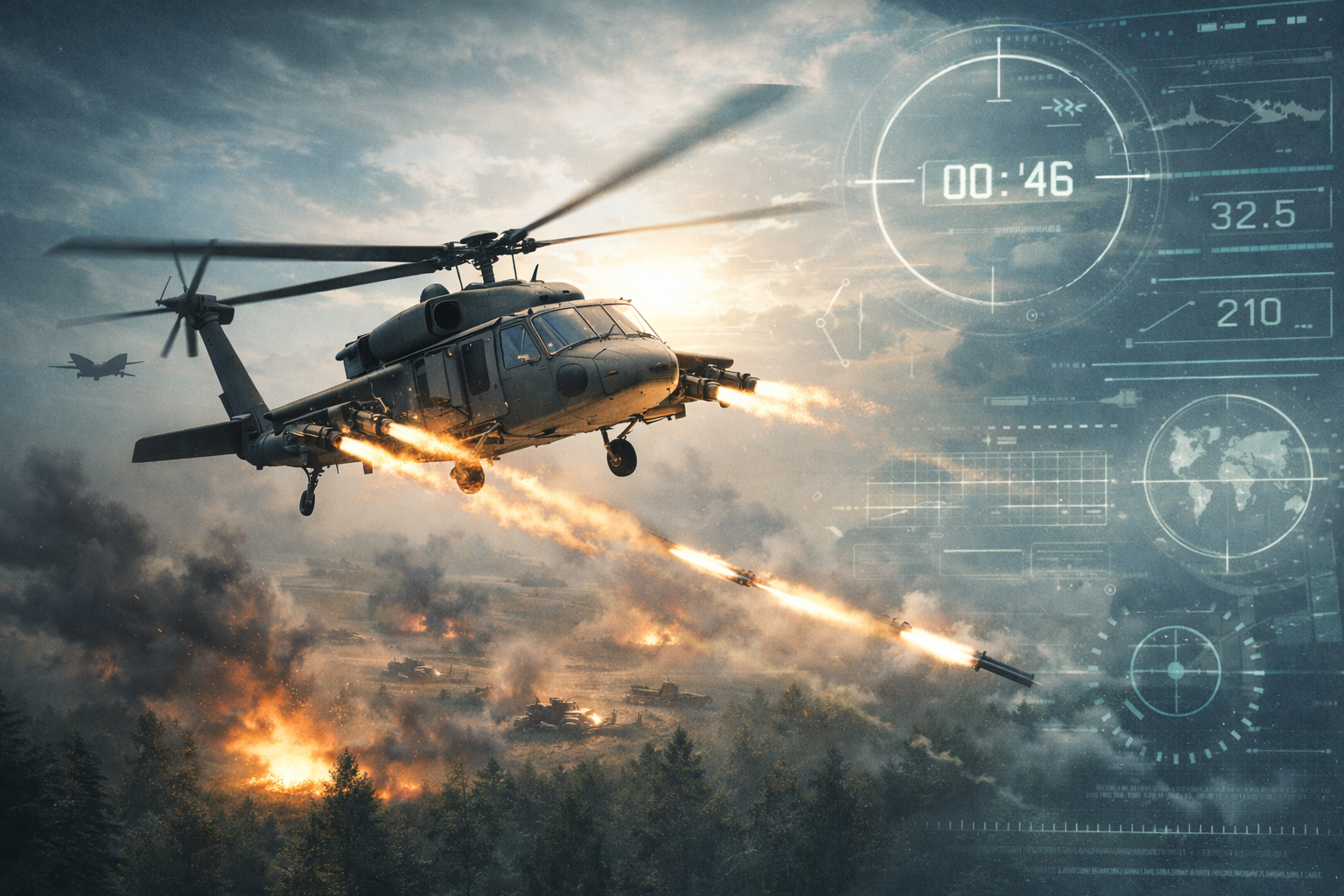
Flying Artillery adapts to this reality by treating the helicopter as a rapid, one-shot firing tool. If it completes its task and leaves before the kill chain closes, it survives.
Operational Requirement: Staying Below Kill-Chain Timing
FA is built around one rule: the helicopter must finish its exposure before the enemy can detect, decide, and fire. Modern kill chains typically take 30–90 seconds to function. FA therefore avoids every action that increases exposure. The aircraft does not hover, search, orbit, lase, or make a second pass. All targeting information is prepared beforehand. The crew only approaches the firing point, rises briefly to shoot, and immediately returns behind terrain before exiting along an unpredictable route. This method does not rely on stealth or armor. It depends on timing.
Detection vs. Targeting
FA accepts that helicopters may be seen. What matters is whether they remain visible long enough to be targeted. Detection is normal in modern airspace; survivability comes from avoiding prolonged exposure. FA shifts the goal from “avoid detection” to “avoid being engaged,” a more realistic and achievable standard.
Employment Sequence
Flying Artillery follows a simple process even though its appearance is unpredictable to the enemy.
- External assets — drones, observers, or sensors — confirm the target.
- Firing geometry is prepared before the aircraft departs.
- The helicopter approaches at low altitude using masking terrain.
- It exposes itself only for the time needed to release the salvo.
- It immediately drops back behind cover.
- It exits the area by a route different from its approach.
Because sensing and shooting are separated, the crew focuses entirely on flying safely and minimizing exposure. RAND’s analysis of contested environments notes that rotary-wing aircraft survive not by lingering, but by rapid movement and short exposure windows.
FA is built around one rule: the helicopter must finish its exposure before the enemy can detect, decide, and fire.
Operational Limitations
FA is not suitable everywhere. It works best in terrain with ridges, hills, or forest margins that can hide movement during approach and exit. Open terrain offers fewer options and increases risk.
FA depends on external sensors; when drones are jammed or grounded by weather, helicopters cannot safely search for targets themselves. Payload is also limited compared to ground artillery, making FA a tool for short, decisive fires rather than sustained engagement.
Weather sensitivity further constrains low-altitude flight, and predictable use of the same ingress routes will allow the enemy to adapt. FA relies on variation and timing to remain effective.
Conclusion
Flying Artillery offers a practical way to deliver fast, disruptive fires in airspace crowded with sensors, drones, and air-defense systems. It relies on time advantage rather than platform survivability. By compressing exposure, separating sensing from shooting, and using common utility helicopters, FA provides a fire-support option that acts before the enemy reacts.
FA is not close air support. It is not attack aviation. It is a time-driven method for delivering fire where lingering is deadly. In modern warfare, survivability is no longer determined by armor or altitude. It is determined by time.


