Information Warfare: The Army’s Continuous Transformation in Action
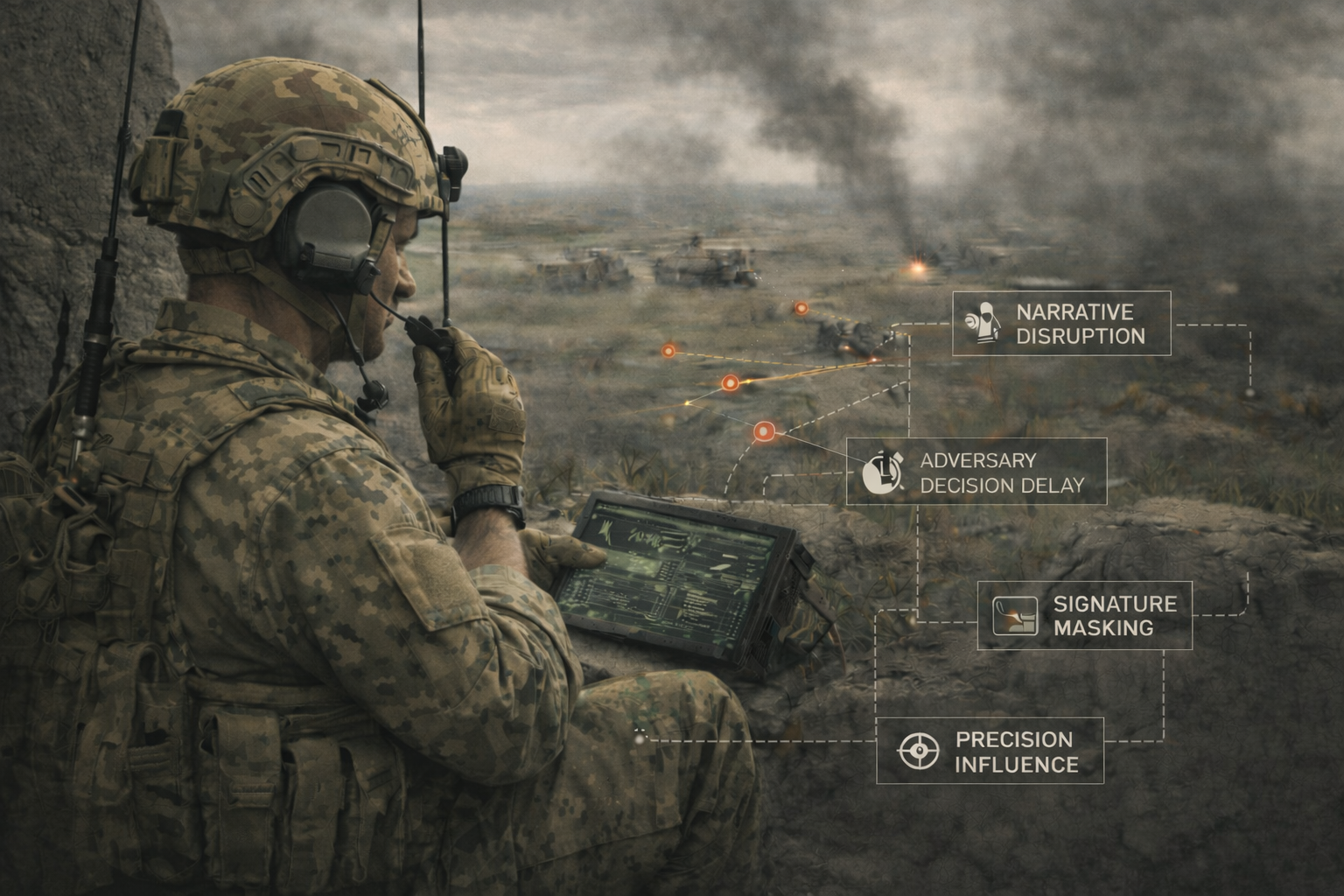

Editors’ Note: This article is the second in a series of IWar transformation papers meant to address initial changes and momentum in this historic transformation. This article is intended to inform Small Wars Journal readers and contribute to an ongoing professional discussion on the Army’s emerging approach to information warfare. It establishes context for developments that may be discussed publicly as they mature.
A military unit deploys overseas. When they arrive, the enemy has already set the stage. Fake GPS signals push civilian traffic and some convoys onto the wrong roads. Decoy radios and corrupted apps fool their sensors into thinking certain routes are safe. Phone and app data leaks reveal where their forces are moving. Enemy-backed lawsuits close air transportation corridors and block access to key areas. Small armed drones circle and strike along the obvious, well-known routes, and fake directions steer vehicles into planned ambushes. Online rumors and deep-fake videos turn the local populace against them, so permits and cooperation are delayed or denied altogether. Soldiers are attacked, equipment is destroyed, and the mission falls apart. The enemy won the important fight in courts, online, and on phones before soldiers faced each other. They were too late to challenge it and paid the price. Is the U.S. setting the conditions, or letting them be set against it?
An Environment for a Different War
For decades, U.S. Army information forces were built and honed for a particular fight. But warfare has evolved, as seen with the current conflict in Ukraine and emerging contests in other parts of the world. Opposing forces are leveraging emerging technology to confuse military decision-making, deceive tactical forces, and protect themselves from attack in the information domain. This is not new; what is more concerning now is the level of investment behind it, the scale at which it can be applied, and the speed with which it spreads across units, populations, and decision cycles. The belligerent that can weaponize and wield information effectively can gain and maintain an advantage akin to holding key terrain, and adversaries of the United States, its allies and partners have taken notice. They have invested in their ability to leverage information’s cognitive and technical effects to set the conditions and achieve a marked advantage.
That is why people and process, not technology or organizational structures alone, are decisive. The practical purpose of evolving Psychological Operations (PO) and Information Operations (Functional Area 30, or IO for short) is to build a cadre capable of executing repeatable planning, execution, and assessment cycles that integrate cognitive and technical effects at echelon. This effort is less about owning every information capability and more about producing professionals trained in behavioral influence who can synchronize those capabilities inside a commander’s decision cycle.
Adversaries Have Adapted Faster
The People’s Republic of China fused public opinion warfare, psychological warfare, and legal warfare into a single operational design to exploit this new landscape. They moved quickly, seized the initiative within the information domain, and exploited seams between geographic and interagency boundaries.
What is most concerning is not simply that adversaries invest in information warfare, but that they can often employ it faster and more coherently than we can respond. In practice, adversaries win by compressing the time between sensing, shaping, and exploiting, while U.S. forces remain constrained by approval latency, fragmented execution, and inconsistent assessment. The result is a temporal mismatch in which effects arrive after decisions are already made. Progress should be measured in time: shorter timelines from detection to decision to effect, with outcomes commanders can observe and assess.
The problem is not a lack of authorities at the combatant command level. The problem is permissions and delegation. When permissions are not delegated to the formations that can execute, actions must climb and descend multiple staff echelons, and staffing time creates the very latency adversaries exploit. Building a professional cadre with standardized processes and assessment makes delegation more routine and less risky for senior leaders.
Lessons from Post–Cold War Atrophy
During the Cold War, the military faced similar information challenges and responded accordingly: it revitalized force structure, clarified policy, and developed strategies to combat the Soviets in the information environment. During the post-Cold War interwar period, the U.S. reduced its information and influence capabilities. The disestablishment of the United States Information Agency (USIA) removed what had been perceived as a whole-of-government integrator, even though it never truly unified information efforts across the enterprise; its strategic coordination was limited, but its tactical capabilities and contributions were real, and the loss was felt. As new domains emerged that could be contested, such as cyber and space, the military as a whole adjusted and invested. The Army, however, did not equally invest in its information forces (specifically Psychological Operations and Information Operations), leading them to fall behind, and the result was predictable: uneven modernization, uneven integration, and a growing risk of ceding ground to adversaries who treated information as a primary instrument of power.
During the Global War on Terror, the Army sought to appropriately invest and refine its ability to influence populations away from violent extremist organizations and support tactical operations. The current and future operating environment, however, requires a different approach. The future environment requires the U.S. military to enhance and protect its ability to command and control forces, and attack, disrupt, and degrade the adversaries’ command and control systems.
Information Warfare as an Army Enterprise
The Army is moving with speed and determination to transform, as outlined in its Continuous Transformation Campaign Plan, to adapt and optimize in response to existing and emerging threats. This presents an opportunity for its information forces to modernize into the 21st century with training and education to develop information warriors that are equipped with equally as modern tools to engage the information domain effectively. This is an Army enterprise modernization effort intended to improve how the total force fights in the information environment, not a niche capability reserved only for special operations.
The U.S. Army Special Operations Center of Excellence (SOCoE) is in the process of modernizing the Army’s information forces. Although SOCoE is leading the proponent work, the effort is designed for Army-wide application, with training and doctrine aimed at improving information maneuver for conventional formations at Division, Corps, and Theater as well as special operations forces. For conventional commanders, this means trained professionals who can plan, synchronize, and assess influence and deception alongside fires, protection, and maneuver as part of a routine battle rhythm.
In close cooperation with the Mission Command Center of Excellence, Cyber Center of Excellence, and Training and Transformation Command, SOCoE is transforming Information Operations and Psychological Operations into a 21st century Information Warfare branch, one that will apply modern tools and rigorous training to maintain a competitive advantage over our adversaries. This effort does not seek to consolidate cyber, space, electronic warfare, public affairs, or civil affairs into a single branch, nor does it aim to replace the specialized expertise resident in those communities. Its purpose is to professionalize influence, deception, and operational integration while strengthening the habitual relationships and processes that allow commanders to converge effects rapidly and lawfully.
Preserving History While Expanding Capacity
This effort is about unity of action and speed of relevance, not bureaucratic ownership. Psychological Operations’ behavioral focus and assessment discipline remain foundational. The Information Warfare branch preserves Psychological Operations’ lineage, history, and heraldry, retaining its identity while expanding the force’s capacity to operate in a contested information environment. That continuity matters because it anchors the branch’s purpose: to produce professionals who can deliver influence and deception with the same rigor and repeatability expected of other warfighting functions.
The goal of the Information Warfare branch is to develop Soldiers and Officers trained and educated in military deception, influence, and combined arms maneuver, with a core emphasis on shaping perception, decision-making, and layering effects. Over a career, they will refine these skills to support Division, Corps, and Theater Commanders by integrating technical and cognitive effects, strengthening friendly command and control, and enabling converged effects that disrupt and degrade adversary Command, Control, Communications, Computers, Cyber, Intelligence, Surveillance, Reconnaissance, and Targeting (C5ISRT) systems.
Why Act Now
None of these changes occur in isolation. Doctrine, policy (to include delegation practices), tools, organizational structures, and command relationships must evolve in parallel, and work in each of these areas is ongoing. Even if every policy were rewritten tomorrow, information warfare would still fail without trained professionals capable of operating at the speed and complexity of the modern environment, and that level of expertise is built over years rather than weeks. This reality is why the Army is evolving PO and IO now, rather than waiting for every other reform to be complete and compounding delays in building the force that will ultimately be asked to employ them.
This work has already started and development continues. These first steps are decisive to improving the Army and joint forces’ ability to gain situational advantage in the information domain, enhance expanded maneuver across all domains, and support convergence of all domain fires to strike a decisive blow to the adversary. Because information competition ultimately spans diplomacy, law, economics, and industry as much as military power, the Army’s modernization effort is one component of a necessary whole-of-society approach—and it must be fast enough to matter.
Check out all the great things Small Wars Journal has to offer. You can find the other articles in this series on IWar transformation here.