





A Long, Hard Year: Russia-Ukraine War Lessons Learned 2023
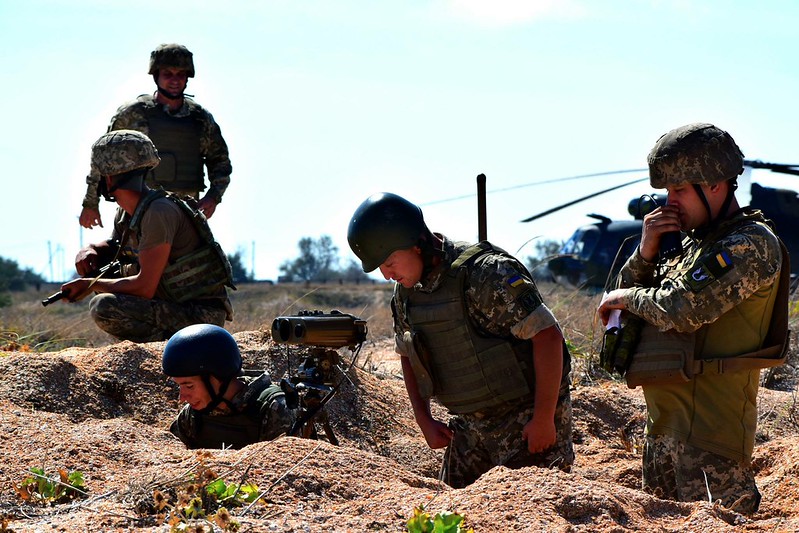

“Marines and land forces aviation in joint operations on the Azov coast” (photo courtesy Ukraine’s Ministry of Defense Flickr).
Take a look at this chapter-by-chapter collection of lessons learned from the US Army War College’s Integrated Research Project on the 2023 Russia-Ukraine War! A Long, Hard Year: Russia-Ukraine War Lessons Learned 2023, edited by John Nagl and Michael Hackett (US Army War College Press, 2026).
Description
Following the 2024 A Call to Action: Lessons from Ukraine for the Future Force, which explored military lessons learned from the first year of the Russia-Ukraine War, this book examines the changing character of war as the second year of the war unfolded. This year’s authors explore the conflict from four different angles: information advantage (intelligence, information operations, and cyber); landpower operations (fires, maneuver, force protection, mission command, and mercenaries); multi-domain operations (air and maritime); and crosscutting themes (diplomacy, sustainment, and innovation and adaptation). The second year witnessed the innovative approaches to combat of the first year—drones, unmanned aerial systems, and electronic-warfare offensive and defensive capabilities—combined with entrenched warfare not seen at the current scale in Europe since World War I. The use of mercenary private military companies like the Wagner Group generated moments of high suspense (with a failed mutiny in July 2023) and led to changes in Russian force structure and tactics. Delays in continued allied support tested the resolve and operational capabilities of the Armed Forces of Ukraine, which nevertheless kept up the fight and held Russia back. Through it all, the conflict offers a compelling picture of the war of the future, along with lessons for the US Army Training and Doctrine Command to prepare the Joint Force to meet the challenges of the large-scale combat operations of tomorrow.
Executive Summary
Although no evidence of the conflict coming to a resolution in the immediate future exists, this book also considers what would be required to bring both Ukraine and Russia to the bargaining table for war termination, as well as alternatives for Ukraine’s postwar future. Ukraine and Russia’s approaches to mission control, sustainment and supply chains, and embracing or rejecting innovation and adaptation all raise timely questions for the US Army Training and Doctrine Command’s training priorities. The conflict also affords vital insights into how future conflicts will be influenced by the abundance of digital information and the maturation of artificial intelligence.
Finally, the book considers resiliency, the importance of leaders like Volodymyr Zelensky in maintaining resolve in Ukraine, and the security assistance and escalation management tactics of the United States and NATO in supporting Ukraine with the weapons systems it desperately needs. Across all domains—including cyber and space warfare—the Russia-Ukraine War continues to demonstrate the changing character of war in a large-scale combat operations environment. Crafted with an eye to potential vulnerabilities in US doctrine, training, tactics, operations, and strategy, this book shares lessons to strengthen the US force for future combat.

