





Choke Points: Critical Minerals and Irregular Warfare in the Gray Zone

Check out “Choke Points” by Dino Garner at Irregular Warfare Initiative.
“For the last decade, the West has slowly awakened to the reality of resource insecurity. We read breathless headlines about the ‘scramble for Africa’ and the rush to stake claims on lithium deposits in the Nevada desert. But this awakening has birthed a dangerous strategic error—what I term ‘The Mining Fallacy.’ This is the mistaken belief that “resource security” is synonymous with ‘access to mines’…This is a fatal oversimplification.”
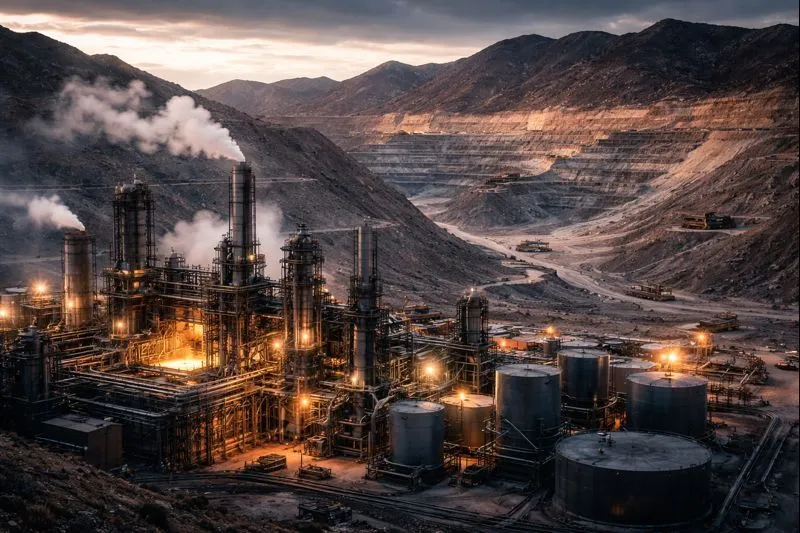
“The true center of gravity in modern economic warfare is not the mine. It’s the refinery…By controlling between 85% and 90% of the world’s processing capacity for rare earths, Beijing has constructed a “kill switch” for Western industrial and defense supply chains.”
The Alchemy of Influence
Extracting the ore is the easy part—it is merely earthmoving. The strategic bottleneck is the separation…It is difficult, expensive and, historically, exceptionally dirty.
But as environmental regulations tightened, the West offshored the dirty work…The result is a vertical monopoly…Even if a mine opens in the U.S. or Australia, the raw concentrate must often be shipped to China for processing before it can be used.
The Administrative Embargo
If midstream dominance provides the capability for coercion, “lawfare” provides the delivery mechanism. The modern tool of economic warfare is no longer the clumsy naval blockade. It is the precise, bureaucratically defensible export control.
Following a collision between a Chinese fishing trawler and the Japanese Coast Guard, China unofficially halted rare earth exports to Japan. Prices skyrocketed. But China’s 2023 restrictions on Gallium and Germanium (to any country) represent the evolution of this tactic.
The Hollow Forge
This fragility extends beyond magnets to the very skeleton of the war machine: magnesium…The timeline for attrition is terrifyingly short. Pentagon sources estimate that if China cuts off magnesium exports, the U.S. would have “six months to decide to go to war. After that, we wouldn’t be able to wage war at all.”
The Policy Response
The Trump Administration’s response to this vulnerability came on March 20, 2025, with the Executive Order ‘Immediate Measures to Increase American Mineral Production’…Whether these measures can close a 15-year infrastructure gap in time to deter conflict remains the central question.
From Extraction to Emancipation
To secure the gray zone, we must implement a strategy of “Industrial Deterrence.” I suggest five pillars:
The Strategic Processing Reserve: The Department of War must stockpile intermediate and finished products, not raw ore. Ore is useless in a crisis without refineries. We need stockpiles of separated oxides and magnet blocks that can be injected directly into the DIB.
Contracts for Difference: To counter Chinese predatory pricing, the U.S. government must utilize Contracts for Difference. This guarantees a “strike price” for domestic producers. If the global market price falls below this level due to foreign manipulation, the government pays the difference. This mechanism de-risks the massive capital investment required for refineries.
The National Critical Mineral Consortium: Government action alone is insufficient. The private sector must mobilize its own industrial base. We need a consortium of the largest end-users of rare earths—defense primes like Lockheed Martin, Anduril and RTX, alongside tech giants like Apple and Tesla—to jointly fund and operate a domestic chemical processing hub running twenty-four hours a day, seven days a week.
Innovation and Urban Mining: We cannot just dig our way out. We must innovate. Research by Tang et al. (2022) into manganese-bismuth magnets offers a rare-earth-free alternative. Simultaneously, we must exploit “Urban Mining.”
Closing the “Carbon Loophole:” Finally, we must turn the adversary’s lack of environmental standards into a liability. Implementing a Carbon Border Adjustment Mechanism specifically for critical minerals would tax the “dirty” processing of adversaries…We must weaponize environmental compliance by transforming our adversary’s disregard for ecological standards from a competitive advantage into a balance-sheet liability.

