Once More, the Sensor

Note: This short fiction article was written in October 2024 and originally submitted for the Horizon 2040 Writing Competition. The piece has been edited and revised over the past year.
His faded, crusty green beret remained crumpled up in his right pocket. He had little use for it now, but it always remained there, just as it had in the old days. The same U.S. Army Special Forces flash and insignia from the first conflict adorned the front of the once coveted hat, sun-bleached, like the hazy memories from barely recognizable operational times. “De Oppresso Liber,” he remembered, “free the oppressed…. look what that got us with the Second Ukraine War. Now, we all need freedom.”
He always knew time would kill him—and all of us, really—just not this slowly and methodically. Not old age, though, maybe death in combat—a glory that only mattered if civilizations—or at least your buddies—survived to remember you. But a stupid clock? Quantum this or that, they said. “Incessant progress always somehow plunges us backward,” he supposed. Time seemed relevant when humans knew it could not be controlled. Once the clock became the master, everything changed. In the quest for complete control, a failed attempt to cause global nuclear impotence, all the power-hungry became the gods of absolute nothingness.
He wiped the frozen grime off his desiccated lips and wondered how so much could change throughout the world in twenty years of endless combat. “2039—how did we even have the time to progress forward or backward?” he pondered. They were caught in the nexus of the in-between, the ebbs and flows of technology advancing and dying, and yet, the resilient human aspect of warfare always seemed to creep back into relevance.
He sank lower into his soggy hide-site, the silence blanketing the vast marshland always more frightening than the mechanical noises of the past. The rest of the Detachment soldiers continued to lie low in the damp, reeking Baltic earth. Sometimes, he never felt like he could get close enough to the ground. The mud embraced him; the madness made him its friend: dirt, the same companion of the dead. “It’s almost amusing; what a wasteland now.”
Something fluttered in one of the distant remaining coppices, and more memories overcame him. It was his first stand-up gunfight. 2019 seemed so long ago, but that was the pinnacle of what society once called the Global War on Terror. He thought about Zabul province, jumping off the ramp of a CH-47 for a prison raid in the dark Afghanistan night. Silence to anarchy. The utter chaos of going toe-to-toe at 40 meters with the Taliban while moving to secure a foothold, knowing that only technology and fire superiority would keep you alive. Then he remembered fighting ISIS-K in Nangarhar, chasing terrorists in Africa, and everything that almost killed him in Ukraine.
In retrospect, those conflicts nearly seemed like a gentleman’s game before the politicians desecrated the memory. “If nothing else, what was left of a memory of that global war against a hodgepodge of self-proclaimed ‘freedom fighters.” Speed, surprise, and violence of action mattered back then. Tactical actions yielding strategic effects; the Green Berets’ bread and butter for the GWOT. At a minimum, there seemed to be some honor in the exchange of bullets. But he was not sure if any of that still mattered now. It all ended up being one giant testing ground for the cataclysm to come.
By 2030, he should have been retiring to find some tranquility and enjoy a well-deserved pension. He pictured a modest house on a little piece of land, some tomatoes growing on vines. However, pensions only mattered when governments still existed to pay them. That was almost ten years ago; a different life, a different time. He scoffed at the thought and adjusted his chest rig; it was much easier without body armor. “Once a warrior, never again a gardener.” He’d become an old man, an old greybeard—the boss. He’d seen the teams evolve to harness the power of artificial intelligence. Even blockchain and quantum computing trickled into the world of Special Operations. For years, drone and counter-drone warfare in all domains danced back and forth like some sick, emotionally-void mechanized natural selection. Robotics and warfare evolved to lack any semblance of humanity, yet humans remained the only ones cognizant of the concept of death. It was almost haunting; now, nothing besieged the skies.
His toes had long become numb from the incessant dampness; he scrunched them in his worn-out boots and peered through a busted set of binoculars. He reminisced about how efficient the teams became with resilient networks, various disaggregating capabilities, and cryptography that brought unconventional communication to an entirely different level. They even had real-time language translation capabilities due to advancements in AI accelerator chips. Special Forces Operational Detachments became the world’s greatest sensors and disrupters to plague enemy interior lines. The days of slugging it out with their foe quickly vanished; all they had to do was let AI aggregate the intelligence, sense deep for the conventional forces, and let the long-range meatgrinders do their work. Humans merely carried sensors; technology did the job. Weapons of the mind no longer mattered until superpowers went too far.
None of it existed now. He dragged out his compass, “a relic of the past,” he thought. He rechecked the azimuths of his sector stakes before pulling out his map to reconfirm his coordinates. Once the old-Russians used weaponized AI to create and then launch those awful things into High Earth Orbit, satellites desynchronized, atomic clocks failed, terrestrial mapping and radar failed, and the AI created an altered perception of celestial navigation. Those were the buzzwords he could remember about the disaster. GPS and inertial navigation systems across the continents crashed. Something about the nukes. And then, as the Second Ukraine War appeared all but won, old-Russia lost control of its so-called “seraphs” in 2032, plunging itself and the rest of the world into technologically devoid disorder.
Since those days, the world inexorably descended into chaos. Owning and controlling information, ideas, and thoughts mattered more than the simple attrition of butchering each other in the slop. He thought about an age-old SF adage to always be ready to destroy the “thing” you created and trained. The irony was not lost on him as he scanned the tree lines for targets; the old NATO countries writhed in a stagnant, bloody stalemate with the Ukrainian regime in Moscow. “I wonder if I might recognize any of my counterparts from the First War,” he seethed. He then thought about how the human mind had once again become the weapon of choice and the contested battlespace all at the same time. “Now, to capture another one of them,” he thinks.
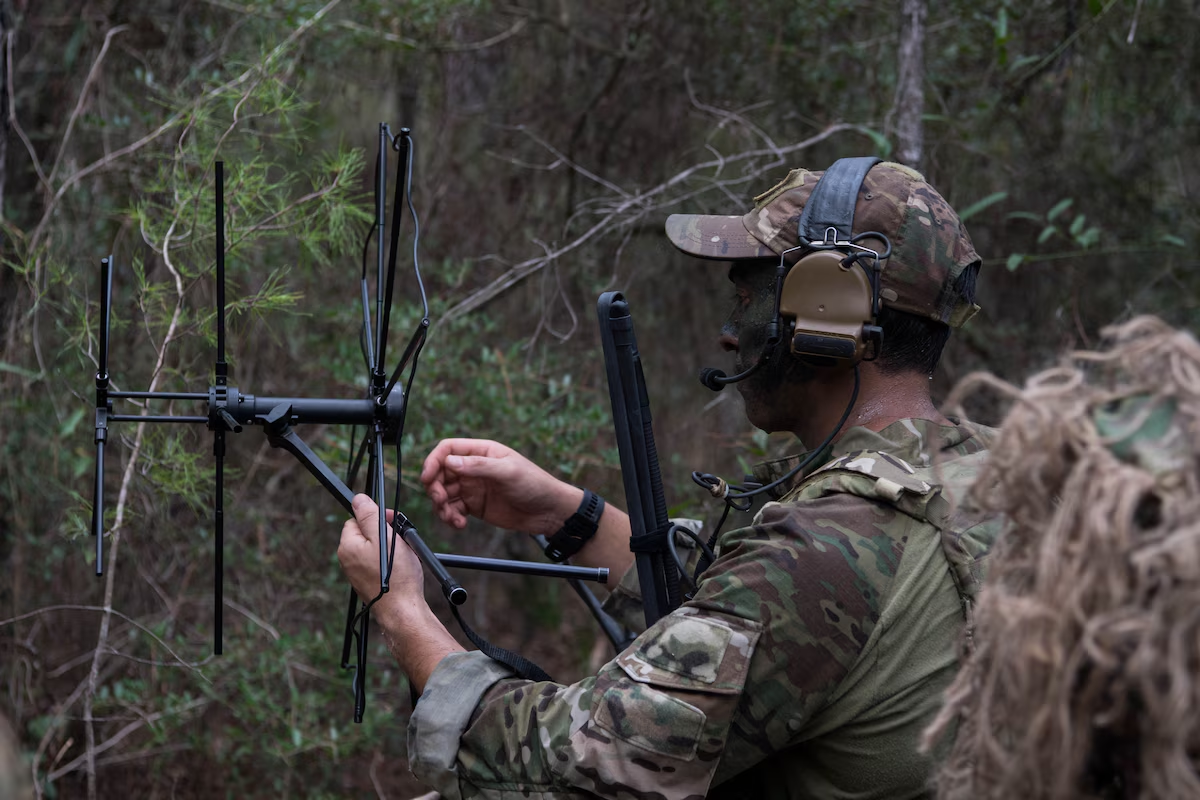
There was more movement in the thicket—maybe 400 meters to the 9 o’clock. He used hand signals to prepare the rest of the team for the ambush. “Funny how technology remains a cyclical reminder of warfare from the past. What technology?” he thought. “It’s gone.” The character of warfare evolved with technology, but humans have always been the ultimate sensors, unearthing the information necessary to influence individuals, the collective, and subsequent policy. Once again, they have become the sensors anew. Small unit tactics, land navigation, survival, prolonged field care—it all mattered once more—the basics in the deep fires. He mused on how the old ways always find their way back to the forefront. The divergent, yet again emergent, in the void of mankind’s self-induced nosedive into obscurity.
He knew he needed to bring at least one in still breathing. It was the only way to gather information in this post-seraph world; human intelligence re-crowned king. The tricky part was getting the enemy out of the bogs alive. “What a shitty way to go,” he thought. “Face down, drowning in the muck.” Yet, the conflict had transcended the physical struggle for control; killing was just the incidental, blunt instrument. Flesh and blood suffered the cost while the true aim was the reshaping of beliefs and dominion over human minds. But he understood that influence, deception, and psychological manipulation still meant nothing in this world without those willing to get their hands dirty. Bodies still needed to be broken for minds to bend. The power of gathering information and weaving controlling webs of ideas outlasted all the drones, bullets, and bombs. The unseen, the intangible realms of perception provided the most potent ability to infect hearts and minds long after the fighting had ceased. He knew this; his masters knew it.
His heart rate quickened. A muffled disturbance persisted in disrupting the eerie dawn silence. Finally, the wet suction of approaching footsteps became discernible. The sounds crept closer, echoing louder with each step sinking deeper into the gunk. There they sat like less-evolved trapdoor spiders, waiting for the prey called ‘information’—Green Beret “snake-eaters” once again just nameless sensors in the mud, scattered across a vast post-European frontline. He knew, though, that they were no longer the ones eating the snake. Like humanity, the snake continued to consume itself, an interminable ouroboros, constantly changing but never disappearing. He wondered when the cycle of destruction would come to an end. “How do we recreate and rebuild after such a quagmire?”
Those thoughts would have to wait.
One final step—the sensor triggered. And the battlespace around him, within him, once more erupted into madness.
Check out everything Small Wars Journal has to offer.