The Innovator’s Burden: Why the Military Must Find, Protect, and Unleash Its True Visionaries

Introduction: The Performance of Progress
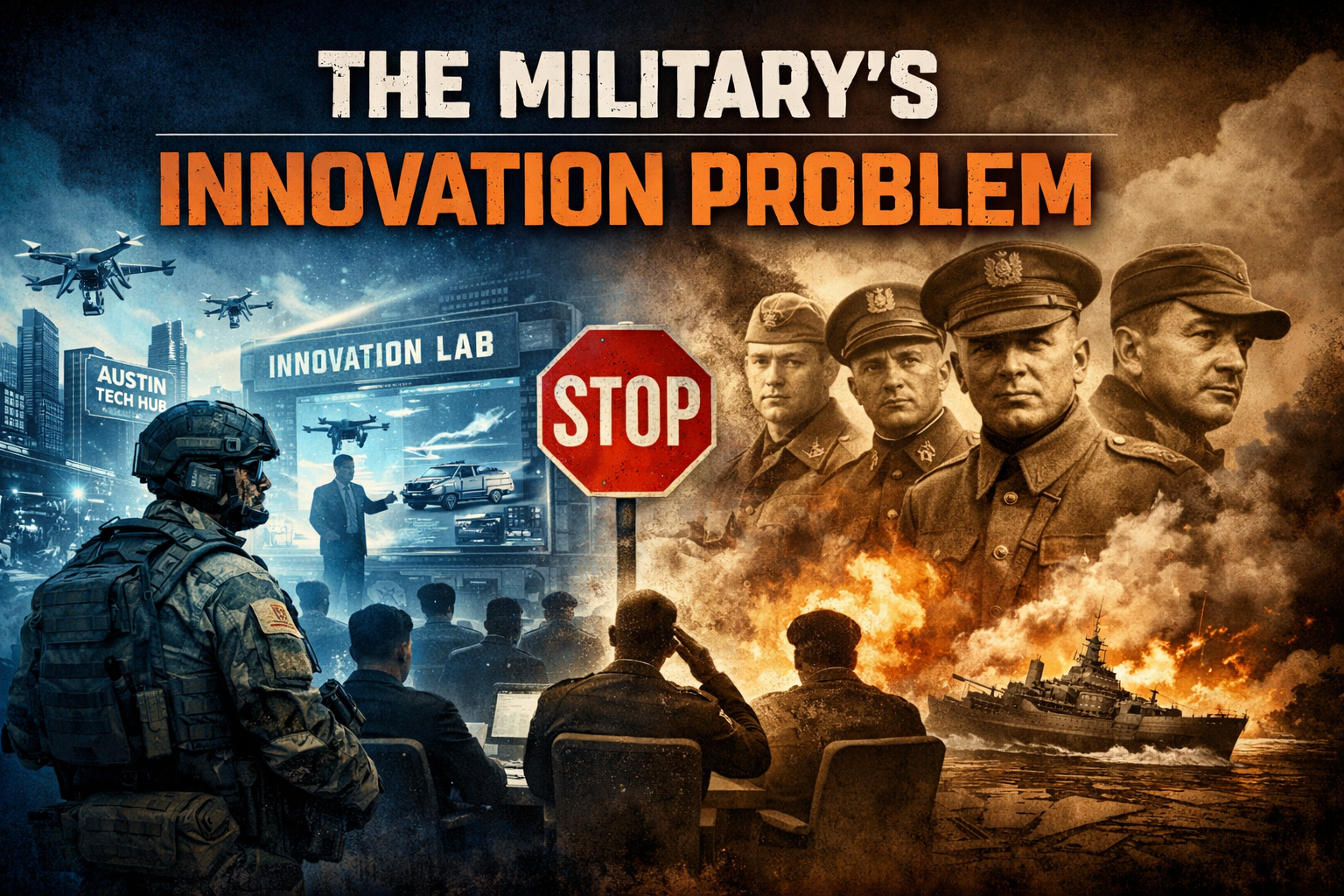
Step inside any military presentation today, and you’ll encounter a meticulously staged production. The language of the future is everywhere: “transformation,” “disruption,” “innovation.” It’s a well-rehearsed performance, complete with “Shark Tank” committees, gleaming “innovation labs,” and new commands planted in tech-centric hubs like Austin. Tech start-up salesmen, flush with venture capitalist dollars, roam the halls, peddling software they promise will win the next war. The presentations are polished, the rhetoric inspiring, all designed to project an image of relentless forward progress.
But here’s the unvarnished truth: the military is deficient in the innovative ideas needed to guide future technological development. There’s a vast chasm between the language of innovation and the arduous, often painful, act of it. The military has mastered the vocabulary of innovation, launching countless initiatives, yet this flurry of activity often masks a deeper challenge: a deep-seated, institutional resistance to and mistrust of the very people who generate truly groundbreaking ideas.
True innovation must be tied to innovative ideas, and those ideas come from real thinkers. This creates the ultimate paradox: many organizations love the concept of innovation but, in practice, they hate their innovators. The military, an institution built on order and discipline and the perpetuation of what it sees as its inherent wisdom and correctness, is a prime example of this phenomenon.
This isn’t an attack on the individuals with the military. The ranks are filled with sharp, dedicated people capable of extraordinary thought. The problem is systemic. A hierarchical structure, by its design, prioritizes conformity over ingenuity. It’s a machine that can unintentionally sideline and push out those who think differently. The institution recognizes the critical need for innovation, but its culture often recoils from the disruptive reality that entails. We have an army of administrators, when what we desperately need are legions of iconoclasts. This is not just an internal management issue; it is a matter of urgent strategic necessity. If the military cannot learn to find, nurture, and most importantly, protect its true innovators, it risks a catastrophic disadvantage in future conflicts. In war, there is no reset button. Irrelevance is the final defeat.
Historical Echoes: A Legacy of Overlooked Visionaries
Military history provides a stark, repeating lesson: the establishment often dismisses its own most brilliant minds. This is a behavioral pattern as old as warfare itself. The ghosts of these spurned prophets haunt the archives, their vindication often coming at the cost of lives.
B.H. Liddell Hart: The Prophet of Mechanized Warfare
Consider Captain B.H. Liddell Hart. This British theorist, writing with fierce urgency between the World Wars, was a prescient champion of mechanized warfare. He argued the future belonged to tanks and aircraft working in concert, rendering the static slaughter of World War I obsolete. The British high command, intellectually trapped in the trenches, approached his ideas with skepticism. While Hart gained some influence, his revolutionary reforms were never fully implemented. As a result, British mechanization lagged behind, a weakness that contributed to defeats in the early years of World War II.
Pete Ellis: The Marine Who Drew the Map to Victory
Then there is Lieutenant Colonel Earl “Pete” Ellis, a man who foresaw the challenges of the Pacific with near-clairvoyant clarity. In the 1920s, this visionary Marine developed exhaustive plans for amphibious warfare in the Pacific, anticipating the island-hopping strategy and its immense logistical demands. His work, “Advanced Base Operations in Micronesia,” became the blueprint for winning the war against Japan. He knew that logistics would be everything. Despite his brilliance, Ellis battled bureaucratic inertia, fighting for recognition of ideas that would later save countless lives. He died under suspicious circumstances in 1923, his work largely unrecognized until it was desperately needed two decades later. His story raises an uncomfortable question: does the system have an autoimmune response to its most creative thinkers?
Billy Mitchell: The Martyr of Airpower
And who could forget Billy Mitchell? This firebrand officer grasped the transformative power of airpower with a zealot’s conviction. He proved aircraft could sink battleships, signaling the end of an era of naval dominance. His argument was an existential threat to the budgets, traditions, and identity of the naval hierarchy. For his heresy, he was met with punitive institutional resistance. He was court-martialed for being right too early. History, of course, vindicated him in the wreckage of Pearl Harbor.
David Hackworth: The Heretic of Counter-Insurgency
David Hackworth must also be considered here too. This warrior-scholar, America’s most decorated living soldier, saw with brutal clarity the strategic bankruptcy of the Vietnam War. He understood that the obsession with body counts and overwhelming firepower was a careerist-driven folly, completely detached from the on-the-ground reality of counter-insurgency. His argument wasn’t just a critique; it was a public indictment of the entire general officer corps, exposing the war as a mismanaged disaster and threatening the reputations of its most powerful leaders. For his heresy, delivered in a bombshell 1971 television interview, he was effectively exiled, ending a storied career and becoming a pariah for decades. History, of course, vindicated him in the painful soul-searching that followed America’s defeat, as the very counter-insurgency doctrines that became central to modern warfare are a direct echo of the uncomfortable truths.
The Modern Prophets and the Anatomy of Resistance
This pattern of rejecting the prescient is not a dusty relic of the past; it continues today with a relentless consistency. Consider the work of Dr. Amos Fox, whose research on attrition warfare serves as a vital corrective to the preferred narrative of clean, rapid maneuver. His data-driven work shows that modern battlefields are still largely defined by brutal, grinding attrition often outweigh tactical brilliance. The Russo-Ukraine War is a real-world validation of his theories, yet his insights meet resistance because they challenge the military’s sleek, high-tech image and suggest that our Army’s current design and our industrial base, optimized for short conflicts, is woefully unprepared.
This resistance to inconvenient data echoes the reception given to Colonel Trevor N. Dupuy, whose quantitative analysis of combat effectiveness was a direct assault on the romantic notion of war as purely an art form. For an establishment that lionizes the “gut feelings” of great commanders, Dupuy’s cold, hard numbers were often dismissed in favor of heroic narratives. In both cases, Fox and Dupuy were not just presenting new ideas; they were challenging the very identity of the institution. The resistance they faced was not because their data was wrong, but because their conclusions were profoundly uncomfortable, forcing a level of self-reflection the culture is conditioned to avoid.
The underlying point is that challenging core assumptions carries a steep professional price. Why? The reasons lie in a toxic stew of institutional pathologies. As theorist Jeff DeGraff notes, large institutions are masters at creating systems that appear to promote innovation while subtly punishing the true disruptors. This manifests in several ways:
- Careerism and Conformity: The promotion system favors conformity. The path to senior rank is a series of “ticket-punching” assignments. It is safer to manage a program perfectly than to champion a risky idea that might fail. Officers learn that bold thinking can derail a career, while cautious stewardship guarantees advancement.
- Bureaucratic Inertia: Military organizations are designed for order and scale, not speed. This structure, essential for managing a global force, tends to crush innovative ideas under the weight of process. A good idea can die a thousand deaths in committees and funding cycles.
- The Fear of Diluted Authority: To a senior leader who has spent 30 years mastering a specific way of warfare, an innovator isn’t just suggesting a new idea; they are implicitly stating that the leader’s experience may be obsolete. Innovation can feel less like a helpful suggestion and more like an indictment of their entire career.
- Entrenched Beliefs and Sacred Cows: Every institution develops sacred cows—beliefs or platforms immune to criticism. Whether it’s the primacy of the aircraft carrier. How the Marine Corps should fight, or the main battle tank, these ideas are protected with religious fervor. Innovators, by their nature, are heretics who threaten the established order.
Theater, Complacency, and the Crisis of Courage
In response to criticism, the military engages in “innovation theater.” This involves creating the visible trappings of innovation without making substantive cultural changes. It includes labs that are more like tech petting zoos than engines of change, and shark tank competitions that generate excitement but little fielded transformation. These initiatives prioritize appearances over outcomes, creating the illusion of progress while the underlying, risk-averse culture remains entrenched. The military has become expert at looking innovative while remaining fundamentally conservative.
This theater is a symptom of a deeper leadership problem. It requires a rare form of courage to embrace novel ideas, protect the subordinates who propose them, and accept the personal risk that comes with championing change. We select leaders for physical courage, but not necessarily for the intellectual courage to value bold thinking over comfortable conformity. We need leaders willing to let messy, inconvenient voices challenge the sacred cows, because those are the voices that might prevent the next strategic surprise.
This complacency has a cost. While our military performs innovation theater, our adversaries are studying its weaknesses with intensity. China’s military modernization is focused on exploiting the vulnerabilities of a slow-moving force. Russia’s use of hybrid warfare caught NATO off-guard because Western military thinking remained trapped in conventional frameworks. The war in Ukraine has been a brutal, daily lesson that many of our long-held assumptions were dangerously wrong.
Conclusion: A Choice Between Transformation and Irrelevance
The time for self-congratulatory innovation theater is over. The military needs a moment of brutal self-honesty. It must stop paying lip service to change and commit to the genuine, painful work of cultural transformation, or it must accept a slow, inexorable slide into strategic irrelevance. The problem isn’t a lack of technology; it’s a crisis of courage, stemming from a leadership culture often unwilling to set aside egos.
Real change demands a fundamental restructuring of how the military identifies, develops, and promotes talent. It means creating alternative career paths for disruptors and contrarians, ensuring they are just as likely to advance as officers with perfect maintenance records and gunnery scores. If the Army can promote four tech executives with no military experience to Lieutenant Colonel, then the Army and other services can surely find creative career paths for its innovators. The recipe for transformation is as difficult as it is clear: we must find, reward, and nurture our true innovators.
- Empower and Protect Career Paths for Disruptors: Create and shield advancement opportunities for those who take intelligent risks, even when those risks lead to the instructive failures that are the lifeblood of learning.
- Wage War on Bureaucratic Inertia: Radically streamline processes, empower experimentation at lower levels, and accept that real innovation requires embracing failure as part of the learning process.
- Mandate Dissent, Don’t Silence It: Make hearing dissenting opinions a mandatory part of any major decision, rewarding leaders who listen and adapt, not those who punish the messengers.
- Unleash Innovation by Challenging Convention: Encourage and demand that subordinates question conventional wisdom. Make it clear that challenging established methods is not insubordination, it is a core professional responsibility.
As General Eric Shinseki so pointedly observed, “If you don’t like change, you’re going to like irrelevance even less.” Our greatest strategic asset is not our technology or our budget. It is our people. It is the latent creativity and intellectual courage residing within our ranks. By finally creating a culture that fosters their creativity and rewards their courage, we can ensure the military remains a potent, strategically relevant force rather than a brittle, historical curiosity. The time for superficial gestures has passed. The consequences of continued complacency will be measured in more than just professional embarrassment; they will be measured in blood and defeat.
Check out all the great things Small Wars Journal has to offer on military innovation.