El Centro Annotated Subject Bibliography: Feral and Criminal (Gang & Narco) Cities
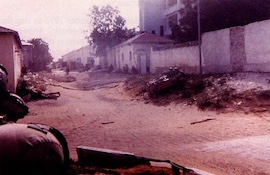

International security studies and perceptions can be typically scaled along a continuum from the micro through the macro levels of analysis. Normally, this scaling begins at the individual and group levels though smaller urban clusters, larger cities, and limited geographic groupings into the regional, national, hemispheric, and then global level. In some ways, mirroring national level concerns related to failed (and fragile or ‘hollow’) states yet at a lower level of analysis, the subject of feral cities as a construct (along with related terms) has become well entrenched in the literature over the last couple of decades. Feral cities can be viewed as a component of urban war and conflict futures concerns as the world increasingly sees the mass of its population reside in megacities and the expansive slums surrounding, and at times intertwined with, them.[2]
The construct was developed in 2003 by Dr. Richard J. Norton, professor of national security affairs at the Naval War College, in a highly influential article published in the Naval War College Review.[3] Cities analyzed within this construct had populations typically in excess of one million people. His model focused on three feral city levels—an initial green level (no danger of ferality—like New York), an intermediate yellow level (marginal governmental control—Mexico City), and a more pronounced red level (becoming feral—Johannesburg). A number of diagnostic criteria were utilized by the author to represent healthy and/or unhealthy city conditions related to government, economy, services, and security for comparative purposes across the three proposed ferality levels. Hedging also prudently took place with the statement “Feral cities, as and if they emerge, will be something new on the international landscape.”[4]
The construct was updated with a new civil society criteria for diagnostic purposes by Norton in a 2010 article. Further, a number of cities with ferality evident at one point or another—Lagos, Nigeria; Fallujah, Iraq; Rosarito Beach (by Tijuana), Mexico; and New Orleans, United States—were discussed. He then “…examine[d] the threat of feral cities to individuals residing in them (in essence, feral cities and human security), the threat to individual states, and the threat to the international system” prior to engaging in a short discussion related to feral city intervention.[5] About a decade later in 2021, in a taped Naval War College lecture posted on YouTube, Norton further articulated the construct and brought in contemporary events to view how they may (or may not) correlate to city ferality.[6] Since the publication of the initial 2003 article by Norton, the construct has been commented on, critiqued, and analyzed by a number of scholars and/or practitioners for its relevance and accuracy related to urban conflict and warfare concerns and projections. In the process, Mogadishu has become a poster child of what city ferality and slum fighting will likely look like.
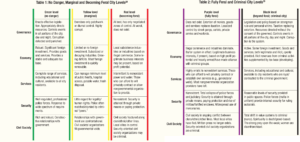
Five Levels of Ferality (Norton Construct Modified): Green through Black Levels. Source: Robert J. Bunker, The Emergence of Feral and Criminal Cities.[7]
The feral city construct was independently modified in 2011 by John P. Sullivan and Robert J. Bunker. Norton took the construct to the very edge but, for whatever reason, refrained from exiting the modern state paradigm and instead danced around the epochal precipice portending post-modernity. These later authors did not and fully kicked over the theoretical hornets’ nest Norton had created. Two additional modal levels: fully feral (purple) and beyond feral criminal controlled (black) were added to the construct. The intent was to reconcile their third phase cartel and third generation gangs constructs with the feral cities construct developed by Norton.[8] Additionally, the BlackFor (Black Force) model developed in the late 1990s as a criminal OPFOR (Opposing Force) threat projection (supporting the US Army in the Army After Next (AAN) initiative) was drawn upon related to the criminal city controlled level of post-ferality.[9] The BlackFor represents a networked criminal entity which engages in five-dimensional (cyber; disruptive targeting, et al.) warfighting and employs mercenary forces in mass. Further, modifications to these additional two phases (such as the inclusion of the civil society criteria) were carried out in a 2014 Institute of Land Warfare paper and later publications.[10]
Feral cities have an increasing potential to emerge OCONUS (Outside the Continental United States)—with some domestic futures concerns at times also being voiced. The construct exists within the milieu of works focusing on pirate havens, criminal enclaves, areas of cartel impunity, and ‘black spots’—places of non-state governance supported by illegal economies. Related crime/war themes include the inability of low political capacity states to contend with armed non-state groups engaging in 21st century criminal insurgencies and newer perceptions of alternative criminal governance (as opposed to simply the existence of ungoverned state areas). The earlier hubris being the assumption only sovereign states can govern with no consideration given to the formation of illicit parallel states.
The crux of the debate surrounding the feral city construct is whether the worst end state for a city is to be a) plunged fully into chaos and anarchy—based on Norton’s original (red into purple) perspective—with a full-blown humanitarian crisis developing due to the vacuum in governance or b) where alternative governance takes place (the BlackFor threat model)—when a criminal controlled city (black) emerges which is post-modern in its values, ideologies, and structures (illicit and barbaric in nature, neo-feudal relationships, and networked)—the antithesis of the modern liberal-democratic state form. For an example, would it be worse from a strategic security perspective for the US
if the border city of Ciudad Juárez, Chihuahua across from El Paso, Texas became fully feral (and imploded) or if it became totally cartel and gang controlled with a belligerent criminal entity governing the entire urban zone. The latter is very much the ‘Gangster Warlord’ dilemma now currently playing out in Port-au-Prince, Haiti, as ‘Barbeque’ and his armed street gang confederation wage their crime war (criminal insurgency) in the capital city.[11]
The following works provide important insights and resources towards a fuller understanding of the feral (and modified criminal) cities construct and can be utilized as a jumping off point for further research on this increasingly important international security (and homeland security—given cartel activities directly south of the border) subject area:
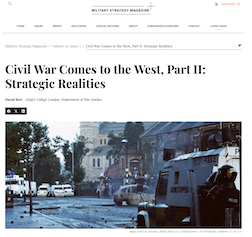
David Betz, “Civil War Comes to the West, Part II: Strategic Realities.” Military Strategy Magazine. Spring 2025, https://www.militarystrategymagazine.com/article/civil-war-comes-to-the-west-part-ii-strategic-realities/:
Abstract: This online article by King’s College professor David Betz asserts that the primary threat to security in the West is internal, specifically a civil war resulting from various existing fractures. Betz connects this issue to Norton’s feral cities by further asserting that densely populated urban areas with fragile authority could turn into epicenters where civil wars begin. Due to their inherent diversity and increasingly hostile relationships with a relevant country, these feral cities would serve as epicenters for conflict. Betz advocates that Western governments and militaries must take appropriate action to preserve cultural capital, establish secure zones for civilians, and secure WMDs (weapons of mass destruction) to ensure that damage is limited if strife should break out.
Stuart S. Brown and Margaret G. Hermann, Transnational Crime and Black Spots: Rethinking Sovereignty and the Global Economy. International Political Economy Series. London: Palgrave Macmillan, 2019, https://link.springer.com/book/10.1057/978-1-137-49670-6:
Abstract: This publication from Brown and Hermann examines ‘black spots’ which are understood to be “areas governed by transnational criminal, terrorist, and insurgent organizations that are outside effective state-based government control and are sustained by illicit economic activities.” Modern-day examples of black spots are discussed and established via a set of four questions that focus on different areas of analysis. OSINT (open source intelligence) based methods were further utilized by international research assistants to provide a multifaceted approach. All in all, this piece provides a strong foundation for the concept of black spots and their relevance in the post-Cold War era.
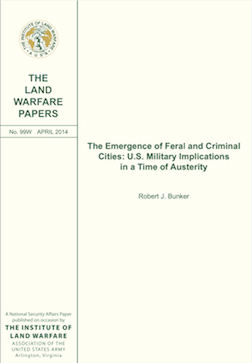
Robert J. Bunker, “The Emergence of Feral and Criminal Cities: U.S. Military Implications in a Time of Austerity.” The Land Warfare Papers No. 99. April 2014, https://www.ausa.org/sites/default/files/LWP-99-The-Emergence-of-Feral-and-Criminal-Cities-US-Military-Implications-in-a-Time-of-Austerity.pdf:
Abstract: This article offers insight into the real-world threats posed by feral cities, with the author establishing a framework for analyzing cities at this level. Such an analysis is crucial as feral and criminalized cities establish values which oppose those of the modern democratic state, i.e., by institutionalizing criminal values. In conjunction with the decrease of the United States’ ability to project power (due to internal and external factors), combating feral cities and other foreign military operation concerns are arguably not realistic. Bunker advocates that US military strategy must be adapted by limiting deployments (“boots on the ground”) to those designated “render safe” for the sake of US national interests.
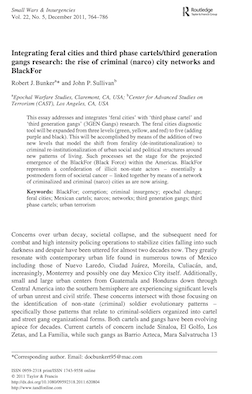
Robert J. Bunker and John P. Sullivan, “Integrating feral cities and third phase cartels/third generation gangs research: the rise of criminal (narco) city networks and BlackFor.” Small Wars & Insurgencies. Vol. 22, no. 5. 29 November 2011: pp. 764–786, https://www.tandfonline.com/doi/abs/10.1080/09592318.2011.620804:
Abstract: This essay provides a comprehensive overview of feral cities and how they are related to other concepts such as “third phase cartels” and “third generation gangs.” Moreover, Bunker and Sullivan expand Robert Norton’s diagnostic tools for categorizing feral cities from three levels into five. These additional levels are purple and black, representing “fully feral” and “criminal cities” respectively, and provide insight into possible continuations of manifested feral cities. The authors’ added categorizations are crucial in gaining an understanding of the current theoretical discourse on feral cities.
LtCol Warren J. Curry, USMC, “Ciudad Juarez: A Feral City Threat on our Doorstep?” United States Army War College Strategy Research Project. March 2013: https://apps.dtic.mil/sti/pdfs/ADA589135.pdf:
Abstract: This research paper focuses on the Mexican city of Ciudad Juárez, an urban area right below the US border deeply affected by violence and labelled in the early 2000s as the murder capital of the world. LtCol Curry applies various security frameworks to feral cities and third-phase cartels to examine Ciudad Juárez’s existence as a feral city, including an assessment of framework strength and limitations. All in all, this paper presents a comprehensive case analysis that encompasses both economic and political issues.

“Mapping Global Insecurity (Black Spots).” Syracuse University, Institute for Security Policy and Law. 4 November 2010, https://securitypolicylaw.syr.edu/our-work/projects/archive/mappingglobalinsecurity/:
Abstract: This collaborative project from the Institute for National Security and Counterterrorism at Syracuse and the Moynihan Institute seeks to identify regions known as “black spots”. Global black spots, as per the website, are recognized as areas that are generally dominated by illicit authority structures that are capable of creating and exporting insecurity. By utilizing data and triangulating it with current events and trends, the project takes proactive steps to identify areas of potential threats.
LCDR Matthew M. Frick, “Feral Cities-Pirate Havens.” U.S. Naval Institute Proceedings. Vol. 134, No. 4, December 2008, https://www.usni.org/magazines/proceedings/2008/december/feral-cities-pirate-havens:
Abstract: This article from the US Naval Institute highlights how numerous naval ports in proximity to pirate havens have similarities to feral cities. These havens provide residency to pirates who serve as governing actors and control the terms on which business is conducted. LCDR Frick reviews how pirate havens, similar to feral cities, revolve primarily around illicit economic issues and individual security. Case studies in this article include Port Royal in Jamaica, Ranter Bay in Madagascar, Canton in China, and Barataria in Louisiana.

Ioan Grillo, Gangster Warlords: Drug Dollars, Killing Fields, and the New Politics of Latin America. New York: Bloomsbury Press, 2016, https://www.amazon.com/Gangster-Warlords-Dollars-Killing-Politics/dp/162040379X:
Abstract: The author, a much-respected journalist reporting on the drug war and criminal insurgencies taking place in Mexico, focuses in this work on the rise of what can be called ‘gangster warlords’—gang and cartel bosses who rule criminal enclaves and cities by force of arms. Four case studies are covered in the book pertaining to these neo-feudal crime lords in Brazil (Red Commando), Jamacia (Shower Posse), Northern Triangle (Mara Salvatrucha), and Mexico (La Familia-Caballeros Templarios). The work readily supports the post-ferality (black phase) of the modified feral cities construct.
Jaideep Gupte with Stephen Commins, “Cities, Violence and Order: The Challenges and Complex Taxonomy of Security Provision in Cities of Tomorrow.” IDS Bulletin. Vol. 47, no. 4. September 2016, https://bulletin.ids.ac.uk/index.php/idsbo/article/view/2784/ONLINE%20ARTICLE:
Abstract: This online article from the IDS Bulletin examines the urban form of violence and order as functions of three interconnected dimensions: grid, governance, and ephemerality. Gupte and Commins’ study sought to understand a) challenges in the future to security provision in cities, b) how development policy and practice can be proactive, and c) what types of programs should be prioritized in the future. This article establishes that violence tends to occur in mid-sized cities, with violence increasingly becoming a defining characteristic of urban life, both in times of peace and war.

David Kilcullen interviewed by Tim Harford, “David Kilcullen: Feral Cities.” BBC Radio 4: Pop-Up Ideas. Podcast. 14 Minutes. 24 July 2013, https://www.bbc.co.uk/programmes/b0375p83:
Abstract: This BBC podcast, hosted by Tim Harford, begins with guest speaker David Kilcullen detailing the accounts of a Somali commander who took action in the infamous 1993 Battle of Mogadishu. Kilcullen connects the city to Richard Norton’s concept of feral cities as, despite descriptions of Mogadishu being destroyed, it actually went feral. Due to population increases, inadequate infrastructure, and competing thiefdoms established by warlords over decades, the state eventually collapsed as Mogadishu descended into ferality.
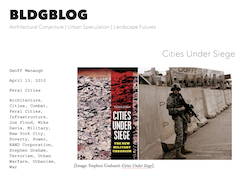
Geoff Manaugh, “Cities Under Siege.” BLDGBLOG. 13 April 2010, https://bldgblog.com/2010/04/cities-under-siege/:
Abstract: This blog post draws upon Richard Norton’s concept of feral cities and expands it by discussing key ideas from Stephen Graham’s “Cities Under Siege”. Graham’s work argues that it should be assumed that all cities exist in a state of marginal fragility. He then examines how urbanism and militarism continually intersect to address such threats. Cities under siege, accordingly, are those that are restructured to possess technologies and aggressive means (i.e., surveillance) that seek to secure/control a city’s population.
Richard J. Norton, “Feral Cities.” Naval War College Review. Vol. 56, no. 4, Autumn 2003: pp. 97–106, https://www.usni.org/magazines/proceedings/2008/december/feral-cities-pirate-havens:
Abstract: This seminal work, published by Norton in 2003, conceptualized and explained the initial feral cities construct. The model covered three levels of ferality—the green level (no danger of ferality), an intermediate yellow level (marginal governmental control), and a more pronounced red level (becoming feral)—with examples provided for each of them. These ferality conditions (or the absence of them) were measured based on government, economy, services, and security criteria for comparative diagnostic purposes. In this work, the emergence of full city ferality was viewed as a future possibility, however, not a given with the author being very conservative—understandably as a US governmental employee—in this regard.
Richard J. Norton, “Feral Cities: Problems Today, Battlefields Tomorrow?” Marine Corps University Journal. Vol. 1, no. 1. Spring 2010: pp. 50–77, https://www.marines.mil/Portals/1/Publications/Marine%20Corps%20University%20Journal%20Vol%201,%20No%201%20PCN%2010600001400.pdf:
Abstract: This article from the Marine Corps University Journal further lays out the foundation of feral cities, explaining their growing prominence in the modern world with new examples, and the multi-level security challenges they pose. Dr. Norton details how feral cities form (i.e., uncoordinated growth, de facto surrender of operational state sovereignty, et al.), along with factors that may amplify a city’s “feralness.” Moreover, the author provides a color-coordinated diagnostic tool—with the addition of a new category (civil society) that indicates a city’s trend towards becoming feral. All in all, feral cities are argued by Norton to be mostly local but also possibly global threats that, if left unchecked, will be extremely difficult to combat.
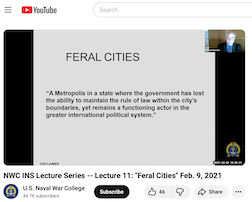
Richard J. Norton, “NWC INS Lecture Series – Lecture 11: ‘Feral Cities.’” U.S Naval War College. YouTube. Video 1:03 Hours. 9 February 2021, https://www.youtube.com/watch?v=ePuu2l34I7A:
Abstract: This hour-long video lecture from Richard Norton provides a comprehensive overview of feral cities, including definitions, diagnoses, case studies, and an examination of how state failure/factors contributing to state failure contribute to the emergence of feral cities. Such factors include governance, telecommunications, availability of weapons, private security forces, global warming, and transportation. More contemporary issues are also examined in their correlation/lack of correlation to feral cities, including drug cartels, pandemics, and protests (specifically the Black Lives Matter protests then taking place).
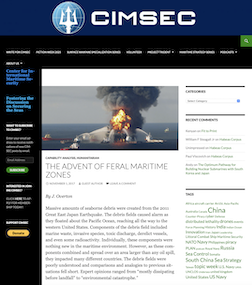
J. Overton, “The Advent of Feral Maritime Zones.” CIMSEC. 1 November 2017: 1-5, https://cimsec.org/advent-feral-maritime-zones/:
Abstract: In this online publication, Overton applies the concept of feral cities to ‘maritime zones,’ hence the feral maritime zones (FMZ). Overton describes such zones as modern regions which may feature “flotilla[s] of debris, animals, and plants surviving for years and crossing thousands of miles of ocean” which no state controls or understands. Overton’s piece demonstrates how feral cities are relevant and can be applied to unconventional settings, i.e., in open regions of the sea with debris fields.
Alon Paz, “The Rise of the Feral Adversary.” War on the Rocks. 13 November 2014, https://warontherocks.com/2014/11/the-rise-of-the-feral-adversary/:
Abstract: This online article by Alon Paz advocates for the recognition of a new adversary, the feral adversary, who emerges from feral environments. Not all adversaries appear identical, but they share innate characteristics which are shaped by “geostrategic conditions, social and cultural traditions, and local political contexts.” Paz describes how regions in the Middle East provide the preconditions for feral adversary emergence as they have been impacted by glocalization (Roland Robertson’s popularized term), littoralization (David Kilcullen’s term), and feralization (Robert Norton’s term). Feral adversaries are described as strategic actors who seek long-term political objectives, utilizing hybrid tactics that necessitate advancements in creative/strategic thinking.
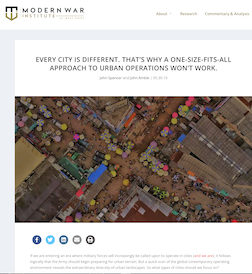
John Spencer and John Amble, “Every City is Different. That’s Why a One-Size-Fits-All Approach to Urban Operations Won’t Work.” Modern War Institute. 30 May 2019, https://mwi.westpoint.edu/every-city-different-thats-one-size-fits-approach-urban-operations-wont-work/:
Abstract: This essay from the Modern War Institute at West Point identifies specific types of cities that should be prioritized in the future of warfare. It emphasizes the need for the US military to modernize in order to address potential threats in rapidly urbanizing environments and to adopt tailored strategies for each relevant city. The article identifies various cities as case studies, using established criteria to enable both military and academic personnel to evaluate concerns and explore potential strategies in different scenarios such as evacuation methods, displacement areas, and rebuilding approaches.

John Spencer, “Feral Cities, Pandemics, and the Military.” Modern War Institute. Podcast 46:02 Minutes. 17 April 2020, https://mwi.westpoint.edu/feral-cities-pandemics-military/:
Abstract: This in-depth podcast from the Modern War Institute’s Urban Warfare Project podcast, hosted by John Spencer, features guest speaker Dr. Richard Norton. Norton begins by detailing how feral cities may still exist within a sovereign state, with the relevant sovereign being unable to exercise its law and security writs. Amplifiers to feral cities are outlined in detail, including pandemics and pollution, framing the discussion around adequate infrastructure (and what this truly means). Moreover, Norton and Spencer shed light on feral cities and how they must be met with innovative methods by the military to deal with the multifaceted challenges that may be presented.
John P. Sullivan, “Criminal Enclaves: When Gangs, Cartels or Kingpins Try to Take Control.” Stratfor Threat Lens. 10 July 2019, https://www.academia.edu/39800892/Criminal_Enclaves_When_Gangs_Cartels_or_Kingpins_Try_to_Take_Control:
Abstract: This article further delves into criminal enclaves and how they are related to feral cities. Areas ruled by criminal enclaves (“other governed areas”) vary in physical size as actors exert control over them, attempting to erode sovereignty and/or alter the state. Moreover, such areas can have different governance capacities; however, criminal enclaves are commonly formed in areas lacking traditional state capacity. Enclave areas (also referred to as “black spots”) further challenge state capacity and are a breeding ground for illicit activities and markets. Dr. Sullivan reviews how preventing such areas from forming involves community resilience and a holistic approach to addressing the issue.
John P. Sullivan, “From Drug Wars to Criminal Insurgency: Mexican Cartels, Criminal Enclaves and Criminal Insurgency in Mexico and Central America. Implications for Global Security.” Working Paper N°9. Paris: Fondation Maison des sciences de l’homme. April 2012, https://shs.hal.science/halshs-00694083v1:
Abstract: This piece examines poly-crime organizations within South America and how they have emerged over the years to challenge rival organizations, states, and sub-state polities. Sullivan discusses how “criminal insurgents” engage in political and economic activities to gain autonomy and control over illicit markets. As criminal insurgents strategically target weak areas (i.e., failed communities), they establish criminal enclaves and “hollow” out the state through a variety of methods to eventually establish “feral cities” which allows them impunity of action.
John P. Sullivan, “Narco-Cities: Mexico and Beyond.” Small Wars Journal. 31 March 2014, https://archive.smallwarsjournal.com/jrnl/art/narco-cities-mexico-and-beyond:
bstract: This Small Wars Journal essay examines Narco-Cities, which are areas controlled by criminal organizations (namely cartels) that are distinguishable by features such as hyperviolence (with the existence of a feral city), contested zones (with cartels challenging political mechanisms and/or civil society), narco-control, and/or hidden financial power. Sullivan utilizes Richard J. Norton’s conception of feral cities and applies Norton’s framework to narco-cities, recognized to have a possible eventual progression from “purple” (fully feral) to “black” (beyond feral) cities.
John P. Sullivan, “Urban Conflict and Transnational Crime in Latin American Cities” in Pablo Baisotti, Ed., New Global Cities in Latin America and Asia: Welcome to the Twenty-First Century. Ann Arbor: University of Michigan Press, 2022: pp. 253–282, https://www.jstor.org/stable/10.3998/mpub.12105185.12:
Abstract: In this book chapter, Sullivan provides a detailed overview of Latin America’s vast urban areas and their concentration of urban violence, largely driven by transnational illicit actors. Insecurity and instability are rampant in regions impacted by these actors as they seek power through violent means, which ultimately affects economic stability, corruption, and/or state capacity (along with perceptions of state legitimacy). Urban enclaves run by illicit actors are referred to as narco-cities (narco-ciudades). They are synonymous with Richard J. Norton’s “feral cities” construct as modified to include the purple and black levels of ferality.
Endnotes
[1] Richard W. Stewart, The United States Army in Somalia 1992-1994. Washington, DC: Army Center of Military History 2002: 25, https://history.army.mil/portals/143/Images/Publications/catalog/70-81-1.pdf.
[2] A rich literature exists on the subject of Military Operations in Urban Terrain (MOUT). As it relates to city level analysis, see Stephen Graham, Cities Under Siege: The New Military Urbanism. London: Verso, 2011: 1-288, https://www.amazon.com/Cities-Under-Siege-Military-Urbanism/dp/1844673154/ref=tmm_hrd_swatch_0. For a Small Wars Journal anthology on urban conflict, see Dave Dilegge et al., Eds., Blood and Concrete: 21st Century Conflict in Urban Centers and Megacities. Bloomington: Xlibris, 2019, https://www.amazon.com/Blood-Concrete-Conflict-Megacities-Anthology/dp/1984573756. For a newer SWJ–El Centro affiliated authors’ work, see John P. Sullivan, Nathan P. Jones, and Daniel Wes Argomedo, Eds., Urban Operations: War, Crime, and Conflict. Association of the US Army (AUSA) Book Program. Boulder: Key Point Press, 2024, https://www.amazon.com/Urban-Operations-War-Crime-Conflict/dp/B0DDZPD5PG.
[3] Richard J. Norton, “Feral Cities.” Naval War College Review. Vol. 56, no. 4, Autumn 2003: pp. 97–106, https://digital-commons.usnwc.edu/nwc-review/vol56/iss4/8.
[4] Ibid., p. 105.
[5] Richard J. Norton, “Feral Cities: Problems Today, Battlefields Tomorrow?” Marine Corps University Journal. Vol. 1, no. 1, Spring 2010: 50-77, https://www.marines.mil/Portals/1/Publications/Marine%20Corps%20University%20Journal%20Vol%201,%20No%201%20PCN%2010600001400.pdf.
[6] Richard J. Norton, “NWC INS Lecture Series – Lecture 11: ‘Feral Cities.’” US Naval War College. YouTube. 1:03 Hours. 9 February 2021, https://www.youtube.com/watch?v=ePuu2l34I7A.
[7] Originally a USAWC SSI funded research study: Robert J. Bunker, “The Emergence of Feral and Criminal Cities: U.S. Military Implications in a Time of Austerity.” The Land Warfare Papers No. 99. April 2014: pp. 4, 6, https://www.ausa.org/sites/default/files/LWP-99-The-Emergence-of-Feral-and-Criminal-Cities-US-Military-Implications-in-a-Time-of-Austerity.pdf.
[8] Robert J. Bunker and John P. Sullivan, “Integrating feral cities and third phase cartels/third generation gangs research: the rise of criminal (narco) city networks and BlackFor.” Small Wars & Insurgencies. Vol. 22, no. 5. 29 November 2011, https://doi.org/10.1080/09592318.2011.620804.
[9] The red team (RedFor)—the military of a hostile nation state—was replaced by the black team (BlackFor)—a criminal-military of a hostile non-state—in this scenario which pitted it against the blue team (BlueFor)—which was meant to represent the US Army in its Army After Next (AAN) configuration. Robert J. Bunker, Five-Dimensional (Cyber) Warfighting: Can the Army After Next be Defeated Through Complex Concepts and Technologies? Carlisle Barracks: United States Army War College, Strategic Studies Institute. 1 March 1998: pp. 1-46, https://press.armywarcollege.edu/cgi/viewcontent.cgi?article=1170&context=monographs.
[10] Robert J. Bunker, “The Emergence of Feral and Criminal Cities: U.S. Military Implications in a Time of Austerity.” The Land Warfare Papers No. 99. April 2014, https://www.ausa.org/sites/default/files/LWP-99-The-Emergence-of-Feral-and-Criminal-Cities-US-Military-Implications-in-a-Time-of-Austerity.pdf.
[11] Ioan Grillo, Gangster Warlords: Drug Dollars, Killing Fields, and the New Politics of Latin America. New York: Bloomsbury Press, 2016: https://www.amazon.com/Gangster-Warlords-Dollars-Killing-Politics/dp/162040379X. See the recent El Centro works on the criminal insurgency taking place in Haiti as an example, Robert J. Bunker, John P. Sullivan, and Jean-michel Newberg, “Third Generation Gangs Strategic Note No. 58: Contracting of Former PMC Blackwater Founder Erik Prince by the Haitian Government for Port-au-Prince Intervention.” Small Wars Journal. 18 June 2025, https://smallwarsjournal.com/2025/06/18/third-generation-gangs-strategic-note-no-58-contracting-of-former-pmc-blackwater-founder-erik-prince-by-the-haitian-government-for-port-au-prince-intervention/